
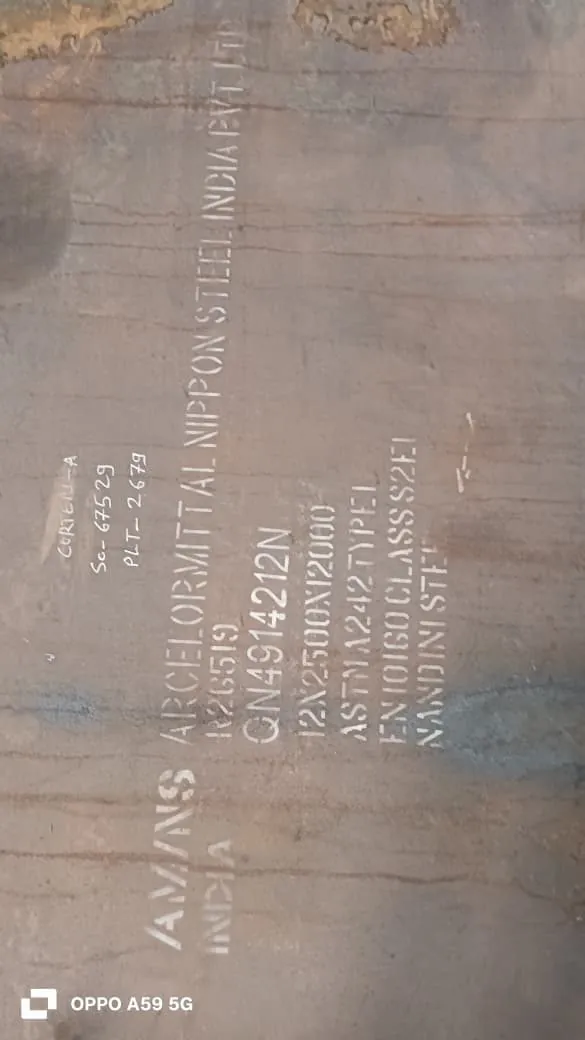
ASTM A240 at a glance
Full title: Standard Specification for Chromium and Chromium-Nickel Stainless Steel Plate, Sheet, and Strip for Pressure Vessels and for General Applications (designation A240/A240M).
Covers flat-rolled stainless steel in three product forms, plate, sheet and strip, each identified by a UNS designation (S30400 for 304, S31600 for 316, N08904 for 904L, as examples).
Sets chemical composition limits and mechanical property requirements for tensile strength, yield, elongation and hardness, along with the solution-annealed condition required for each grade.
- Adopted by ASME as SA-240 into ASME BPVC Section II Part A, the two documents are technically identical.
General requirements for tolerances, finish, marking, and testing procedure fall under the companion specification ASTM A480/A480M. A240 points to it rather than spelling those details out again.
At Nandini Steel, we supply flat stainless to ASTM A240 / ASME SA-240 from genuine mill plate. Every order ships with an EN 10204 3.1/3.2 mill test certificate.
Scope: what ASTM A240 covers (and what it does not)
ASTM A240 covers flat-rolled chromium and chromium-nickel stainless steel in the austenitic, ferritic, martensitic and duplex families, made as plate, sheet and strip for pressure-vessel and general service work. The standard lays out the chemistry and mechanical minima each heat has to meet, and it calls for delivery in the solution-annealed condition, or whatever other condition is specified. Bar, pipe, tube, forgings and fittings fall outside its scope. So do nickel-base alloys.
Plate vs sheet vs strip under A240
A240 splits its three flat forms mostly by thickness and width, and the mechanical test requirements follow suit. Broadly speaking, plate is the heavier, discretely cut flat product, while sheet and strip run thinner, with strip the narrowest of the three. For a fuller breakdown of how plate vs sheet vs strip differ in thickness, width and typical use, see our dedicated guide. Grade chemistry stays constant across all three forms under A240; it's only the dimensional and some mechanical provisions that shift.
Where A240 stops: nickel alloys use ASTM B424
A240 is a stainless-steel specification. Nickel-base alloys are out of its scope and carry their own standards: Incoloy 825 (UNS N08825) flat product conforms to ASTM B424 / ASME SB-424, not A240. Likewise carbon pressure-vessel plate such as A516 Gr 70 conforms to ASTM A516, not A240. If a drawing calls out "A240" against a nickel alloy or a carbon grade, that is a specification error worth catching at order entry, the super-austenitic grade 904L sits right at this boundary and is one of the few high-nickel austenitics that is in A240.
Key requirements ASTM A240 specifies
Chemical composition
A240 fixes the chemical composition limits for every grade in its scope. Composition is what sets each grade's corrosion behavior, the molybdenum in 316, the ~4.5% Mo and copper in 904L, so A240 is the upstream reason a 316 plate resists PREN-driven pitting better than a 304 plate. Representative A240 composition limits (wt%):
| Grade | UNS | C | Cr | Ni | Mo | Other |
|---|---|---|---|---|---|---|
| 304 | S30400 | ≤0.07 | 17.5–19.5 | 8.0–10.5 | – | N ≤0.10 |
| 304L | S30403 | ≤0.030 | 17.5–19.5 | 8.0–12.0 | – | N ≤0.10 |
| 316 | S31600 | ≤0.08 | 16.0–18.0 | 10.0–14.0 | 2.00–3.00 | N ≤0.10 |
| 316L | S31603 | ≤0.030 | 16.0–18.0 | 10.0–14.0 | 2.00–3.00 | N ≤0.10 |
| 321 | S32100 | ≤0.08 | 17.0–19.0 | 9.0–12.0 | – | Ti ≥5×C |
| 347 | S34700 | ≤0.08 | 17.0–19.0 | 9.0–13.0 | – | Nb ≥10×C |
| 310S | S31008 | ≤0.08 | 24.0–26.0 | 19.0–22.0 | – | – |
| 904L | N08904 | ≤0.020 | 19.0–23.0 | 23.0–28.0 | 4.00–5.00 | Cu 1.0–2.0 |
Mechanical properties
A240 sets minimum mechanical requirements in the annealed condition: ultimate tensile, 0.2% proof (yield), minimum elongation and a maximum hardness. Want the metallurgy behind these figures? See mechanical properties explained. Here are representative A240 minima:
| Grade | Tensile min | Yield 0.2% min | Elongation min | Hardness max |
|---|---|---|---|---|
| 304 | 515 MPa (75 ksi) | 205 MPa (30 ksi) | 40% | 201 HBW / 92 HRB |
| 304L | 485 MPa (70 ksi) | 170 MPa (25 ksi) | 40% | 201 HBW / 92 HRB |
| 316 | 515 MPa (75 ksi) | 205 MPa (30 ksi) | 40% | 217 HBW / 95 HRB |
| 316L | 485 MPa (70 ksi) | 170 MPa (25 ksi) | 40% | 217 HBW / 95 HRB |
| 321 | 515 MPa (75 ksi) | 205 MPa (30 ksi) | 40% | 217 HBW / 95 HRB |
| 347 | 515 MPa (75 ksi) | 205 MPa (30 ksi) | 40% | 201 HBW / 92 HRB |
| 310S | 515 MPa (75 ksi) | 205 MPa (30 ksi) | 40% | 217 HBW / 95 HRB |
| 904L | 490 MPa (71 ksi) | 220 MPa (31 ksi) | 35% | – |
Heat treatment: the solution-annealed condition
A240 calls for austenitic grades to ship in the solution-annealed condition: heated into the solution range, then quenched fast enough to keep carbides dissolved. That step is what brings back full corrosion resistance, since it dissolves the chromium carbides that would otherwise sensitize the steel. For the mechanism behind this, see solution annealing. And for why the low-carbon "L" grades and stabilized 321/347 hold onto that condition through welding, check how to prevent sensitization.
General requirements via ASTM A480/A480M
Dimensional tolerances, flatness, edge condition, surface finish designation, marking and the testing mechanics aren't spelled out in A240 itself. They live in ASTM A480/A480M, the general-requirements specification that A240 pulls in by reference. Order plate "to A240," and A480 is the companion standard that dictates how it gets cut, finished and marked.
Finishes
Flat stainless to A240 comes in standard mill finishes: No.1 (hot-rolled, annealed, pickled) on heavier plate, and 2B, BA or No.4 on sheet. The finish you pick matters for both looks and how easy the surface is to keep clean. Our guide to 2B / BA / No.4 finishes breaks down the differences and where each one fits.
Grades & forms covered by ASTM A240
A240 spans a wide range of grades across four families. The table lists the ones most often called out, along with their UNS numbers and flat forms. Grades Nandini holds ex-stock are flagged and linked to their product pages.
| Family | Grade | UNS | Forms | Nandini stock |
|---|---|---|---|---|
| Austenitic | 304 | S30400 | Plate, sheet, coil | Yes |
| Austenitic | 304L | S30403 | Plate, sheet | Yes |
| Austenitic | 316 | S31600 | Plate, sheet | Yes |
| Austenitic | 316L | S31603 | Plate, sheet | Yes |
| Austenitic (stabilized) | 321 | S32100 | Plate, sheet | Yes |
| Austenitic (stabilized) | 347 | S34700 | Plate, sheet | Yes |
| Austenitic (heat-resistant) | 310S | S31008 | Plate, sheet | Yes |
| Super-austenitic | 904L | N08904 | Plate, sheet, coil | Yes |
| Duplex | 2205 | S32205 | Plate, sheet | On inquiry |
| Super-duplex | 2507 | S32750 | Plate, sheet | On inquiry |
| Ferritic / martensitic | 409 / 410 / 430 | S40900 / S41000 / S43000 | Plate, sheet | On inquiry |
904L (UNS N08904) is a grade Nandini knows inside and out, and she's a certified specialist in it. Our ISO 9001:2015 certificate lists 904L plate by name, right alongside Alloy 28, Incoloy 800 and Hastelloy. Flat 904L carries a dual listing too: it conforms to A240/SA-240 as well as ASTM B625/SB-625. You can order it as 904L plate, 904L sheet, or 904L coil.
ASTM A240 vs ASME SA-240: the code twin
ASME folds A240 into SA-240 almost word for word, right there in BPVC Section II Part A. Chemistry, mechanical properties, heat-treat condition, none of it changes; what changes is which body publishes the standard and which contract calls for it. On export jobs, people often mistake this for two separate materials. It's one plate. A mill certificate stamped "ASTM A240 / ASME SA-240" covers both.
| ASTM A240 | ASME SA-240 | |
|---|---|---|
| Issuing body | ASTM International | ASME |
| Document | A240/A240M | SA-240 (BPVC Section II Part A) |
| Technical content | Effectively identical (chemistry, mechanicals, solution anneal) | |
| Where invoked | General and ASTM-referenced contracts | ASME Boiler & Pressure Vessel Code work |
| When to call it out | General stainless procurement | When the vessel is built to the ASME code stamp |
For the full code-adoption story and when a job needs the "SA" callout, see ASME SA-240. Here's how A240 stacks up against its neighbors:
| Specification | What it governs |
|---|---|
| ASTM A240 / A240M | Stainless flat product, composition + mechanicals + solution anneal |
| ASTM A480 / A480M | General requirements for A240 flat product, tolerances, finish, marking |
| ASTM B424 | Nickel-alloy flat product (e.g. Incoloy 825), outside A240 |
| ASTM A516 | Carbon pressure-vessel plate, outside A240 |
Testing, inspection & the mill test certificate
A240 calls for a tension test and, where applicable, a hardness test on every heat. When the service calls for it, intergranular corrosion (IGC) testing per ASTM A262 gets specified as a supplementary requirement, proving the heat isn't sensitized. Marking requirements come from A240 too, so each plate carries its grade and heat identification. Want the wider picture? Our reference on testing, MTC, NDT & PMI covers it.
The mill test certificate (MTC) is what proves conformance to A240. Every order from Nandini ships with an EN 10204 3.1/3.2 mill test certificate recording the heat/cast number, the A240 composition and mechanical results, and the solution-anneal condition. That's the document a QA reviewer reads before accepting the plate. Want to know how to read one? See how to read a mill test certificate. For how heat numbers tie plate to certificate, check material traceability. PMI (positive material identification) verifies grade at receiving when it's required. Our plate is genuine mill material, sourced from Aperam, Outokumpu, Jindal, POSCO, Nippon Steel and JFE.
How to order stainless to ASTM A240
- State grade + UNS, state grade and UNS together, for example "316L, UNS S31603." The UNS number clears up any ambiguity across naming systems, so cross-check equivalents in our UNS / Werkstoff / JIS cross-reference.
- State the form, plate, sheet or strip. Thickness and width decide which A240 provisions apply.
- Call out A240 or SA-240, use SA-240 when the vessel is built to the ASME code; otherwise A240 is sufficient.
- Give dimensions and tolerance, size, thickness and the A480/A480M tolerance class.
- Specify finish, No.1, 2B, BA or No.4 per the application.
- Confirm heat-treat condition, solution-annealed is the A240 default; state it explicitly.
- Set the MTC level, EN 10204 3.1 (mill) or 3.2 (third-party witnessed).
- Add supplementary tests, IGC per ASTM A262 (name the practice), PMI, UT or hardness if the job requires them.
Use our plate weight calculator to turn the dimensions into a shipping weight. If the grade's still open, run it through the grade selector. A240 plate shows up constantly in pressure-vessel applications.
ASTM A240 grades Nandini supplies
Nandini Steel keeps the core A240 austenitic range ex-stock, ready for immediate dispatch. Each piece comes with an EN 10204 3.1/3.2 MTC.
- 304 / 304L, general and welded fabrication: 304 plate, 304 sheet, 304 coil, 304L plate.
- 316 / 316L, grades carrying molybdenum, built for chloride exposure: 316 plate, 316 sheet, 316L plate, 316L sheet.
- 321 / 347, stabilized for high-temperature service: 321, 347.
- 310S, heat-resistant austenitic: 310S.
904L stands as our certified specialty: a super-austenitic grade built for sulfuric-acid environments and high-chloride duty. We stock it in three forms: 904L plate, 904L sheet, and 904L coil.
All products are ex-stock, ready for immediate dispatch. Comparing grades? Have a look at 304 vs 316 or 904L vs 316L.
Frequently asked questions
What is the full form of ASTM A240?
What is the latest edition of ASTM A240?
What is the difference between ASTM A240 and ASME SA-240?
Is 904L covered by ASTM A240?
What is the difference between ASTM A240 and ASTM A480?
Is Incoloy 825 covered by ASTM A240?
Order stainless to ASTM A240
Nandini Steel has held ISO 9001:2015 certification since 2003 (Cert No. 1283438, Unitas Certification Services, valid through 11 January 2028), working as a stockist and supplier of corrosion-resistant steel for more than 20 years. The numbers back it up: 307+ projects, 260+ clients, shipments into 36+ countries. Flat stainless products meet ASTM A240 and ASME SA-240, cut from genuine mill plate and held ex-stock for immediate dispatch. Every order ships with an EN 10204 3.1/3.2 mill test certificate. Pricing isn't fixed in a catalog; it's quoted live, against whatever you send in.
Send your grade, form, dimensions and MTC level for a quotation.
- Phone: +91 22 43404600 · +91 9920209184
- WhatsApp: +91 99202 09184
- Email: reachus@nandinisteel.com
- GSTIN: 27ADJPA7240C1Z0
- Review our quality assurance, certifications and sample mill test certificates.