
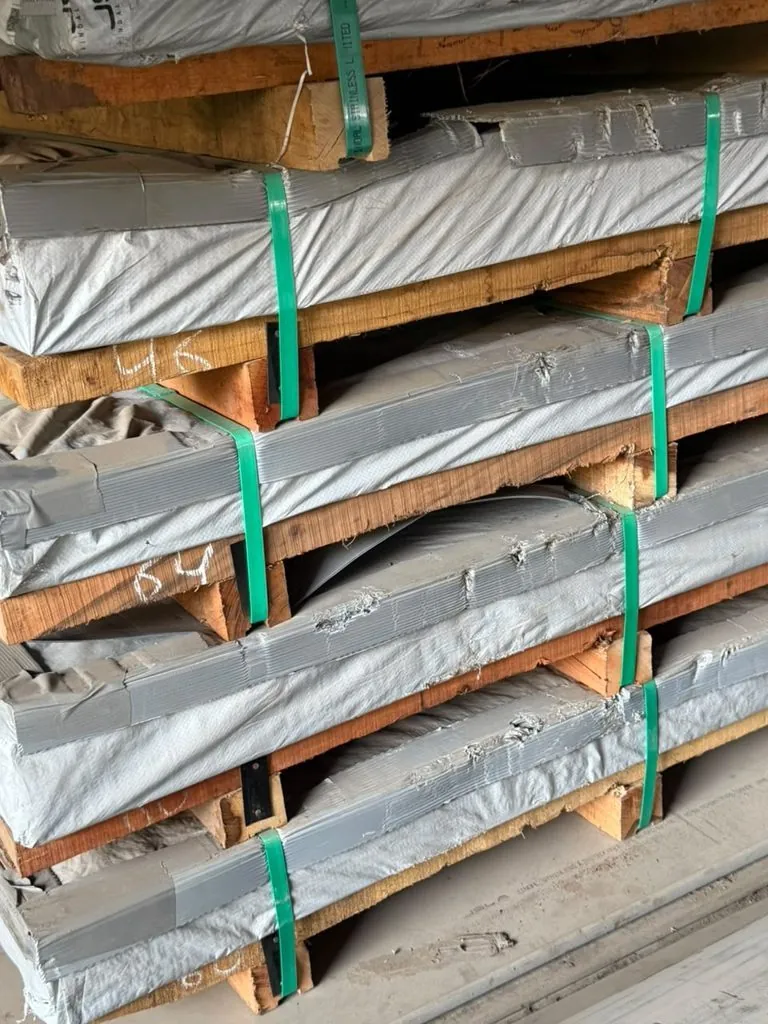
310 & 310S stainless steel at a glance
- Designations: 310 is UNS S31000; low-carbon sibling 310S is UNS S31008 (Werkstoff 1.4845, JIS SUS310S).
- Chemistry: a 25Cr-20Ni austenitic. The chromium and nickel content, both high, build the protective scale that gives the alloy its heat resistance.
- Service temperature: resists oxidation in continuous service to ~1150°C and intermittent service to ~1035°C.
- The carbon difference: 310 carries up to 0.25% C for creep strength; 310S holds C ≤0.08% for better weldability and less carbide precipitation.
- Standard & traceability: supplied to ASTM A240 / ASME SA-240, with an EN 10204 3.1/3.2 mill test certificate included with every order.
Chemical composition of 310 and 310S
Both grades start from the same 25Cr-20Ni base. What sets them apart comes down to carbon content. The table below lists the ASTM A240 limits (wt%).
| Element | 310 (S31000) | 310S (S31008) |
|---|---|---|
| Carbon (C) | ≤0.25 | ≤0.08 |
| Chromium (Cr) | 24.0–26.0 | 24.0–26.0 |
| Nickel (Ni) | 19.0–22.0 | 19.0–22.0 |
| Manganese (Mn) | ≤2.00 | ≤2.00 |
| Silicon (Si) | ≤1.50 | ≤1.50 |
| Phosphorus (P) | ≤0.045 | ≤0.045 |
| Sulfur (S) | ≤0.030 | ≤0.030 |
| Iron (Fe) | Balance | Balance |
310 vs 310S: the carbon difference
310 (S31000, C ≤0.25%) holds onto more carbide-driven creep strength once you're at the top end of the temperature range. 310S (S31008, C ≤0.08%) is the one to specify for welded fabrications, though: its lower carbon content cuts down on chromium-carbide precipitation in the heat-affected zone, which improves weldability and guards against sensitization. Most fabricated furnace parts default to 310S. 310 gets picked only when maximum elevated-temperature strength is the deciding factor.
Mechanical properties of 310 / 310S
Minimum room-temperature properties for plate in the solution-annealed condition, per ASTM A240, are as follows:
| Property | Minimum (annealed plate) |
|---|---|
| Tensile strength | ≥515 MPa (75 ksi) |
| Yield strength (0.2% offset) | ≥205 MPa (30 ksi) |
| Elongation (in 50 mm) | ≥40% |
| Hardness | ≤95 HRB (≤217 HB) |
Physical & high-temperature properties
The physical data below covers the attribute that defines 310: its maximum service temperature. Note that the intermittent ceiling sits below the continuous one. Thermal cycling promotes scale spalling, so cyclic duty gets de-rated.
| Property | Typical value |
|---|---|
| Density | 7.9 g/cm³ |
| Melting range | ~1400–1450°C |
| Thermal conductivity (100°C) | ~14.2 W/m·K |
| Mean coefficient of thermal expansion (20–100°C) | ~15.9 µm/m·°C |
| Elastic modulus | ~200 GPa |
| Magnetic response | Non-magnetic (austenitic) |
| Max service temp, continuous | ~1150°C |
| Max service temp, intermittent | ~1035°C |
Heat resistance, oxidation & corrosion behavior
The 25% chromium and 20% nickel build a stable, clinging chromium-oxide scale that resists oxidation and scaling in air up to about 1150°C continuous. That's why people reach for 310/310S once service conditions push past the ceiling for 304/316. High nickel content also keeps the structure fully austenitic and non-magnetic across the whole temperature range, holding back the ferrite that would otherwise make the material brittle.
Two high-temperature cautions shape the design choices here. First, holding 310 in the 650–900°C range for long stretches leaves it open to sigma-phase embrittlement, which cuts room-temperature toughness. Parts that cycle through this band need to be checked for it. Second, sulfur-bearing atmospheres bring a different risk: 310's high nickel content reacts with sulfur and forms low-melting phases, so it's susceptible to sulfidation. Reducing sulfidizing environments call for a different alloy altogether.
Crucially, 310 is a heat grade, not a chloride grade. It has no molybdenum, so its PREN sits around 25, and it underperforms 316L when chloride pitting is the concern. For wet chloride, acid or seawater duty, step up to 316L or the super-austenitic 904L instead. Matching the grade to the actual corrosion mechanism costs far less than replacing a pitted part later.
Equivalent grades & designations
| System | 310 | 310S |
|---|---|---|
| UNS | S31000 | S31008 |
| Werkstoff (W.-Nr.) | – | 1.4845 |
| EN | – | X8CrNi25-21 |
| JIS | SUS310 | SUS310S |
| AISI | 310 | 310S |
| BS | – | 310S24 |
Full cross-referencing appears in our UNS / W.-Nr. / JIS cross-reference.
Comparisons: when to choose 310
Among the austenitic stainless steel grades, 310/310S sits at the heat-resistant end. Reach for it when sustained oxidation resistance, not pitting, is the deciding factor.
- vs 304: 304 stainless steel handles oxidation to roughly 870°C continuous; above that its scale breaks down. Choose 310 when the service temperature exceeds 304's ceiling, a common buyer error is holding 304 in sustained furnace heat where only 310's higher chromium survives.
- vs 309: 309 (23Cr-13Ni) is the lighter-alloyed heat-resistant grade; 310's extra chromium and nickel extend the oxidation ceiling and give better high-temperature stability, so 310 is chosen where 309 is marginal.
- vs 321 / 347: the stabilized grades 321 stainless steel and 347 stainless steel resist sensitization through titanium or niobium additions and suit elevated-temperature pressure service, but their oxidation ceiling is lower than 310's. Pick 321/347 for sensitization-prone welded service below 310's range; pick 310 when continuous oxidation resistance above ~900°C governs.
Available forms, sizes & standards
All 310/310S stock sits ex-stock, ready for immediate dispatch, and it's cut from genuine mill plate and long product sourced from nameable mills including Aperam, Outokumpu, Jindal, POSCO, Nippon Steel and JFE. We supply 310/310S as sheet, plate and coil, and also as pipe, pipe-fittings, forged fittings, flanges, round bar and fasteners. Send us your thickness, size and quantity on the RFQ, and we'll confirm what's held against your schedule.
| Form | Applicable standards |
|---|---|
| Sheet / Plate / Coil | ASTM A240 / ASME SA-240 |
| Pipe / Tube | ASTM A312 / A213 |
| Round bar | ASTM A479 / A276 |
| Fittings | ASTM A403 |
| Flanges | ASME B16.5 |
Flat product is supplied to ASTM A240 / ASME SA-240; 310/310S is welded with ER310 (25-20) filler to maintain matching high-temperature chemistry.
Testing & certification
Every 310/310S order ships with an EN 10204 3.1/3.2 mill test certificate (MTC): heat number, chemistry and mechanical results, all traceable back to the melt. On request, we'll add positive material identification (PMI) and intergranular corrosion testing to ASTM A262, confirming resistance to sensitization. Nandini Steel is an ISO 9001:2015-certified stockist and supplier (Cert No. 1283438, Unitas Certification Services UCS-UK, valid to 11 January 2028), and it's supplied certified stainless and nickel alloys since 2003.
Applications of 310 / 310S
Furnace muffles, radiant tubes, burner parts, annealing trays, heat-treatment baskets, all of these live in sustained high-temperature oxidizing heat, which is exactly where furnaces and heat treatment demand this grade.
In petrochemical and thermal processing, fired heater components, flares, recuperators and kiln furniture all depend on scaling resistance to keep working. That resistance is what governs how long the part lasts.
Cryogenic service is a different story, but 310 shows up there too. Its austenitic structure stays stable and keeps its toughness even at very low temperatures, which is why selected cryogenic equipment relies on it as well.
FAQ
What is the maximum temperature for 310 stainless steel?
What is the difference between 310 and 310S?
Is 310 stainless steel good for corrosion resistance?
Is 310 stainless steel magnetic?
Request a quote for 310 / 310S
Reach the Nandini Steel team with the grade, form, thickness and quantity you need, and we'll come back with live pricing and availability, pricing comes through an RFQ, not a published table. Email reachus@nandinisteel.com, call +91 22 43404600 or +91 9920209184, or message us on WhatsApp at +91 99202 09184. You'll find us at Nandini Steel, 25, Dreamland Building, 601, 6th Floor, Mama Parmanand Marg, Charni Road, Opera House, Girgaon, Mumbai, Maharashtra 400004, India (GSTIN 27ADJPA7240C1Z0).