
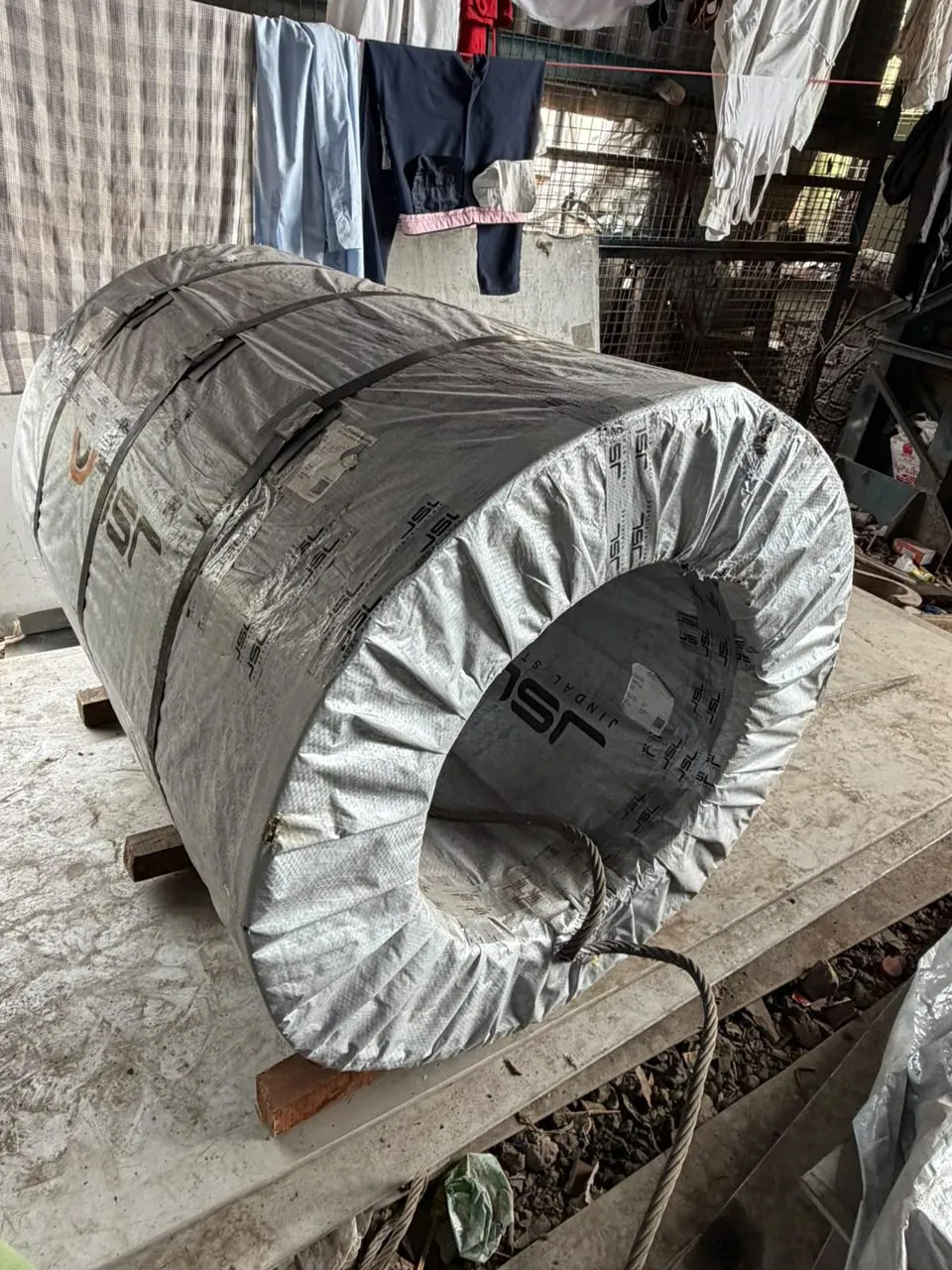
347 stainless steel at a glance
- Designations: UNS S34700, Werkstoff 1.4550, EN X6CrNiNb18-10, JIS SUS347, AISI 347.
- Family: niobium-stabilized austenitic stainless, part of the stainless steel grades family. It sits in the carbide-stabilized sub-group alongside 321 and 316Ti.
- Why it exists: niobium forms NbC in preference to chromium carbide. That keeps chromium in solution, so the grade stays intergranular-corrosion resistant after welding and hot service, much like 316 in that regard.
- Chloride caveat: no molybdenum means PREN ~18, treat chlorides as you would 304, not 316.
- High-temperature variant: 347H (UNS S34709) carries higher carbon for creep strength in sustained hot service.
What is 347 stainless steel?
347 stainless is a chromium-nickel austenitic grade, stabilized with niobium (also called columbium). Take plain 304 and hold it in the 425–815 °C range: carbon combines with chromium and precipitates Cr₂₃C₆ carbides at the grain boundaries. That chromium depletion leaves the grain-boundary zone open to intergranular corrosion, the mechanism known as sensitization. 347 handles this differently. Niobium goes in at a stabilizer ratio of at least ten times the carbon content, so it locks that carbon away as stable niobium carbide (NbC) instead, leaving chromium in solution where it belongs. The result: this grade resists sensitization in conditions that would send a non-stabilized grade straight into weld decay.
Chemical composition
Element ranges for UNS S34700 against ASTM A240 / ASME SA-240, with the 347H high-carbon variant included for comparison.
| Element | 347 (S34700) wt% | 347H (S34709) wt% |
|---|---|---|
| Carbon (C) | ≤ 0.08 | 0.04–0.10 |
| Chromium (Cr) | 17.0–19.0 | 17.0–19.0 |
| Nickel (Ni) | 9.0–13.0 | 9.0–13.0 |
| Niobium (Nb/Cb) | 10 × C min – 1.00 | 8 × C min – 1.00 |
| Manganese (Mn) | ≤ 2.00 | ≤ 2.00 |
| Silicon (Si) | ≤ 1.00 | ≤ 1.00 |
| Phosphorus (P) | ≤ 0.045 | ≤ 0.045 |
| Sulfur (S) | ≤ 0.030 | ≤ 0.030 |
| Iron (Fe) | Balance | Balance |
The niobium stabilizer ratio (Nb ≥ 10 × C) defines the grade's chemistry. It guarantees enough niobium is present to consume the carbon before chromium gets to it.
Mechanical properties
Minimum room-temperature properties in the solution-annealed condition, per ASTM A240.
| Property | Minimum (SI) | Minimum (Imperial) |
|---|---|---|
| Tensile strength | ≥ 515 MPa | ≥ 75 ksi |
| Yield strength (0.2% offset) | ≥ 205 MPa | ≥ 30 ksi |
| Elongation (in 50 mm) | ≥ 40% | ≥ 40% |
| Hardness | ≤ 201 HBW | ≤ 92 HRB |
Physical properties
| Property | Typical value |
|---|---|
| Density | 8.0 g/cm³ |
| Melting range | ~1400–1425 °C |
| Thermal conductivity (100 °C) | ~16.3 W/m·K |
| Mean coefficient of thermal expansion (20–100 °C) | ~16.6 µm/m·°C |
| Elastic modulus | ~193–200 GPa |
| Magnetic response | Non-magnetic (austenitic) |
Corrosion and temperature behavior
Niobium ties up carbon as NbC before it can precipitate at the grain boundaries, and that's what gives 347 its edge: corrosion resistance that holds up under heat. It resists intergranular attack in the as-welded heat-affected zone, and it keeps resisting even after long exposure in the 425–815 °C sensitization band. That's the band that defeats 304 outright. It's also where the low-carbon 304L fix runs out of road, losing its effectiveness above roughly 425 °C. When an application calls for documented proof, an ASTM A262 intergranular-corrosion test can be furnished on request.
What 347 doesn't add is chloride resistance. With no molybdenum, its pitting resistance equivalent (PREN = Cr + 3.3 × Mo + 16 × N) comes in around 18, same as 304, so it stays vulnerable to chloride pitting and stress-corrosion cracking. Pick 347 when the threat is sensitization rather than chlorides. Typical maximum continuous service temperature runs around 870 °C for oxidation resistance. For sustained load at temperature, specify 347H instead.
Equivalent grades and designations
| Standard | 347 | 347H |
|---|---|---|
| UNS | S34700 | S34709 |
| Werkstoff (W.-Nr.) | 1.4550 | 1.4912 |
| EN | X6CrNiNb18-10 | X7CrNiNb18-10 |
| JIS | SUS347 | SUS347H |
| AISI | 347 | 347H |
For full cross-referencing across systems, see the UNS / W.-Nr. / JIS cross-reference.
347 vs 321 vs 304: when to choose it
Both 347 and 321 are stabilized grades. What sets them apart is the stabilizer itself and how it behaves in the weld. The comparison below frames that stabilized-grade decision.
| Attribute | 347 (S34700) | 321 (S32100) | 304 (S30400) |
|---|---|---|---|
| Stabilizer | Niobium (Cb) | Titanium | None |
| PREN | ~18 | ~18 | ~18 |
| IGC-resistant after welding | Yes | Yes | No (use 304L) |
| Max continuous service | ~870 °C | ~870 °C | ~870 °C (but sensitizes 425–815 °C) |
| Choose when | Welded/hot service; niobium filler preferred | Hot service where titanium stabilization is specified | Ambient, non-welded or non-hot duty |
See the sibling 321 stainless steel grade for the titanium-stabilized alternative, or 316Ti and 310S for stabilized and high-temperature cluster options, respectively.
Available forms, sizes and standards
Nandini Steel keeps 347 ready ex-stock across flat, long and fitting forms, cleared for immediate dispatch, each one supplied to whatever standard applies to that particular product form.
| Form | Applicable standard | Availability |
|---|---|---|
| Sheet / plate / coil | ASTM A240 / ASME SA-240 | Ex-stock |
| Pipe | ASTM A312 | Ex-stock |
| Tube | ASTM A213 | Ex-stock |
| Round bar | ASTM A479 / A276 | Ex-stock |
| Forgings / forged fittings | ASTM A182 / ASME B16.11 | Ex-stock |
| Flanges | ASME B16.5 / B16.47 | Ex-stock |
Plate and sheet conform to ASTM A240 and its pressure-vessel equivalent ASME SA-240. Pipe is supplied to ASTM A312. For long and fitting forms, see 347 round bar, pipe, flanges and forged fittings. To estimate section mass before ordering, use the weight calculator. RFQ for live pricing; contact us for current thickness, outside-diameter and size availability.
Welding and filler
347 welds easily with the standard austenitic processes, and it's also the stabilized chemistry chosen for the filler. Titanium oxidizes in the arc and some of it burns off, which is why nobody supplies 321 as a bare filler wire. Niobium holds up through the transfer instead, so ER347 filler gets used to lay down a stabilized weld metal. For that same reason, it's the standard choice for welding 321 base material. A solution anneal at roughly 1010–1120 °C brings back the fully austenitic structure after fabrication, and for the toughest high-temperature jobs, an optional stabilize anneal can follow. More detail sits in the notes on weld decay and filler selection and solution annealing.
Applications of 347 stainless steel
- High-temperature exhaust systems and expansion joints, stabilization keeps the welded structure resistant to IGC through repeated thermal cycling that would otherwise sensitize 304.
- Boiler, superheater and heat-exchanger tubing, niobium carbide holds its stability, which protects grain-boundary chromium during long stretches of hot service. 347H gets specified whenever creep strength is the deciding factor.
- Refinery and petrochemical equipment, welded vessels and piping sitting in the sensitization range depend on the stabilized chemistry to resist weld decay.
Quality, traceability and certification
Every order of 347 goes out with an EN 10204 3.1 mill test certificate, the MTC, covering full chemical and mechanical traceability back to the heat; 3.2 is available too. Need an ASTM A262 intergranular-corrosion test cut or PMI verification? We can furnish either on request.
The material itself is genuine mill plate, sourced from established producers: Aperam, Outokumpu, Jindal, POSCO, Nippon Steel and JFE. Nandini Steel holds ISO 9001:2015 certification as a stockist and supplier (Certificate No. 1283438, issued by Unitas Certification Services UCS-UK, valid through 11 January 2028). The company was founded in 2003, so there's more than two decades of supply history behind it.