
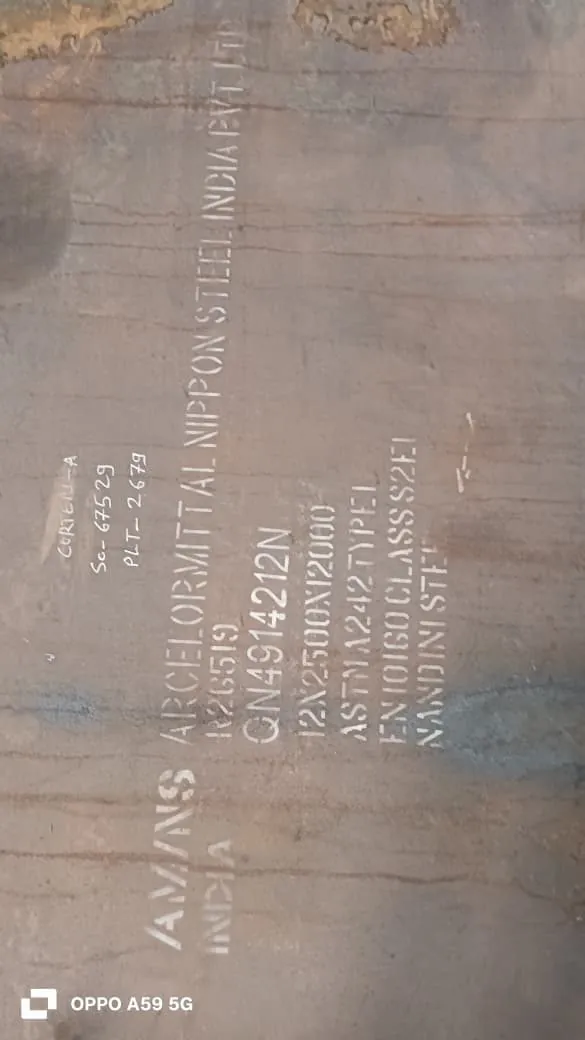
A516 Grade 70 at a Glance: Key Takeaways
Pressure-vessel-quality (PVQ) carbon steel, a killed, fine-grain plate built for boilers, pressure vessels and storage tanks. It isn't a stainless or alloy grade.
- "70" = 70 ksi minimum tensile (485 MPa). The number is the strength floor, not a thickness or a year.
- No corrosion resistance to speak of. A516 Gr 70 is a plain carbon steel with no PREN. It's chosen for strength, low-temperature toughness, and weldability, not for standing up to a harsh environment. If the service is wetted or corrosive, move up to a corrosion-resistant alloy (CRA).
- Two sourcing forks buyers routinely get wrong: heat-treatment condition (as-rolled vs normalized, needed for low-temperature impact) and sour-service compliance (standard vs NACE-HIC tested).
- UNS K02700, governed by ASTM A516 / ASME SA-516 with ASTM A20 / SA-20 general requirements.
ASTM A516 vs ASME SA-516: Same Chemistry, Different Adoption
ASTM A516 and ASME SA-516 call for the same chemistry and the same mechanical requirements. SA-516 is just ASME's adoption of the ASTM spec into Section II, Part A of the Boiler and Pressure Vessel Code. If a vessel is being built to the ASME Code, order SA-516 Gr 70. The mill test certificate will reference the SA-516 designation. For background on this plate class, see our boiler-quality plate explainer and pressure-vessel steel explained.
Chemical Composition
ASME SA-516/ASTM A516 Grade 70 is a killed steel, made to fine-grain practice for weldability and toughness. Carbon and manganese limits depend on thickness. Heavier sections carry slightly higher maxima. The values below come from ASTM A516 / ASME SA-516, with general requirements from ASTM A20. Confirm the exact limits for your ordered thickness against the governing standard.
| Element | Limit (% max unless a range) | Note |
|---|---|---|
| Carbon (C) | 0.27 (≤12.5 mm) rising to 0.30 (heavier sections) | Thickness-dependent max |
| Manganese (Mn) | 0.85–1.20 | Range widens with thickness |
| Phosphorus (P) | 0.025 | – |
| Sulfur (S) | 0.025 | Lower S aids HIC resistance |
| Silicon (Si) | 0.15–0.40 | Deoxidation (killed steel) |
Low, controlled carbon paired with a fine-grain, fully-killed practice drives the plate's behavior. That chemistry is what gives A516 Gr 70 its mix of weldability and notch toughness.
Mechanical Properties
| Property | Requirement | Metric |
|---|---|---|
| Tensile strength | 70–90 ksi | 485–620 MPa |
| Yield strength (min, 0.2%) | 38 ksi | 260 MPa |
| Elongation in 200 mm (min) | 17% | – |
| Elongation in 50 mm (min) | 21% | – |
| Hardness (typical) | ≈ 149–197 HB | Not a specification limit |
Mechanical minimums shift with section thickness, so always state the ordered plate thickness up front. Need to know what each figure actually means? See mechanical properties explained.
Low-Temperature Impact / Charpy & the Normalized Condition
Low-temperature vessels live or die by Charpy V-notch toughness at the design temperature, not tensile strength. As-rolled A516 Gr 70 can't be counted on to pass impact testing at sub-zero conditions. Normalizing fixes that: it refines the grain and lifts low-temperature toughness. Specify the normalized condition, and have Charpy testing run at the actual design temperature.
| Condition | Typical low-temp Charpy capability | Specify when |
|---|---|---|
| As-rolled | Ambient service; impact not guaranteed cold | Non-low-temperature vessels |
| Normalized | Charpy to the design temperature (e.g. 27 J at −46 °C, project-dependent) | Low-temperature / impact-tested service |
Service-Condition Fitness: the A516 Gr 70 Differentiator
A516 Gr 70 remains the default code-compliant plate for pressure vessels; nobody argues about the grade. The real work lies in matching condition and compliance to your service envelope, and backing that match with EN 10204 traceability. A516 is carbon steel, so the usual corrosion-rating question doesn't come into play here. What matters instead is toughness and resistance to sour service.
Low-Temperature Toughness → Normalizing
Normalizing heats the plate to roughly 900 °C, then lets it air-cool, which refines the grain and improves low-temperature impact performance. For cold-service vessels, this is the right route. See our normalized A516 plate and the background on normalizing PVQ plate.
Sour Service / Wet H2S → HIC Resistance
In wet-H2S (sour) service, the main threat is hydrogen-induced cracking (HIC). The HIC-tested variant gets ordered to NACE MR0175 / ISO 15156 with HIC testing per NACE TM0284, and it benefits from low-sulfur, calcium-treated chemistry. Plain Gr 70 isn't sour-service plate. Call out the tested grade explicitly. See the NACE-HIC A516 plate, the sour-service NACE MR0175 science and the NACE MR0175 / ISO 15156 standard.
A516 Is Carbon Steel, Not a CRA: When to Step Up
A516 Gr 70 carries no pitting-resistance equivalent number, and general corrosion will eat it if the duty is wet or otherwise corrosive. Paint it, line it, protect it somehow. When the process fluid is genuinely corrosive, though, a corrosion-resistant alloy is the right call, 316L stainless fits that bill. Check the ladder at 904L vs 316L to see where each one lands. For weighing carbon against stainless and alloy steels generally, the carbon vs stainless vs alloy steel page covers it, or just run the grade selector.
Physical Properties
| Property | Value |
|---|---|
| Density | ≈ 7.85 g/cm³ |
| Thermal conductivity | ≈ 52 W/m·K |
| Coefficient of thermal expansion | ≈ 12 µm/m·K (20–100 °C) |
| Modulus of elasticity | ≈ 200 GPa |
| Magnetic response | Ferromagnetic |
Equivalent Grades
The nearest international equivalents to A516 Grade 70 appear below. "Equivalent" doesn't mean identical, so always confirm the actual grade against the governing code for your vessel. See the UNS / W.-Nr. / JIS cross-reference.
| System | Designation | Note |
|---|---|---|
| UNS | K02700 | Direct designation |
| EN 10028-2 | P355GH | Nearest European PVQ grade (≈) |
| DIN (former) | 17 Mn 4 / HII | Historical (≈) |
| JIS | SPV315 / SG295 family | Pressure-vessel plate (≈) |
A516 Gr 70 vs Gr 60
Grade 70 and Grade 60 come down to strength. Grade 70 carries the higher tensile rating and gets specified more often. Grade 60 gives up some of that strength for slightly better ductility, which makes sense when a lower design stress lets you use a thinner, more formable plate. We also stock A516 Gr 60 plate.
| Property | Grade 70 | Grade 60 |
|---|---|---|
| Tensile strength | 70–90 ksi (485–620 MPa) | 60–80 ksi (415–550 MPa) |
| Yield strength (min) | 38 ksi (260 MPa) | 32 ksi (220 MPa) |
| Typical use | Higher design stress, thinner walls | Lower design stress, improved formability |
Forms, Sizes & Plate Weight
A516 Gr 70 ships mainly as plate. For the transactional side of things, head to our A516 Gr 70 plate money page. Thin-gauge sheet also folds into this hub, though coil isn't a standard form for this grade. We keep all stock ready for immediate dispatch.
Condition & Form Selector
| Supply condition | What it is for | Where to order |
|---|---|---|
| As-rolled | Ambient-temperature vessels and tanks | A516 Gr 70 plate |
| Normalized | Low-temperature / impact-tested service | Normalized plate |
| NACE-HIC | Sour / wet-H2S service | NACE-HIC plate |
A516 Gr 70 Sheet
For thin-gauge needs, A516 Gr 70 also comes in sheet, cut to size from the same mill plate. Chemistry and mechanical requirements match the plate exactly; what changes is thickness and handling. Ask for a quote on the gauge and condition you need.
Plate Weight
Plate weight follows directly from density (≈ 7.85 g/cm³): weight = length × width × thickness × density. For a worked figure, use our plate weight calculator or the step-by-step how to calculate steel plate weight. To size the plate itself, see how to choose plate thickness.
Standards & Specifications
ASTM A516 Gr 70 falls under ASTM A516 / ASME SA-516, and ASTM A20 / SA-20 sets the general requirements for pressure-vessel plate: tolerances, testing frequency, marking. Sour-service plate has to meet NACE MR0175 / ISO 15156 as well.
- ASTM A516 standard, this is the governing plate spec, and it pulls in A20 general requirements here.
- NACE MR0175 / ISO 15156, sour-service materials requirements.
- EN 10204 MTC types, certification document types.
Related elevated-temperature pressure-vessel plate in the Cr-Mo family gets covered on our SA387 alloy-steel plate page.
Testing, Inspection & Certification
Every order ships with an EN 10204 3.1 / 3.2 mill test certificate traceable to the heat number. For A516 Gr 70, the following testing is available:
- Tensile and bend testing to A516 / A20.
- Charpy V-notch impact testing at the specified design temperature (normalized plate).
- Ultrasonic examination (UT) to ASTM A578 / SA-578 for internal soundness.
- HIC testing to NACE TM0284 for sour-service plate.
- Positive material identification (PMI) on request.
For how to read the paperwork, check out how to read a mill test certificate and testing, MTC, NDT & PMI.
Applications by Industry
A516 Gr 70 is the workhorse plate for welded pressure equipment:
- Pressure vessels, separators and heat exchangers, see pressure vessel applications.
- Boilers and steam drums, boiler-quality plate in the normalized condition.
- Storage tanks, atmospheric and low-temperature storage.
- Oil and gas and refining, standard and HIC-tested for sour duty; see oil and gas and petrochemical applications.
Welding & Fabrication of A516 Gr 70
A516 Gr 70 welds just fine using standard carbon-steel methods. Here's what matters:
- Use low-hydrogen filler (e.g. E7018 / ER70S) matched to the plate strength.
- Apply preheat scaled to section thickness and carbon equivalent.
- Specify PWHT (post-weld heat treatment) where thickness, code or sour-service rules require it.
- For normalized plate, keep heat input controlled so the weld HAZ retains its low-temperature toughness.
The full how-to guidance sits here: how to specify A516 for pressure vessels.
Pricing & Availability
A516 Gr 70 plate sits ex-stock, ready to ship in both standard and variant conditions. Price depends on thickness, condition, testing scope and where the mill market happens to be that day, so we don't publish a flat rate. We quote against what you actually need. Request a quote and you'll get live pricing.
Frequently Asked Questions
Is A516 Grade 70 carbon steel or stainless?
What does the "70" in A516 Gr 70 mean?
What is the UNS number for A516 Grade 70?
When does A516 Gr 70 need to be normalized?
What is the difference between A516 and SA-516?
Is A516 Gr 70 suitable for sour service?
What certification comes with A516 Gr 70 plate?
Request a Quote
Nandini Steel is a stockist and supplier certified to ISO 9001:2015 (certificate no. 1283438, Unitas Certification Services UCS-UK, valid to 11 January 2028). The company was established in 2003, and in that time it has racked up more than 20 years of service, 307+ projects, 260+ clients and exports to over 36 countries. We supply genuine mill plate from named producers like POSCO, Nippon Steel, JFE and Jindal, all ex-stock for immediate dispatch. Every order ships with an EN 10204 3.1/3.2 mill test certificate.
To quote the A516 Gr 70 plate, we'll need a few details from you: thickness, condition (as-rolled, normalized, or NACE-HIC), and the certification or testing you're after.
- Phone: +91 22 43404600 · +91 9920209184
- WhatsApp: +91 99202 09184
- Email: reachus@nandinisteel.com
- GSTIN: 27ADJPA7240C1Z0
Address: 25, Dreamland Building, 601, 6th Floor, Mama Parmanand Marg, Charni Road, Opera House, Girgaon, Mumbai, Maharashtra 400004, India