
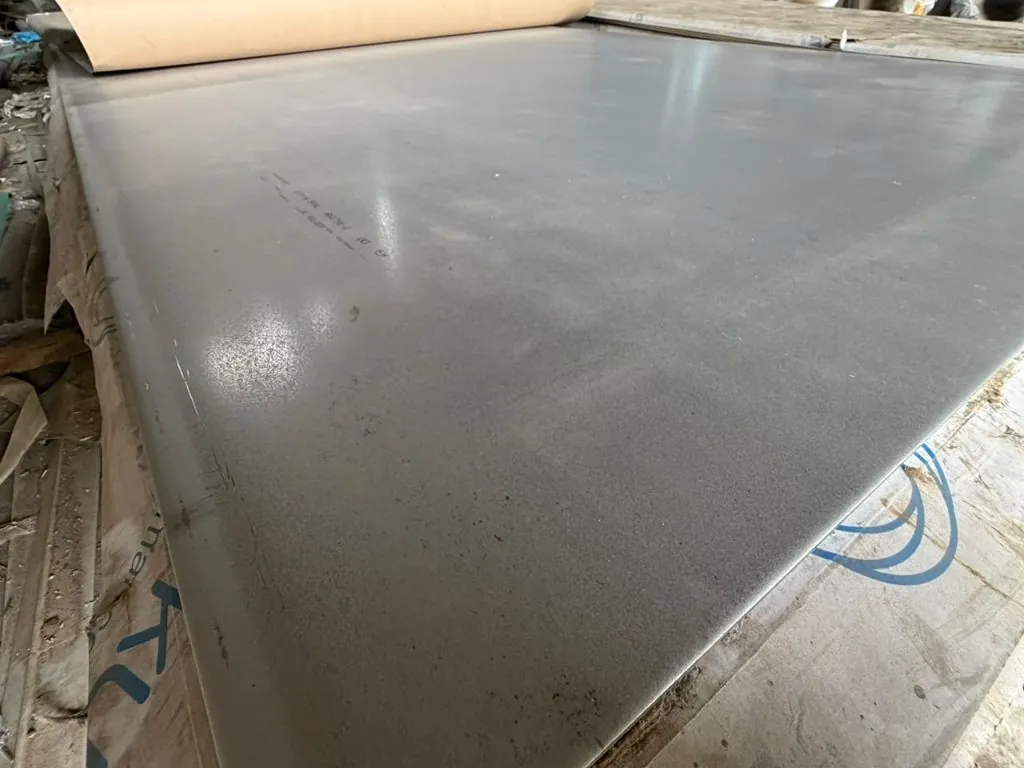
Key takeaways: ASME SA-240 at a glance
- It's ASME's adoption of ASTM A240. SA-240 reproduces ASTM A240 inside the ASME Boiler & Pressure Vessel Code, Section II Part A, so the same stainless plate can be used in Code construction.
- It governs flat-rolled stainless only: plate, sheet and strip. Bar, pipe, forgings and nickel alloys fall under other specifications.
- Four families fall under its UNS designations. Austenitic (304/304L, 316/316L, 321, 347, 310S), duplex (2205) and super-austenitic (904L), plus ferritic and martensitic grades.
- Material gets solution-annealed and mechanically tested. Intergranular-corrosion testing per ASTM A262 comes into play when the order specifies it.
- Use SA- for Code work and A- for general work. The chemistry doesn't change; the prefix just tells the inspector which book your material answers to.
Scope: what ASME SA-240 covers
ASME SA-240 covers chromium and chromium-nickel stainless steel in flat-rolled form: plate, sheet, and strip, meant for pressure vessels and general use. The standard pins down chemical composition, mechanical properties, heat-treatment condition, and the testing a mill has to pass before marking material to it. Dimensional, tolerance, surface, and marking requirements live elsewhere, in the companion general-requirements specification, SA-480.
What SA-240 does not cover is as important as what it does. It is a flat-product standard: it does not apply to round bar, pipe, tube, forgings or fasteners, each of which has its own specification. It also does not cover nickel alloys. For example, Incoloy 825 is supplied to ASTM B424 / SB-424, not SA-240, and pressure-vessel carbon-steel plate is supplied to ASME SA-516, not SA-240. Stating these borders up front prevents the wrong specification landing on a purchase order.
Because SA-240 covers both the material itself and the paperwork that comes with it for Code work, every stainless flat-product grade that claims "standards complied" is really pointing back to this one authority. It licenses the grade. The grade you pick inside it, though, is what determines corrosion performance.
ASME SA-240 vs ASTM A240: the difference that matters
Same chemistry, different book
Buyers get one thing wrong most often: SA-240 and A240 aren't two different materials. ASTM A240 is the base specification, issued by ASTM International. ASME SA-240 is that same specification adopted, essentially word for word, into the ASME Boiler & Pressure Vessel Code, Section II Part A. Chemistry limits and mechanical minimums don't change between them. What does change is the governing authority, and with it, where the material can legally be used. See the base specification at ASTM A240.
When you must cite SA-240
You cite SA-240 the moment your equipment is designed and stamped to the ASME Code, most commonly Section VIII, Division 1 pressure vessels carrying a U-stamp. In that context, the Authorized Inspector expects the mill test certificate to name SA-240, matched to the Code edition and addenda your fabrication is built to. The error our QA team sees most at receiving inspection: a plate certified only to A240 showing up for a Code vessel, or an order that skips the edition/addenda and forces a re-certification delay. For general, non-Code fabrication, A240 is enough.
| Aspect | ASME SA-240 | ASTM A240 |
|---|---|---|
| Issuing body | ASME, Boiler & Pressure Vessel Code, Section II Part A | ASTM International |
| Primary purpose | Material for ASME Code construction (U-stamped vessels) | General stainless flat-product specification |
| Chemistry & mechanicals | Identical to A240 | The base requirements |
| Prefix meaning | "SA-" = adopted into the ASME Code | "A" = ASTM base specification |
| General requirements | SA-480 | A480 |
| Edition / addenda | Must align with the Code edition of the build | Revision year of the ASTM spec |
| When to cite | ASME Code-stamped equipment | Non-Code / general fabrication |
Key requirements of SA-240
Chemical composition
Each grade under SA-240 carries its own UNS designation and composition limits. The low-carbon "L" grades keep carbon at or below 0.03%. Molybdenum in 316/316L and 904L is what gives these grades their pitting resistance, while stabilizing titanium (321) or niobium (347) ties up carbon so the steel resists sensitization. The values shown here come from independent sources and are meant for reference only; the published standard holds the controlling limits.
| Grade (UNS) | C | Cr | Ni | Mo | Other | Fe |
|---|---|---|---|---|---|---|
| 304L (S30403) | ≤ 0.030 | 17.5–19.5 | 8.0–12.0 | – | Mn ≤ 2.0 | Balance |
| 316L (S31603) | ≤ 0.030 | 16.0–18.0 | 10.0–14.0 | 2.0–3.0 | Mn ≤ 2.0 | Balance |
| 321 (S32100) | ≤ 0.08 | 17.0–19.0 | 9.0–12.0 | – | Ti ≥ 5×C | Balance |
| 347 (S34700) | ≤ 0.08 | 17.0–19.0 | 9.0–13.0 | – | Nb ≥ 10×C | Balance |
| 904L (N08904) | ≤ 0.020 | 19.0–23.0 | 23.0–28.0 | 4.0–5.0 | Cu 1.0–2.0 | Balance |
| Duplex 2205 (S32205) | ≤ 0.030 | 22.0–23.0 | 4.5–6.5 | 3.0–3.5 | N 0.14–0.20 | Balance |
Mechanical properties
SA-240 sets the floor on tensile strength, the minimum 0.2% proof (yield) strength, a minimum elongation figure, and a ceiling on hardness. These get checked with tension and hardness tests on the product once it's finished and annealed.
| Grade | Tensile, min | 0.2% yield, min | Elongation, min | Hardness, max |
|---|---|---|---|---|
| 304L | ≥ 485 MPa (70 ksi) | ≥ 170 MPa (25 ksi) | 40% | 201 HBW / 92 HRB |
| 316L | ≥ 485 MPa (70 ksi) | ≥ 170 MPa (25 ksi) | 40% | 217 HBW / 95 HRB |
| 321 | ≥ 515 MPa (75 ksi) | ≥ 205 MPa (30 ksi) | 40% | 217 HBW / 95 HRB |
| 347 | ≥ 515 MPa (75 ksi) | ≥ 205 MPa (30 ksi) | 40% | 201 HBW / 92 HRB |
| 904L | ≥ 490 MPa (71 ksi) | ≥ 220 MPa (31 ksi) | 35% | 90 HRB |
| Duplex 2205 | ≥ 655 MPa (95 ksi) | ≥ 450 MPa (65 ksi) | 25% | 293 HBW / 31 HRC |
Heat treatment: solution annealing
SA-240 austenitic and duplex grades ship in the solution-annealed condition: the mill heats them into the single-phase range, then cools them fast enough that chromium carbides stay dissolved rather than settling out. That's the metallurgical basis for the standard's corrosion promise. Sensitization sets in when carbides precipitate at grain boundaries somewhere in the 425–815 °C band, stripping chromium from the metal nearby and opening the door to intergranular attack. Three things guard against this: a low-carbon ("L") chemistry, which typically caps carbon at roughly 1/3 the level found in standard grades; stabilized grades such as 321 and 347; and solution annealing done correctly. ASTM A262 is the test that confirms none of this went wrong.
Tolerances, surface and marking
Dimensional tolerances, flatness, edge condition, surface finish and product marking all fall under the general-requirements spec SA-480. If a specific mill finish matters, 2B, BA or No.4, call it out on the order; see stainless finishes (2B / BA / No.4). Each plate carries the specification, grade, heat/cast number and mill identity, so it stays traceable through fabrication.
Grades & UNS designations covered by SA-240
SA-240 covers grades spanning the full corrosion range. PREN (pitting-resistance equivalent number) rises from austenitic 304, through molybdenum-bearing 316, up to super-austenitic 904L and duplex 2205. That progression is a useful reminder: pitting and crevice performance come down to the grade you pick within SA-240, not the specification itself. Every grade listed here is available ex-stock, supplied as genuine mill plate from authorized mills including Aperam, Outokumpu, Jindal, POSCO, Nippon Steel and JFE.
| Grade | UNS | Family | Typical PREN | Nandini money page |
|---|---|---|---|---|
| 304 | S30400 | Austenitic | ~18 | 304 plate (hub) |
| 304L | S30403 | Austenitic | ~18 | 304L stainless plate |
| 316 | S31600 | Austenitic | ~24 | 316 plate (hub) |
| 316L | S31603 | Austenitic | ~24 | 316L plate to SA-240 |
| 321 | S32100 | Austenitic (stabilized) | ~18 | 321 plate |
| 347 | S34700 | Austenitic (stabilized) | ~18 | 347 plate |
| 310S | S31008 | Austenitic (heat-resistant) | ~18 | 310S plate |
| Duplex 2205 | S31803 / S32205 | Duplex | ~35 | duplex 2205 plate |
| 904L | N08904 | Super-austenitic | ~34 | 904L super-austenitic plate |
904L is a third-party-certified Nandini specialty (named on our ISO 9001:2015 certificate alongside Alloy 28, Incoloy 800 and Hastelloy). It is also stocked as 904L coil for strip and sheet work. Ferritic and martensitic SA-240 grades exist but are outside our core stainless-plate range.
Forms & thickness covered
SA-240 covers three flat-rolled forms, and the split between them follows a standard dimensional rule. Plate generally runs 3/16 in (about 4.76 mm) and thicker. Anything thinner than that gets classified as sheet or strip. SA-480 fixes the exact boundary, along with widths and tolerances. Not sure which form your drawing calls for? Check plate vs sheet vs strip.
| Form | Thickness convention | Typical use |
|---|---|---|
| Plate | ≥ 3/16 in (~4.76 mm) | Pressure-vessel shells, heads, tube sheets |
| Sheet | < 3/16 in, in cut lengths | Linings, light fabrication, cladding |
| Strip | Narrow coil / slit widths | Formed components, strip-wound work |
Testing, inspection & certification to SA-240
SA-240 requires the mill to run a tension test and a hardness test on each heat/lot, and to report the chemical analysis. Where the application calls for it, an intergranular corrosion (IGC) test per ASTM A262 (Practice A or E) gets added to prove the material isn't sensitized. Positive material identification (PMI) confirms the alloy at receiving. All of these results show up on the mill test certificate.
- What the mill certifies: heat/cast chemistry, mechanical test results, heat-treatment condition and specification/grade, issued as an EN 10204 3.1 mill test certificate.
- What a 3.2 certificate adds: third-party witnessing by an independent inspector (TÜV SÜD, Bureau Veritas, DNV, SGS or ABS) against your SA-240 order.
- What a certified stockist adds: maintained heat/cast traceability from mill plate to your cut piece, with the original MTC intact. See how to read a mill test certificate, and for a fuller picture, our notes on MTC, NDT and PMI testing.
Every Nandini order ships with the EN 10204 3.1/3.2 mill test certificate, which names the specification and heat number. Supplementary A262 IGC cuts and PMI reports come on request. See our mill test certificates and quality assurance.
How to order stainless plate to ASME SA-240
A clean SA-240 purchase order clears receiving inspection on the first pass. The order needs to state, in sequence:
- Grade and UNS, e.g. "316L, UNS S31603" (not just "316").
- Specification and edition, "ASME SA-240" plus the Code edition/addenda your vessel is built to.
- Form, thickness and width, plate / sheet / strip, with dimensions and quantity.
- Surface finish, 2B, BA, No.4 or mill finish, per SA-480.
- MTC level, EN 10204 3.1 (mill) or 3.2 (third-party witnessed).
- Supplementary tests, ASTM A262 Practice A/E (IGC), PMI, or UT, if required.
Use the plate weight calculator to turn dimensions into shipping weight. If the grade's still open, check the grade selector or read how to select a stainless grade. Once you know the grade, order it directly: 304L stainless plate, 316L plate to SA-240, or 904L super-austenitic plate.
Applications governed by SA-240
SA-240 flat product is the workhorse of Code fabrication: pressure vessels and boilers, chemical processing and acid plants, oil & gas equipment and petrochemical units. The grade carries the service, 316L for moderate chlorides, 904L for sulfuric acid and aggressive chlorides, while SA-240 carries the compliance. For the wider context of why stainless and PVQ plate is specified this way, see pressure-vessel steel.
FAQ
What is the difference between ASME SA-240 and ASTM A240?
Which stainless steel grades does ASME SA-240 cover?
Is 316L available to ASME SA-240?
What is the minimum plate thickness under ASME SA-240?
Does ASME SA-240 require a 3.1 mill test certificate?
What does SA-240 stand for?
Request a quote for SA-240 stainless plate
Nandini Steel has been in business since 2003, putting corrosion-resistant steel at the center of what it does for over 20 years now. The company is an ISO 9001:2015-certified stockist and supplier, with 307+ projects behind it and 260+ clients spread across 36+ export countries. SA-240 stainless plate, sheet and strip ship ex-stock, and every order comes with EN 10204 3.1/3.2 mill test certificates. Just send over your grade, specification edition, dimensions and MTC level; our team will get back to you with availability and a quotation.
- Email: reachus@nandinisteel.com
- Phone / WhatsApp: +91 22 43404600 · +91 99202 09184
- Address: 25, Dreamland Building, 601, 6th Floor, Mama Parmanand Marg, Charni Road, Opera House, Girgaon, Mumbai, Maharashtra 400004, India
Explore our certifications, read about Nandini Steel, or contact us to check against the UNS / Werkstoff / JIS cross-reference.