
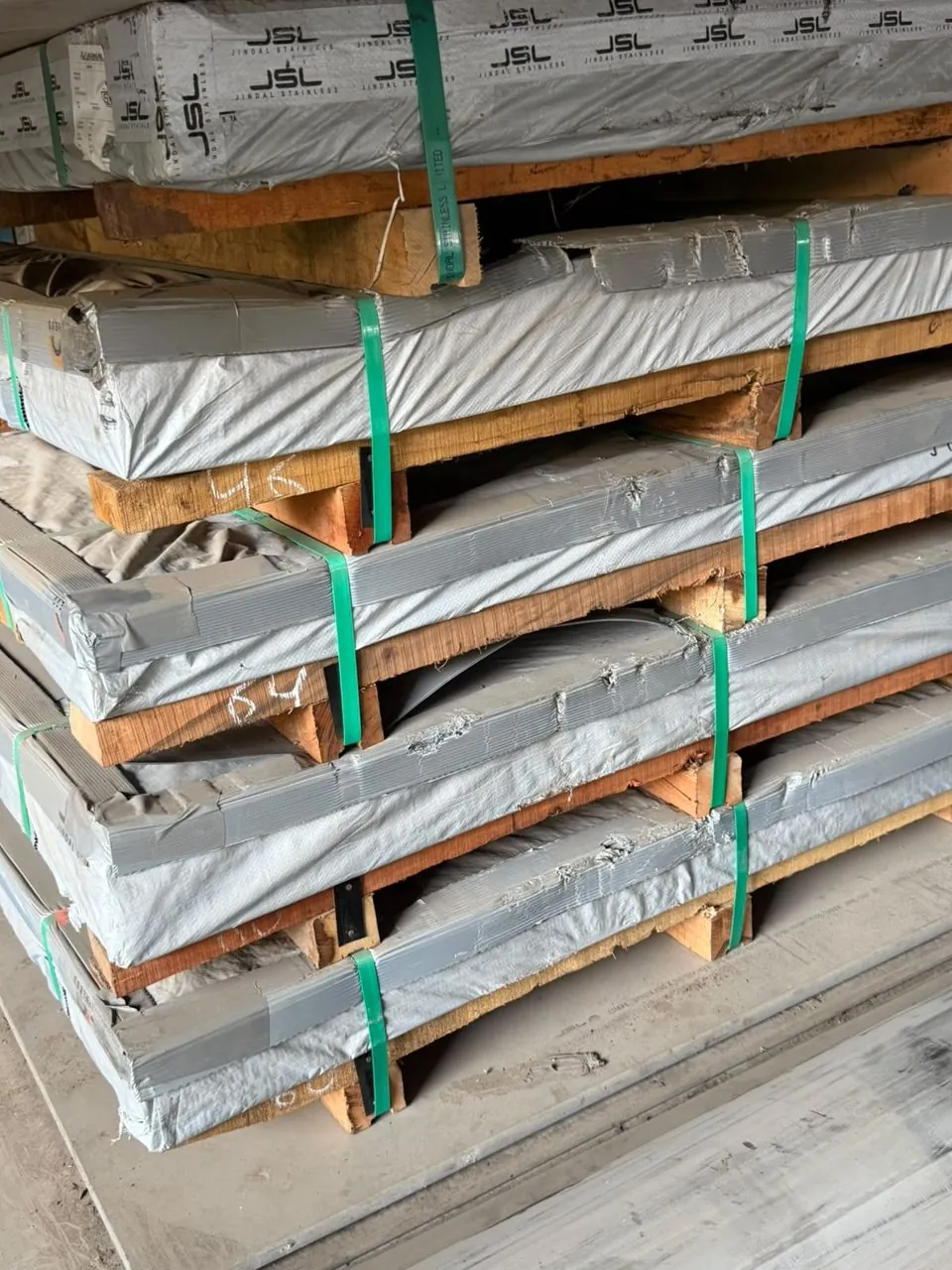
Key takeaways: 304 plate at a glance
- Designation: UNS S30400 / Werkstoff 1.4301 / JIS SUS304 / AISI 304, the "18-8" austenitic baseline.
- Chemistry: ~18–20% Cr, 8–10.5% Ni, no molybdenum, which is exactly why its PREN sits near 18.
- Condition: non-magnetic in the solution-annealed condition; may turn slightly magnetic after heavy cold work.
- Standard: it ships as ASTM A240 / ASME SA-240 flat product. Every order comes with an EN 10204 3.1/3.2 mill test certificate.
- Fit: good for food, dairy, architectural work and general fabrication in dry or mild service. Not for chloride or marine duty, that's where you step up to 316.
What is 304 stainless steel plate?
304 is the most widely specified grade of austenitic stainless steel, a face-centered-cubic, chromium-nickel alloy that is tough, formable and weldable, and that forms a self-repairing passive chromium-oxide film in air and mild aqueous service. In plate form (S30400) it is the flat product most industrial and fabrication buyers reach for first: the cost-effective, general-purpose workhorse you specify when the environment is dry, mild or non-chloride.
304 is defined by a roughly 18% chromium and 8% nickel balance, the classic "18-8" chemistry, with no molybdenum. That single omission tells you nearly everything about this grade. Chromium builds the passive film, and nickel stabilizes the austenite, but without molybdenum the alloy has no reserve against chloride pitting. 304 plate is the right call across a huge range of general work. The moment chlorides enter the picture, though, it becomes the wrong one. The sections below make that case honestly, pointing you to 316 or over to 304L plate exactly when 304 isn't the correct choice. For a broader look at the grade and its other forms, see the 304 grade hub.
Chemical composition
304 plate is supplied within the S30400 element ranges of ASTM A240. Its corrosion resistance and formability come from a low carbon ceiling paired with chromium and nickel content that's kept deliberately high.
| Element | 304 (S30400) wt% | 304L (S30403) wt% | 316 (S31600) wt% |
|---|---|---|---|
| Carbon (C) | ≤ 0.08 | ≤ 0.03 | ≤ 0.08 |
| Chromium (Cr) | 18.0–20.0 | 18.0–20.0 | 16.0–18.0 |
| Nickel (Ni) | 8.0–10.5 | 8.0–12.0 | 10.0–14.0 |
| Molybdenum (Mo) | – | – | 2.0–3.0 |
| Manganese (Mn) | ≤ 2.0 | ≤ 2.0 | ≤ 2.0 |
| Silicon (Si) | ≤ 0.75 | ≤ 0.75 | ≤ 0.75 |
| Phosphorus (P) | ≤ 0.045 | ≤ 0.045 | ≤ 0.045 |
| Sulfur (S) | ≤ 0.030 | ≤ 0.030 | ≤ 0.030 |
| Nitrogen (N) | ≤ 0.10 | ≤ 0.10 | ≤ 0.10 |
| Iron (Fe) | Balance | Balance | Balance |
Why 18-8 and no molybdenum
The "18-8" label gets at something close to a balance: roughly 18% chromium builds the passive film, and about 8% nickel holds the structure austenitic. 304 carries no molybdenum at all, which keeps its pitting resistance equivalent (PREN = Cr + 3.3·Mo + 16·N) stuck near 18. 316 brings in 2–3% molybdenum and pushes PREN up to roughly 24. That molybdenum addition is exactly what buys chloride resistance, and it's exactly what 304 is missing. Chlorides in your service environment mean you need the molybdenum, which means 316, not 304.
Mechanical properties
Minimum room-temperature properties for 304 plate in the solution-annealed condition, per ASTM A240 and ASME SA-240.
| Property | Minimum (304 plate, annealed) |
|---|---|
| Tensile strength | ≥ 515 MPa (75 ksi) |
| Yield strength (0.2% proof) | ≥ 205 MPa (30 ksi) |
| Elongation (in 50 mm) | ≥ 40% |
| Hardness | ≤ 201 HBW / ≤ 92 HRB |
304 is an austenitic grade, and it work-hardens as it's formed. That means cold-worked plate will test well above these annealed minima. It's a plus for strength, but something to plan around when you're bending or machining it.
Physical properties
| Property | Typical value (304 / S30400) |
|---|---|
| Density | 8.0 g/cm³ |
| Melting range | ~1400–1450 °C |
| Thermal conductivity (100 °C) | ~16.2 W/m·K |
| Mean coefficient of thermal expansion (0–100 °C) | ~17.3 µm/m·°C |
| Elastic modulus | ~193 GPa |
| Magnetic response | Non-magnetic (annealed); slightly magnetic after heavy cold work |
The 8.0 g/cm³ density is what drives the plate weight calculation below. A non-magnetic response is a handy field check for correctly annealed 304, but it doesn't substitute for a PMI test or the mill certificate.
Corrosion behavior & PREN: what 304 resists and where it stops
This section nails down whether 304 plate suits your job. Corrosion-resistant, yes; rust-proof, no. The real limit, honestly, comes down to chlorides.
General / uniform resistance
In clean air, drinking water, food products, dairy settings and most mild atmospheric or organic environments, 304 holds up excellently. Its passive chromium-oxide film reforms instantly the moment it's scratched, as long as oxygen is present. That's why 304 serves as the baseline grade for food and dairy equipment, hygienic surfaces, and architectural and structural cladding.
Pitting & crevice corrosion: PREN ~18
304 starts with no molybdenum, which puts its PREN at roughly 18, the bottom rung of the stainless ladder. That's fine for mild service. It falls apart with chlorides, though: brackish water, de-icing salt, coastal air, swimming-pool atmospheres, chloride process streams. In any of those, 304 is prone to pitting corrosion and crevice attack. Once chlorides enter the picture, move up to 316, with a PREN near 24, or go higher still.
Our engineering team's most common field observation is buyers defaulting to 304 for chloride-adjacent or coastal duty. It pits. Confirm the actual service chlorides before choosing 304 over 316, stepping up costs far less than a failed part.
Chloride stress-corrosion cracking
Like all standard austenitic grades, 304 is susceptible to chloride stress-corrosion cracking under the combination of tensile stress, chlorides and temperature (typically above ~60 °C). Hot chloride service, even at low concentrations, is a reason to reconsider the grade and the design, not just the alloy.
Intergranular corrosion / sensitization in welded sections
Held in the 425–815 °C range, as happens in the heat-affected zone of thick welds, standard 304 (C ≤ 0.08%) can sensitise. Chromium carbides precipitate at the grain boundaries and leave them locally depleted, and that's what drives intergranular corrosion.
For welded fabrications sitting in that range, specify 304L plate (C ≤ 0.03%). It avoids sensitization without needing post-weld solution annealing.
Equivalent grades & designations
| System | Designation |
|---|---|
| UNS | S30400 |
| Werkstoff (W.-Nr.) | 1.4301 |
| JIS | SUS304 |
| EN name | X5CrNi18-10 |
| BS | 304S31 |
| AISI | 304 |
| Common name | 18-8 |
A full cross-reference of designations across standards sits on our UNS / Werkstoff / JIS cross-reference page.
304 plate vs the alternatives: when it is the right choice (and when it isn't)
304 remains the baseline against which the other grades get measured. The PREN ladder below shows where each one lands, and the stay-or-step-up column tells you when it's time to move off 304.
| Grade | Approx. PREN | Key chemistry difference vs 304 | Specify it when… |
|---|---|---|---|
| 304 | ~18 | Baseline 18-8, no Mo | Dry, mild, non-chloride service |
| 316 | ~24 | +2–3% Mo | Chlorides, marine, mild acids |
| 304L | ~18 | C ≤ 0.03% | Heavy welded sections (anti-sensitization) |
| 904L | ~34 | ~25% Ni, ~4.5% Mo, Cu | Sulfuric acid, high chlorides |
| Incoloy 825 | ~31–40 | Ni-Fe-Cr, Ti-stabilised | Sour service, mixed acids |
304 vs 316: the chloride / marine step-up
If chlorides, seawater or mild acids come into play, you need the molybdenum in 316. For the full breakdown, see the 304 vs 316 comparison.
304 vs 304L: the welded-section decision
For heavy or multi-pass welds that risk sensitization, the low-carbon sibling is the answer. Our 304 vs 304L comparison covers when the grade with C ≤ 0.03% earns its place.
304 vs 201 and 430: why cost-down substitutes fall short
| Grade | Family | Nickel | Corrosion | Why not to substitute for 304 |
|---|---|---|---|---|
| 304 | Austenitic | 8–10.5% | Good (mild service) | – |
| 201 | Austenitic (Mn-substituted) | ~3.5–5.5% | Lower | Manganese replaces nickel, reduced corrosion and SCC margin |
| 430 | Ferritic | None | Lower | No nickel, magnetic, lower formability and corrosion resistance |
Forms, sizes & thickness ranges
304 flat product comes as sheet, plate and coil, available here. We keep genuine mill plate ex-stock for immediate dispatch, and we cut and process it to your drawing.
| Parameter | Typical 304 plate range |
|---|---|
| Thickness | Hot-rolled plate from ~3 mm upward |
| Width | Standard mill widths up to 2500 mm |
| Length | Cut to requirement |
| Condition | Solution-annealed and pickled |
Other 304 forms
For thinner gauges and continuous supply, check out 304 sheet and 304 coil. Working with welded heavy sections instead? The low-carbon 304L plate sibling might be the better call.
Plate weight & how to calculate
304 plate weight follows directly from its 8.0 g/cm³ density:
Weight (kg) = thickness (mm) × width (m) × length (m) × 8.0 × 1000 ÷ 1000 = thickness (mm) × width (m) × length (m) × 8.0
Worked example: take a 10 mm × 1.25 m × 2.5 m plate in 304 steel. Multiply it out: 10 × 1.25 × 2.5 × 8.0, and you land on 250 kg.
| Thickness | Plate size | Approx. weight |
|---|---|---|
| 6 mm | 1.25 m × 2.5 m | ~150 kg |
| 10 mm | 1.25 m × 2.5 m | ~250 kg |
| 12 mm | 1.5 m × 3.0 m | ~432 kg |
| 20 mm | 1.5 m × 6.0 m | ~1440 kg |
Use our weight calculator for any size, or work through the guide to calculating steel plate weight step by step.
Finishes
For plate, the standard supply condition is No.1, hot-rolled, annealed and pickled (HRAP): a matt, descaled surface suited to structural, tank and general fabrication work. Thinner 304 plate and sheet come in cold-rolled 2B (smooth, mildly reflective) too, along with polished No.4 finishes, which matter most where looks or cleanability count, think architectural and hygienic settings. For help choosing, see the guide to stainless finishes (2B, BA, No.4).
Standards & specifications complied
304 plate is supplied to ASTM A240 and its pressure-vessel equivalent ASME SA-240 for S30400 flat product, covering chemistry, mechanical properties and tolerances.
ASTM A240 vs ASME SA-240 for S30400 flat product
The two documents cover the same technical requirements for S30400, but ASME SA-240 is the version written into the ASME Boiler & Pressure Vessel Code. Cite it when the plate's going into a code-stamped vessel. ASTM A240 is what you'd reach for in general fabrication work.
Testing, inspection & certification
Every 304 plate carries a trace back to its heat and comes with the paperwork to prove it:
Mill test certificate: every order ships with an EN 10204 3.1/3.2 mill test certificate, see the EN 10204 3.1 mill test certificate explainer.
Intergranular corrosion: when sensitization resistance needs demonstrating, IGC testing follows ASTM A262 (Practice A or E).
- Positive material identification (PMI): spectrometric confirmation of the 18-8 chemistry against the certificate.
- Ultrasonic testing (UT): for thicker plate where internal soundness is specified.
Our full approach to documentation and traceability is covered under testing, MTC, NDT & PMI.
Applications of 304 plate by industry
304 plate is the general-purpose stainless flat product across:
- Food, dairy and beverage, tanks, hoppers, work surfaces and hygienic equipment in non-chloride service.
- Architectural and structural, cladding, façades, handrails, canopies and street furniture.
- General fabrication, frames, enclosures, brackets and machinery guards.
Chemical processing, this one's for mild, non-chloride streams only. If you're dealing with chloride or acid duty, step up to 316, 904L, or a nickel alloy.
Welding & fabrication of 304 plate
304 plate welds without much trouble using the common arc processes, and shops typically pair it with a matching ER308L / E308L filler (AWS A5.9 / A5.4). That filler gives you a weld deposit that's slightly over-alloyed and low in carbon. A few things worth knowing:
- Use ER308L as the standard matching filler for 304-to-304 joints.
- For heavy or multi-pass welds held in the 425–815 °C sensitization range, specify 304L plate to keep the heat-affected zone corrosion-resistant without post-weld annealing.
- 304 work-hardens, so allow for higher forming forces and plan bend radii accordingly.
- If full corrosion resistance needs to come back after heavy cold work or thick welding, solution-anneal at roughly 1010–1120 °C and quench fast.
See our guide to welding 304 plate for process settings, filler selection and sensitization control on welded fabrications.
Price & how we quote
We quote 304 plate on an RFQ basis for live pricing only. 304 tracks the LME nickel price, so rather than publish a band that would be stale by the time you read it, we price every inquiry against the current market and your exact size, quantity and finish. All plate is ex-stock for immediate dispatch, supplied as genuine mill material from Aperam, Outokumpu, Jindal, POSCO, Nippon Steel or JFE. Every order comes with an EN 10204 3.1/3.2 mill test certificate. Send your sizes and we'll get back to you with a same-day quote.
FAQ
Is 304 stainless steel plate rust proof?
Is 304 stainless steel plate food grade?
Is 304 stainless steel plate magnetic?
304 or 316 plate, which should I choose?
What thickness does 304 plate come in?
How do I calculate 304 plate weight?
Request a quote
Nandini Steel has been in the trade since 2003 and holds ISO 9001:2015 certification as a stockist and supplier of stainless steel, nickel-alloy and PVQ products. Over 20 years in, the firm has delivered 307+ projects for 260+ clients spread across 36+ export countries. Send along your 304 plate sizes, quantities and finish, and you'll get a same-day RFQ, complete with an EN 10204 3.1/3.2 mill test certificate on dispatch.
- Call: +91 22 43404600 · +91 9920209184
- WhatsApp: +91 99202 09184
- Email: reachus@nandinisteel.com
- Address: 25, Dreamland Building, 601, 6th Floor, Mama Parmanand Marg, Charni Road, Opera House, Girgaon, Mumbai, Maharashtra 400004, India
- GSTIN: 27ADJPA7240C1Z0
Related grades to cross-shop
Part of our steel plate range and all stainless steel plate grades.