
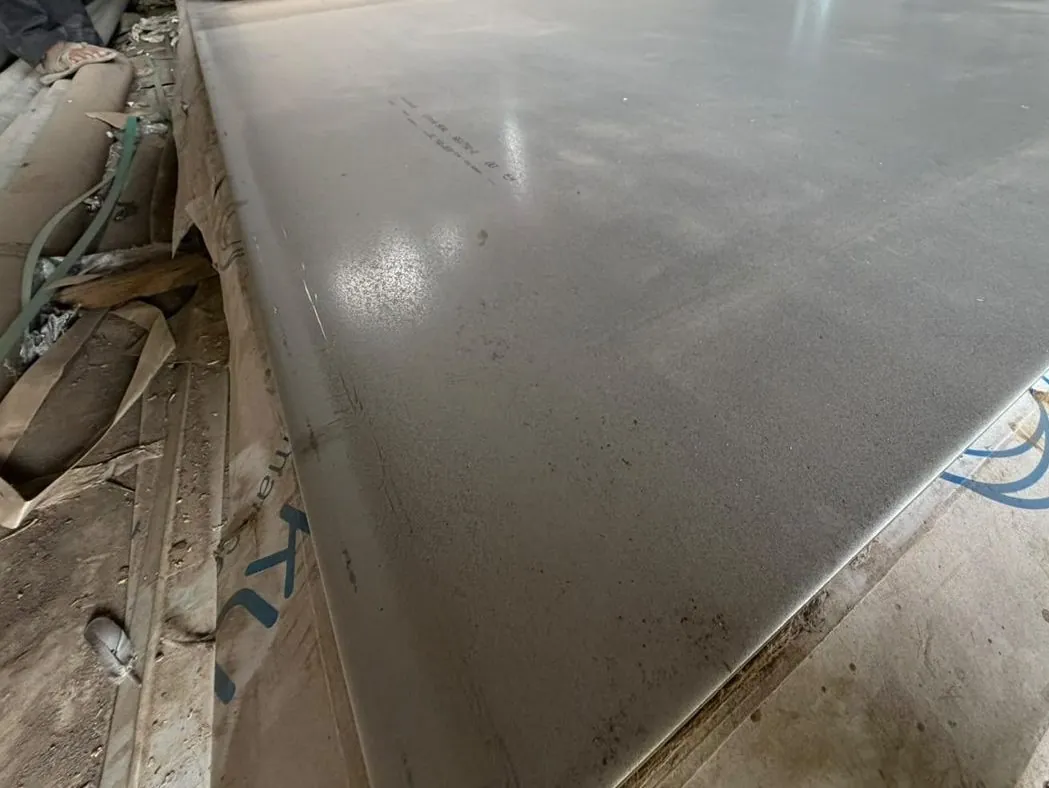
Scope: what ASTM B424 covers
ASTM B424 serves as the flat-product rulebook for the titanium-stabilized Ni-Fe-Cr-Mo-Cu alloy family. It governs plate, sheet and strip supplied in the hot- or cold-rolled and solution/stabilize-annealed condition. Three things get pinned down here, and a buyer needs to agree with the mill on each: the chemical composition of every heat, the mechanical minima for the annealed product, and the test regime that proves out corrosion resistance. Cite B424 on a purchase order, and the mill, the mill test certificate and the inspector all read from the same rules.
B424 is a product specification, not a grade name. It defines the form, not the bar, tube or forging. For those, different ASTM specs apply; see the form map below.
Which UNS numbers B424 lists
The specification covers UNS N08825 (Incoloy 825) first and foremost. It also lists the low-carbon, related variant UNS N08221. Both are nickel-iron-chromium alloys, and their resistance to intergranular corrosion comes from titanium stabilization paired with a controlled anneal.
The alloy B424 governs: Incoloy 825 (UNS N08825)
Incoloy 825 belongs to the Ni-Fe-Cr family of nickel alloys, nominally 42% nickel, 21% chromium, 3% molybdenum, and 2% copper, with titanium added to guard against sensitization. People often call it "Inconel 825," but that's wrong. The correct name is Incoloy / Alloy 825 (UNS N08825), Werkstoff 2.4858. Get that designation right on the PO and the MTC. Skip it, and you're asking for a receiving-inspection dispute. For more on the grade, see what is Incoloy 825.
Its real strength is holding up against both reducing and oxidizing acids at once, plus resisting chloride stress-corrosion cracking and sour H₂S service. That combination is why engineers specify it over 316L or 904L for mixed-acid and sour-gas duty. A 825 flat-product money page conforms to ASTM B424, the governing spec.
Key requirements of ASTM B424
Chemical composition
B424 sets the element ranges below for UNS N08825. Copper and molybdenum do the heavy lifting on acid resistance, while titanium acts as the stabilizer, which, given a proper anneal, keeps grain boundaries free of chromium-carbide sensitization.
| Element | Min | Max |
|---|---|---|
| Nickel (Ni) | 38.0 | 46.0 |
| Chromium (Cr) | 19.5 | 23.5 |
| Molybdenum (Mo) | 2.5 | 3.5 |
| Copper (Cu) | 1.5 | 3.0 |
| Titanium (Ti) | 0.6 | 1.2 |
| Iron (Fe) | 22.0 | balance |
| Carbon (C) | – | 0.05 |
| Manganese (Mn) | – | 1.0 |
| Silicon (Si) | – | 0.5 |
| Sulfur (S) | – | 0.03 |
| Aluminum (Al) | – | 0.2 |
Mechanical properties
B424 sets the following minima for annealed flat product. Check the exact figures against the current revision when you place the order, since minima can shift depending on product and section.
| Property | Requirement |
|---|---|
| Tensile strength | ≥ 85 ksi (586 MPa) |
| Yield strength (0.2% offset) | ≥ 35 ksi (241 MPa) |
| Elongation in 2 in. | ≥ 30% |
| Hardness (typical, annealed) | ≤ ~95 HRB |
Required condition & heat treatment
B424 flat product ships in the annealed condition. Incoloy 825 gets a stabilize/solution anneal that dissolves chromium carbides and develops the titanium stabilization, which restores intergranular-corrosion resistance after rolling. Specify the annealed condition explicitly on the order. It's a requirement of the spec, not an extra. For the metallurgy behind this, see solution annealing.
Dimensional tolerances & finish
Thickness, width, flatness and edge tolerances follow B424 and the general tolerance spec referenced for the product. Sheet and strip hold tighter gauge tolerances than plate does. State the mill finish and edge condition, mill, slit, or sheared, on the order.
Forms & thickness ranges covered
B424 splits products by shape: flat forms fall under it, long or hollow ones don't. Plate is the heavy flat stuff. Sheet is thinner, running down to light gauge. Strip, meanwhile, is the narrow coiled version. Coil in this alloy isn't easy to find. Bar, forgings, tube and pipe sit outside B424's scope entirely; those get handed off to sibling product specs.
| Form | Specification | Use when |
|---|---|---|
| Plate, sheet, strip | ASTM B424 / ASME SB-424 | Flat product for vessels, liners, trays |
| Rod & bar | ASTM B425 | Machined parts, fasteners, shafts |
| Forgings | ASTM B564 | Flanges, forged fittings, bodies |
| Seamless tube / pipe | ASTM B163 / B423 | Heat-exchanger, condenser, process lines |
| Welded tube / pipe | ASTM B704 / B705 | Welded process piping |
| Flat form | Typical thickness | Nandini availability |
|---|---|---|
| Plate | ≥ 3/16 in. (4.76 mm) | Ex-stock, immediate dispatch |
| Sheet | < 3/16 in. down to light gauge | Ex-stock, immediate dispatch |
| Strip | Narrow coiled product | Ex-stock / indent per size |
Testing, inspection & certification to B424
Nandini Steel proves conformance to B424 through testing, and the mill test certificate is the document that carries that evidence. Every order ships with an EN 10204 3.1 / 3.2 mill test certificate, giving full heat and cast traceability. Details on certificate levels sit on the EN 10204 3.1 mill test certificate page, and a broader look at testing, MTC, NDT & PMI is available in the explainer.
| Test | Method | Requirement / purpose | When required |
|---|---|---|---|
| Tension test | ASTM B424 / E8 | Meets annealed tensile, yield, elongation minima | Every heat / lot |
| Intergranular corrosion (IGC) | ASTM A262 / ASTM G28 | No intergranular attack after sensitizing exposure | Corrosion / acid service, when specified |
| Positive material identification | PMI (XRF / OES) | Confirms N08825 chemistry | On request |
| Hardness | HRB | Within NACE MR0175 hardness limit | Sour service |
| Mill test certificate | EN 10204 3.1 / 3.2 | Documents conformance + traceability | Every order |
Because titanium-stabilized 825 is still susceptible to sensitization if mis-annealed, the IGC test per ASTM A262 / ASTM G28 is the check that the supplied condition is sound. Call it out on the order and it is documented on the accompanying mill test certificate.
Sour-service add-on: NACE MR0175 / ISO 15156
B424 doesn't by itself qualify material for sour service. For wet-H₂S duty, call out NACE MR0175 / ISO 15156 on the order, so the heat gets supplied in the qualified hardness condition. The cracking mechanisms this controls are covered in sour service.
ASME SB-424 & equivalent standards
The ASME Boiler & Pressure Vessel Code picks up B424 under the designation ASME SB-424 (Section II, Part B). When you're working on code vessels, cite SB-424. The chemistry and testing requirements don't change: they match ASTM B424 exactly. Designation systems vary, though, and UNS N08825 maps across them as shown below. For the complete table, see the UNS / Werkstoff / JIS cross-reference.
| System | Designation |
|---|---|
| UNS | N08825 |
| Werkstoff / W.-Nr. | 2.4858 |
| EN | NiCr21Mo |
| ASME | SB-424 |
| Common misnomer | "Inconel 825" (use Incoloy 825) |
The flat-product analogue for stainless grades is ASTM A240 / ASME SA-240, useful contrast when a project spans both stainless and nickel-alloy flat product. For A240 itself see ASTM A240.
B424 vs B425 vs B564: one alloy, different product specs
The same N08825 alloy shows up across several ASTM specs, divided by form. Order the wrong one, say, B425 (bar) when plate is what you actually need, and that's a frequent reason material gets rejected. Match the spec to the form: B424 for flat product, B425 for bar, B564 for forgings, and B163/B423 for tube and pipe.
Why engineers specify to ASTM B424
Incoloy 825 gets the nod when one alloy has to stand up to more than one kind of attack. It resists both reducing and oxidizing acids, sulfuric and phosphoric among them (see reducing-acid resistance), and it shrugs off chloride stress-corrosion cracking, the failure mode that trips up austenitic stainless. Its PREN falls in the roughly 31–40 range: 304 sits near 18, 316 around 24, 904L about 34, 825 at 31–40, and Duplex 2205 near 35. Specifying to B424 locks in the chemistry and the annealed condition that make all of this possible. That's what gets the plate to arrive sour-service-ready, not just "825-grade" in name.
How to order Incoloy 825 plate & sheet to ASTM B424
Use this line-item checklist on the purchase order so nothing gets left to guesswork:
- Specification, ASTM B424 (or ASME SB-424 for code work).
- Grade / UNS, Incoloy 825, UNS N08825.
- Form, plate, sheet or strip.
- Dimensions, thickness × width × length (and finish/edge).
- Condition, solution/stabilize-annealed.
- Test level, IGC per ASTM A262 / G28; NACE MR0175 hardness if sour service.
- MTC level, EN 10204 3.1 or 3.2.
- Marking, heat/cast number for traceability.
Request quotes against the money pages built to this spec: Incoloy 825 plate to B424, Incoloy 825 sheet, Incoloy 825 coil/strip, or the grade hub Incoloy 825 (UNS N08825). For flat-product mass, the 825 plate weight calculator does the job. Trying to narrow down a CRA? Use the grade selector.
From the Nandini Steel Engineering Team: on 825 orders, two spec gaps show up more than any others. The first is leaving the annealed condition unstated. The second is skipping the citation of NACE MR0175 / ISO 15156 for sour duty, and when that happens, the heat may not arrive in the qualified condition. Call both out on the PO. If the service is acidic, name IGC testing too.
Applications ordered to B424 flat product
Incoloy 825 flat product to B424 covers acid duty and sour duty alike.
- Oil & gas sour service, sour-gas separators, liners, internals.
- Chemical / acid processing, mixed-acid reactors, heat-exchanger plate.
- Fertilizer / acid-regeneration service, phosphoric and sulfuric circuits.
- Petrochemical, process vessels and pollution-control equipment.
FAQ
Is ASTM B424 the same as Incoloy 825?
What is the ASME equivalent of ASTM B424?
Does ASTM B424 cover bar?
What is the difference between ASTM B424 and B906?
Is NACE MR0175 required by ASTM B424?
Ready to specify? Request a quote for Incoloy 825 plate, sheet or strip to ASTM B424 / ASME SB-424, supplied ex-stock with an EN 10204 3.1 / 3.2 mill test certificate. Give us a call at +91 22 43404600 or +91 99202 09184, drop a line to reachus@nandinisteel.com, or send your line-item checklist through the contact page. Nandini Steel is an ISO 9001:2015-certified stockist and supplier based in Mumbai, India. Founded in 2003, the company has more than 20 years of track record, with 307+ projects completed across 260+ clients in 36+ export countries.