
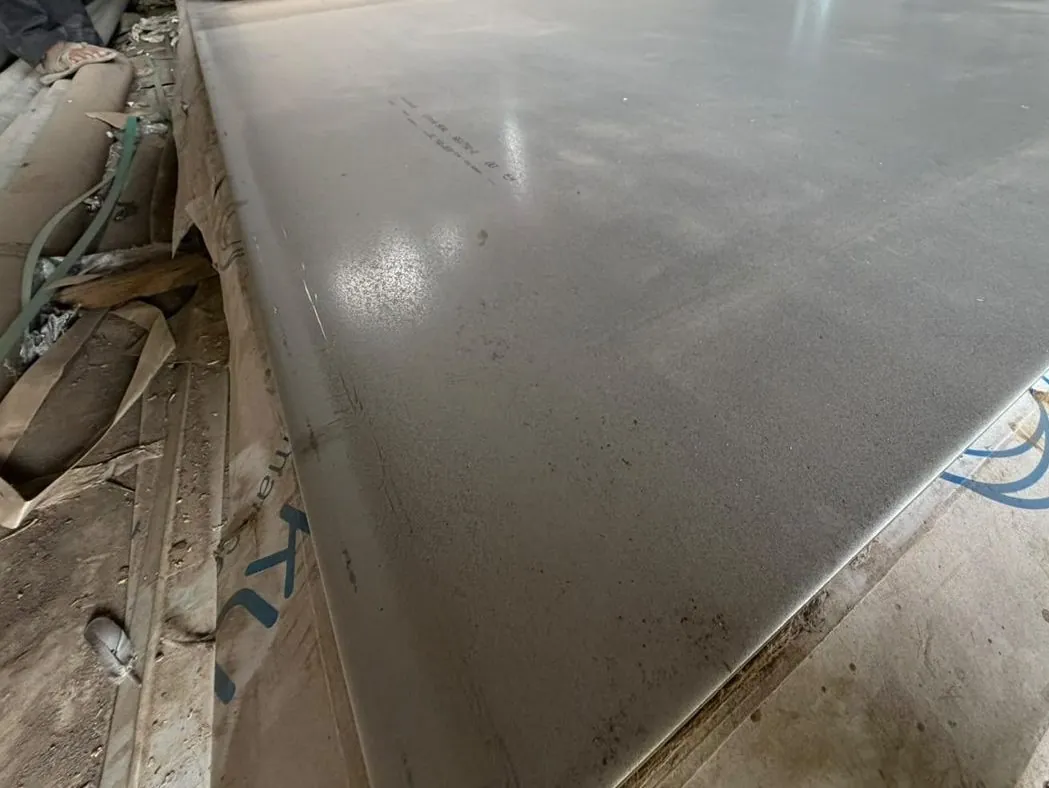
Key takeaways: 304 stainless steel at a glance
- Designation: UNS S30400 / Werkstoff 1.4301 / JIS SUS304 / AISI 304, the "18-8" austenitic stainless steel.
Chromium 18.0–20.0%, nickel 8.0–10.5%, no molybdenum at all. That's the trade-off built right into the alloy: skip the molybdenum and you get a cheaper steel, but you also hit a wall on what it can resist.
That wall shows up clearly in the numbers. A PREN near 18 puts 304 at the bottom of the pitting-resistance scale among common stainless grades. Chloride pitting and chloride stress-corrosion cracking are real risks here, so anything touching chlorides, seawater, or a coastal environment calls for 316 stainless steel instead.
Welding brings its own hazard. Sit the material in the 425–815 °C band for too long and sensitization sets in. For welded joints or heavy sections, specify the low-carbon 304L grade rather than standard 304.
On the supply side: we stock genuine mill plate, sheet, and coil to ASTM A240 / ASME SA-240, ready for immediate dispatch. Every order ships with an EN 10204 3.1/3.2 mill test certificate.
What is 304 stainless steel?
304 is the default workhorse of the austenitic stainless steel family, the grade every other stainless gets measured against. The nickname "18-8" comes from its nominal 18% chromium and 8% nickel. Chromium forms the self-healing passive oxide film that makes the steel stainless. Nickel does something different: it stabilizes the austenitic, face-centered-cubic structure, and that's what gives 304 its formability, toughness, and non-magnetic response in the annealed condition.
It is chosen as the baseline stainless steel grade because it balances corrosion resistance, fabrication ease, weldability, and cost across general, architectural, and food or dairy service. The job of this hub is to specify 304 completely and then bound it honestly: it tells you exactly where 304's envelope ends and routes you to 304L when welding risks sensitization, and to 316 when chlorides are present.
Chemical composition of 304 (and 304L)
304 falls under the composition Cr 18–20%, Ni 8–10.5%, with no molybdenum. The low-carbon variant, 304L, caps carbon at 0.03% to resist sensitization during welding. Beyond that, the two share the same 18-8 base.
| Element | 304 (S30400) wt% | 304L (S30403) wt% |
|---|---|---|
| Carbon (C) | ≤ 0.08 | ≤ 0.03 |
| Chromium (Cr) | 18.0–20.0 | 18.0–20.0 |
| Nickel (Ni) | 8.0–10.5 | 8.0–12.0 |
| Manganese (Mn) | ≤ 2.00 | ≤ 2.00 |
| Silicon (Si) | ≤ 0.75 | ≤ 0.75 |
| Phosphorus (P) | ≤ 0.045 | ≤ 0.045 |
| Sulfur (S) | ≤ 0.030 | ≤ 0.030 |
| Nitrogen (N) | ≤ 0.10 | ≤ 0.10 |
| Molybdenum (Mo) | none | none |
| Iron (Fe) | balance | balance |
Ranges follow ASTM A240 / ASME SA-240. Positive material identification (PMI) performed on receipt confirms the 18-8 chemistry against the heat number shown on the mill test certificate.
Why 304 has no molybdenum (and what that costs you)
Molybdenum is the one element that does the most to shore up the passive film against chloride attack. 304 has none of it, and that's exactly why it's cheaper and lighter on alloy than 316, and why it stops working once chlorides enter the picture. The pitting resistance equivalent number, PREN = Cr + 3.3·Mo + 16·N, drops to roughly 18 for 304 since the molybdenum term is zero. Add 2–3% molybdenum and 304 becomes 316, pushing PREN up to about 24. That single compositional change is what drives the whole chloride-upgrade decision below.
Mechanical properties of 304
304 meets the annealed minima set out in ASTM A240. It work-hardens fast during cold forming, picking up strength as it sheds ductility. That's why heavily cold-worked parts end up slightly magnetic too.
| Property (annealed) | 304 (S30400) | 304L (S30403) |
|---|---|---|
| Tensile strength, min | 515 MPa (75 ksi) | 485 MPa (70 ksi) |
| Yield strength 0.2%, min | 205 MPa (30 ksi) | 170 MPa (25 ksi) |
| Elongation in 50 mm, min | 40% | 40% |
| Hardness, max | 201 HBW / 92 HRB | 201 HBW / 92 HRB |
304L runs slightly lower on strength minima, since its lower carbon content cuts down on solid-solution strengthening. That's the price you pay for resistance to weld decay.
Physical properties of 304
| Property | Value (approx.) |
|---|---|
| Density | 8.0 g/cm³ |
| Melting range | 1400–1455 °C |
| Thermal conductivity (100 °C) | 16.2 W/m·K |
| Mean coefficient of thermal expansion (0–100 °C) | 17.3 µm/m·°C |
| Elastic modulus | 193 GPa |
| Electrical resistivity | 0.72 µΩ·m |
| Specific heat (0–100 °C) | 500 J/kg·K |
| Magnetic response | non-magnetic (annealed); slightly magnetic after cold work |
Corrosion behavior & PREN: where 304 stops
304's corrosion story is the reason to read this page: it is excellent in clean, dry, and mildly corrosive service and unreliable the moment chlorides enter. Knowing that boundary is what separates a correct specification from a field failure.
General & atmospheric resistance and passivation
In clean atmospheres, fresh water, many foods, and dilute non-halide chemicals, 304 resists general and uniform corrosion thanks to its passive chromium-oxide film. Scratch that film and it re-forms on its own, as long as oxygen is present. Fabrication can also disrupt it, which is why the film gets restored afterward through passivation per ASTM A967. That combination of traits makes 304 the default choice for architectural work and food contact.
Pitting & crevice corrosion / PREN ~18
304, susceptibleTo, pitting. With a PREN of roughly 18, 304 sits at the bottom of the ladder and is vulnerable to localized pitting and crevice corrosion wherever chlorides concentrate, under gaskets, deposits, or stagnant films. On the orderable PREN scale, 304 (~18) < 316 (~24) < 904L (~34) < Incoloy 825 (~31–40); 304 anchors the lowest rung.
| Grade | Approx. PREN | Molybdenum | Chloride position |
|---|---|---|---|
| 304 | ~18 | none | bottom rung, avoid chlorides |
| 316 | ~24 | 2–3% | moderate chloride service |
| 904L | ~34 | ~4.5% | high chloride / sulfuric acid |
| Incoloy 825 | ~31–40 | 2.5–3.5% | sour / mixed-acid service |
Chloride stress-corrosion cracking (SCC)
Chloride stress-corrosion cracking is a real risk for 304, stress-corrosion cracking, that is. Like every common austenitic, 304 can crack under tensile stress, chlorides, and heat together, typically above 60 °C, and this happens even when general corrosion barely shows. Hot chloride environments are the classic trap: swimming-pool halls, coastal exteriors, brine lines. The fix isn't a thicker section of 304. Moving up to 316, or to a duplex or super-austenitic grade, is the real engineering answer.
Intergranular corrosion / sensitization & the 304L answer
Held long enough in the 425–815 °C range, or cooled slowly through it, as happens in a weld heat-affected zone, 304 can throw down chromium carbides at the grain boundaries. That strips chromium from the metal right next to them and leaves it exposed to sensitization / intergranular corrosion, also called weld decay. A few things head this off: the low-carbon (L) grade, stabilized grades such as 321/347, or solution annealing. In most welded fabrications, though, the practical answer is just 304L.
304 vs 304L: the low-carbon / sensitization decision
Verdict: choose 304L for welded or thick, heavily restrained sections where post-weld intergranular corrosion is a risk; choose 304 where sections are thin, unwelded, or will be solution-annealed, and where the higher strength minima matter. See the full difference between 304 and 304L.
| Factor | 304 | 304L |
|---|---|---|
| Carbon | ≤ 0.08% | ≤ 0.03% |
| Sensitization risk (425–815 °C) | higher | low, carbide precipitation suppressed |
| Welded heavy sections | may need post-weld anneal | weldable as-is, no post-weld anneal |
| Strength | higher minima (515/205 MPa) | lower minima (485/170 MPa) |
| Choose when | thin / unwelded / annealed parts | welded, thick, or IGC-sensitive parts |
A field note from the Nandini Steel Engineering Team: welded fabrications sitting at 425–815 °C in service should call for 304L (C ≤ 0.03%) from the start. That avoids sensitization without needing a post-weld annealing step. It costs far less than requalifying a cracked weld down the road.
304 vs 316: when chlorides force the upgrade
Verdict: go with 304 for dry, indoor, architectural work and anything touching food or dairy. Switch to 316 the moment chlorides, marine air, or coastal exposure enter the picture. The whole difference comes down to 2–3% molybdenum, and that's enough to lift the PREN from roughly 18 to 24. Read the full 304 vs 316 comparison before you specify.
| Factor | 304 | 316 |
|---|---|---|
| PREN | ~18 | ~24 |
| Molybdenum | none | 2–3% |
| Chloride / pitting resistance | limited | markedly better |
| Chloride-SCC | susceptible | susceptible (improved margin) |
| Choose when | dry, indoor, food, architectural | chlorides, marine, coastal, chemical |
The most common mistake we see: people default to 304 for chloride-adjacent or coastal duty, and it pits. Check the actual service chlorides before you pick 304 over 316. Stepping up grades costs far less than a failed part.
Equivalent grades & designations
304, equivalentTo across the major standard systems. For a full cross-walk see the UNS / Werkstoff cross-reference.
| System | 304 | 304L |
|---|---|---|
| UNS | S30400 | S30403 |
| Werkstoff (W.-Nr.) | 1.4301 | 1.4307 |
| EN name | X5CrNi18-10 | X2CrNi18-9 |
| JIS | SUS304 | SUS304L |
| BS | 304S31 | 304S11 |
| AISI | 304 | 304L |
| GB | 06Cr19Ni10 | 022Cr19Ni10 |
| Common name | 18-8 | 18-8 L |
Forms, sizes & thickness ranges
304 sheet, plate, and coil are available ex-stock for immediate dispatch, all to ASTM A240 / ASME SA-240. The hub carries the grade-level detail; stock sizes, finishes, and weight tables sit on the form pages. We confirm live thickness and size availability on RFQ.
| Form | Typical use | Standard | Page |
|---|---|---|---|
| Sheet | panels, enclosures, hygienic surfaces | ASTM A240 / SA-240 | 304 stainless steel sheet |
| Plate | structural, tanks, machined parts | ASTM A240 / SA-240 | 304 plate |
| Coil | slitting, pressing, roll-formed work | ASTM A240 / SA-240 | 304 coil |
304 sheet / plate / coil and 304L forms
For welded applications or jobs prone to sensitization, the L grade is the one to reach for: see 304L sheet and 304L plate. Flat product under roughly 4.76 mm generally ships as sheet or coil; anything thicker counts as plate. Check the form pages for the exact gauges held.
Weight & how to calculate
For a rectangular 304 sheet or plate at a density of 8.0 g/cm³:
Weight (kg) equals thickness (mm) times width (m), times length (m), times 8.0.
Worked example: a 6 mm × 1.25 m × 2.5 m plate works out to 6 × 1.25 × 2.5 × 8.0 = 150 kg.
Use the weight calculator for other sizes. If you'd rather work through it by hand, the how to calculate steel plate weight guide walks you through it step by step.
Finishes
304 is supplied in the standard mill and polished finishes; the right one depends on whether the surface is structural, hygienic, or architectural. See the stainless steel finishes guide for selection detail.
- No.1, hot-rolled, annealed and pickled; dull, for industrial and high-temperature use.
- 2D, cold-rolled, annealed, pickled; uniform matte.
- 2B, the common cold-rolled finish; smooth, lightly reflective, general-purpose.
- BA (bright annealed), mirror-like reflective finish for architectural and appliance work.
- No.4, brushed/satin, the hygienic and architectural standard.
- No.8, mirror polish for decorative and reflective applications.
Standards & specifications complied
304, conformsTo, ASTM A240 / ASME SA-240 for stainless sheet, plate, and coil. A handful of supporting standards cover testing and traceability:
- ASTM A240, covers chromium and chromium-nickel stainless plate, sheet, and strip meant for pressure vessels, though plenty of general-use applications call for it too.
- ASME SA-240, the ASME Boiler & Pressure Vessel Code adoption of A240.
- EN 10204 3.1 mill test certificate, this document spells out inspection levels for chemistry and mechanical traceability.
Testing, inspection & certification
Every order comes with an EN 10204 3.1/3.2 mill test certificate, tying chemistry and mechanical results to the heat or cast number and backing full material traceability. What gets furnished depends on form and specification. See testing, MTC, NDT & PMI for the options below:
- MTC, EN 10204 3.1 (mill) or 3.2 (third-party witnessed) inspection certificate.
- PMI, positive material identification confirming the 18-8 chemistry.
- IGC, intergranular corrosion testing per ASTM A262 (Practice E) for welded or 304L material.
- Ultrasonic / hydrostatic testing, as applicable to the form and order.
Material is genuine mill plate, sheet, and coil, sourced from producers like Aperam, Outokumpu, Jindal, POSCO, Nippon Steel, and JFE.
Applications of 304 by industry
304, used in, general fabrication, architectural work, and food or dairy service, plus mild chemical processing:
- Food & dairy, tanks, piping, worktops, and hygienic equipment where surfaces get cleaned regularly but never see chloride loading.
- Architectural, cladding, railings, trims, and street furniture, all in settings well away from the coast.
- General fabrication, enclosures, brackets, frames, and process equipment.
- Chemical, dilute, non-halide media within 304's passive envelope.
The caveat matters: 304 isn't a marine or coastal grade. If you're dealing with seawater, salt-laden air, or chloride-bearing media, specify 316 instead, see marine applications.
Welding & fabrication of 304
304 is welded with ER308/ER308L filler, the standard austenitic over-match that keeps the weld metal's corrosion resistance on par with the base metal. Sensitization is the real risk, so keep heat input and interpass temperature under control. For heavy sections or multi-pass welds, reach for the low-carbon 304L instead, so the heat-affected zone doesn't sensitize. If a 304 weldment will see service in the 425–815 °C range, solution-anneal it after welding to restore the chromium distribution. The full guide is here: how to weld 304.
How we quote
We quote against your live specification, not a published list, so an RFQ gets you current pricing only. Send the grade (304 or 304L), form, dimensions, finish, quantity, standard, and any test requirements, and you'll get a quote back with lead time. Every product ships ex-stock for immediate dispatch. Each order comes with an EN 10204 3.1/3.2 mill test certificate, and the material itself is genuine mill plate, sheet, and coil.
FAQ
Is 304 stainless steel magnetic?
Does 304 stainless steel rust?
Is 304 stainless steel food grade?
What is the difference between 304 and 316?
When should I use 304L instead of 304?
Call +91 22 43404600, WhatsApp +91 99202 09184, or email reachus@nandinisteel.com to request a quote. Include your grade, form, size, finish, and quantity. Nandini Steel is located at 25, Dreamland Building, 601, 6th Floor, Mama Parmanand Marg, Charni Road, Opera House, Girgaon, Mumbai, Maharashtra 400004, India. The company is an ISO 9001:2015-certified stockist and supplier, founded in 2003. It has served more than 260 clients across 307+ projects in 36+ export countries.