
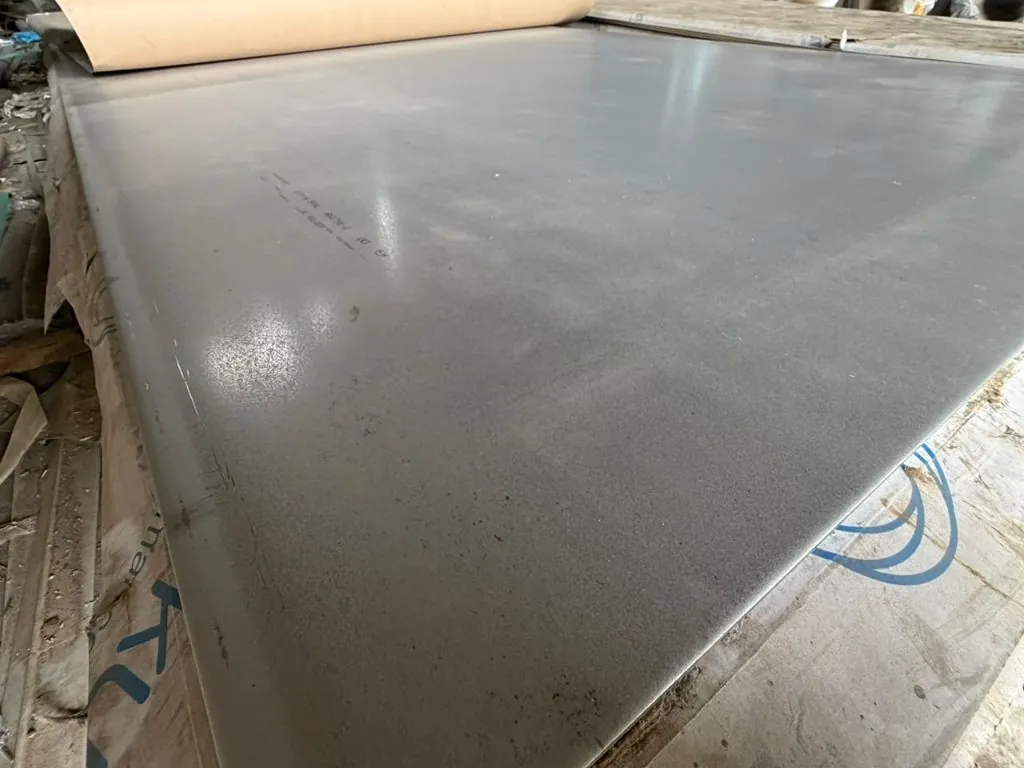
Key takeaways: 304 sheet at a glance
Designation: UNS S30400, Werkstoff 1.4301, JIS SUS304, AISI 304, the classic 18-8 austenitic chemistry (roughly 18% Cr, 8% Ni, no molybdenum).
Corrosion ceiling: with a PREN around 18, 304 sits at the bottom rung of the pitting-resistance ladder. It holds up fine against mild atmospheres, dry indoor air, and food contact. Chlorides and marine air are another matter entirely.
- Magnetic response: non-magnetic in the annealed condition, becoming slightly magnetic after cold work.
- Standard & finishes: flat product to ASTM A240 / ASME SA-240, stocked in 2B, BA, No.4 satin and No.8 mirror finishes.
- Step-up rule: choose 304L for welded heavy sections to avoid sensitization, and 316 the moment chlorides or coastal air appear.
- Traceability: genuine mill sheet with an EN 10204 3.1/3.2 mill test certificate provided with every order, ex-stock for immediate dispatch.
What is 304 stainless steel sheet?
304 remains the most widely used grade of austenitic stainless steel, part of the "18-8" family named for its roughly 18% chromium and 8% nickel. Chromium forms a passive oxide film that delivers the corrosion resistance; nickel stabilizes the austenitic, face-centered-cubic structure, and that's what makes the grade tough, formable and non-magnetic. In sheet form, this chemistry becomes the flat product a buyer reaches for first. It's cost-effective. It's available everywhere. And it's easy to fabricate.
304 sheet is built for general-purpose service, that broad middle ground of dry, mild, architectural and hygienic work where you need a corrosion-resistant stainless but the aggressive chlorides that call for a molybdenum-bearing grade aren't present. It comes out of the wider 304 grade range, which also covers plate and coil. When the job involves welding in heavy section, or exposure to chlorides, 304 is deliberately not the right choice. The sections below spell out exactly where that line falls.
Chemical composition
304 marks its identity with 18-8 chemistry, holding carbon at a ceiling of 0.08%. No molybdenum. That absence is precisely what caps its corrosion resistance and sets it apart from 316.
| Element | Symbol | Composition (wt%) |
|---|---|---|
| Carbon | C | ≤ 0.08 |
| Manganese | Mn | ≤ 2.00 |
| Silicon | Si | ≤ 0.75 |
| Phosphorus | P | ≤ 0.045 |
| Sulfur | S | ≤ 0.030 |
| Chromium | Cr | 18.0 – 20.0 |
| Nickel | Ni | 8.0 – 10.5 |
| Nitrogen | N | ≤ 0.10 |
| Iron | Fe | Balance |
Why 18-8: the role of chromium and nickel, and why there is no molybdenum
Chromium above about 10.5% is what makes steel "stainless." It builds the self-repairing passive film that resists oxidation and mild corrosion. Nickel converts the structure to austenite, which is where the ductility, weldability and formability come from, qualities that make 304 sheet so easy to work. 304 lacks one thing: molybdenum, the element that gives pitting resistance in chloride environments. That single omission explains why 304 costs less than 316 and why its PREN sits at the bottom of the ladder. The molybdenum in 316 is exactly what you're paying for when chlorides are in the picture.
Mechanical properties
Minimum room-temperature properties for annealed S30400 sheet to ASTM A240:
| Property | Minimum (metric) | Minimum (imperial) |
|---|---|---|
| Tensile strength | 515 MPa | 75 ksi |
| Yield strength (0.2% proof) | 205 MPa | 30 ksi |
| Elongation (in 50 mm) | 40% | 40% |
| Hardness | ≤ 201 HBW | ≤ 92 HRB |
304 work-hardens quite a bit during forming, so the measured strength in a cold-worked part can end up well above these annealed minima.
Physical properties
| Property | Value |
|---|---|
| Density | 8.00 g/cm³ |
| Melting range | ~1400 – 1455 °C |
| Thermal conductivity (100 °C) | ~16.2 W/m·K |
| Mean coefficient of thermal expansion (0–100 °C) | ~17.3 µm/m·°C |
| Elastic modulus | ~193–200 GPa |
| Specific heat (0–100 °C) | ~500 J/kg·K |
| Magnetic response | Non-magnetic annealed (µ ≈ 1.02); slightly magnetic cold-worked |
Is 304 magnetic?
In the solution-annealed condition, 304 is essentially non-magnetic because its structure is austenitic. Cold work changes that, rolling, deep drawing, bending, cutting, and some austenite shifts to martensite at the deformed edges, leaving the sheet weakly magnetic. So a magnet sticking lightly to a formed 304 part is normal. It doesn't mean you've got the wrong grade.
Corrosion behavior and PREN: what 304 resists and where it stops
304 shrugs off atmospheric corrosion, potable water, most organic and dilute mineral acids, and the gentle demands of food and architectural work. Chloride is where it falls apart. The pitting resistance equivalent number (PREN), worked out as Cr + 3.3·Mo + 16·N, lands at roughly 18 for 304. The molybdenum term is zero, which puts it at the bottom rung among the grades we stock. That's the honest limit of this grade, and it's what pushes every "step up" decision that follows.
Pitting and chlorides
With PREN at about 18, 304 is susceptible to pitting corrosion anywhere chlorides concentrate: splash zones, salt-laden air, de-icing salts, chlorinated wash-downs. Pits start where the passive film breaks down in one spot, and they can punch through a thin sheet far quicker than general corrosion would. If the service water or atmosphere carries meaningful chloride, 304 isn't the right default. 316 sheet is the correct specification.
Chloride stress-corrosion cracking
Like all austenitic grades, 304 is vulnerable to chloride stress-corrosion cracking. Tensile stress, chlorides, and temperature (typically above roughly 60 °C) combine to produce sudden branching cracks, often with little warning. Swimming-pool halls and heated process liquors are classic failure settings for 304 because they run hot and chloride-rich. These situations call for a duplex or higher-nickel grade instead of a standard austenitic.
Sensitization and intergranular corrosion
Holding 304 in the 425–815 °C range, as happens in the heat-affected zone of a weld on thick section, lets chromium carbides precipitate at grain boundaries, depleting the adjacent chromium and leaving the steel prone to sensitization / intergranular corrosion. The fix is either the low-carbon variant 304L (C ≤ 0.03%), which starves the reaction of carbon, or solution annealing after welding followed by a rapid quench. For welded heavy sections, specify 304L from the start.
Does 304 rust? Is it food-safe?
304 doesn't rust under normal dry, indoor, or clean-water conditions. Surface staining usually comes from embedded carbon-steel particles or trapped chlorides rather than the stainless itself, and passivation restores the film.
It's fully food-safe, too. The inert passive layer and easy-clean surface make it a standard choice for kitchen, dairy, and food-contact equipment.
Equivalent grades and designations
| System | Designation |
|---|---|
| UNS | S30400 |
| Werkstoff (W.-Nr.) | 1.4301 |
| JIS | SUS304 |
| EN name | X5CrNi18-10 |
| BS | 304S31 |
| AISI | 304 |
| GB | 06Cr19Ni10 |
| Common name | 18-8 |
For a full set of designations across standards, see the UNS / Werkstoff / JIS cross-reference.
304 sheet vs the alternatives: when to choose it (and when not)
304 is the right call when the setting is dry, mild, indoor, architectural or food-grade, and when cost and availability actually matter. The moment chlorides, marine air or heavy welded sections show up, it stops being a good fit. The summary below lays out the decision. Each comparison gets its own detailed page.
| Attribute | 304 (S30400) | 304L (S30403) | 316 (S31600) |
|---|---|---|---|
| Carbon (max) | 0.08% | 0.03% | 0.08% |
| Molybdenum | None | None | 2–3% |
| PREN (approx.) | ~18 | ~18 | ~24 |
| Sensitization risk (welded) | Higher | Low | Higher |
| Chloride suitability | Poor | Poor | Better |
| Relative cost | Lowest | Low | Higher |
| Choose when | Dry/mild/food, general fab | Welded heavy section | Chlorides, marine, hot wash-down |
304 vs 304L
304 and 304L share the same 18-8 chemistry; carbon content is the only difference. 304 vs 304L really comes down to a sensitization call. 304L's carbon, capped at 0.03%, keeps the weld heat-affected zone resistant to corrosion without needing post-weld annealing. You give up a bit of annealed strength for that. Thin sheet that gets a light weld, or none at all, does fine in standard 304. Welded heavy section is where 304L earns its keep.
304 vs 316
304 vs 316 is where chloride and marine exposure settle the question. The 2–3% molybdenum in 316 pushes its PREN from roughly 18 up to about 24, which is what gives it the pitting and crevice resistance that 304 simply doesn't have. Coastal structures, chlorinated water, de-icing-salt exposure, most chemical-contact duty: all of that calls for 316. Reserve 304 for service that's truly free of chlorides.
304 vs 430 and 202
Buyers weighing 304 against cheaper substitutes should understand what they're giving up. 430 is a ferritic grade with no nickel in it. It's magnetic, harder to form, and less resistant to corrosion, so it belongs in dry indoor trim rather than anything demanding. Then there's 202, an austenitic grade that swaps in manganese to cut nickel content and lower cost. It falls short of 304 on corrosion resistance and can struggle in humid or mildly aggressive conditions. When you need predictable 18-8 performance, 304 is still the benchmark.
Forms, sizes and thickness ranges
304 is available as sheet, plate and coil. Sheet is the thin-gauge product with a finished surface, rolled flat. Commonly supplied sheet dimensions:
| Parameter | Typical range |
|---|---|
| Thickness | ~0.4 mm to 6.0 mm (sheet gauge) |
| Widths | 1000, 1219, 1250, 1500 mm |
| Lengths | 2000, 2438 (8 ft), 2500, 3000 mm |
| Common plate-size equivalent | 4 × 8 ft (1219 × 2438 mm), 1250 × 2500 mm |
| Finishes | 2B, 2D, BA, No.4, No.8 |
Cut-to-size service ships straight from stock. Need material above sheet gauge, or something in continuous form? That's covered in the sibling nodes below.
Other 304 forms
- 304 plate, heavier flat product for structural and pressure applications.
- 304 coil, continuous feedstock for roll-forming and blanking lines.
- 304L sheet, the low-carbon sibling for welded fabrications.
Sheet weight and how to calculate
304 sheet weight follows directly from its 8.00 g/cm³ density. For practical estimating, just use a density factor of 8.0:
- Weight per square meter (kg/m²) = thickness (mm) × 8.0
- Weight per sheet (kg) = thickness (mm) × width (m) × length (m) × 8.0
Worked example, a 1.5 mm × 1220 mm × 2440 mm sheet: 1.5 × 1.22 × 2.44 × 8.0 ≈ 35.7 kg.
| Thickness (mm) | Weight per m² (kg) | Weight of 1219 × 2438 mm sheet (kg) |
|---|---|---|
| 1.0 | 8.0 | ~23.8 |
| 1.5 | 12.0 | ~35.7 |
| 2.0 | 16.0 | ~47.6 |
| 3.0 | 24.0 | ~71.4 |
For other sizes and grades, check the stainless steel weight chart or try the weight calculator.
Surface finishes for 304 sheet
Finish selection matters most in sheet specification, since the surface drives both appearance and cleanability. The common 304 sheet finishes:
| Finish | Description | Typical use |
|---|---|---|
| 2B | Cold-rolled, annealed, pickled, lightly skin-passed, smooth, slightly reflective | General fabrication, process equipment, the default mill finish |
| 2D | Cold-rolled, annealed, pickled, dull matte | Where a non-reflective base is needed before further finishing |
| BA (bright annealed) | Bright, mirror-like finish from annealing in a controlled atmosphere | Appliances, reflectors, decorative panels |
| No.4 | Satin / brushed directional grain | Kitchens, food and dairy equipment, architectural cladding |
| No.8 | Polished mirror finish | Decorative mirror panels, high-end architectural features |
Match the finish to the job at hand. No.4 satin works well for hygienic and architectural surfaces that need easy cleaning. No.8 mirror suits decorative applications. For general fabrication where looks don't matter much, 2B does the job. You'll find more detail in the guide to 2B, BA and No.4 finishes.
Standards and specifications complied
304 sheet is supplied as chromium-nickel austenitic flat product to ASTM A240 and its ASME pressure-equipment equivalent ASME SA-240, which fix the composition and mechanical requirements for S30400 plate, sheet and strip. These are the controlling specifications cited on the mill test certificate for every sheet we supply.
Testing, inspection and certification
Every order is dispatched with an EN 10204 3.1 mill test certificate, a 3.1 or 3.2 mill test certificate provided with every order, that reports the heat chemistry, mechanical results and the controlling specification, with full heat and cast traceability. On request we can confirm grade by positive material identification (PMI), supply intergranular corrosion testing per ASTM A262, and provide dimensional and finish inspection. See our overview of MTC, NDT and PMI testing.
Applications of 304 sheet by industry
304 sheet is the general-purpose stainless for environments without significant chlorides:
- Food & dairy and beverage, tanks, hoppers, benches and enclosures where a No.4 or BA surface gives an inert, easy-clean food-contact face.
- Architectural / decorative, cladding, balustrades, signage and interior panels, typically in No.4 satin or No.8 mirror finish.
- General fabrication, enclosures, brackets, trim and light structural work where corrosion resistance and formability matter but the duty is mild.
- Process and chemical equipment, non-chloride service such as dry gas handling, organic chemicals and dilute acids within 304's range.
Welding and fabrication of 304 sheet
304 sheet welds readily by TIG, MIG and resistance methods using matching austenitic filler, ER308 or ER308L, where the low-carbon 308L filler guards the weld metal against sensitization. On thick welded section, protect the parent metal too by using 304L or by solution annealing after welding; our guide to how to weld 304 covers the practical limits. Because 304 work-hardens, use sharp tooling, adequate power and generous bend radii when forming, and plan for springback on brake-formed parts.
Price and how we quote
We quote by RFQ for live pricing only. There are no fixed price tables, since stainless pricing shifts with alloy surcharges, finish, thickness and quantity (No.4 and No.8 finishes cost more than 2B). Send us your grade, finish, thickness, sizes and quantity, and we'll get you a current quotation. All 304 sheet is held ex-stock for immediate dispatch. Request a quote.
FAQ
Is 304 stainless steel sheet magnetic?
Does 304 stainless steel sheet rust?
Is 304 stainless steel sheet food-safe?
304 vs 316 sheet, which do I need?
What thickness does 304 sheet come in?
Is 304 stainless steel sheet weldable?
Related grades to cross-shop
Part of our steel sheet range and all stainless steel sheet grades.