
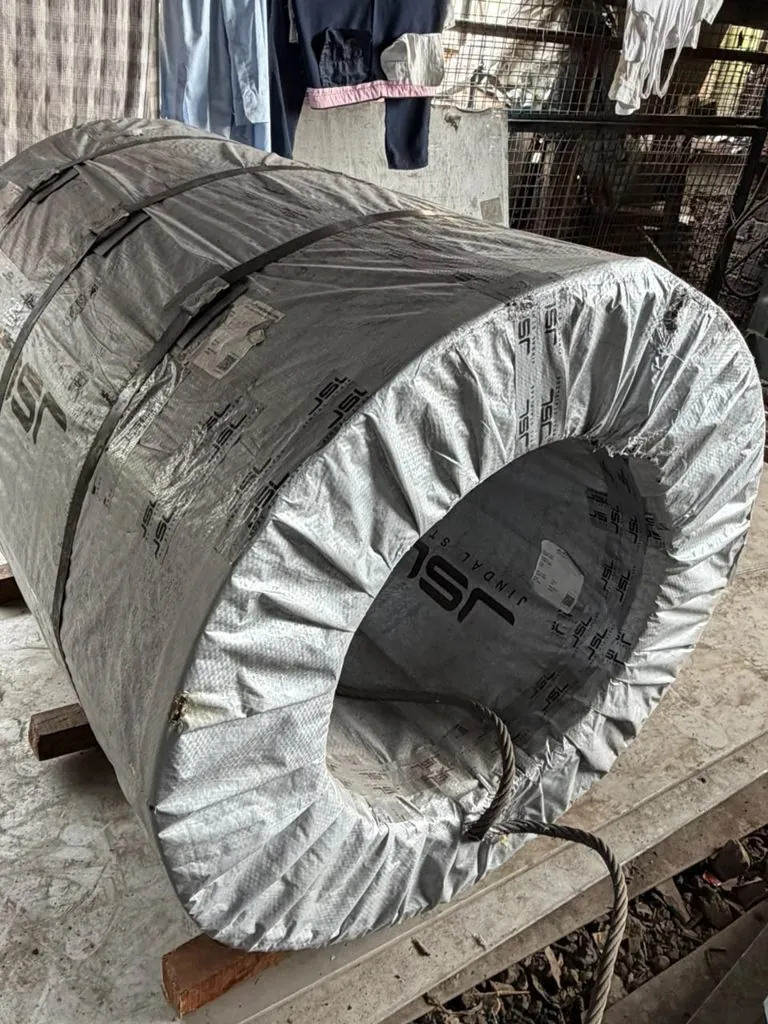
Nandini Steel is an ISO 9001:2015-certified stockist and supplier, with 904L held as a third-party-certified specialty. All 904L coil ships ex-stock for immediate dispatch, sourced from genuine mill material, and every order comes with an EN 10204 3.1/3.2 mill test certificate.
Key takeaways: 904L coil at a glance
- Grade / form: UNS N08904 (Werkstoff 1.4539), super-austenitic stainless steel, supplied as continuous cold-rolled coil and slit strip.
- Finishes: mill-annealed 2B and BA (bright annealed) on cold-rolled coil; No.1 on hot-rolled gauges.
- Corrosion: copper-bearing chemistry gives this alloy its signature sulfuric-acid resistance; a PREN of roughly 34 holds off chloride pitting and crevice attack.
- Versus 316L: nickel content runs about 25% higher, which pushes up the chloride stress-corrosion-cracking threshold, so 904L outperforms 316L in hot chloride service.
- Standards & proof: conforms to ASTM A240 / ASME SA-240 (ASTM A480 general requirements); every coil carries heat/cast traceability and a 3.1/3.2 MTC.
What is 904L stainless steel coil?
904L is a highly alloyed super-austenitic stainless steel developed for reducing acids and aggressive chloride media. Its name is misleading, the high nickel and molybdenum content place it well above the standard 300-series austenitics, closer to the nickel-alloy end of the family. The grade is defined by UNS N08904 and Werkstoff 1.4539, and this coil leaf belongs to the wider 904L grade hub.
"Coil" is the continuous flat-product form: the strip gets cold- or hot-rolled, mill-annealed, and wound into coils rather than cut into discrete sheets. This is the feedstock a fabricator spools onto a slitting line, roll-former, or tube mill. You'd choose 904L coil over a nickel-base alloy that would be over-specified, or over 316L once it's hit its limit, when sulfuric acid or chlorides call for that copper-bearing ~4.5% Mo chemistry in a continuous length.
Coil vs sheet vs plate: which 904L form do you need?
Coil, sheet and plate aren't just different sizes; they're different sourcing decisions. Coil is continuous flat product, the go-to for high-volume cut-to-length work, slitting, roll-forming and tube/pipe manufacture. Sheet comes as discrete cut lengths, suited to panel and tank work. Plate is hot-rolled heavy gauge, meant for pressure parts and machined components. For the full trade-off, see our sheet vs plate vs coil guide.
| Form | Typical use | 904L leaf |
|---|---|---|
| Coil / slit strip | Feedstock for slitting, roll-forming, tube mills, high-volume blanking | This page |
| Sheet | Cut-length panels, tank walls, linings | 904L sheet |
| Plate | Heavy-gauge pressure and structural parts | 904L plate |
Choose coil over plate when your line eats continuous material or needs slit-to-width strip. Step down to sheet if you only need a handful of cut blanks.
Chemical composition
904L carries extra-low carbon, C ≤ 0.02%, and that holds down carbide precipitation and sensitization during welding and forming. The ranges below follow UNS N08904 / ASTM A240 (wt%).
| Element | Min % | Max % |
|---|---|---|
| Carbon (C) | – | 0.020 |
| Chromium (Cr) | 19.0 | 23.0 |
| Nickel (Ni) | 23.0 | 28.0 |
| Molybdenum (Mo) | 4.0 | 5.0 |
| Copper (Cu) | 1.0 | 2.0 |
| Manganese (Mn) | – | 2.0 |
| Silicon (Si) | – | 1.0 |
| Phosphorus (P) | – | 0.045 |
| Sulfur (S) | – | 0.035 |
| Iron (Fe) | Balance | |
The role of copper and molybdenum
The ~4.5% molybdenum content is what gives 904L its edge over 316L in pitting and crevice resistance. The 1–2% copper addition, deliberately added, is what really sets 904L apart in reducing environments: it slows corrosion dramatically in sulfuric and phosphoric acid, conditions where chromium-only stainless steels simply get attacked. Nickel, at roughly 25%, stabilizes the austenite and boosts resistance to chloride stress-corrosion cracking.
Mechanical properties
Values for solution-annealed sheet/strip in coil form, per ASTM A240 minima.
| Property | Requirement |
|---|---|
| Tensile strength | ≥ 490 MPa (71 ksi) |
| Yield strength (0.2% offset) | ≥ 220 MPa (32 ksi) |
| Elongation (in 50 mm) | ≥ 35% |
| Hardness | ≤ 90 HRB |
904L work-hardens a fair amount during cold forming. Plan for springback, and build in interstage annealing on deep-drawn or heavily roll-formed parts. For how these minima translate to design, see mechanical properties explained.
Physical properties
Density drives coil-weight calculation; the figures below are nominal for N08904.
| Property | Value |
|---|---|
| Density | 7.95 g/cm³ |
| Melting range | ~1300–1390 °C |
| Thermal conductivity (20 °C) | ~11.5 W/m·K |
| Mean CTE (20–100 °C) | ~15.3 µm/m·°C |
| Elastic modulus | ~190 GPa |
| Magnetic response | Non-magnetic (austenitic) |
Corrosion behavior & PREN: why 904L coil exists
The grade margin is the whole reason to spool 904L instead of 316L. Spec 904L where chlorides, sulfuric acid, or both run past what a 2–3% Mo stainless like 316 can handle.
Sulfuric-acid resistance
904L holds up against sulfuric acid and other reducing acids across a wide band of concentration and temperature, thanks to its copper and molybdenum content. That's the service window that justifies choosing it over 316L in acid plants, pickling lines, and acid-regeneration duty. Check your actual acid concentration and temperature against the 904L iso-corrosion limits; see sulfuric-acid resistance.
Pitting, crevice & PREN ~34
PREN, the pitting resistance equivalent number, scores an alloy's ability to resist chloride pitting and crevice attack based on its chromium, molybdenum and nitrogen content. 904L comes in around PREN 34, well above 316's roughly 24. That gap explains why 904L holds up in chloride-bearing process streams where 316L pits. For more detail, see PREN, along with how pitting and crevice corrosion actually work.
Chloride stress-corrosion cracking
Standard austenitics are susceptible to chloride stress-corrosion cracking once temperature, stress and chloride coincide. The ~25% nickel in 904L raises the SCC threshold, so it outperforms 316L in hot chloride environments, a common upgrade driver for heat-exchanger strip and liner coil.
Equivalent grades & designations
| System | Designation |
|---|---|
| UNS | N08904 |
| Werkstoff (W.-Nr.) | 1.4539 |
| EN | X1NiCrMoCu25-20-5 |
| BS | 904S13 |
| AISI | 904L |
See the full UNS / Werkstoff cross-reference for mapping across systems.
904L coil vs the alternatives: when to choose it
904L sits in a clear spot on the corrosion-resistance ladder. It beats 316L, matches duplex 2205 roughly on pitting resistance, and falls short of the 6-Mo and super-duplex grades.
| Grade | PREN (approx.) | Choose when |
|---|---|---|
| 316 / 316L | ~24 | Moderate chlorides; no reducing-acid duty |
| 904L | ~34 | Sulfuric/reducing acids + chlorides beyond 316L |
| Duplex 2205 | ~35 | High strength + chloride SCC resistance, lower nickel cost |
| Alloy 20 / 254 SMO | ~34–43 | More aggressive hot acids / seawater; genuine 6-Mo need |
vs 316L
316L costs less and forms more easily, but it pits and stress-corrodes once chlorides start concentrating, and it does almost nothing against reducing acids. When service conditions push past 316L's pitting or acid limit, move up to 904L, see the full 904L vs 316L comparison for details.
vs duplex 2205
Duplex 2205 matches 904L on PREN and comes close to doubling its yield strength, all at a lower nickel cost. Still, 904L's copper content and fully austenitic structure make it the stronger choice for concentrated sulfuric service and complex cold forming. For the full breakdown, see 904L vs duplex 2205.
vs 316, Alloy 20 and 254 SMO: the upgrade ladder
Reaching for Alloy 20, Inconel 625 or titanium for sulfuric or high-chloride duty is a common mistake, and an expensive one, 904L already handles plenty of that work for less. Check the concentration and temperature against 904L's limits before you pay for the upgrade. On the flip side, don't under-spec 904L when the job genuinely calls for a 6-Mo grade like 254 SMO or a super-duplex. The grade selector and how to select a stainless grade can help you land on the right choice.
Coil dimensions: gauge, width & slitting
904L comes in as cold-rolled coil and gets supplied slit-to-width as strip. Exact gauge, coil width and slit widths get confirmed per order against live stock. All 904L ships ex-stock, so available ranges and slitting get confirmed at RFQ.
| Parameter | Supplied as |
|---|---|
| Form | Cold-rolled coil; hot-rolled coil (heavier gauge) |
| Strip | Slit-to-width from master coil |
| Finish | 2B, BA (cold-rolled); No.1 (hot-rolled) |
| Traceability | Heat/cast number carried per coil through slitting |
Other 904L forms
Need discrete lengths or heavy gauge instead? Check out 904L sheet and 904L plate, or head back to the 904L grade hub.
Coil finishes: 2B, BA & No.1
Finish gets picked based on the downstream process and the service environment. A smoother surface resists fouling and cleans up more easily in hygienic duty.
| Finish | Description | Typical use |
|---|---|---|
| 2B | Cold-rolled, annealed, pickled, skin-passed, standard smooth matte | General fabrication, forming, most process equipment |
| BA | Bright annealed, reflective cold-rolled finish | Hygienic/pharma, decorative, low-fouling surfaces |
| No.1 | Hot-rolled, annealed and pickled, thicker gauges | Heavy-gauge coil where surface is non-critical |
For how these grades of surface finish come about, and how you pick between them, see 2B, BA & No.4 finishes.
Coil weight & how to calculate
Flat-length coil mass comes straight out of the dimensions, combined with 904L's density of 7.95 g/cm³:
Mass in kilograms equals thickness in millimeters times width in meters times length in meters times 7.95.
Worked example: a 2.0 mm × 1.0 m strip, 500 m long, gives 2.0 × 1.0 × 500 × 7.95 = 7,950 kg.
To estimate length from a wound coil, work out the outer and inner diameter and the gauge, then plug those into the formula above. If you need quick checks across gauges and widths, the coil weight calculator handles that. The underlying method is laid out in how to calculate steel plate weight, and gauge selection gets its own treatment in how to choose plate thickness.
Standards & specifications complied
904L coil and strip conform to ASTM A240 and its pressure-equipment twin ASME SA-240 for chemical and mechanical requirements, with ASTM A480 covering general requirements, dimensional tolerances and finish for flat-rolled product. Coil standards for the grade fall under the A240/B-series flat-product family.
Testing, inspection & certification
Every 904L coil ships with an EN 10204 3.1/3.2 mill test certificate provided with every order, reporting heat chemistry and mechanical results against ASTM A240. The material itself is genuine mill coil, sourced from producers like Aperam, Outokumpu, Jindal, POSCO, Nippon Steel and JFE. Intergranular corrosion can be verified to ASTM A262. PMI confirms the grade on receipt, and the heat/cast number travels with each coil through slitting, so traceability holds all the way to the finished part. For more detail, see the EN 10204 3.1 mill test certificate, material traceability and testing, MTC, NDT & PMI pages; the how to read a mill test certificate guide walks through each field.
Applications of 904L coil by industry
904L coil and slit strip get specified wherever reducing acids and chlorides meet.
- Chemical / acid processing, sulfuric and phosphoric acid equipment, along with pickling and acid-regeneration lines.
- Pharmaceutical, hygienic process surfaces in BA finish.
- Pulp & paper bleaching, chloride-rich bleach plant equipment.
- Fertilizer / acid-regeneration service, phosphoric and mixed-acid duty.
- Oil & gas, chloride-bearing process streams and heat-exchanger strip.
FGD and scrubber liner strip comes up constantly as a coil application, and standard austenitics are out of the question there, since chlorides and acidic condensate combine to rule them out.
Welding & fabrication of 904L coil/strip
904L gets welded with over-alloyed filler, either ER385 (904L) or a nickel-base consumable such as FM 625, to hold corrosion resistance across the weld and offset elemental dilution. Keep heat input and interpass temperature under control, and don't let the material sit in the 425–815 °C sensitization range. The extra-low carbon content resists intergranular sensitization. Full corrosion resistance after heavy forming only comes back through solution annealing at roughly 1070–1150 °C, followed by a rapid quench. 904L work-hardens, so plan on interstage anneals for parts that see severe forming. For the full procedure, see how to weld 904L.
How we quote
We quote 904L coil on RFQ for live pricing only. There are no fixed price tables, since super-austenitic coil cost tracks nickel, molybdenum and copper. Send your gauge, width, finish, slit requirement and tonnage, and we'll respond with current pricing against ex-stock material for immediate dispatch, with the 3.1/3.2 MTC included.
FAQ
Is 904L coil good for sulfuric acid?
What is the difference between 904L coil, sheet and plate?
How does 904L coil compare with 316L?
What finishes are available on 904L coil?
What filler is used to weld 904L strip?
Do you supply a mill test certificate with 904L coil?
Request a quote from Nandini Steel, based at 25, Dreamland Building, 601, 6th Floor, Mama Parmanand Marg, Charni Road, Opera House, Girgaon, Mumbai, Maharashtra 400004, India. Call +91 22 43404600 or +91 99202 09184, send a WhatsApp to +91 99202 09184, or email reachus@nandinisteel.com. The company's ISO 9001:2015 certification (Cert. No. 1283438, issued by Unitas Certification Services UCS-UK) runs through 11 January 2028. GSTIN: 27ADJPA7240C1Z0. 904L is a third-party-certified specialty here. The numbers back it up: 307+ projects, 260+ clients, 36+ export countries, and 20+ years in business since 2003. Every coil of 904L sits ex-stock, ready to ship at once, with EN 10204 3.1/3.2 MTC included.
Related grades to cross-shop
Part of our steel coil range and all stainless steel coil grades.