
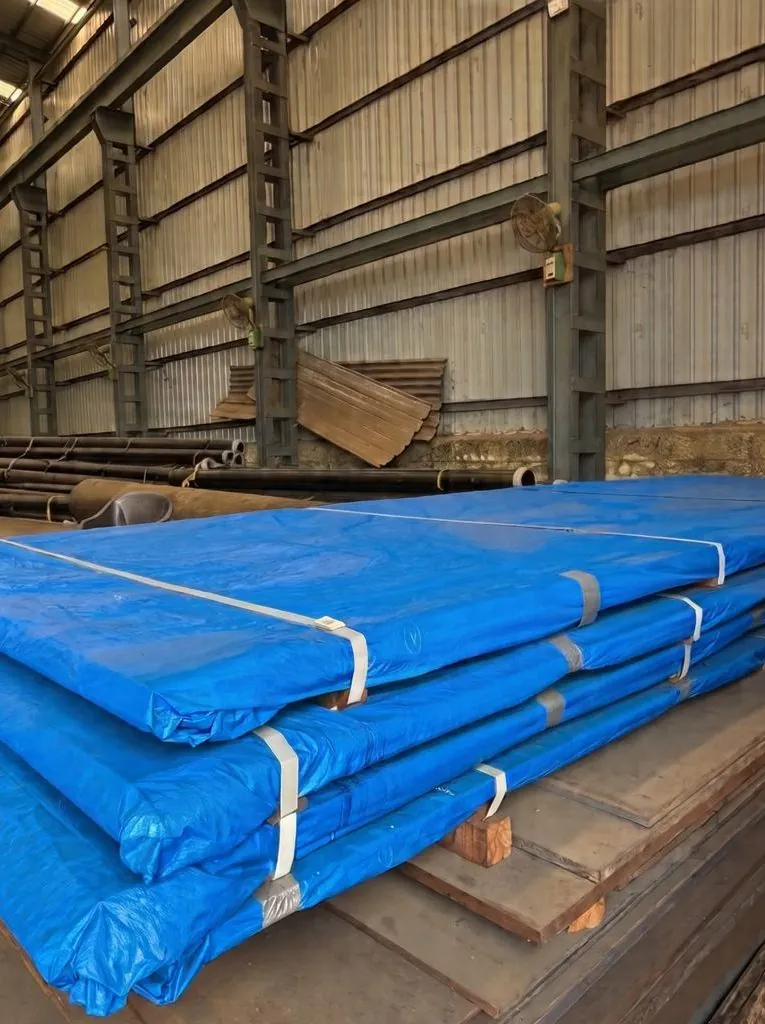
How grade is chosen for a vessel or boiler
Grade selection for a pressure vessel follows the service, not habit. Three questions decide it: what is the design temperature, how corrosive is the contained medium, and is the vessel exposed to wet H2S (sour service). Carbon steel PVQ plate like A516 Grade 70 handles clean water, steam, air and hydrocarbons at moderate temperature at the lowest installed cost. The moment chlorides, acids or elevated temperature enter the picture, the shell moves to a stainless or nickel-alloy clad or solid plate.
The table below maps common vessel duties to the grade Nandini Steel supplies ex-stock.
| Service / duty | Typical grade | Standard | Why |
|---|---|---|---|
| Steam drums, air receivers, hydrocarbon storage, separators | A516 Gr 70 | ASTM A516 / ASME SA-516 | PVQ carbon steel, good weldability and notch toughness |
| Low-temperature vessels (below 0 °C) | A516 Gr 70 normalized | ASTM A516 + ASTM A20 | Charpy impact at design temperature after normalizing |
| Wet H2S / sour-gas separators and drums | A516 Gr 70 HIC-tested | NACE MR0175 / ISO 15156 | Resists hydrogen-induced cracking |
| Mildly corrosive process, food, water treatment | 304 / 304L | ASTM A240 / ASME SA-240 | Austenitic stainless, general corrosion resistance |
| Chloride or acid-bearing process streams | 316 / 316L | ASTM A240 / ASME SA-240 | 2 to 3% molybdenum lifts pitting resistance |
| Sulfuric acid, high chloride, FGD scrubber vessels | 904L | ASTM A240 / ASME SA-240 | Super-austenitic, PREN ~34, copper for acid resistance |
| Sour and mixed-acid duty, reducing and oxidizing media | Incoloy 825 | ASTM B424 / ASME SB-424 | Ni-Fe-Cr alloy, NACE-qualified for sour service |
| Elevated-temperature hydrogen / refinery service | SA387 Gr 11 / 22 | ASTM A387 | Chrome-moly plate for high-temperature strength |
A516 Grade 70: the default pressure-vessel plate
A516 Grade 70 is the workhorse PVQ (pressure-vessel-quality) carbon steel plate. It belongs to the ASTM A516 / ASME SA-516 specification, governed by the general requirements of ASTM A20, and it is prized for a balance of strength, weldability and notch toughness that suits code-stamped shells, heads and nozzles.
Two things buyers commonly under-specify. First, impact testing: for low-temperature vessels you need normalized plate with Charpy values verified at the design temperature, not as-rolled plate. Second, sour service: where the vessel sees wet H2S, call out the HIC-tested variant per NACE TM0284 rather than plain Grade 70. State the plate thickness up front, because the mechanical minimums and the normalizing requirement both vary with section.
| Property | A516 Gr 60 | A516 Gr 70 |
|---|---|---|
| Family | PVQ carbon steel | PVQ carbon steel |
| Tensile strength | 415–550 MPa | 485–620 MPa |
| Yield strength (min) | 220 MPa | 260 MPa |
| Standard | ASTM A516 / ASME SA-516 | ASTM A516 / ASME SA-516 |
| Low-temperature toughness | Improved by normalizing | Improved by normalizing |
Nandini Steel keeps A516 Gr 70 plate, the normalized plate and the NACE HIC-tested plate in stock, along with the A516 Gr 60 plate for lighter duty. For the full ordering walk-through, see our guide on how to specify A516 for a vessel and the background on pressure-vessel steel.
SA-240 stainless for corrosive service
When the medium attacks carbon steel, the shell (or an internal cladding) moves to austenitic stainless under ASTM A240 / ASME SA-240. The step from 304 to 316 to 904L is a step up the pitting-resistance ladder, and the right rung depends on the chloride concentration, acid type and temperature your vessel will actually see.
| Grade | Family | Key composition | PREN (approx.) | Best vessel use |
|---|---|---|---|---|
| 304 / 304L | Austenitic SS | 18Cr-8Ni | ~18 | Mild process, water, food, low chloride |
| 316 / 316L | Austenitic SS | 16Cr-10Ni-2/3Mo | ~24 | Chloride and acid-bearing streams |
| 904L | Super-austenitic SS | ~25Ni-4.5Mo-1.5Cu | ~34 | Sulfuric acid, high chloride, FGD |
| Incoloy 825 | Ni-Fe-Cr alloy | 38–46Ni-3Mo-Cu-Ti | ~31–40 | Sour and mixed-acid duty |
A few selection notes worth carrying into the purchase order:
Choose the L grade for welded shells
All vessel work is welded, and welding holds the heat-affected zone in the 425–815 °C range where chromium carbides precipitate and sensitize the steel, causing intergranular (weld-decay) attack. Specifying the low-carbon L grade (C ≤ 0.03%), such as 304L or 316L, prevents sensitization without a post-weld solution anneal. See our notes on how to prevent sensitization and intergranular corrosion.
Do not over-pay, and do not under-spec
Buyers often pay for 316 where dry, indoor, non-chloride 304 would serve, or under-spec 316 for hot concentrated chlorides where 904L is really needed. The molybdenum is what you are buying, so match it to the real pitting risk. Where sulfuric acid or high chloride is involved, 904L's copper-bearing chemistry often covers the duty at lower cost than Alloy 20, 625 or titanium. The 304L vs 316L comparison and 904L vs 316L comparison help place the decision, and PREN explained explains the pitting ladder.
Stainless plate for vessels is available as 304 plate, 304L plate, 316 plate, 316L plate and 904L plate, with nickel-alloy options in Incoloy 825 plate and Inconel 625 plate.
Sour service and high-temperature duty
Two services deserve a dedicated spec line. For wet H2S (sour) vessels, the carbon steel must resist hydrogen-induced cracking: order A516 Gr 70 HIC-tested per NACE TM0284 and qualify the heat to NACE MR0175 / ISO 15156. The full background sits in our sour-service guide. Incoloy 825 is the common nickel-alloy upgrade where sour gas is combined with reducing and oxidizing acids.
For elevated-temperature refinery and hydrogen service, chrome-moly plate carries the load that plain carbon steel cannot. Nandini Steel stocks SA387 Grade 11 and 22 chrome-moly pressure-vessel plate under ASTM A387.
Standards that govern vessel materials
| Standard | Scope |
|---|---|
| ASTM A516 / ASME SA-516 | Carbon steel plate for pressure vessels (A516 Gr 60/70) |
| ASTM A20 | General requirements for pressure-vessel plate, the umbrella over A516 |
| ASTM A240 / ASME SA-240 | Stainless plate, sheet and strip for vessels |
| ASTM A387 | Chrome-moly alloy plate for elevated-temperature vessels |
| ASTM A479 | Stainless bar for boilers and pressure vessels |
| EN 10204 | 3.1 / 3.2 mill test certificate, supplied with every order |
For connecting components, the vessel will also call on ASTM A182 forged flanges and fittings and ASME B16.5 pipe flanges. Our grade selector and the primer on boiler-quality plate explained support the wider material take-off.
Why buy vessel plate from Nandini Steel
Nandini Steel is an ISO 9001:2015-certified stockist and supplier established in 2003, serving 260+ clients across 307+ projects and 36+ export countries. Every order ships ex-stock for immediate dispatch and carries an EN 10204 3.1 or 3.2 mill test certificate for full traceability. The company is a certified specialist in 904L, Alloy 28, Incoloy 800 and Hastelloy plate, with genuine mill material and third-party inspection available on request.
Frequently asked questions
What grade of steel is used for pressure vessels?
What is the difference between A516 Grade 60 and Grade 70?
When do I need normalized A516 plate?
Which stainless grade resists chlorides best in a vessel?
Do you provide mill test certificates for vessel plate?
Request a quote
Tell us the design temperature, pressure, service medium and plate thickness, and the Nandini Steel Engineering Team will recommend the grade and condition and quote live pricing from ex-stock. Reach us at reachus@nandinisteel.com, call +91 22 43404600, or message WhatsApp +91 99202 09184. Visit our contact page to start an RFQ.