
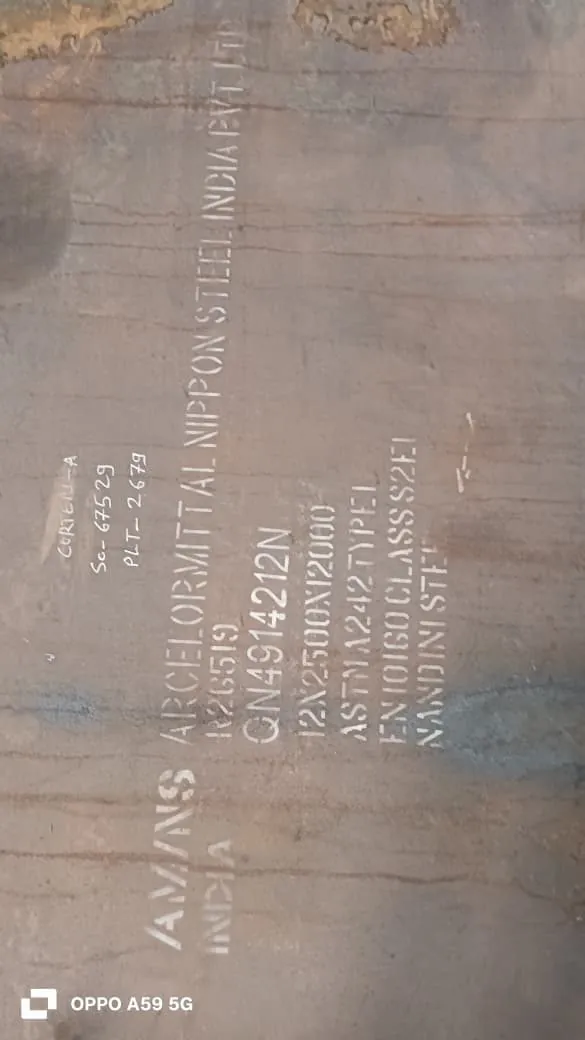
What ASTM A387 Covers
ASTM A387 ("Standard Specification for Pressure Vessel Plates, Alloy Steel, Chromium-Molybdenum") defines the chemistry, heat treatment, and mechanical properties of Cr-Mo alloy steel plate intended for welded boilers and pressure vessels in high-temperature and creep service. The chromium gives oxidation and sulfidation resistance, while molybdenum raises creep strength and resistance to hydrogen attack. That combination is why A387 plate is the default material for refinery reactors, hydrocrackers, catalytic reformers, boiler drums, and steam headers where carbon plate such as A516 Gr 70 would lose strength or scale.
A387 is a plate specification. Its chemistry twins run through the companion product standards: seamless ferritic chrome-moly pipe falls under ASTM A335, forged flanges and fittings under ASTM A182, and wrought buttweld fittings under ASTM A234. On the ASME side the plate is ordered as SA387, documented on our SA387 Grade 11 and 22 hub and the broader SA387 overview.
A387 Grades and Nominal Chemistry
Each A387 grade is named for its approximate chromium and molybdenum content. Higher chromium shifts the plate toward hotter, more sulfur-bearing and more hydrogen-aggressive duty.
| A387 Grade | Nominal Cr | Nominal Mo | Typical service |
|---|---|---|---|
| Grade 11 | 1.25% | 0.5% | Boilers, hydrotreaters, moderate temperature and hydrogen duty |
| Grade 12 | 1.0% | 0.5% | General elevated-temperature vessels and piping drums |
| Grade 22 | 2.25% | 1.0% | Hydrocracker and hydrotreater reactors, higher hydrogen partial pressure |
| Grade 5 | 5.0% | 0.5% | Refinery heater and sulfidation-exposed components |
| Grade 9 | 9.0% | 1.0% | High-temperature, high-sulfur service |
| Grade 91 | 9.0% | 1.0% + V, Nb, N | High-temperature steam headers and creep-critical power plant work |
Grade 11 and Grade 22 are the two workhorses and the grades we carry in depth. Grade 91 is a modified 9Cr steel micro-alloyed with vanadium, niobium, and nitrogen for the highest creep strength in supercritical steam service, and it demands tightly controlled normalizing and tempering.
Class 1 and Class 2
Every A387 grade is ordered in one of two classes, which set the heat treatment and therefore the strength level. Getting the class right on the purchase order matters as much as the grade, because the two classes are not interchangeable in a vessel design calculation.
| Class | Condition | Relative strength | When to specify |
|---|---|---|---|
| Class 1 | Annealed, or normalized and tempered to the lower range | Lower tensile and yield | Better formability and weldability where design stress is modest |
| Class 2 | Normalized and tempered (or quenched and tempered) to the higher range | Higher tensile and yield | Thinner, lighter vessel walls at a given design pressure |
Why Chrome-Moly Instead of Carbon Plate
Below roughly 400 to 450 °C a normalized carbon plate such as A516 Grade 70 is the economical choice. Above that, carbon steel loses allowable stress quickly, graphitizes, and is attacked by hydrogen. A387 chrome-moly plate holds its creep strength at temperature and resists high-temperature hydrogen attack, which is why it dominates refinery and petrochemical reactor construction. For the full carbon-versus-alloy decision, see our guide on carbon, stainless, and alloy steel and the broader pressure-vessel steel explainer.
Like all pressure-vessel plate, A387 is supplied against the general-requirements umbrella of ASTM A20, which governs testing frequency, tolerances, marking, and certification, the same framework that sits over ASTM A516 carbon plate.
Welding, Heat Treatment, and Fabrication
Chrome-moly steels are air-hardening, so they need preheat, controlled interpass temperature, and post-weld heat treatment to produce a tough, crack-free weld. Grade 22 and Grade 91 are more demanding than Grade 11 and call for careful matching filler metal and strict PWHT control. Normalizing and tempering develop the grain structure and mechanical properties that the class requires; our note on normalizing PVQ plate explains the principle, and the how to specify A516 for a vessel guide walks through the parallel spec discipline for carbon plate. For companion high-temperature bolting, order to ASTM A193 / A194.
Where A387 Plate Is Used
A387 plate goes into the heaviest elevated-temperature equipment in refining, petrochemicals, and power generation.
- Pressure vessels and boilers: reactor shells, boiler drums, steam separators.
- Petrochemical plant: hydrocrackers, hydrotreaters, reformers operating under hydrogen.
- Oil and gas: heat exchangers and process vessels in refinery service.
Ordering, Certification, and Stock
Every A387 plate we dispatch ships with an EN 10204 3.1 or 3.2 mill test certificate, so the heat chemistry, mechanical results, and heat-treatment condition are fully traceable. Learn how to read one in our mill test certificate guide and the EN 10204 standard page. All A387 plate is held ex-stock for immediate dispatch, and you can size a plate quickly with our steel plate weight calculator.
Nandini Steel has supplied corrosion-resistant and pressure-vessel steel since 2003, is certified to ISO 9001:2015 (Certificate 1283438, Unitas Certification Services UCS-UK, valid to 11 January 2028), and has delivered 307+ projects to 260+ clients across 36+ export countries.
Frequently Asked Questions
What is ASTM A387 used for?
What is the difference between A387 Grade 11 and Grade 22?
What is the difference between Class 1 and Class 2?
Is ASTM A387 the same as ASME SA387?
Does Nandini Steel supply A387 plate with mill test certificates?
What grades and conditions do you stock?
Request a Quotation
For live pricing and availability on ASTM A387 chrome-moly plate, contact Nandini Steel with your grade, class, thickness, and size. Call +91 22 43404600, WhatsApp +91 99202 09184, or email reachus@nandinisteel.com, and our team will confirm ex-stock material with certification.