
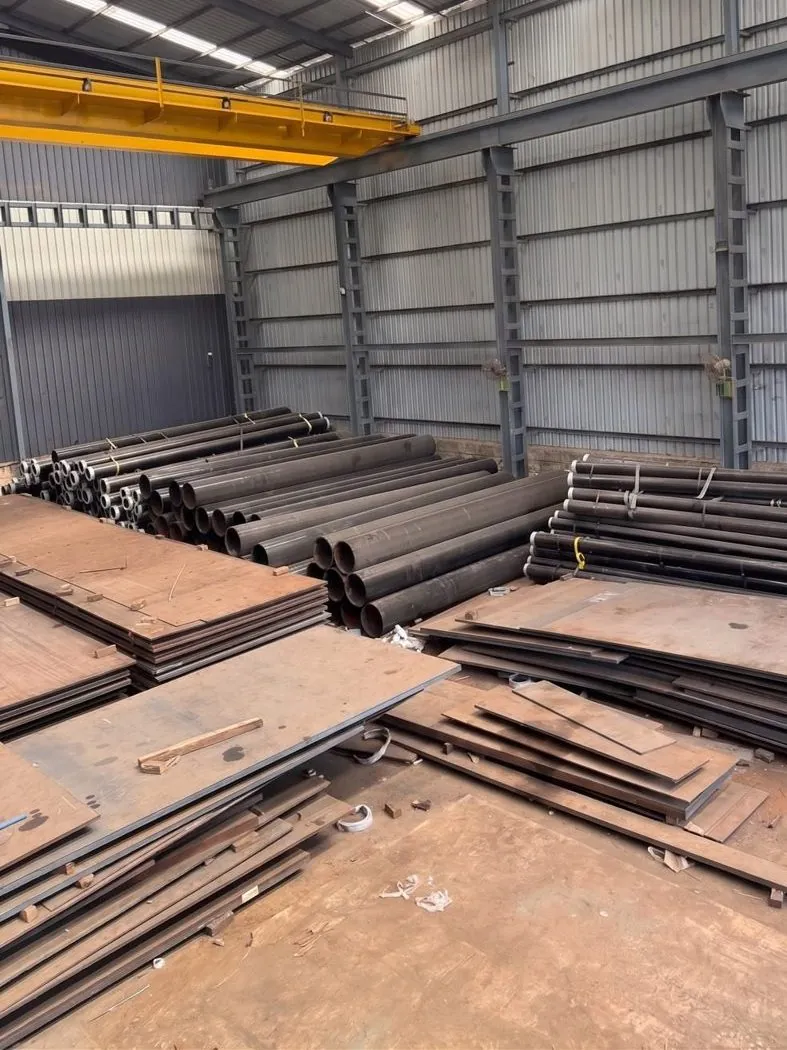
The calculator
The tool takes the volume of your piece and multiplies it by the verified density of the exact grade you pick, so the theoretical weight you're costing against lines up with the heat you actually get. Every stocked grade has its own density value. A generic "steel = 7.85" figure only works for carbon plate, and it understates every corrosion-resistant alloy.
Inputs
Output
The calculator shows weight per piece and total weight in both kilograms and pounds, updating live as you type. That result then flows straight into a request-for-quote, grade, form and dimensions attached, so you can go from calculation to a live price in a single step. See request a quote.
How metal weight is calculated
Every row the tool runs on reduces to one relation: mass equals volume times density. Volume comes from the shape of the form. Density comes from the grade. Multiply the two together and an inaccurate density feeds straight into an inaccurate cost. That's why picking the right alloy matters more than any decimal place in the dimensions.
For a plate or sheet the simplified working formula is:
Weight (kg) equals Length (m) times Width (m) times Thickness (mm) times Density (g/cm³).
The millimeter-and-meter mix cancels straight to kilograms, so there's no separate unit conversion needed. For the full derivation and a shape-by-shape method, see how to calculate steel plate weight.
Why grade-specific density matters
Austenitic stainless weighs more than carbon steel, and nickel alloys weigh more still. A 316 plate runs roughly 2% heavier than an A516 carbon plate of the same size, and an Incoloy 825 plate adds another 4% on top of that. Those differences shift a freight quote and a material cost on any sizeable order. The per-grade density library below is what this tool draws on; each value traces back to the grade's datasheet or governing standard.
Weight formulas by form
Enter the dimensions in millimeters and the density in g/cm³. Each formula hands back kilograms for plate and sheet, or kilograms per meter for long products. From there, just multiply by length and quantity.
| Form | Formula | Unit note |
|---|---|---|
| Plate / Sheet | L (m) × W (m) × t (mm) × ρ (g/cm³) | Result in kg per piece |
| Coil | Developed length (m) × W (m) × t (mm) × ρ (g/cm³) | Same as sheet, using the uncoiled length |
| Round bar | (π ÷ 4) × D² (mm) × ρ (g/cm³) ÷ 1000 | Result in kg per meter |
| Flat bar | W (mm) × t (mm) × ρ (g/cm³) ÷ 1000 | kg per meter |
| Square bar | a² (mm) × ρ (g/cm³) ÷ 1000 | kg per meter (a = side) |
| Hex bar | 0.866 × AF² (mm) × ρ (g/cm³) ÷ 1000 | kg per meter (AF = across flats) |
| Pipe / Tube | π × (OD − t) × t (mm) × ρ (g/cm³) ÷ 1000 | kg per meter; t = wall thickness |
Each formula starts by working out the cross-sectional area, then stretches that along the length to get a volume, then multiplies by density. For hollow sections, it's the mean diameter (OD minus wall thickness) that carries the metal. That's why the wall thickness shows up twice.
Density of each grade we stock
These are the densities the calculator applies per grade. The values come from public metallurgical data, each one cited to the grade's governing standard. Flat stainless product conforms to ASTM A240; Incoloy 825 conforms to ASTM B424. Before anything gets published, every value gets checked against the grade datasheet.
| Grade | UNS / WNr | Family | Density (g/cm³) | Chosen for |
|---|---|---|---|---|
| SS 304 / 304L | S30400 / S30403 | Austenitic SS | 8.0 | General fabrication, food and architectural duty |
| 316 / 316L | S31600 / S31603 | Austenitic SS | 8.0 | Molybdenum-bearing, resists chloride pitting 304 cannot |
| 321 | S32100 | Austenitic SS (stabilized) | 7.9 | Titanium-stabilized against sensitization at high temperature |
| 310 | S31008 | Austenitic SS (heat-resistant) | 7.9 | Oxidation resistance in furnace and high-temperature service |
| 904L super-austenitic | N08904 / 1.4539 | Super-austenitic SS | 7.95 | Copper-bearing ~4.5% Mo, sulfuric acid and high chlorides |
| Incoloy 825 (N08825) | N08825 / 2.4858 | Ni-Fe-Cr alloy | 8.14 | Sour service and mixed reducing/oxidizing acids |
| Inconel 625 | N06625 / 2.4856 | Ni-Cr-Mo alloy | 8.44 | Severe corrosion plus high-temperature strength |
| A516 Gr 70 plate | K02700 | PVQ carbon steel | 7.85 | Pressure vessels and boilers, the one grade where 7.85 is correct |
Incoloy 825 is a Ni-Fe-Cr alloy, UNS N08825 / Werkstoff 2.4858. People often write "Inconel 825" on a purchase order, but that's the wrong name. Getting the designation and density right matters, and it matters on both the cost estimate and the mill test certificate. For the form each grade is held in, see sheet vs plate vs coil. 304, 316 and 904L are stocked as sheet, plate and coil. Incoloy 825 comes as sheet and plate, with coil limited. A516 Gr 70 is stocked as plate only.
Worked example
Estimating a single 904L plate, 6 mm thick by 1500 mm by 3000 mm:
- Convert the plan dimensions to meters: 1500 mm = 1.5 m, 3000 mm = 3.0 m. Keep thickness in millimeters.
- Take the 904L density from the library: ρ = 7.95 g/cm³.
- Apply the plate formula: 1.5 × 3.0 × 6 × 7.95.
- 1.5 × 3.0 = 4.5 m²; 4.5 × 6 = 27; 27 × 7.95 = 214.65 kg per plate.
- For ten plates, multiply by quantity: 214.65 × 10 = 2146.5 kg total.
Run the same piece at the A516 carbon density of 7.85 and it weighs 211.95 kg. That's proof the real alloy density, not some generic figure, changes the costed mass.
Theoretical vs actual (shipped) weight
The tool this site runs figures theoretical weight, the mass of a piece at its exact nominal dimensions using published density. The actual weight you receive can differ, since rolled product carries a mill thickness tolerance; a plate ordered at nominal 6 mm might come in slightly over or under. For costing purposes, theoretical weight is what you should use to compare quotes and plan freight. The weighed heat weight on the mill test certificate is the definitive figure for what you actually get. Every order ships with an EN 10204 3.1/3.2 mill test certificate stating the heat and its data, backed by our quality assurance system.
Units & conversions
| Convert | Multiply by | Example |
|---|---|---|
| mm → in | 0.03937 | 6 mm = 0.236 in |
| in → mm | 25.4 | 0.25 in = 6.35 mm |
| kg → lb | 2.2046 | 214.65 kg = 473.2 lb |
| lb → kg | 0.4536 | 500 lb = 226.8 kg |
| g/cm³ → kg/m³ | 1000 | 7.95 g/cm³ = 7950 kg/m³ |
| kg/m² → lb/ft² | 0.2048 | 47.7 kg/m² = 9.77 lb/ft² |
Related tools & charts
To settle on a thickness before costing, read choosing plate thickness. For the ranking that drives grade choice on corrosion duty, see the PREN pitting-resistance table. Before you weigh a part, match its grade to the right service using the grade selector tool, and keep the stainless steel weight chart on hand as a printable reference for standard sizes.
FAQ
What is the formula for metal weight?
Why does grade matter in a steel weight calculator?
What is the density of stainless steel?
Does 904L weigh more than 316?
How do I calculate pipe weight per meter?
What is the difference between theoretical and actual weight?
Get a price for your calculated weight
Nandini Steel is an ISO 9001:2015-certified stockist and supplier, established in 2003, and it holds stainless, nickel-alloy, alloy-steel and PVQ products ex-stock for immediate dispatch, once you've got a weight, the next step is a live price. We're a certified specialist in 904L, Alloy 28, Incoloy 800 and Hastelloy plate. We supply genuine mill material from Aperam, Outokumpu, Jindal, POSCO, Nippon Steel and JFE, and every order comes with an EN 10204 3.1/3.2 mill test certificate. Over 20+ years, we've delivered 307+ projects for 260+ clients across 36+ export countries. Send your grade, form, dimensions and quantity for live pricing, request a quote, or just reach us on WhatsApp at +91 99202 09184.