
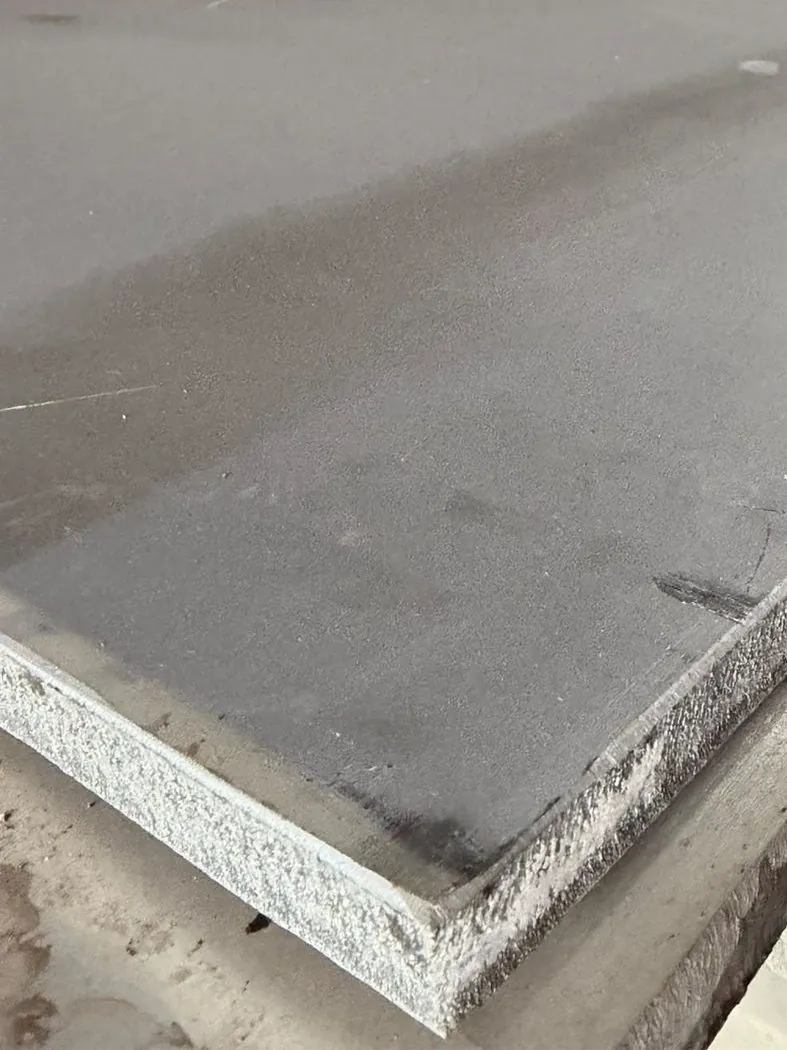
Key takeaways: 316 plate at a glance
Designation: UNS S31600, Werkstoff 1.4401, JIS SUS316, AISI/SAE 316. It's an austenitic, non-magnetic stainless steel.
The differentiator: Add 2–3% molybdenum and the PREN climbs to about 24. That's why 316 fends off chloride pitting corrosion so much better than 304, which sits around 18.
Standard-carbon grade: Carbon tops out at 0.08%. For welded or thick sections sitting in the sensitization range, though, step up to the low-carbon 316L plate.
Supplied as plate to ASTM A240 / ASME SA-240, hot-rolled, annealed and pickled (No. 1), held ex-stock for immediate dispatch.
- Traceability: an EN 10204 3.1/3.2 mill test certificate is provided with every order, from genuine mill plate.
What is 316 stainless steel plate?
316 is a chromium-nickel-molybdenum austenitic stainless steel, and plate is its hot-rolled flat form supplied above roughly 5 mm thickness. Like all members of the 316 stainless steel family, it belongs to the austenitic class, face-centered-cubic, non-magnetic in the annealed condition, and hardenable only by cold work, not heat treatment.
The reason to pick 316 over the cheaper 304 comes down to corrosion, not strength. Molybdenum stabilizes the passive film against chloride attack. Where 304 pits, coastal air, brackish water, chlorinated process streams, 316 keeps going. Think of it as the molybdenum upgrade from 304: enough pitting resistance for most chloride-bearing duties, and you skip the cost of a super-austenitic or nickel alloy. What follows makes that case with numbers and flags the one fork that actually matters: standard-carbon 316 versus low-carbon 316L.
Chemical composition
Element ranges for UNS S31600 plate per ASTM A240 (weight %, iron balance):
| Element | Symbol | Composition (wt %) |
|---|---|---|
| Carbon | C | ≤ 0.08 |
| Chromium | Cr | 16.0 – 18.0 |
| Nickel | Ni | 10.0 – 14.0 |
| Molybdenum | Mo | 2.0 – 3.0 |
| Manganese | Mn | ≤ 2.0 |
| Silicon | Si | ≤ 0.75 |
| Phosphorus | P | ≤ 0.045 |
| Sulfur | S | ≤ 0.030 |
| Nitrogen | N | ≤ 0.10 |
| Iron | Fe | Balance |
The role of molybdenum
That 2–3% molybdenum is exactly what the buyer is paying for. It reinforces the chromium-rich passive layer, specifically against chloride ions, the very species that kick off pitting. Strip it out and 304's PREN sits near 18; add it back and 316 climbs to about 24. For service that's dry, indoor and free of chlorides, 304 does the job fine, and 316 becomes overkill. But when conditions turn to hot concentrated chloride or sulfuric acid, 316 falls short, and 904L plate or a duplex grade is the right call. The molybdenum content should match the real pitting risk, nothing more.
Standard-carbon 316 vs low-carbon 316L
316 is the standard-carbon grade, with carbon capped at 0.08%. 316L brings that down to 0.03% or less, and the point is to stop chromium-carbide precipitation. That precipitation causes sensitization / intergranular corrosion, and it shows up when the steel sits or cools slowly through the 425–815 °C range, which is exactly what happens during welding. Beyond carbon content, the chemistry and corrosion resistance are identical between the two.
So for welded pharma and food equipment, spec 316L. It keeps the heat-affected zone resistant to corrosion. More detail at 316 vs 316L.
Mechanical properties
Minimum room-temperature properties for annealed 316 plate per ASTM A240:
| Property | Minimum (SI) | Minimum (Imperial) |
|---|---|---|
| Tensile strength | ≥ 515 MPa | ≥ 75 ksi |
| Yield strength (0.2% offset) | ≥ 205 MPa | ≥ 30 ksi |
| Elongation (in 50 mm) | ≥ 40% | ≥ 40% |
| Hardness | ≤ 217 HBW | ≤ 95 HRB |
Physical properties
| Property | Value (annealed) |
|---|---|
| Density | 7.98–8.00 g/cm³ |
| Melting range | ~1370–1400 °C |
| Thermal conductivity (100 °C) | ~16.3 W/m·K |
| Mean coefficient of thermal expansion (0–100 °C) | ~15.9 µm/m·°C |
| Elastic modulus | ~193 GPa |
| Magnetic response | Non-magnetic (austenitic, annealed) |
The density sits right around 8.00 g/cm³, and that figure is what drives the plate weight calculation below.
Corrosion behavior & PREN: why 316 plate exists
Corrosion resistance is the whole point of this grade. The best way to read it is through the pitting resistance equivalent number.
Pitting & crevice resistance: PREN ~24
PREN estimates resistance to localized chloride attack: PREN = %Cr + 3.3 × %Mo + 16 × %N. For S31600 that lands at about 24, against roughly 18 for 304, a meaningful step up the chloride ladder. 316 resists pitting corrosion and shielded-geometry crevice corrosion across most marine, chemical and hygienic duties. Where chloride concentration and temperature climb, move up the ladder rather than hoping 316 holds.
| Grade | PREN (approx.) | Choose when |
|---|---|---|
| 304 / 304L | ~18 | Dry, indoor, non-chloride service |
| 316 / 316L | ~24 | Chlorides present, marine, chemical, pharma, food |
| 904L | ~34 | Sulfuric acid, high / hot chloride |
| Duplex 2205 | ~35 | Chloride plus higher strength |
| Incoloy 825 | ~31–40 | Mixed reducing + oxidizing acids, sour service |
Chloride stress-corrosion cracking: the austenitic limit
316 is austenitic, and all standard austenitics remain susceptible to chloride stress-corrosion cracking under the combination of tensile stress, chlorides and temperature (typically above ~60 °C). Molybdenum helps pitting, not chloride SCC. Where hot chloride SCC is the governing risk, 316 underperforms 904L and duplex grades, which is the honest reason to step up rather than specify thicker 316.
Sensitization & intergranular corrosion: why and when 316L
Held in the 425–815 °C range, standard-carbon 316 can precipitate chromium carbides at its grain boundaries. That depletes the chromium nearby and leaves the steel open to sensitization / intergranular corrosion. Using the low-carbon 316L grade prevents this, as does a stabilized grade or solution annealing after welding. For multi-pass welds, thick welded sections, or corrosive service of any kind across a weld, 316L is the safer choice.
Equivalent grades & designations
| System | Designation |
|---|---|
| UNS | S31600 |
| Werkstoff (W.-Nr.) | 1.4401 |
| EN name | X5CrNiMo17-12-2 |
| JIS | SUS316 |
| BS | 316S31 |
| AISI / SAE | 316 |
Need another cross-walk? Take a look at the full UNS / Werkstoff / JIS cross-reference.
316 plate vs the alternatives: when to choose it
vs 304: the molybdenum upgrade
PREN 316 outperforms 304 once chlorides enter the picture: coastal and marine exposure, chlorinated or brackish water, plenty of process chemicals too. The core decision comes down to this. In chloride pitting resistance, 316 has the edge (PREN ~24 vs ~18 for 304); 304 only wins on price, and only in genuinely benign service. For the full case, see 304 vs 316.
vs 316L: the carbon / sensitization fork
Standard-carbon 316 and low-carbon 316L share the same corrosion grade; what separates them is the carbon ceiling. Use standard 316 for unwelded parts and sections headed for solution annealing. Choose 316L when you can't anneal and need to protect the weld zone. The fabrication route should drive the decision, not the medium. For details, see 316 vs 316L.
vs 904L / duplex 2205: the next rung up
When 316's PREN of roughly 24 falls short, think hot concentrated chlorides, sulfuric acid, or severe chloride SCC, the right move is stepping up to 904L or duplex 2205. 904L carries a PREN near 34 and its copper content gives it an edge in acid service. 2205 sits a bit higher still, around 35, and brings greater strength to the table. Either one is the correct upgrade. Buying thicker 316 won't fix a problem that isn't about thickness at all; it's a grade problem, plain and simple.
Forms, sizes & thickness ranges
Plate covers the flat product above roughly 5 mm; anything thinner ships as sheet or coil. Representative commercial ranges available ex-stock appear below. Confirm exact sizes and stock condition by RFQ.
| Dimension | Typical range |
|---|---|
| Thickness | 5 – 100 mm (heavier by arrangement) |
| Width | up to 2500 mm |
| Length | up to 6000 mm |
| Standard | ASTM A240 / ASME SA-240, UNS S31600 |
Other 316 forms
316 is also available as thinner flat product, see 316 sheet or 316 coil, and, for welded or thick corrosive sections, the low-carbon 316L plate. The full grade range sits on the 316 grade hub.
Plate weight & how to calculate
Because 316 plate holds a near-constant density of 8.00 g/cm³, weight turns out to be a direct function of dimensions.
Weight in kilograms equals thickness in millimeters times width in meters times length in meters times 8.0.
Worked example: take a 10 mm × 1.5 m × 6.0 m plate. Multiply it out: 10 × 1.5 × 6.0 × 8.0, and you land on 720 kg.
| Thickness | Plate size | Approx. weight |
|---|---|---|
| 6 mm | 1.5 × 6.0 m | 432 kg |
| 10 mm | 1.5 × 6.0 m | 720 kg |
| 12 mm | 2.0 × 6.0 m | 1152 kg |
| 20 mm | 2.0 × 6.0 m | 1920 kg |
For other sizes, try the weight calculator, or work through it manually with how to calculate steel plate weight.
Finishes
316 plate most often ships as No.1, hot-rolled, annealed and pickled, giving a matte, descaled surface that suits structural, chemical and marine fabrication work. Thinner stock can come cold-rolled instead, either 2B (smooth, reflective) or No.4 (brushed), when looks or ease of cleaning matter; hygienic equipment is a good example. The service dictates the finish. Not habit.
Standards & specifications complied
316 plate is supplied to the austenitic stainless flat-product standards:
- ASTM A240, covers chromium and chromium-nickel stainless steel plate, sheet and strip meant for pressure vessels and general use (S31600).
- ASME SA-240, the ASME Boiler & Pressure Vessel Code adoption of A240 for coded equipment.
Testing, inspection & certification
Every order of 316 plate ships with an EN 10204 3.1 mill test certificate reporting the heat's chemistry and mechanical results against ASTM A240. A 3.2 certificate with third-party endorsement is available on request. 316 is standard-carbon, so intergranular-corrosion testing to ASTM A262 matters for welded or sensitization-prone service. Positive material identification (PMI) confirms the 2–3% molybdenum, and ultrasonic testing can be specified for thick plate. For the full picture, see the testing, MTC, NDT & PMI overview.
Applications of 316 plate by industry
- Marine & coastal: hulls, deck hardware, tanks, and splash-zone structures that take a beating from salt air and seawater.
- Chemical processing: reactors, tanks, and heat-exchanger components working in chloride-bearing or mildly acidic streams.
- Pharmaceutical: hygienic vessels and process equipment, where both cleanability and corrosion resistance matter.
- Food & beverage: brewing, dairy, and processing equipment that deals with salt, acids, and constant wash-down.
- Oil & gas: topside and process components in chloride-exposed but non-sour service.
Welding & fabrication of 316 plate
316 plate welds readily by common arc processes and is normally joined with ER316L filler, the low-carbon filler keeps the weld metal resistant to sensitization even on standard-carbon base plate. Key fabrication notes:
- Weld with ER316L and control interpass temperature to limit time in the 425–815 °C sensitization range.
Solution anneal heavily worked or welded corrosive-service parts at roughly 1040–1120 °C, then quench rapidly to restore full corrosion resistance.
Machine with sharp tooling, positive feeds and coolant. 316 is austenitic and work-hardens, so letting the tool dwell just glazes the surface.
Pricing & how we quote
We quote 316 plate by RFQ against live mill and stock pricing rather than publishing price tables, since cost shifts with heat, size, finish and quantity. Send us your thickness, plate size, quantity and standard, and we'll return a firm price with lead time. All stock is held ex-stock for immediate dispatch. Request a quote via our contact page or WhatsApp +91 99202 09184.
FAQ
Is 316 stainless steel plate good for seawater and marine use?
What is the difference between 316 and 316L plate?
Does 316 stainless steel plate rust?
What standards does 316 plate comply with?
How do I calculate the weight of a 316 plate?
Can you supply 316 plate with a mill test certificate?
Request a quote
Nandini Steel is an ISO 9001:2015-certified stockist and supplier of 316 stainless steel plate. Genuine mill plate only, sourced from producers such as Aperam, Outokumpu, Jindal, POSCO, Nippon Steel and JFE. Founded in 2003, we've completed 307+ projects for 260+ clients across 36+ export countries over 20+ years. Every order ships ex-stock, ready for immediate dispatch, and each one carries an EN 10204 3.1/3.2 mill test certificate.
Send your thickness, size, quantity and standard, and we'll turn around a firm RFQ with live pricing and lead time.
- Phone: +91 22 43404600 · +91 9920209184
- WhatsApp: +91 99202 09184
- Email: reachus@nandinisteel.com
Address: 25, Dreamland Building, 601, 6th Floor, Mama Parmanand Marg, Charni Road, Opera House, Girgaon, Mumbai, Maharashtra 400004, India
- GSTIN: 27ADJPA7240C1Z0
Related grades to cross-shop
Part of our steel plate range and all stainless steel plate grades.