
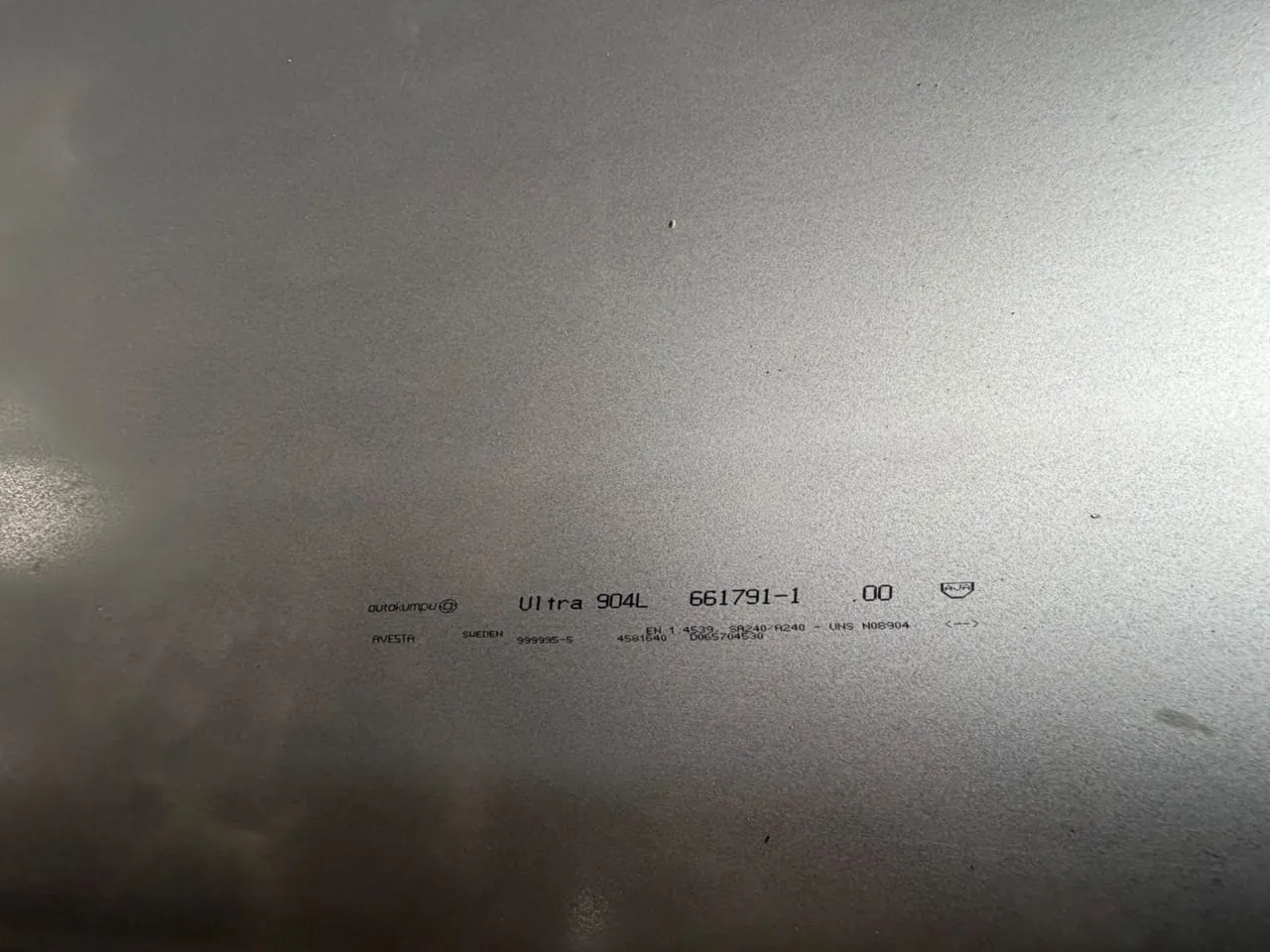
904L vs 316L at a Glance: the Verdict Table
The decision comes down to corrosion and cost, not strength. 316L and 904L behave almost identically under mechanical load. What sets them apart is molybdenum, nickel, and the copper that only 904L carries. Read the table top-down. Then price the gap against the service you're actually running.
| Attribute | 316L | 904L |
|---|---|---|
| UNS / Werkstoff | S31603 / 1.4404 | N08904 / 1.4539 |
| Family | Austenitic stainless | Super-austenitic stainless |
| PREN (approx.) | ~24 | ~34 |
| Molybdenum | 2.0–3.0% | 4.0–5.0% (~4.5) |
| Nickel | 10.0–14.0% | 23.0–28.0% (~25) |
| Copper | none | 1.0–2.0% (~1.5) |
| Chloride pitting / crevice | Good | Resists (higher PREN) |
| Chloride stress-corrosion cracking | Susceptible (austenitic) | Outperforms 316L (high Ni) |
| Sulfuric / reducing acids | Limited | Resists (copper-bearing) |
| Relative metal cost | ≈1× baseline | Several times higher |
| Choose when | General marine, chemical, pharma, food | Sulfuric acid, hot/high chlorides, pulp & paper, FGD |
The Short Answer: When to Choose Each
Stick with 316L for general marine, chemical, pharmaceutical and food duty, and for ambient or moderate chloride exposure. Its 2–3% molybdenum is what you're paying for, so match it to the real pitting risk instead of over-specifying.
Move up to 904L when the medium is sulfuric or other reducing acids, or when chlorides and temperature push past 316L's pitting and crevice limit. The copper and extra molybdenum earn their premium here, not as a blanket upgrade.
When PREN demand runs higher still, go past 904L: weigh the 904L vs duplex 2205 decision, Alloy 20, or 254 SMO, and for genuinely severe mixed-acid or sour service, reach for a nickel alloy such as Incoloy 825 vs Inconel 625.
Composition: What Actually Differs
Both grades are low-carbon "L" variants (C ≤ 0.03%), so neither needs mandatory post-weld annealing to resist intergranular sensitization. Where they actually part ways is chromium, nickel, molybdenum and copper content. ASTM A240 / ASME SA-240 set those ranges for S31603, while ASTM B625 governs N08904.
| Element | 316L (S31603) | 904L (N08904) |
|---|---|---|
| C | ≤0.030 | ≤0.020 |
| Cr | 16.0–18.0 | 19.0–23.0 |
| Ni | 10.0–14.0 | 23.0–28.0 (~25) |
| Mo | 2.0–3.0 | 4.0–5.0 (~4.5) |
| Cu | – | 1.0–2.0 (~1.5) |
| Mn | ≤2.0 | ≤2.0 |
| Si | ≤0.75 | ≤1.0 |
| P | ≤0.045 | ≤0.045 |
| S | ≤0.030 | ≤0.035 |
| N | ≤0.10 | ≤0.10 |
| Fe | balance | balance |
Copper and the Extra Molybdenum: Why They Matter
Molybdenum is what gives 316L the pitting resistance plain 304 doesn't have, and 904L roughly doubles that amount to about 4.5%. The extra molybdenum accounts for most of 904L's PREN advantage. Copper tells a different story: absent from 316L, present at around 1.5% in 904L, it's the element behind the super-austenitic grade's signature resistance to sulfuric and other reducing acids. Nickel content runs much higher too, near 25%, and that's what pushes 904L's resistance to chloride stress-corrosion cracking past the austenitic baseline.
Corrosion Resistance: 904L vs 316L
Corrosion is where the two grades split apart, and every difference traces straight back to the composition table above.
Pitting & Crevice: the PREN Ladder
PREN, short for pitting resistance equivalent number, scores how well a grade stands up to chloride pitting and crevice attack. The formula is %Cr + 3.3 × %Mo + 16 × %N. Run the numbers and 316L comes out around 24, while 904L sits near 34. That gap matters a lot once you're dealing with hot or concentrated chloride service. For the underlying mechanism, see PREN (pitting resistance equivalent), pitting and crevice corrosion.
| Grade | PREN (approx.) |
|---|---|
| 304 / 304L | ~18 |
| 316 / 316L | ~24 |
| 904L | ~34 |
| Duplex 2205 | ~35 |
| Super-Duplex 2507 | ~43 |
Chloride Stress-Corrosion Cracking
All austenitic stainless steels, 316L included, are susceptible to chloride stress-corrosion cracking under tensile stress in warm chloride environments. 904L outperforms 316L here because its nickel content of roughly 25% lifts the temperature and chloride threshold at which cracking initiates, a key reason it is specified for hot chloride process equipment where a 316L component is cracking in service.
Sulfuric & Reducing Acids: the Copper Story
904L exists for one reason. The copper in its chemistry suppresses corrosion in sulfuric and other reducing acids across concentration ranges where 316L gets steadily attacked. In acid-plant service, pulp & paper bleaching, and flue-gas desulfurization duty, 904L holds up against sulfuric-acid resistance conditions that push 316 outside its envelope. Check the acid concentration and temperature against the 904L iso-corrosion limits before you commit to a spec.
Where 316L Is Still Fine
Do not over-specify. For ambient seawater splash, general chemical / acid processing at moderate conditions, pharma and food contact, 316L remains the correct, cheaper answer. A common buyer error is paying for 904L, or even Alloy 20, 625 or titanium, where 316L's 2–3% molybdenum already covers the real pitting risk. Match the grade to the medium, not to the worst case imagined.
Mechanical & Physical Properties
In the annealed condition the two grades sit close enough that strength rarely decides the matter. 904L carries a modestly higher yield; 316L, a touch more elongation. The real decision still comes down to corrosion resistance and cost.
| Property | 316L | 904L |
|---|---|---|
| Tensile strength, min | ≥485 MPa (70 ksi) | ≥490 MPa (71 ksi) |
| Yield strength (0.2%), min | ≥170 MPa (25 ksi) | ≥220 MPa (32 ksi) |
| Elongation, min | ≥40% | ≥35% |
| Hardness, max | ≤95 HRB | ≤90 HRB |
| Property | 316L | 904L |
|---|---|---|
| Density | 7.98 g/cm³ | 7.95 g/cm³ |
| Thermal conductivity | ~16 W/m·K | ~11.5 W/m·K |
| CTE (20–100 °C) | ~16 µm/m·°C | ~15.3 µm/m·°C |
| Elastic modulus | ~193 GPa | ~190 GPa |
| Magnetic response | Non-magnetic (austenitic) | Non-magnetic (austenitic) |
Cost: How Much More Is 904L?
904L costs several times more than 316L per kilogram, and the reason lies in the mix: roughly 25% nickel, about 4.5% molybdenum, and added copper are all pricey alloying additions stacked on top of 316L's leaner recipe. That premium only makes sense when you look at total cost of ownership. Where a 316L vessel or lining would fail and need replacing in acid or hot-chloride service, 904L's longer campaign life earns back the extra metal cost. For general duty, though, the premium is just over-specification. Want live, order-specific pricing on either grade? Request a quote. We price to current mill levels rather than publish tables that go stale.
Identity & Equivalents
| System | 316L | 904L |
|---|---|---|
| UNS | S31603 | N08904 |
| Werkstoff (W.-Nr.) | 1.4404 | 1.4539 |
| EN | X2CrNiMo17-12-2 | X1NiCrMoCu25-20-5 |
| AISI / common | AISI 316L | AISI 904L |
| BS / JIS | SUS316L (JIS) | 904S13 (BS); no direct JIS |
Full mapping lives on the UNS / Werkstoff cross-reference. Both grades meet ASTM A240 / ASME SA-240 for flat product, and 904L flat product is also covered under ASTM B625 / SB-625.
When 904L Is NOT the Answer: the Upgrade Ladder
904L sits on a ladder, not at its peak. When PREN or acid demand outstrips its envelope, move up a grade rather than forcing the material to cope.
| Grade | PREN (approx.) | Choose when |
|---|---|---|
| 316L | ~24 | General marine, chemical, pharma, food |
| 904L | ~34 | Sulfuric/reducing acids, hot/high chlorides |
| Duplex 2205 | ~35 | Higher strength + chloride resistance, lower nickel cost |
| Alloy 20 | ~30+ | Concentrated sulfuric acid, mixed-acid plants |
| 254 SMO (6-Mo) | ~43 | Seawater, bleach, very high chlorides |
| Nickel alloy (825 / 625) / titanium | high | Sour service, severe mixed acids, extreme chlorides |
Compare the adjacent rungs directly, 904L vs duplex 2205 for the strength-and-cost trade, and Incoloy 825 vs Inconel 625 for the nickel-alloy step in oil & gas and acid duty. For the leaner end of the range, the 304 vs 316 and 316 vs 316L (the low-carbon decision) comparisons close out the austenitic set.
Weldability & Fabrication
Welders pair 316L with matching ER316L filler, plain and simple. 904L is a different story. Because it's over-alloyed, it calls for an over-alloyed filler too: ER385 (Avesta P12-R) or a nickel-base consumable, chosen so the weld metal's corrosion resistance doesn't fall behind the base metal. Matching 904L composition in the weld itself just isn't reliable enough to trust. When joining 904L to 316L in a dissimilar weld, stick with the over-alloyed or nickel-base filler. That keeps the weld from becoming the weak point in whatever aggressive medium the joint will face. For the full procedure, see how to weld 904L. Both grades carry low carbon, so sensitization in the 425–815 °C range is already held in check. Still, solution-annealed material and controlled heat input are worth sticking to.
Forms, Sizes & Sourcing Both Grades
Both grades ship as super-austenitic stainless steel and austenitic flat product, sheet, plate and coil, under ASTM A240 / ASME SA-240. Every item sits ex-stock, ready to go out the door immediately.
- 904L: 904L stainless steel plate and 904L sheet and coil come out of the 904L super-austenitic grade hub.
- 316L: Everything starts at the 316L stainless steel hub. From there you'll find 316L plate and 316L sheet.
Buy 904L or 316L from Nandini Steel
Nandini Steel has been an ISO 9001:2015-certified stockist and supplier since 2003, and it's a certified specialist in 904L among its super-austenitic and nickel-alloy range. Every order ships with an EN 10204 3.1/3.2 mill test certificate. Heat and cast traceability follows the plate from mill to site, and a positive material identification (PMI) check can tell 904L apart from 316L on dispatch. The material itself is genuine mill plate from Aperam, Outokumpu, Jindal, POSCO, Nippon Steel and JFE. Over 20+ years, the company has delivered 307+ projects for 260+ clients across 36+ export countries. Need pricing on either grade? Send your specification and quantity for a quote.
FAQ
Is 904L better than 316L?
What is the PREN of 904L versus 316L?
When should I upgrade from 316L to 904L?
Why is 904L more expensive than 316L?
Can you weld 904L to 316L?
What are the UNS numbers for 904L and 316L?
Request a Quote
Specifying 904L or 316L for an acid, chloride or marine application? Send the grade, form, dimensions and quantity, and we'll return live, order-specific pricing along with ex-stock availability. Every order ships with an EN 10204 3.1/3.2 mill test certificate, plus full traceability back to genuine mill plate.
- Phone: +91 22 43404600 · +91 9920209184
- WhatsApp: +91 99202 09184
- Email: reachus@nandinisteel.com
- GSTIN: 27ADJPA7240C1Z0