
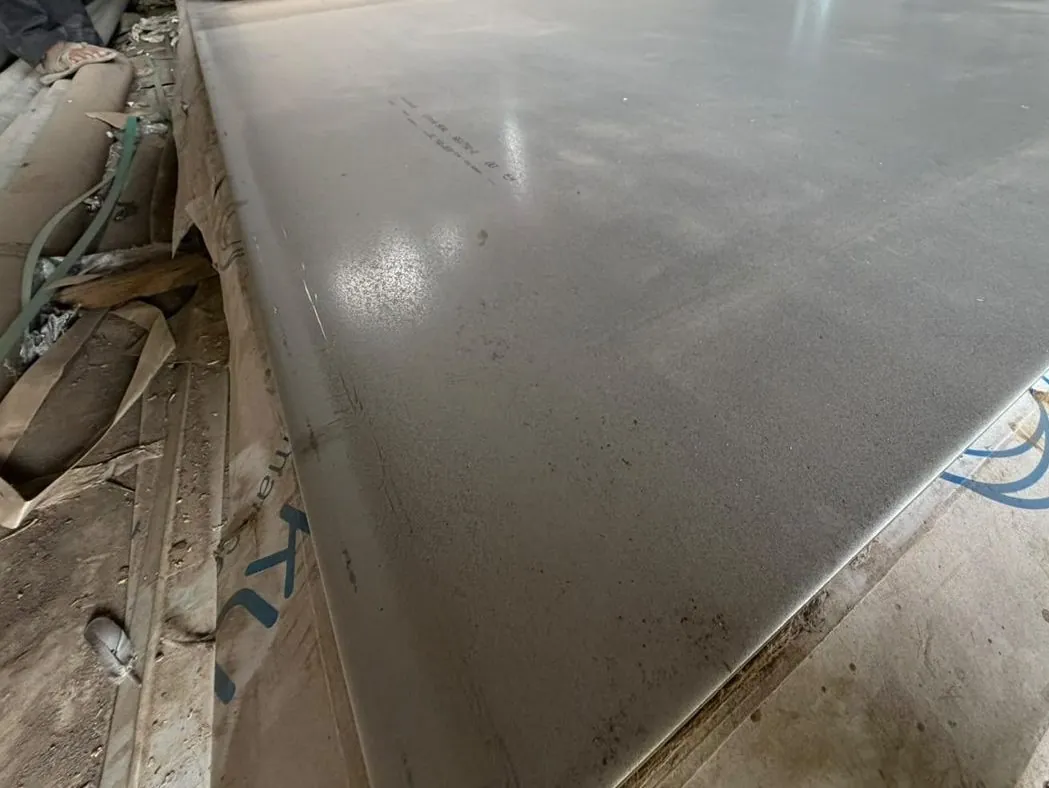
316L stainless steel sheet is a low-carbon, molybdenum-bearing austenitic grade (UNS S31603 / 1.4404) containing 2–3% molybdenum with carbon capped at 0.03%. The molybdenum lifts pitting resistance to a PREN of about 24, well above 304, while the low carbon prevents weld sensitization, making it the standard sheet for marine, pharmaceutical and chloride-bearing service.
Key takeaways: 316L sheet at a glance
- Designation: UNS S31603 / Werkstoff 1.4404 / JIS SUS316L, the low-carbon, molybdenum-bearing member of the austenitic stainless steel family.
- The molybdenum is what you buy: 2.00–3.00% Mo raises the pitting resistance equivalent to PREN ≈ 24, a full step above 304's ~18, for chloride and marine service.
- The "L" is weld insurance: carbon held ≤0.03% prevents sensitization (chromium-carbide precipitation) at 425–815 °C, so welded sheet stays corrosion-resistant without post-weld annealing.
- Standards & traceability: supplied to ASTM A240 / ASME SA-240; an EN 10204 3.1/3.2 mill test certificate is provided with every order.
- Availability: genuine mill sheet ex-stock for immediate dispatch, 2B / BA / No.4 / mirror finishes, cut-to-size on request.
What is 316L stainless steel sheet?
Specifying 316L over 304/304L comes down to molybdenum: it gives you pitting resistance the 18/8 grades just don't have. Specifying it over plain 316 comes down to carbon content. Keep it low and a welded part keeps its corrosion resistance across the heat-affected zone. Put those two things together, molybdenum and low carbon, and you can see why 316L ends up the default sheet for welded fabrication in chloride, mildly acidic and hygienic service.
Chemical composition
Molybdenum content and the low carbon ceiling are the two rows that define 316L. Both sit within the element ranges set out in ASTM A240 (UNS S31603), the standard that distinguishes it from standard 316.
| Element | 316L (S31603) wt% |
|---|---|
| Carbon (C) | ≤0.030 |
| Chromium (Cr) | 16.0–18.0 |
| Nickel (Ni) | 10.0–14.0 |
| Molybdenum (Mo) | 2.00–3.00 |
| Manganese (Mn) | ≤2.00 |
| Silicon (Si) | ≤0.75 |
| Phosphorus (P) | ≤0.045 |
| Sulfur (S) | ≤0.030 |
| Nitrogen (N) | ≤0.10 |
| Iron (Fe) | Balance |
Why molybdenum and low carbon matter
Two deliberate molybdenum additions of 2–3% strengthen the passive film against chloride attack. That's why 316L resists pitting corrosion where 304 doesn't. The measurable result: PREN ≈ 24 versus roughly 18.
Carbon gets capped at 0.03%, and that ceiling starves the chromium-carbide reaction that would otherwise kick in whenever stainless sits between 425 and 815 °C. That's precisely the condition found in a weld heat-affected zone. Keeping carbon low means the grain boundaries stay chromium-rich. A welded 316L sheet can then resist sensitization and intergranular corrosion without needing a post-weld solution anneal.
Mechanical properties
ASTM A240 minimum requirements for S31603 sheet in the annealed condition.
| Property | 316L (S31603) sheet, annealed |
|---|---|
| Tensile strength (min) | ≥485 MPa (70 ksi) |
| Yield strength, 0.2% (min) | ≥170 MPa (25 ksi) |
| Elongation in 50 mm (min) | ≥40% |
| Hardness (max) | ≤95 HRB / ≤217 HBW |
The low-carbon chemistry shaves the minimum yield down a touch against standard 316, the same trade-off every "L" grade carries. For fabricated sheet, though, that barely matters next to the weld-zone corrosion resistance it buys you.
Physical properties
| Property | Value (316L sheet, annealed) |
|---|---|
| Density | 7.98–8.0 g/cm³ |
| Melting range | ~1375–1400 °C |
| Thermal conductivity (100 °C) | ~16.3 W/m·K |
| Mean coefficient of thermal expansion (0–100 °C) | ~16.0 µm/m·°C |
| Elastic modulus | ~193 GPa |
| Magnetic response | Non-magnetic (annealed); mildly magnetic after cold work |
In the solution-annealed condition, 316L is non-magnetic. Cold forming, deep drawing, bending, roll-forming, turns some austenite into martensite, and this can leave the worked area slightly ferromagnetic. That's normal. It doesn't mean you've got the wrong grade.
Corrosion behavior & PREN: why 316L, not 304
316L's corrosion resistance depends on a chromium-rich passive film that molybdenum reinforces. The selection logic is simple: molybdenum separates it from 304, and the low carbon content separates it from plain 316 once you're dealing with welds.
Pitting, crevice resistance & PREN ≈ 24
Chromium sits at about 17, molybdenum at roughly 2.1, and nitrogen near 0.05. Plug those into the pitting resistance equivalent number formula, PREN = Cr + 3.3·Mo + 16·N, and you get 17 + 6.9 + 0.8, landing at roughly 24. That molybdenum contribution is why 316L holds up against pitting corrosion and crevice corrosion in chloride-laden service, while 304, with a PREN near 18, doesn't. See the PREN method for how the number is derived and compared across grades. A PREN of 24 marks the starting point for genuine chloride resistance. It's fine for marine atmospheres and typical process chlorides, but hot, concentrated chlorides are another matter; the ladder keeps climbing from there.
Chloride stress-corrosion cracking: the austenitic limit
Like all austenitic grades, 316L is susceptible to chloride stress-corrosion cracking under tensile stress in warm chloride environments (roughly above 50–60 °C). The molybdenum raises the pitting threshold but does not remove the SCC limit, which is a structural property of the austenitic lattice. Where hot chlorides and sustained stress coexist, 316L underperforms a duplex or a super-austenitic grade, and the correct move is to upgrade rather than to specify thicker 316L.
Intergranular corrosion & sensitization: what the "L" buys
This is the one edge 316L has over standard 316: with carbon held at 1/3 the usual ceiling (≤0.03%), it resists chromium-carbide precipitation in the weld heat-affected zone. That means welded, as-fabricated sheet stays immune to sensitization / intergranular corrosion without needing a post-weld solution anneal. You can reach the same result through solution annealing, or by choosing a stabilized grade like 321 or 347. For welded sheet, though, low carbon is just the easier path. See how to prevent sensitization for more.
Equivalent grades & designations
| System | Designation |
|---|---|
| UNS | S31603 |
| Werkstoff (W.-Nr.) | 1.4404 (X2CrNiMo17-12-2) |
| EN name | X2CrNiMo17-12-2 |
| JIS | SUS316L |
| BS | 316S11 |
| AISI | 316L |
| GB | 022Cr17Ni12Mo2 |
For a full map across standards, check the UNS / Werkstoff / JIS cross-reference.
316L sheet vs the alternatives: when to choose it
316L vs 316
316 allows carbon up to 0.08%, while 316L caps it at 0.03%, that's the only metallurgical difference between them. Molybdenum content is the same in both, and so is PREN, around 24, which means their pitting resistance comes out identical. If a part gets welded and won't be re-annealed afterward, go with 316L so the heat-affected zone keeps its corrosion resistance. For unwelded sections, or when you want the slightly higher yield strength, 316 is the better pick. For the full reasoning behind the low-carbon and sensitization tradeoff, see 316 vs 316L.
316L vs 304 / 304L
Molybdenum is what sets these apart. The 18/8 grades have none of it and top out around PREN ~18; the error we see most often in the field is defaulting to 304 in chloride-adjacent or coastal settings, where it pits. Once the service water carries chlorides, marine, coastal, de-iced, or process, the Mo in 316L starts paying for itself. Confirm the actual chloride exposure before you pick a grade. The full Mo/chloride upgrade case is laid out in 304 vs 316.
When to upgrade to 904L or duplex
316L is the entry point of chloride resistance, not the ceiling. When you're dealing with sulfuric acid, high or hot chlorides, or chloride-SCC risk, when to upgrade to 904L covers the step up to super-austenitic chemistry (PREN ~34). Duplex 2205 adds high strength along with better SCC resistance. Buyers get this wrong in both directions: some pay for 316 where dry indoor 304 would do the job fine, while others under-specify 316L for hot concentrated chlorides when 904L or duplex is what's actually needed. Match the molybdenum to the real pitting risk.
| Grade | PREN (approx.) | Choose when |
|---|---|---|
| 304 / 304L | ~18 | General fabrication, low/no chloride |
| 316 / 316L | ~24 | Chlorides present, marine, process, hygienic |
| 904L | ~34 | Sulfuric acid, high chloride, SCC risk |
| Duplex 2205 | ~35 | High strength + chloride-SCC resistance |
| Super-duplex 2507 | ~43 | Aggressive seawater / very high chloride |
Forms, sizes & thickness ranges
316L comes as flat sheet, typically up to about 6 mm; anything heavier falls into 316L plate. The usual stock sizes run 1219 × 2438 mm (4 × 8 ft), 1250 × 2500 mm, and 1500 × 3000 mm. Cut-to-size is available on request. Here's a gauge/thickness reference:
| Gauge (approx.) | Thickness (mm) |
|---|---|
| 22 ga | 0.8 |
| 20 ga | 1.0 |
| 18 ga | 1.2 |
| 16 ga | 1.5 |
| 14 ga | 2.0 |
| 12 ga | 2.5–2.6 |
| 10 ga | 3.0–3.4 |
Other 316L forms
Heavier sections ship as 316L plate, while continuous thin-gauge feedstock comes as 316L coil. For the difference between the flat forms, and when to specify each, see sheet vs plate vs coil.
Sheet weight & how to calculate
316L and 316 both come in at roughly the same weight as any other austenitic stainless, figure on a density of 8.0 g/cm³ when calculating sheet weight. Two formulas will cover most buyers:
- Per square meter: kg/m² = thickness (mm) × 8.0
- Per sheet: kg = thickness (mm) × width (m) × length (m) × 8.0
Worked example, a 2 mm × 1.25 m × 2.5 m sheet: 2 × 1.25 × 2.5 × 8.0 = 50.0 kg (16.0 kg/m² once you run 2 × 8.0).
| Thickness (mm) | Weight (kg/m²) |
|---|---|
| 1.0 | 8.0 |
| 1.5 | 12.0 |
| 2.0 | 16.0 |
| 3.0 | 24.0 |
Run your own numbers through the weight calculator or check them against the stainless steel weight chart.
Surface finishes for 316L sheet
Finish is the sheet-specific decision, and it tracks the job: hygienic, architectural or general fabrication.
- 2B, smooth, cold-rolled, lightly reflective; the default for general fabrication, tanks and process equipment.
- BA (bright annealed), brighter, mirror-approaching cold-rolled finish for hygienic and decorative work.
- No.1, hot-rolled, annealed and pickled (HRAP), for heavier-gauge, non-cosmetic and high-temperature use.
- No.4, directional brushed/satin finish for architectural panels and food-service surfaces.
- 2D, dull cold-rolled finish, a uniform matte base often used before forming.
- Mirror (No.8), highly reflective polished finish for decorative and specular applications.
For how a mill actually produces and matches these finishes, see stainless steel finishes (2B / BA / No.4).
Standards & specifications complied
316L sheet is supplied to the recognized flat-product standards for S31603:
- ASTM A240, this covers chromium and chromium-nickel stainless sheet, plate and strip meant for pressure vessels, plus general use.
- ASME SA-240, this is simply the ASME Boiler & Pressure Vessel Code's adoption of A240, so it applies to coded equipment.
- EN 10088-2, the European flat-product standard for stainless X2CrNiMo17-12-2 (1.4404).
Testing, inspection & certification
Every order ships with an EN 10204 3.1/3.2 mill test certificate reporting heat/cast chemistry and mechanicals against ASTM A240, see EN 10204 3.1 mill test certificate and how to read a mill test certificate. For welded or sensitization-critical work, intergranular corrosion testing to ASTM A262 (Practice A or E) can be specified, alongside positive material identification (PMI), passivation verification per ASTM A967 and dimensional inspection, more on testing, MTC, NDT & PMI. Heat/cast traceability runs from the mill certificate to the stamped sheet.
Applications of 316L sheet by industry
316L is the weld-safe, chloride-service austenitic sheet across:
- Marine & coastal, hull fittings, deck hardware, splash-zone enclosures. Chlorides win out over 304 here.
- Pharmaceutical / sanitary, clean-room gear, process equipment, hygienic fixtures, all in welded sheet that passivates without much fuss.
- Chemical processing, tanks, ducting, vessels built for mildly acidic, chloride-bearing media.
- Food & dairy, tanks, work surfaces, hygienic enclosures. Welded sheet that has to stay corrosion-free and easy to clean, no exceptions.
Welding & fabrication of 316L sheet
316L welds easily with TIG, MIG, resistance and laser processes. Pair it with a low-carbon, molybdenum-bearing filler, ER316L / E316L, so the deposit matches the weld-safe, Mo-bearing chemistry. No post-weld heat treatment is needed to keep the joint corrosion-resistant. That's the whole point of specifying 316L in the first place. See how to weld 316L for procedure detail.
316L work-hardens as you form it. It draws and bends well, but it gains strength as it deforms, so budget for springback and plan on interstage annealing when the draws get severe. Laser, plasma and waterjet all cut it cleanly. On thin sheet, watch your heat input and interpass temperature to keep distortion down, then passivate after fabrication to bring back the full passive film on the 316.
Price & how we quote
Nandini Steel keeps genuine mill 316L sheet in stock from recognized producers, Aperam, Outokumpu, Jindal, POSCO, Nippon Steel and JFE. It ships ex-stock for immediate dispatch, and cut-to-size is available on request. Every order comes with an EN 10204 3.1/3.2 mill test certificate.
We don't publish price tables. Stainless sheet pricing shifts with alloy surcharges, so we quote live against your thickness, finish, size and quantity. Send us the specification and you'll get a same-day RFQ. Pricing is by quotation only.
FAQ
Is 316L better than 304 for marine use?
What is the difference between 316 and 316L?
Does 316L stainless steel rust?
Is 316L sheet magnetic?
What filler is used to weld 316L sheet?
Does 316L sheet come with a mill test certificate?
What is the equivalent of 316L stainless steel?
Request a quote
Call us with thickness, finish, size and quantity for 316L (S31603) sheet, and the Nandini Steel Engineering Team will send back a same-day RFQ with mill test certification. Reach us at +91 22 43404600, on WhatsApp at +91 99202 09184, or by email at reachus@nandinisteel.com. We're an ISO 9001:2015-certified stockist and supplier. Every sheet is genuine mill stock, held ex-stock, and shipped worldwide to more than 36 export countries.
Related grades to cross-shop
Part of our steel sheet range and all stainless steel sheet grades.