
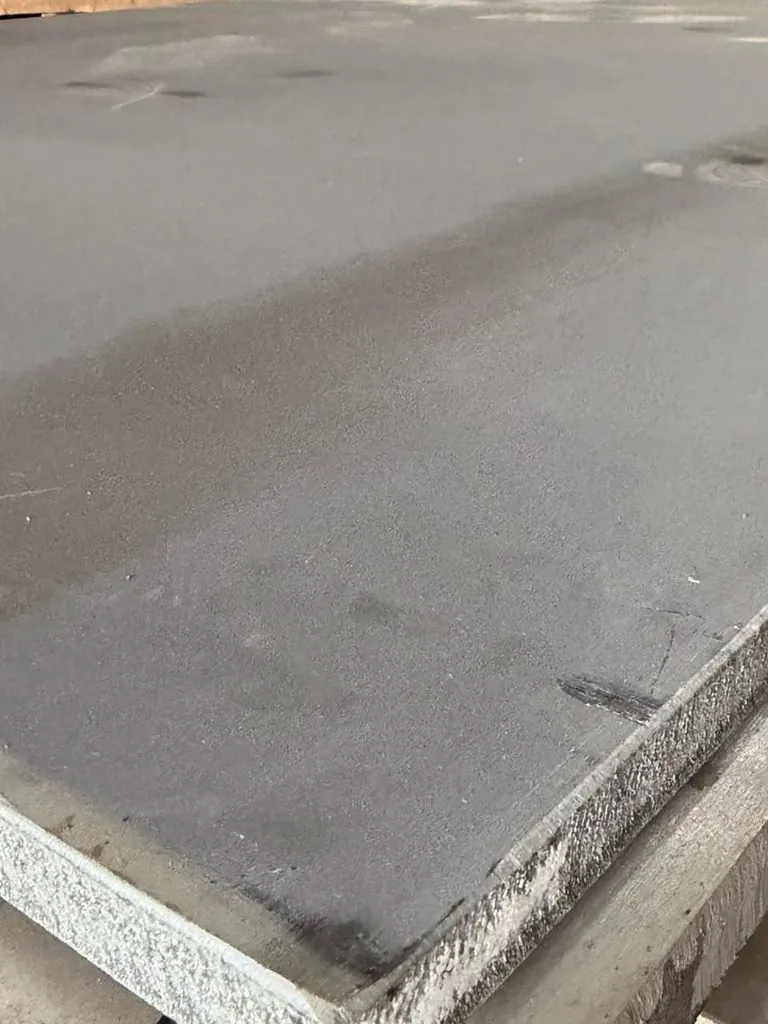
321 stainless steel at a glance
- Designations: UNS S32100, Werkstoff 1.4541, JIS SUS321, AISI 321, a titanium-stabilized austenitic stainless steel that's non-magnetic.
- Why it exists: titanium locks up carbon as titanium carbide (TiC), so chromium stays in solution. That's what lets the grade resist chromium-carbide sensitization across the 425-815°C range.
- Heat resistance: it holds up in continuous elevated-temperature service to roughly 900°C. Low-carbon 304L loses strength well before that point, and plain 304 sensitizes.
- Specification: flat product falls under ASTM A240 / ASME SA-240. Other forms are covered by A312/A213, A276 and A182.
- Corrosion note: there's no molybdenum here, so PREN sits around 17-18, giving chloride-pitting resistance close to what you'd see with 304. This is a heat-stable grade, not a chloride-upgraded one.
What is 321 stainless steel?
321 is the titanium-stabilized member of the 18-8 austenitic stainless family. Take an unstabilized grade like 304 and hold it in the 425-815°C range during welding, stress relief, or hot service, and chromium and carbon start combining into chromium carbides at the grain boundaries. The chromium nearby gets depleted. That's sensitization, and it leaves the boundaries open to intergranular corrosion.
Titanium changes the chemistry. Titanium bonds to carbon more readily than chromium does, so it forms titanium carbide first and ties up the carbon before chromium gets pulled out of solution. The chromium stays dissolved and keeps protecting the steel. That single mechanism is why you'd reach for 321: it's the grade to pick when a 304-type stainless has to run hot or needs to stay weld-stable. For the underlying mechanism, see our note on intergranular corrosion and sensitization; for weld practice, see how to prevent sensitization.
Chemical composition
Composition for UNS S32100 to ASTM A240, by weight percent. The stabilization rule calls for titanium at no less than five times the carbon content (Ti ≥ 5 × C). That ratio ensures there's enough titanium around to bind whatever carbon is present.
| Element | Symbol | Min % | Max % |
|---|---|---|---|
| Carbon | C | – | 0.08 |
| Chromium | Cr | 17.0 | 19.0 |
| Nickel | Ni | 9.0 | 12.0 |
| Titanium | Ti | 5 × C | 0.70 |
| Manganese | Mn | – | 2.0 |
| Silicon | Si | – | 1.0 |
| Phosphorus | P | – | 0.045 |
| Sulfur | S | – | 0.030 |
| Iron | Fe | Balance | |
Mechanical properties
Minimum room-temperature properties apply to annealed plate and sheet made to ASTM A240. For sustained high-temperature load-bearing service, engineers specify the higher-carbon variant 321H (0.04-0.10% C), which offers better creep and stress-rupture strength.
| Property | Minimum (SI) | Minimum (Imperial) |
|---|---|---|
| Tensile strength | 515 MPa | 75 ksi |
| Yield strength (0.2% offset) | 205 MPa | 30 ksi |
| Elongation in 50 mm | 40% | 40% |
| Hardness | ≤ 217 HB | ≤ 95 HRB |
Physical properties
| Property | Value |
|---|---|
| Density | 7.90 g/cm³ |
| Melting range | ~1400-1425°C |
| Thermal conductivity (100°C) | ~16.1 W/m·K |
| Mean coefficient of thermal expansion (0-100°C) | ~16.6 µm/m·°C |
| Elastic modulus | ~193 GPa |
| Magnetic response | Non-magnetic (austenitic) |
Use the density of 7.90 g/cm³ with our weight calculator to estimate plate and sheet weights for an inquiry.
Corrosion and high-temperature behavior
321's claim to fame is its resistance to sensitization and the intergranular corrosion that comes with it. Titanium stabilization holds chromium in solution, so 321 keeps its corrosion resistance after welding and after long exposure in the 425-815°C band. That's what sets it apart from plain 304.
In aqueous and chloride service, 321 behaves much like 304. With no molybdenum, its pitting resistance equivalent number (PREN = Cr + 3.3 × Mo + 16 × N) works out to roughly 17-18, close to 304's ~18 and below 316's ~24. Like other austenitics it remains susceptible to chloride pitting and to chloride stress-corrosion cracking; it is chosen for heat stability, not for upgraded chloride resistance. For continuous service, 321 offers good oxidation resistance and strength up to about 900°C.
Equivalent grades and designations
| Standard | Designation |
|---|---|
| UNS | S32100 |
| Werkstoff (W.-Nr.) | 1.4541 |
| EN name | X6CrNiTi18-10 |
| JIS | SUS321 |
| AISI | 321 |
| BS | 321S31 |
A full mapping across systems lives on our UNS / W.-Nr. / JIS cross-reference.
321 vs 347 vs 304: when to choose it
321 and 347 stainless steel are both stabilized austenitics, differing only in which stabilizer they use. Titanium goes into 321; niobium goes into 347. Plain 304, by contrast, isn't stabilized at all. When a titanium-stabilized grade also needs molybdenum for pitting resistance, 316Ti is the one to look at. For purely oxidizing service at high heat, 310S pushes the usable temperature range even further.
| Grade | Stabilizer | High-temp / weld stability | Choose when |
|---|---|---|---|
| 321 (S32100) | Titanium | Resists sensitization 425-815°C; good to ~900°C | Welded or hot parts needing a 304-type grade that stays stable |
| 347 (S34700) | Niobium | Similar stabilized resistance; favored where filler matching matters | Stabilized service where niobium chemistry or 347 filler is preferred |
| 304 / 304L | None | 304 sensitizes; 304L limited above ~425°C | Ambient service; 304L for welded work held in the sensitizing range |
Available forms, sizes and standards
321 ships in both flat and long product, with the governing spec set by form. Every item sits ex-stock for immediate dispatch, and exact thickness, diameter and size ranges get confirmed against live stock when you inquire.
| Form | Governing standard |
|---|---|
| Sheet / plate / coil | ASTM A240 / ASME SA-240 |
| Pipe (welded / seamless) | ASTM A312 |
| Tube | ASTM A213 |
| Round bar | ASTM A276 |
| Forged fittings | ASTM A182 / ASME B16.11 |
| Flanges | ASME B16.5 |
Flat product is supplied to ASTM A240 and its ASME twin SA-240. For fabricated items, see our stainless steel forged fittings and stainless steel flanges.
Welding and heat treatment
321 welds just fine with standard austenitic procedures. Titanium oxidizes across the arc, though, so the usual bare filler is ER347, a niobium-stabilized rod that keeps stabilization intact in the weld metal. It's the standard filler choice for joining 321. Matching stabilized filler keeps the deposit resistant to weld decay. See our note on weld decay and filler selection.
Solution annealing runs at about 1050°C, with rapid cooling afterward to redissolve carbides and relieve stress. A lower-temperature stabilize anneal can also be applied beforehand, deliberately precipitating titanium carbides ahead of service. For more on the thermal cycle, see our overview of solution annealing.
Applications of 321 stainless steel
- Aircraft and exhaust systems: exhaust stacks, manifolds and expansion joints that cycle through the sensitizing temperature range.
- Heat exchangers and superheaters: tube bundles and headers in sustained high-temperature, high-pressure duty.
- Refinery and furnace parts: bellows, furnace components and process hardware that spend long stretches at high temperature.
Testing, MTC and how to order
Every order ships with an EN 10204 3.1/3.2 mill test certificate, giving full heat and cast traceability back to genuine mill plate from producers such as Aperam, Outokumpu, Jindal, POSCO, Nippon Steel and JFE. Positive material identification (PMI) can confirm titanium stabilization. Intergranular corrosion testing to ASTM A262 is available where the application calls for documented resistance. Buyers often slip up by specifying 304L for welded service above 425°C. At that temperature it loses strength, and 321 is the correct stabilized choice. Confirm the sustained metal temperature before settling the grade.
Nandini Steel is an ISO 9001:2015-certified stockist and supplier established in 2003, with 307+ projects delivered for 260+ clients across 36+ export countries over 20+ years. For current availability and pricing, request a quotation or send your requirement on WhatsApp at +91 99202 09184. We quote against live stock, RFQ for live pricing. More on documentation is in our guide to the EN 10204 mill test certificate.