
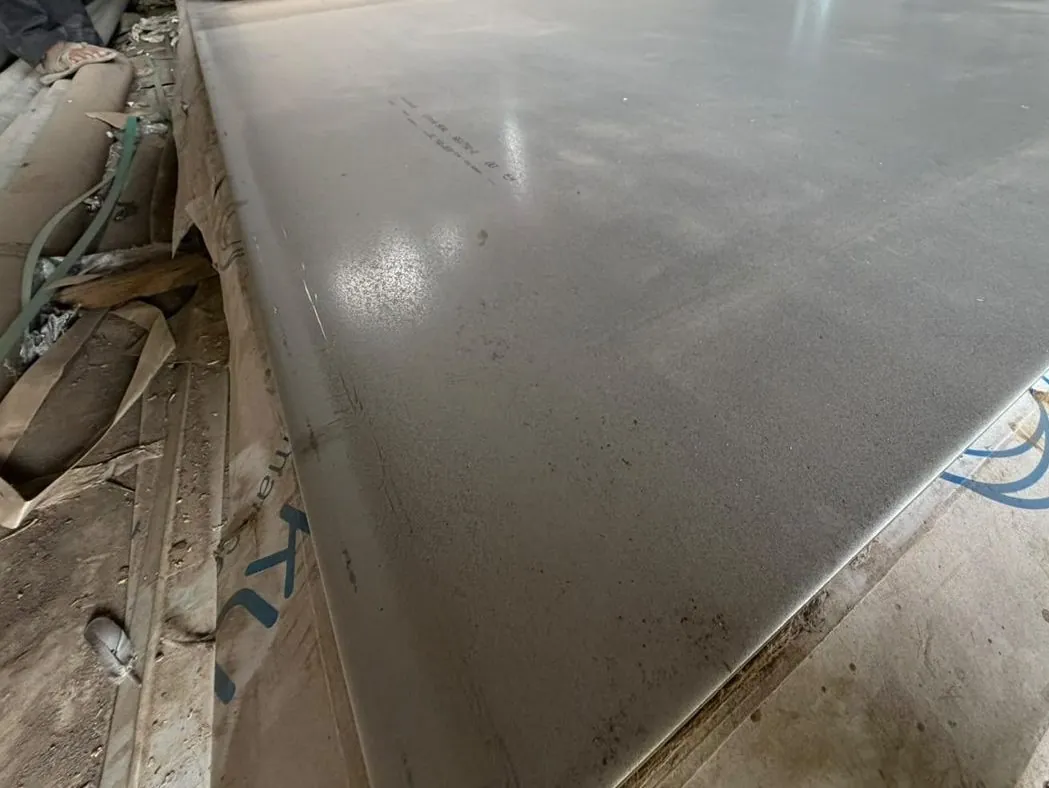
These three forms aren't quality tiers. A 904L plate and a 904L coil are the same alloy, held to the same standard. What separates them is dimension and supply class, you pick based on thickness, width, fabrication route and finish, then check that your grade actually comes in that form. Below you'll find the exact thresholds, the production reasons behind them, and a grade-by-grade availability table, so you get the right leaf on the first order.
Sheet vs plate vs coil at a glance
The table below gives you the fast answer. It covers where each flat-rolled form falls on thickness and width, how it's made, the finish you should expect, and what it's typically used for.
| Form | Thickness (ASTM A480) | Typical width | Production route | Typical finish | Supply form | Typical use |
|---|---|---|---|---|---|---|
| Plate | ≥ 4.76 mm (3/16") | > 250 mm (10") | Hot-rolled, cut-to-length | No.1 (HRAP) | Flat cut pieces | Vessel shells, tube sheets, structural |
| Sheet | < 4.76 mm (3/16") | ≥ 600 mm (24") | Cold- or hot-rolled | 2B, BA, No.4 | Cut lengths or coil | Tank walls, ducting, skins, cladding |
| Coil | Any sheet/strip gauge | Mill width (slit to order) | Cold- or hot-rolled, continuous | 2B, BA, No.4 (as the sheet it holds) | Continuous wound master coil | Press-shop feed, continuous lining, roll-forming |
| Strip | < 4.76 mm (3/16") | < 600 mm (24") | Cold-rolled, slit from coil | 2B, BA, No.4 | Slit coil | Narrow parts, gaskets, formed sections |
What is steel plate?
Steel plate is a flat-rolled product at least 4.76 mm (3/16") thick and more than 250 mm (10") wide, produced by hot rolling and supplied as discrete cut-to-length pieces rather than wound on a coil. Because it is rolled from slab on a reversing (plate) mill, it carries a hot-rolled, annealed and pickled surface, the No.1 (HRAP) finish, not a cold-rolled bright finish. Plate is the only correct form where section thickness, flatness and through-thickness properties matter: pressure-vessel plate, tube sheets, and heavy structural members. Some grades exist only as plate, pressure-vessel-quality A516 Gr 70, for example, has no standard sheet or coil form.
What is steel sheet?
Steel sheet is a flat-rolled product thinner than 4.76 mm (3/16") and at least 600 mm (24") wide. It can be hot-rolled, but for stainless it's more often cold-rolled to a bright, dimensionally tight surface, the familiar 2B, BA or No.4 finishes covered in our stainless finishes (2B, BA, No.4) guide. Sheet comes either as flat cut lengths or wound as coil and cut to length later. For tank walls, ducting, enclosures, architectural cladding, and thin-gauge fabrication work where formability and surface appearance matter most, it's the right form to specify.
What is steel coil?
Coil is a delivery and packaging form, not a thickness class. It's the continuous strip the mill winds after rolling, the master coil, sometimes called the mother coil, from which flat sheet gets cut to length and narrower slit coil and strip are produced. Any gauge within the sheet or strip range can ship as coil; the metallurgy matches the cut sheet it yields exactly. Buyers pick coil when they're feeding a press shop, a roll-forming line or a continuous lining operation and want an uninterrupted run instead of handling individual sheets. Order it by grade, gauge, coil width and finish. The surface classes are the same 2B/BA/No.4 you'd see on sheet.
The dimensional rule: how the forms are defined (ASTM A480)
The split between the forms is set by the general-requirements standard for flat-rolled stainless, ASTM A480/A480M, which the product standard ASTM A240 (and its ASME counterpart ASME SA-240) references. Two numbers do most of the work: one thickness break and two width breaks.
Thickness threshold
At or above 4.76 mm (3/16"), hot-rolled flat product counts as plate; below it, the product becomes sheet or strip. That single cutoff explains why a 5 mm order ends up plate while a 3 mm order of the identical grade ends up sheet. The number decides the form name, not what the product gets used for.
Width threshold
Width sets the lower bound for plate and separates it from the thin forms.
- Sheet, width ≥ 600 mm (24"), thickness below 4.76 mm.
- Strip, width < 600 mm (24"), thickness below 4.76 mm (typically slit from coil).
- Plate, width > 250 mm (10"), thickness at or above 4.76 mm.
| Break | Value | Separates |
|---|---|---|
| Thickness | 4.76 mm (3/16") | Sheet/strip (below) ↔ plate (at or above) |
| Width, thin product | 600 mm (24") | Strip (below) ↔ sheet (at or above) |
| Width, heavy product | 250 mm (10") | Lower bound for plate |
Production route and why it drives form
Steel shape comes down to how the mill rolls it. Plate gets hot-rolled from slab on a reversing mill, then cut to length, past a certain thickness it won't wind into tight coil, so heavy sections just stay flat. Sheet and coil, on the other hand, come off a strip mill: slab is hot-rolled into a continuous hot band, wound into coil, and for stainless it then gets cold-reduced, annealed, pickled, and re-wound. The continuous coil is the master form here. Flat sheet and slit strip get cut-to-length or slit from that coil afterward.
Coil and sheet share a production route. Plate doesn't. That's the physical reason you can't order heavy plate "as coil."
Finishes by form
Finish follows the route, so it follows the form. Hot-rolled plate carries the No.1 (HRAP) finish, a matte, annealed-and-pickled surface. Cold-rolled sheet and coil carry the bright 2B, mirror BA, or brushed No.4 finishes. The annealed / HRAP condition matters mechanically too, not just for looks: solution annealing restores the corrosion resistance of the flat product after rolling.
| Form | Typical finishes | Surface character |
|---|---|---|
| Plate | No.1 (HRAP) | Hot-rolled, annealed & pickled, matte |
| Sheet & coil | 2B, BA, No.4 | Cold-rolled, bright, mirror or brushed |
Form availability by grade: you can't always get every form
ASTM theory says any grade could be rolled to any form, but standards and real supply narrow it. Austenitic grades such as 304, 316 and 904L are made to ASTM A240 as sheet, plate and coil. The Ni-Fe-Cr alloy Incoloy 825 is made to ASTM B424 as sheet and plate, with coil only in limited gauges. A516 Gr 70 is a pressure-vessel-quality carbon steel to ASTM A516, it exists as plate only. At Nandini Steel every listed form is held ex-stock for immediate dispatch, cut from genuine mill material from Aperam, Outokumpu, Jindal, POSCO, Nippon Steel and JFE.
| Grade | Sheet | Plate | Coil | Governing standard | Stock reality at Nandini |
|---|---|---|---|---|---|
| 304 / 304L | ✓ | ✓ | ✓ | ASTM A240 / ASME SA-240 | All three forms ex-stock |
| 316 / 316L | ✓ | ✓ | ✓ | ASTM A240 / ASME SA-240 | All three forms ex-stock |
| 904L | ✓ | ✓ | ✓ | ASTM A240 / ASME SA-240 | Certified specialty, all forms ex-stock |
| Incoloy 825 | ✓ | ✓ | Limited | ASTM B424 / ASME SB-424 | Sheet & plate ex-stock; coil by indent |
| A516 Gr 70 | – | ✓ | – | ASTM A516 / ASME SA-516 + A20 | Plate only, ex-stock |
904L is the all-forms grade. Specify 904L coil for a continuous press feed, or pick the plate leaf for a vessel shell: it's the same super-austenitic alloy either way. Incoloy 825 is more limited. Incoloy 825 coil only comes in restricted gauges, so for most 825 work, the sheet or plate leaf is the right order to place. Still torn between grades? Start with selecting the grade first or try the grade selector, then come back here to settle on the form.
How to order the right form
Nandini Steel supplies an EN 10204 3.1 mill test certificate with every order, giving you heat/cast traceability with every form. A plate, a sheet, a coil, all travel with the same documented chemistry and mechanicals.
When you place a flat-rolled order, lay it out in four parts: standard, grade, dimension (thickness times width times length, or coil weight), and finish. State plainly that a mill test certificate is required.
Standards that cover each form
- Flat stainless (sheet, plate, coil): ASTM A240 / ASME SA-240.
- Incoloy 825 (sheet, plate): ASTM B424 / ASME SB-424.
- PVQ carbon plate: ASTM A516 / ASME SA-516 with ASTM A20 general requirements.
Cross-system designations (UNS, Werkstoff, and JIS) are gathered in our grade cross-reference.
Weight and how much to order
Before you raise the RFQ, convert your dimensions to mass. Use the steel weight calculator for a quick figure, the stainless steel weight chart for standard gauges, or work through the method in how to calculate plate weight. Working with heavy sections? Choosing plate thickness sets the section before you compute weight.
Examples: picking the form in practice
Three worked cases show the rule applied:
- Pressure-vessel shell, 12 mm wall → plate. Above the 4.76 mm threshold and needing certified through-thickness properties, this is cut plate to A240 or SA-516, never coil. See chemical-processing duty for grade choice.
- Tank skin or ducting, 2 mm wall → sheet (2B or BA). Below 4.76 mm and at least 600 mm wide, supplied as cut lengths or cut to length from coil.
- Continuous press-shop or roll-forming feed, 1.5 mm → coil. Same gauge as sheet, but wound so the line runs uninterrupted.
A practical note from the Nandini Steel Engineering Team: buyers sometimes order coil to save on the per-kg rate, then end up cutting and flattening it on site for parts that were really plate work all along. Coil-set and the cut edge eat right through that saving. Match the form to the fabrication, not to the headline price. For cut flat pieces above 4.76 mm, order plate instead.
FAQ
At what thickness does sheet become plate?
Is coil the same as sheet?
What is the difference between plate and coil?
Can I order 904L as coil?
Is A516 available as coil or sheet?
Does a mill test certificate come with every form?
Nandini Steel has carried ISO 9001:2015 certification since it opened its doors in 2003, working as a stockist and supplier of stainless, nickel-alloy, alloy-steel and PVQ flat products. Over more than 20 years the company has handled 307+ projects for 260+ clients, shipping to 36+ export countries. Every item sits ex-stock, ready for immediate dispatch, and pricing is available live on request. Need a sheet, plate or coil? Get an RFQ, or just message us on WhatsApp at +91 99202 09184.
Related guides: stainless finishes (2B, BA, No.4) · stainless steel weight chart · choosing plate thickness · selecting the grade first.