
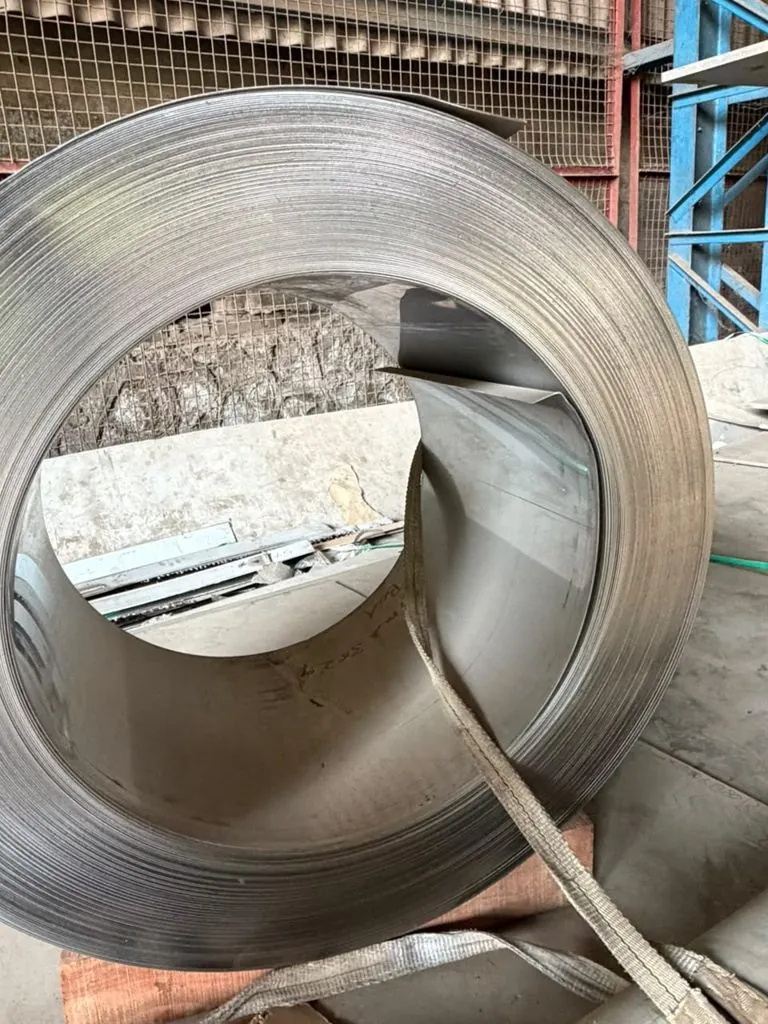
Inconel 600 at a glance
Designation: UNS N06600, Werkstoff 2.4816, commonly called INCONEL alloy 600, a nickel-chromium solid-solution alloy.
Nominal chemistry runs Ni ≥72%, Cr 14–17%, Fe 6–10%. The high nickel content handles chloride-SCC and caustic resistance; chromium takes care of oxidation resistance at high temperature.
In terms of high-temperature behavior, the alloy resists scaling and oxidation in continuous service up to roughly 1175 °C. It's essentially non-magnetic too.
This isn't a pitting alloy. It carries no molybdenum, so engineers specify it for oxidation and stress-corrosion duty rather than aqueous chloride pitting.
On the supply side, it's available ex-stock in sheet, plate, pipe, tube, round bar, forged fittings, flanges and fasteners. Each comes with an EN 10204 3.1/3.2 mill test certificate.
What is Inconel 600?
Inconel 600 is a nickel-chromium solid-solution alloy from the nickel-base family of nickel alloys. With a nickel matrix above 72% stiffened by 14–17% chromium, it does not depend on a passive film the way austenitic stainless steel does, the high nickel content keeps it ductile and tough across cryogenic to elevated temperatures and raises its threshold against chloride stress-corrosion cracking.
You reach for N06600 when a stainless steel would scale or crack. It holds a protective chromium-oxide scale in oxidising heat, and its nickel content resists chloride stress-corrosion cracking and caustic attack. It sits below Inconel 625, which adds molybdenum and niobium for aqueous and acid service, and below the aluminum-bearing Inconel 601 for the most extreme oxidation. Choose 600 when the duty is high-temperature oxidation plus SCC or caustic immunity, not wet pitting corrosion.
Chemical composition
Element ranges for UNS N06600, nickel-chromium alloy, weight percent.
| Element | Symbol | Composition (wt %) |
|---|---|---|
| Nickel (plus cobalt) | Ni | ≥ 72.0 |
| Chromium | Cr | 14.0 – 17.0 |
| Iron | Fe | 6.0 – 10.0 |
| Carbon | C | ≤ 0.15 |
| Manganese | Mn | ≤ 1.00 |
| Sulfur | S | ≤ 0.015 |
| Silicon | Si | ≤ 0.50 |
| Copper | Cu | ≤ 0.50 |
Mechanical properties
Typical minimums for annealed plate and sheet made to ASTM B168, in the hot-worked or mill-annealed condition.
| Property | Value (metric) | Value (imperial) |
|---|---|---|
| Tensile strength | ≥ 550 MPa | ≥ 80 ksi |
| Yield strength (0.2% offset) | ≥ 240 MPa | ≥ 35 ksi |
| Elongation in 2 in. | ≥ 30% | ≥ 30% |
| Hardness | ~ 65 – 85 HRB | ~ 65 – 85 HRB |
Physical properties
| Property | Value |
|---|---|
| Density | 8.47 g/cm³ |
| Melting range | 1354 – 1413 °C |
| Thermal conductivity (at 20 °C) | ~ 14.9 W/m·K |
| Mean coefficient of thermal expansion (20–100 °C) | ~ 13.3 µm/m·°C |
| Modulus of elasticity | ~ 207 GPa |
| Magnetic response | Essentially non-magnetic |
The 8.47 g/cm³ density is what drives plate and bar weight. Use it alongside our plate weight guide when you need to estimate shipping and fabrication masses.
Corrosion & high-temperature behavior
Inconel 600 earns its place through a mix of high-temperature oxidation resistance and immunity to the chloride and caustic failure modes that defeat austenitic stainless steel. It's a solid-solution alloy, supplied mill-annealed or solution-annealed around 1010–1120 °C, and heat treatment won't harden it.
High-temperature oxidation
Chromium forms a tough oxide scale that clings tight and shrugs off thermal cycling without flaking away, which lets the alloy handle continuous service to roughly 1175 °C and brief excursions beyond that. Furnace builders reach for N06600 in muffles, retorts and internals precisely because stainless would scale and warp in those same conditions.
Chloride-SCC & caustic resistance
Nickel content this high pushes the threshold against chloride stress-corrosion cracking well past what 304 or 316 austenitic grades can manage. The alloy also holds up against caustic corrosion, dry chlorine, and hydrogen chloride at high temperature. Hot chlorides, strong alkalis: that's where engineers reach for Inconel 600 instead of stainless.
Limits: where not to use it
Inconel 600 has no molybdenum in it, which means its pitting-resistance equivalent runs low, and it's not the alloy you'd pick for wet-chloride pitting service. For aqueous acid and pitting duty, move up to Inconel 625, which does carry molybdenum. There's also the matter of sulfur: Inconel 600 is vulnerable to attack from it at high temperatures, so exposure should stay limited in sulfur-bearing or strongly reducing atmospheres.
Equivalent grades & designations
| Standard / system | Designation |
|---|---|
| UNS | N06600 |
| Werkstoff (W.Nr.) | 2.4816 |
| DIN | NiCr15Fe |
| BS | NA14 |
| JIS | NCF 600 |
| AMS | 5540 / 5665 |
| Common name | INCONEL alloy 600 |
For switching between systems on a purchase order, check our UNS / W.Nr / JIS cross-reference.
Inconel 600 vs related grades
Inconel 600 is the solid-solution Ni-Cr workhorse; the grades built around it add elements for specific jobs. Use the "choose when" column to match the alloy to the actual service.
| Grade | Key chemistry difference | Choose when |
|---|---|---|
| Inconel 600 (N06600) | Ni-Cr, no Mo/Al | High-temperature oxidation plus chloride-SCC / caustic immunity |
| Inconel 601 (N06601) | Adds ~1.4% aluminum | Extreme, cyclic high-temperature oxidation |
| Inconel 625 (N06625) | Adds ~9% Mo + Nb | Aqueous acids, pitting and seawater service |
| Incoloy 800 (N08800) | Lower-Ni Ni-Fe-Cr | High-temperature strength at lower nickel cost |
vs Inconel 601
Inconel 601 adds aluminum to form an alumina-rich scale for even better resistance to cyclic oxidation at the highest temperatures. Specify 601 when oxidation and thermal cycling are the governing limit; 600 is usually sufficient and more widely stocked below that extreme.
vs Inconel 625
Inconel 625 adds molybdenum and niobium, shifting the alloy toward aqueous and acid corrosion resistance with much higher strength. When acids, pitting or seawater are involved, choose 625, Inconel 600's moat is heat and SCC, not wet-chloride pitting.
vs Incoloy 800
Incoloy 800 is a lower-nickel nickel-iron-chromium alloy used for high-temperature strength and resistance to oxidation and carburisation at a lower alloy cost. Inconel 600, with its higher nickel, holds a stronger edge in chloride-SCC and caustic environments.
Available forms, sizes & standards
Inconel 600 comes in both flat and long product forms, each made to its governing ASTM specification, with the matching ASME SB- designation. We keep all forms in stock for immediate dispatch, and we'll cut or cut-to-length on request.
| Form | Specification | Nandini range |
|---|---|---|
| Sheet / plate / strip | ASTM B168 (ASME SB-168) | Ex-stock, cut-to-size |
| Rod / round bar | ASTM B166 (ASME SB-166) | Inconel round bar |
| Seamless pipe / tube | ASTM B167 (ASME SB-167) | Inconel 600 pipe |
| Forgings | ASTM B564 (ASME SB-564) | forged fittings |
| Fittings | ASTM B366 (ASME SB-366) | pipe fittings |
| Flanges | ASME B16.5 / B16.47 | Inconel flanges |
| Fasteners | Bar to ASTM B166 | Inconel fasteners |
Material comes off genuine mill plate and bar sourced from producers like Aperam, Outokumpu, Jindal, POSCO, Nippon Steel and JFE, and every piece carries full heat and cast traceability.
Applications
Muffles, retorts, baskets, radiant tubes and thermocouple sheaths all depend on N06600's oxidation-resistant scale and its strength at high temperature. That's what lets them hold up through continuous furnace service.
Chemical & food processing. In plants handling caustic solutions, hot chlorides and dry chlorine or HCl, reactor and vessel components call for Inconel 600, since plain stainless would crack or corrode there. That includes chemical processing plant.
Steam-generator and reactor components rely on the alloy's resistance to stress-corrosion cracking in high-purity water, along with mechanical properties that hold steady across a wide temperature range.
Testing, certification & how to order
Every order of Inconel 600 comes with an EN 10204 3.1/3.2 mill test certificate, reporting chemistry and mechanical results against the applicable ASTM specification, with full heat and cast traceability. Positive material identification (PMI) is available on request to confirm grade before dispatch. For a rundown of what the document actually contains, see how to read the EN 10204 mill test certificate.
Nandini Steel has worked as an ISO 9001:2015-certified stockist and supplier since 2003 (Certificate No. 1283438, Unitas Certification Services UCS-UK, valid to 11 January 2028). Over more than 20 years the company has delivered 307+ projects to 260+ clients spread across 36+ export countries. Every grade sits ex-stock and ready for immediate dispatch. Rather than publish price tables, Nandini Steel quotes live pricing by RFQ.
To order, send in your form along with the dimensions, quantity, and specification, and we'll get you a quotation.
- Phone: +91 22 43404600 · +91 99202 09184
- WhatsApp: +91 99202 09184
- Email: reachus@nandinisteel.com
- GSTIN: 27ADJPA7240C1Z0