
Why choose 316L stainless steel
Molybdenum handles the chlorides. Add 2–3% Mo and you get the pitting and crevice resistance that plain 304 just doesn't have, pushing the pitting resistance equivalent (PREN) up to roughly 24 for 316L.
Carbon has to stay low for welding. Keep it at 0.03% or under and the grade remains weld-safe, resisting the intergranular corrosion / sensitization that attacks standard 316 in the heat-affected zone.
It's an austenitic workhorse: non-magnetic once solution-annealed, tough, formable, and welds easily with ER316L filler.
- Fully traceable, supplied with an EN 10204 3.1/3.2 mill test certificate on every order.
- Unambiguous identity, specified worldwide as UNS S31603, 1.4404, SUS316L or X2CrNiMo17-12-2.
What is 316L stainless steel?
316L is the low-carbon variant of 316, an austenitic stainless steel alloyed with chromium, nickel and molybdenum, and one of the austenitic stainless steel grades Nandini Steel stocks. The "L" marks a maximum carbon of 0.03%, which suppresses chromium-carbide precipitation during welding. Buyers choose 316L over 316 when a part is welded, and over 304 when the service environment contains chlorides that demand molybdenum.
Chemical composition
316L shares 316's molybdenum band but caps carbon far lower. Composition per ASTM A240 (weight %):
| Element | Symbol | Range (wt %) |
|---|---|---|
| Chromium | Cr | 16.0–18.0 |
| Nickel | Ni | 10.0–14.0 |
| Molybdenum | Mo | 2.0–3.0 |
| Carbon | C | ≤ 0.03 |
| Manganese | Mn | ≤ 2.0 |
| Silicon | Si | ≤ 0.75 |
| Phosphorus | P | ≤ 0.045 |
| Sulfur | S | ≤ 0.03 |
| Nitrogen | N | ≤ 0.10 |
| Iron | Fe | Balance |
The role of molybdenum
Molybdenum is what you are paying for in 316L. The 2–3% Mo addition stabilizes the passive film against chloride attack, so 316L resists pitting and crevice corrosion that pit 304 in coastal, marine and process-chloride duty. Match the Mo to the real pitting risk: dry, indoor, non-chloride service rarely needs it, while hot concentrated chlorides may need more than 316L offers.
Why the "L" (low carbon) matters
316L's carbon tops out at 0.03%. Standard 316 can carry up to 0.08%. That difference matters most in the 425–815 °C range, right where any weld heat-affected zone sits, carbon there combines with chromium to form grain-boundary carbides, stripping chromium from the surrounding metal and sensitizing the steel. Because 316L has so little carbon to begin with, that reaction never really gets going. The HAZ stays corrosion-resistant, and you skip post-weld solution annealing altogether.
Mechanical properties
Low carbon cuts strength a bit compared with 316; here are the minimum values in the annealed condition:
| Property | Minimum (annealed) |
|---|---|
| Tensile strength | ≥ 485 MPa (70 ksi) |
| Yield strength (0.2% proof) | ≥ 170 MPa (25 ksi) |
| Elongation (in 50 mm) | ≥ 40% |
| Hardness | ≤ 217 HB / ≤ 95 HRB |
Physical properties
| Property | Value |
|---|---|
| Density | 8.0 g/cm³ |
| Melting range | ~1375–1400 °C |
| Thermal conductivity (100 °C) | ~16.2 W/m·K |
| Elastic modulus | 193 GPa |
| Coefficient of thermal expansion (0–100 °C) | ~16.0 µm/m·°C |
| Magnetic response | Non-magnetic (solution-annealed) |
Cold work can leave 316L slightly magnetic. Fully solution-annealed 316, though, is non-magnetic.
Corrosion behavior & PREN
316L exists because of its corrosion resistance: enough molybdenum to fend off chlorides, and low enough carbon to stay sound after welding.
Pitting & crevice resistance
With Cr, Mo and N contributing, 316L carries a pitting resistance equivalent (PREN) of about 24, markedly better than 304's ~18. Where PREN sits in the austenitic ladder:
| Grade | Approx. PREN |
|---|---|
| 304 / 304L | ~18 |
| 316 / 316L | ~24 |
| 904L | ~34 |
| Incoloy 825 | ~31–40 |
Chloride stress-corrosion cracking
Like all austenitic grades, 316L is still vulnerable to chloride stress-corrosion cracking when it's under tensile stress in warm chloride environments. That's a limit baked into the austenitic structure itself, not a sign that the molybdenum content is lacking. Where hot, concentrated chlorides raise the risk of SCC, step up to a duplex or super-austenitic grade instead of 316.
Intergranular corrosion & sensitization: why 316L is weld-safe
Sensitization happens between 425 and 815 °C, when chromium carbides form at the grain boundaries. 316L avoids this through chemistry: its low carbon content leaves too little material to form those carbides. Welded fabrications made from it resist intergranular corrosion without needing a post-weld anneal. That's the whole reason welded pharma, food and chemical work calls for 316L instead of 316.
Equivalent grades & designations
316L carries one identity across every standards system:
| System | Designation |
|---|---|
| UNS | S31603 |
| Werkstoff (WNr) | 1.4404 |
| JIS | SUS316L |
| EN name | X2CrNiMo17-12-2 |
| AISI | 316L |
Full cross-referencing lives in our UNS / WNr / JIS cross-reference.
316L compared with 316, 304 and 904L
The molybdenum and carbon content are what settle the decision here. A common mistake is paying for 316 where dry, indoor conditions would be fine with 304, or going with 316L in hot, concentrated chlorides when the job really calls for 904L.
| Need | Choose | Why |
|---|---|---|
| Welded part, chloride exposure | 316L | Mo for pitting + low C against sensitization |
| Unwelded, chloride exposure | 316 | Same Mo; higher carbon acceptable without welds |
| General, dry, non-chloride | 304 | No Mo needed; lower cost |
| Sulfuric acid / severe chlorides | 904L | ~4.5% Mo + Cu, PREN ~34 |
See the full 316 vs 316L breakdown (molybdenum the same, carbon different), the 304 vs 316 comparison, and when to upgrade to 904L via 904L vs 316L. The broader 316 stainless steel grade sits alongside 316L in the same austenitic family.
Forms, sizes & weight
Nandini Steel keeps 316L ex-stock across both flat and long products: sheet, plate and coil, plus pipe, fittings, flanges and bar. It's all ready for immediate dispatch, and every bit of it is genuine mill material, sourced from Aperam, Outokumpu, Jindal, POSCO, Nippon Steel and JFE. Buyers get real traceability on 316 grade material without waiting on production runs.
| Form | Typical standards | Link |
|---|---|---|
| Sheet | ASTM A240 / B168 / B424 | 316L stainless steel sheet |
| Plate | ASTM A240 / A516 / B575 | 316L plate |
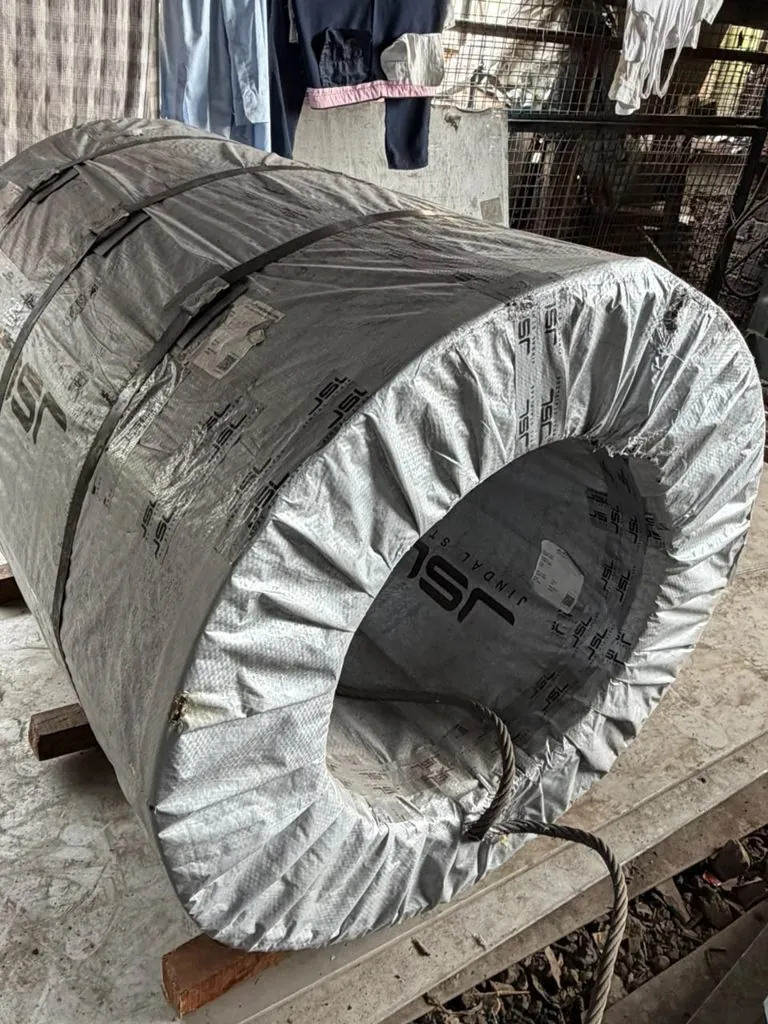
| Coil | ASTM A240 / B168 | 316L coil |
| Pipe & tube | ASTM A312 / A213 | stainless steel pipe |
| Pipe & forged fittings | ASTM A403 / A182, ASME B16.11 | stainless steel fittings |
| Flanges | ASME B16.5 / B16.47 | stainless steel flanges |
| Round bar | ASTM A276 / A479 | stainless steel round bar |
For theoretical weights by form and dimension, use our 316L weight calculator.
Finishes
316L flat products are stocked in the standard mill finishes: 2B (smooth, cold-rolled, the general-purpose default), No. 4 (brushed, satin), BA (bright annealed, reflective) and No. 1 / hot-rolled (plate, pickled and annealed). Finish selection is explained in our stainless steel finishes guide.
Welding & fabrication
316L is welded with a matching ER316L filler, and it doesn't need a post-weld anneal. Its low carbon content already blocks sensitization.
- Use ER316L filler to match composition and keep the weld low-carbon.
- Control interpass temperature and minimize time in the 425–815 °C sensitization band.
- Pickle and passivate the weld zone to restore the passive film.
Full procedure's in how to weld 316/316L. 316L machines and forms like other austenitics do: it work-hardens, so stick to sharp tooling, positive feeds and rigid setups. When heavy sections have been welded or cold-worked, a full solution anneal (around 1040–1110 °C, then a rapid quench) brings back maximum corrosion resistance.
Standards complied
316L flat products conform to ASTM A240 / ASME SA-240, with pipe to A312/A213, fittings and flanges to A403/A182, and bar to A276/A479. Intergranular corrosion is verified to ASTM A262 and passivation to ASTM A967 where specified.
Testing & certification
Every 316L order ships with an EN 10204 3.1/3.2 mill test certificate reporting heat chemistry and mechanical results against ASTM A240. Positive material identification (PMI), intergranular corrosion testing (ASTM A262) and ultrasonic testing are available on request, see our testing, MTC, NDT & PMI overview. Nandini Steel is an ISO 9001:2015-certified stockist (Certificate No. 1283438, Unitas Certification Services UCS-UK, valid to 11 January 2028).
Applications by industry
316L is the chloride-and-weld workhorse across process industry:
- Marine, fittings, railings and splash-zone fabrications where chlorides pit 304.
- Pharmaceutical / hygienic, welded, electropolished vessels and tubing that need a clean HAZ free of sensitization.
- Chemical processing, tanks, heat exchangers and piping handling moderate chloride and acid duty.
- Food & beverage, hygienic surfaces and welded tanks in wet, chloride-bearing service.
Price
Nandini Steel quotes 316L on an RFQ basis, request a quote for live pricing only, matched to your form, dimensions, finish and quantity. All products ship ex-stock for immediate dispatch, which covers the full 316 range as well.
Expert note from the Nandini Steel Engineering Team
Buyers often pay for 316 where a dry, indoor, non-chloride setting would really only call for 304, or they under-spec 316 for hot, concentrated chlorides when 904L or duplex is what's actually needed. That 2–3% molybdenum content is the whole reason you're paying more, so match it to the real pitting risk rather than guessing. For welded pharma and food work, specify 316L. It keeps the heat-affected zone corrosion-resistant without needing post-weld annealing.
FAQ
What is 316L stainless steel?
What is the difference between 316 and 316L?
Is 316L magnetic?
Is 316L marine grade stainless steel?
What is the PREN of 316L?
Can you weld 316L without post-weld heat treatment?
Request a quote
Give us the grade, form, dimensions, finish and quantity, and the Nandini Steel team will come back with live 316L pricing and current stock availability. Every order ships ex-stock, and each one comes with an EN 10204 3.1/3.2 mill test certificate. Reach us by phone at +91 22 43404600, on WhatsApp at +91 99202 09184, or by email at reachus@nandinisteel.com.