
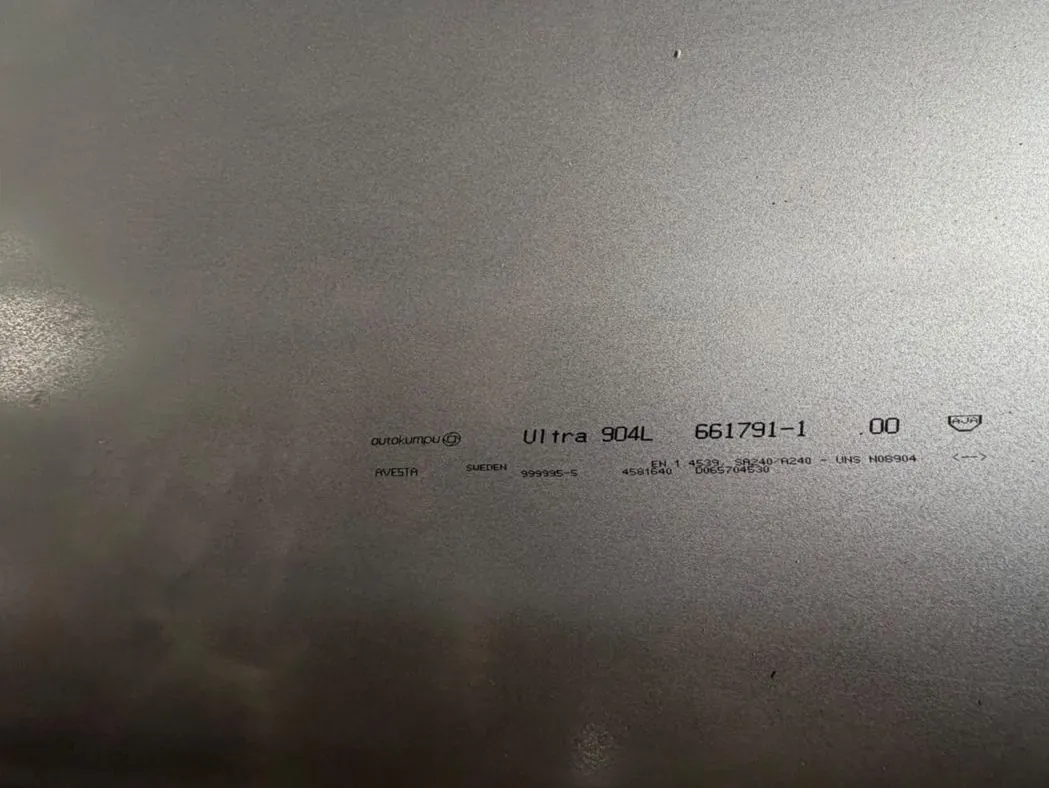
Key takeaways: why choose 904L
- Super-austenitic chemistry: 904L belongs to the super-austenitic stainless steel family, a high-nickel, high-molybdenum, copper-bearing grade designed to run where standard austenitics corrode.
- PREN ~34: its pitting resistance equivalent number sits near 34, roughly 40% above 316's ~24, so it resists chloride pitting and crevice attack in media that would pit 316L.
- Copper for acid: the ~1.5% copper addition is what gives 904L its signature resistance to dilute and mid-concentration sulfuric acid, the reason the grade exists.
- Outperforms 316L in chloride SCC: its ~25% nickel content raises resistance to chloride stress-corrosion cracking well beyond 316L's.
- Fully austenitic, low-magnetic: solution-annealed 904L is essentially non-magnetic, and its low carbon (≤0.02%) keeps it free of weld sensitization.
- Certified specialty, supplied ex-stock: 904L is one of the grades named on Nandini Steel's ISO 9001:2015 certificate, held ex-stock as sheet, plate and coil for immediate dispatch with an EN 10204 3.1/3.2 mill test certificate.
What is 904L stainless steel?
904L is a low-carbon super-austenitic stainless steel, designated UNS N08904 and Werkstoff 1.4539. "Super-austenitic" means it keeps the single-phase austenitic structure of ordinary 18-8 stainless, but it carries far higher alloy content: about 25% nickel, 4.5% molybdenum, and a deliberate ~1.5% copper addition, over a 19–23% chromium base. That chemistry puts it a clear step above 316L on the corrosion ladder, yet it doesn't cross into duplex or nickel-alloy territory.
The grade was developed for one job: handling sulfuric acid and aggressive chlorides that defeat 316L, at a lower cost than nickel alloys such as Alloy 20 or titanium. Within the wider range of stainless steel grades it is the cost-justified upgrade a specifier reaches for when 316L pits, cracks or corrodes, not a general-purpose grade.
904L is best known to most people as the steel behind some luxury wristwatches, but that reputation rests on polish and marketing, nothing more. Its actual job is far less glamorous: an industrial corrosion-resistant alloy for process plant. That's where its metallurgy earns its keep.
Chemical composition
Composition per UNS N08904 to ASTM A240 (weight %, balance iron).
| Element | 904L (N08904) |
|---|---|
| Carbon (C) | ≤ 0.020 |
| Chromium (Cr) | 19.0–23.0 |
| Nickel (Ni) | 23.0–28.0 (~25) |
| Molybdenum (Mo) | 4.0–5.0 (~4.5) |
| Copper (Cu) | 1.0–2.0 (~1.5) |
| Manganese (Mn) | ≤ 2.0 |
| Silicon (Si) | ≤ 1.0 |
| Phosphorus (P) | ≤ 0.045 |
| Sulfur (S) | ≤ 0.035 |
| Iron (Fe) | Balance |
Why the copper and extra molybdenum matter
Three deliberate additions set this grade apart. The ~4.5% molybdenum content, nearly double what you'd find in 316, drives the high PREN and fights off chloride pitting and crevice corrosion. More distinctive is the ~1.5% copper: it specifically slows general corrosion in reducing acids. That's the reason 904L holds up against sulfuric acid where molybdenum by itself would fail. Nickel at roughly 25% stabilizes the austenite and pushes up resistance to chloride stress-corrosion cracking. Carbon stays capped at ≤0.02%, so the grade avoids chromium-carbide sensitization as welded.
Mechanical properties
Minimum properties in the solution-annealed condition, per ASTM A240.
| Property | 904L minimum |
|---|---|
| Tensile strength | ≥ 490 MPa (71 ksi) |
| 0.2% yield strength | ≥ 220 MPa (32 ksi) |
| Elongation in 50 mm | ≥ 35% |
| Hardness | ≤ 90 HRB |
904L isn't a high-strength grade, its yield sits close to 316L's. Where chloride resistance has to come paired with higher strength, duplex 2205 is the alternative, covered below.
Physical properties
| Property | Value (approx.) |
|---|---|
| Density | 7.95 g/cm³ |
| Melting range | 1300–1390 °C |
| Thermal conductivity (RT) | 11.5 W/m·K |
| Mean CTE (20–100 °C) | 15.3 µm/m·°C |
| Elastic modulus | 190 GPa |
| Magnetic response | Essentially non-magnetic (annealed) |
Is 904L magnetic?
In the solution-annealed condition, 904L is fully austenitic and essentially non-magnetic. Its high nickel content makes the austenite more stable than in 304 or 316, so it's less prone to picking up magnetism from cold work. A near-nil magnetic response is normal here, not a sign of the wrong grade.
Corrosion behavior and PREN
Corrosion resistance is the whole reason PREN exists for 904L. Its PREN comes in around 34, worked out as Cr + 3.3·Mo + 16·N, which puts it well ahead of the 316 family and nearly on par with duplex 2205. Copper is what sets it apart, though: it hands 904L acid resistance that neither of the other two grades can match.
Sulfuric-acid resistance: the reason 904L exists
904L resists dilute and mid-concentration sulfuric acid across a wide temperature band. That's the service it was developed for. Copper suppresses general corrosion in reducing conditions, which lets 904L hold up in situations where 316L would simply get consumed. Before committing to either alloy, check the actual acid concentration and temperature against the 904L iso-corrosion limits. The detail is on sulfuric-acid resistance.
Chloride pitting, crevice and SCC vs 316L
With ~4.5% molybdenum, 904L resists pitting corrosion and crevice corrosion in chloride media that would attack 316L. Its ~25% nickel also lifts resistance to chloride stress-corrosion cracking, the failure mode that limits austenitic grades in warm chlorides, so 904L outperforms 316L in chloride SCC. The PREN ladder shows where each grade sits:
| Grade | PREN (approx.) | Step up when… |
|---|---|---|
| 304 | ~18 | baseline, no chlorides |
| 316 | ~24 | moderate chlorides, marine atmosphere |
| 904L | ~34 | sulfuric acid, hot chlorides |
| Duplex 2205 | ~35 | chloride SCC plus strength |
| Super-Duplex 2507 | ~43 | aggressive seawater, high chlorides |
Equivalent grades and designations
| System | Designation |
|---|---|
| UNS | N08904 |
| Werkstoff (W.-Nr.) | 1.4539 |
| EN name | X1NiCrMoCu25-20-5 |
| AISI | 904L |
| BS | 904S13 |
| JIS | No direct equivalent |
Full cross-referencing is on the UNS / Werkstoff cross-reference table.
904L vs other grades: when to choose what
904L sits on an upgrade ladder: step up to it when 316L is not enough, and step past it only when the service genuinely demands a 6-moly or super-duplex grade. The matrix below frames the decision.
| Grade | PREN | Mo | Ni | Acid / chloride strength | Choose when… |
|---|---|---|---|---|---|
| 316L | ~24 | 2–3% | ~10–14% | moderate | baseline chloride service |
| 904L | ~34 | ~4.5% | ~25% | high (sulfuric acid) | 316L pits or acid exceeds it |
| Duplex 2205 | ~35 | ~3% | ~5% | high + strength | chloride SCC with higher yield |
| 254 SMO (6-Mo) | ~43 | ~6% | ~18% | very high | seawater, strong brines |
| Alloy 20 | ~28 | ~2.5% | ~33% | very high (hot H₂SO₄) | hot concentrated sulfuric acid |
904L vs 316L
This is the core upgrade decision. 904L carries roughly twice the molybdenum of 316L and more than double the nickel, which buys a higher PREN, better sulfuric-acid resistance and far stronger resistance to chloride SCC. That comes at a higher price, though. Specify it only where 316L's envelope is genuinely exceeded. You'll find the full side-by-side on 904L vs 316L.
904L vs duplex 2205
904L and duplex 2205 have almost identical PREN, but they solve different problems: 2205 adds roughly double the yield strength and strong chloride SCC resistance, while 904L adds copper for reducing-acid service and is easier to form and weld. The trade-off is laid out on 904L vs duplex 2205.
904L vs 254 SMO, Alloy 20 and titanium
Above 904L, the ladder keeps going: 254 SMO (6% molybdenum) for seawater and strong brines, Alloy 20 for hot concentrated sulfuric acid, and titanium for oxidizing chloride service such as wet chlorine. The costly mistake happens when people jump straight to one of these, or to Inconel 625, without realizing that 904L's copper-bearing ~4.5% Mo chemistry already handles the job for less money.
Forms, sizes and availability
Nandini Steel keeps 904L on hand in flat product, ex-stock and ready for immediate dispatch. It's cut from genuine mill plate supplied by Aperam, Outokumpu, Jindal, POSCO, Nippon Steel and JFE.
904L sheet
Thin-gauge flat stock built for tanks, linings, heat-exchanger parts and acid-plant fabrication. Check out 904L stainless steel sheet for gauges, widths and finishes.
904L plate
Heavier flat product for vessels, reactors and structural acid-service fabrication. See 904L plate for thickness and plate-size ranges.
904L coil
Mill coil for slitting, blanking and continuous production is available ex-stock. See 904L coil for widths, thicknesses and coil weights.
Weight and how to calculate
Flat-product weight follows directly from the 7.95 g/cm³ density:
Weight (kg) equals length (m) times width (m) times thickness (mm) times 7.95.
A 2.44 m × 1.22 m × 6 mm 904L plate works out to 2.44 × 1.22 × 6 × 7.95 ≈ 142 kg. For other sizes, run the numbers through the 904L weight calculator; if you want to see the method behind it, the plate-weight guide walks through it step by step. Flat stainless products like these fall under HSN heading 7219/7220 for import classification purposes.
Finishes
904L flat product is available in the standard mill finishes:
- 2B, smooth, cold-rolled, lightly reflective; the default for sheet.
- No. 1 (HRAP), hot-rolled, annealed and pickled; typical of plate.
- BA, bright-annealed, highly reflective cold-rolled.
- No. 4, directional brushed finish.
Finish selection by product gets covered in the 2B, BA and No. 4 finishes guide.
Standards complied
904L flat product is supplied to ASTM A240 / ASME SA-240 for chemistry and mechanicals, the pressure-vessel edition is ASME SA-240, with traceability certified to EN 10204.
Testing and certification
Every 904L order ships with an EN 10204 3.1/3.2 mill test certificate carrying full heat and cast traceability. On request, we can supply 904L with positive material identification (PMI) to confirm molybdenum and copper content, plus an intergranular-corrosion test to ASTM A262 proving sensitization resistance. You'll find the full inspection scope described under testing, MTC, NDT and PMI, and there's guidance on reading the paperwork under reading a mill test certificate.
Welding and fabrication
904L welds easily with any of the common processes, but two things about the technique actually matter.
- Use an over-alloyed filler, ER385 (Avesta P12-R / 904L) or a nickel-base consumable such as ERNiCrMo-3. Never go with a matching-composition wire; weld metal segregation will leave the joint weaker against corrosion than the plate itself. For the full reasoning behind filler choice, see weld filler selection.
- Keep heat input and interpass temperature low to protect corrosion resistance in the HAZ.
Austenitics like 904L work-harden, so sharp tooling, positive feeds and lower machining speeds are necessary. After heavy forming or welding, a full solution anneal (roughly 1100–1150 °C followed by a rapid quench) brings corrosion resistance back to its peak. For the step-by-step procedure, see how to weld 904L; the metallurgy behind it is covered in what is super-austenitic 904L.
Applications by industry
904L is specified where corrosion, not strength, governs the design: sulfuric-acid and chemical processing plant, fertilizer and acid-regeneration service, pharmaceutical and hygienic process lines, pulp and paper bleaching equipment, and flue-gas desulfurization (FGD) scrubbers in power generation. In each case it is chosen as the upgrade from 316L once chlorides or acids exceed that grade's limit.
Pricing and how we quote
Nandini Steel keeps no price tables on hand, since 904L pricing shifts with mill, size, finish and quantity. Every form sits ex-stock, ready to ship; send an RFQ with grade, form, dimensions and quantity and you'll get live pricing back. The company has operated since 2003 as an ISO 9001:2015-certified stockist and supplier, with certified expertise in 904L specifically. Over that time it's completed 307+ projects for 260+ clients spread across 36+ export countries.
904L stainless steel FAQ
Is 904L stainless steel magnetic?
Is 904L better than 316L?
Why does 904L contain copper?
What is 904L stainless steel used for?
Is 904L the same as the steel in Rolex watches?
Request a quote
Send your 904L inquiry to Nandini Steel for live pricing and stock confirmation, grade, form (sheet, plate or coil), dimensions, finish and quantity. All material ships ex-stock with an EN 10204 3.1/3.2 mill test certificate.
- Phone: +91 22 43404600 · +91 9920209184
- WhatsApp: +91 99202 09184
- Email: reachus@nandinisteel.com
- Address: 25, Dreamland Building, 601, 6th Floor, Mama Parmanand Marg, Charni Road, Opera House, Girgaon, Mumbai, Maharashtra 400004, India
- GSTIN: 27ADJPA7240C1Z0