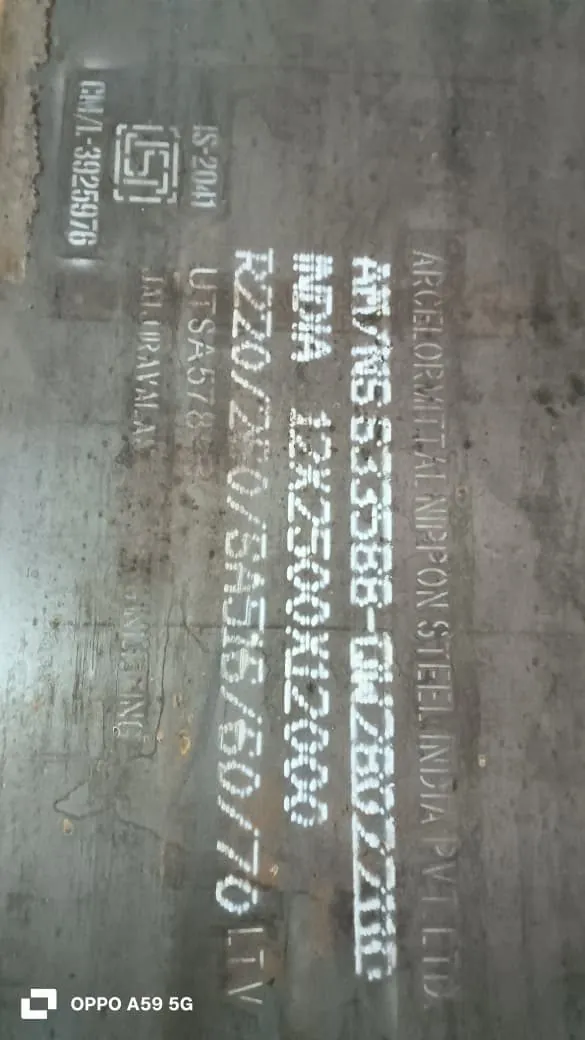
Nandini Steel is an ISO 9001:2015 certified stockist and supplier of carbon steel since 2003, holding 1 grades ex-stock in Mumbai with EN 10204 3.1/3.2 mill test certificates and full heat-to-cast traceability. The focus is A516 Grade 70 pressure-vessel plate in normalized and NACE-HIC sour-service variants to ASME SA-516.
We cut, slit and supply to your dimensions and ship worldwide with full export documentation. Browse the range below, then send your grade, form, size and quantity for a same-day quotation.
Pressure-vessel quality (PVQ) carbon steel plate
Carbon steel plate for pressure vessels, boilers and storage tanks is specified as pressure-vessel quality, commonly abbreviated PVQ, which means the plate carries tighter chemistry control, defined mechanical minimums and mandatory mill testing beyond what structural carbon steel plate requires. A516 Grade 70 plate is the standard PVQ grade for this duty, conforming to ASTM A516 and its ASME equivalent SA-516. Nandini Steel stocks A516 plate ex-stock in Mumbai for immediate dispatch, with EN 10204 3.1/3.2 mill test certificates traceable to heat number on every order, under our ISO 9001:2015 certification (Cert No. 1283438).
A516 Grade 60 vs Grade 70
A516 Grade 60 and A516 Grade 70 plate share the same ASTM A516 specification and a similar carbon-manganese-silicon chemistry window, but Grade 70 carries a higher minimum tensile and yield strength than Grade 60. That higher strength lets a designer use a thinner Grade 70 plate for the same design pressure compared with Grade 60, which is why Grade 70 is the grade most frequently requested for new pressure-vessel and boiler fabrication, while Grade 60 still appears on older designs and lighter-duty vessels. A516 Grade 60 plate remains available ex-stock alongside Grade 70 for projects that specify it directly.
Normalized and NACE HIC-tested plate
Two conditions of A516 Grade 70 plate cover duty that plain as-rolled plate cannot. Normalized A516 plate is heat-treated to refine the grain structure and improve low-temperature impact toughness, which is required whenever the vessel's design temperature calls for Charpy impact testing rather than as-rolled properties alone. NACE HIC-tested A516 plate is tested per NACE TM0284 to confirm resistance to hydrogen-induced cracking, the specific failure mode that plain Grade 70 plate is not qualified against in sour, wet H2S service. Buyers who skip stating normalizing or HIC-testing on the purchase order are the most common source of rejected plate at receiving inspection, so always confirm plate thickness and service condition up front, since the mechanical minimums and the normalizing requirement both vary with section size.
Standards: ASTM A516 / ASME SA-516 / A20
A516 plate is governed by ASTM A516 and its ASME equivalent ASME SA-516, which set the chemical composition and mechanical property requirements for carbon steel plate used in moderate and lower-temperature pressure-vessel service. ASTM A20 is the general requirements specification that sits alongside A516, covering supplementary requirements such as additional testing, marking, and the normalizing and impact-test options a purchaser can invoke on the order. Reading A516 or SA-516 together with A20 is how the exact testing and heat-treatment condition of a given plate order gets defined.
| Condition | Standard reference | Typical duty |
|---|---|---|
| As-rolled Grade 70 | ASTM A516 / ASME SA-516 | General pressure vessels, ambient to moderate temperature |
| Normalized Grade 70 | ASTM A516 + ASTM A20 | Low-temperature vessels requiring Charpy impact testing |
| HIC-tested Grade 70 | ASTM A516 + NACE TM0284 | Sour, wet H2S service |
Carbon steel plate applications: boilers, pressure vessels, sour service
Carbon steel plate in A516 Grade 70 is the default material for boiler shells, pressure vessels, storage tanks and gas-liquid separators across refining, oil and gas and general process industries, chosen for its reliable strength and weldability at a lower cost than any stainless or nickel alloy. Normalized plate extends that same grade into lower-temperature vessel service where impact toughness matters, and HIC-tested plate extends it into sour, H2S-bearing service where hydrogen-induced cracking would otherwise shorten vessel life. Across all three conditions, the plate ships ex-stock with full mill traceability so the fabricator's documentation matches the vessel code requirement.
Browse carbon steel