
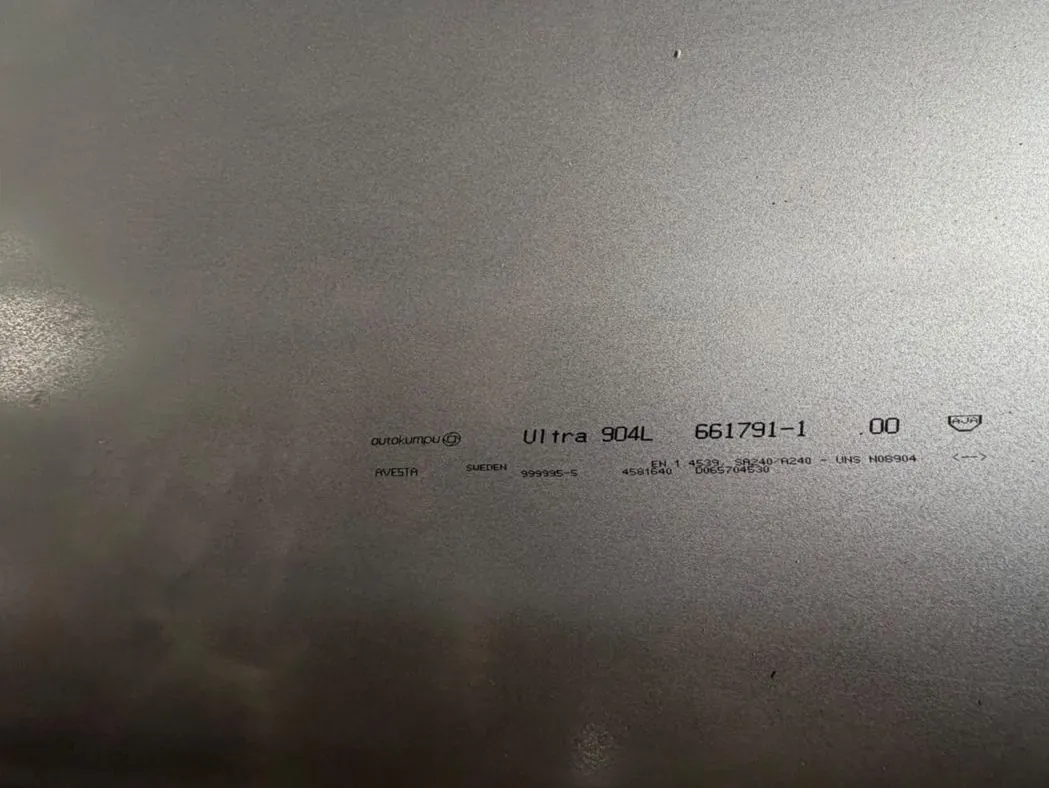
Key takeaways: 904L plate at a glance
- Designation: UNS N08904, Werkstoff 1.4539, a copper-bearing super-austenitic stainless steel, not your standard 300-series austenitic.
- Why it exists: roughly 1.5% copper and about 4.5% molybdenum hand it a signature resistance to sulfuric acid and other reducing acids, exactly the conditions where 316L and 316 corrode.
- PREN ~34: resists chloride pitting and crevice attack well above 316 and 316L.
- Chloride SCC: that high nickel content, roughly 25%, pushes the stress-corrosion-cracking threshold up. The result: 904L holds up far better than 316L in hot chloride service.
- Supplied as plate: to ASTM A240 / ASME SA-240 and ASTM B625 / ASME SB-625, ex-stock. Every order ships with an EN 10204 3.1/3.2 mill test certificate.
What is 904L stainless steel plate?
904L is a fully austenitic, low-carbon stainless steel (UNS N08904, Werkstoff 1.4539) that sits in the super-austenitic stainless steel family. Its defining feature is a deliberately high alloy content, about 25% nickel, 4.5% molybdenum, 20% chromium and, unusually, 1–2% copper. That copper addition is what separates 904L from conventional grades: it suppresses corrosion in reducing acids such as sulfuric acid, which attack chromium-only stainless steels.
As plate, 904L is the grade a specifier reaches for once 316L has hit its limit in acid or chloride service, though a nickel-base alloy such as Alloy 825 or 625 would be overkill for the duty. The full 904L grade hub covers the alloy across all forms. Plate is the annealed, descaled flat product used for vessels, linings, tube sheets and heavy fabrications.
Chemical composition
Composition for UNS N08904 flat product per ASTM A240 (weight %, balance iron):
| Element | Symbol | Content (wt %) |
|---|---|---|
| Carbon | C | ≤ 0.020 |
| Chromium | Cr | 19.0 – 23.0 |
| Nickel | Ni | 23.0 – 28.0 |
| Molybdenum | Mo | 4.0 – 5.0 |
| Copper | Cu | 1.0 – 2.0 |
| Manganese | Mn | ≤ 2.0 |
| Silicon | Si | ≤ 1.0 |
| Phosphorus | P | ≤ 0.045 |
| Sulfur | S | ≤ 0.035 |
| Iron | Fe | Balance |
The role of copper and molybdenum
Molybdenum drives pitting and crevice resistance, almost every point of PREN beyond what chromium provides comes from the roughly 4.5% Mo content. Copper does quieter work. It slows the corrosion rate in reducing environments, which is why 904L performs so well in dilute-to-mid-concentration sulfuric acid. Extra-low carbon, at or below 0.02%, keeps chromium in solution so the plate resists intergranular attack after welding. That limits sensitization between 425 and 815 °C.
Mechanical properties
Minimum room-temperature properties for solution-annealed 904L plate per ASTM A240:
| Property | Minimum value |
|---|---|
| Tensile strength | 490 MPa (71 ksi) |
| Yield strength (0.2% offset) | 220 MPa (32 ksi) |
| Elongation in 50 mm | 35% min |
| Hardness | ≤ 90 HRB |
904L work-hardens a fair amount during cold forming. Plan your forming forces and spring-back with that in mind, and solution-anneal whenever heavy cold work precedes corrosive service.
Physical properties
| Property | Value |
|---|---|
| Density | 7.95 g/cm³ |
| Melting range | ~1300 – 1390 °C |
| Thermal conductivity (20 °C) | ~11.5 W/m·K |
| Mean coefficient of thermal expansion (20–100 °C) | ~15.3 µm/m·°C |
| Elastic modulus | ~190 GPa |
| Magnetic response | Non-magnetic (austenitic) |
The 7.95 g/cm³ density figure is what gets used in the plate weight calculation below.
Corrosion behavior & PREN: why 904L plate exists
904L earns its spot almost entirely on corrosion resistance. On the orderable PREN ladder it sits well above the common austenitics and close to lean duplex: 304 (~18) < 316/316L (~24) < 904L (~34) < Duplex 2205 (~35), with Incoloy 825 around 31–40 and super-duplex 2507 near 43. Three mechanisms decide whether 904L plate is the right call, and the sections below cover each one.
Sulfuric-acid resistance
The copper addition gives 904L its signature sulfuric-acid resistance across dilute and intermediate concentrations where 316L suffers rapid general attack. Before upgrading, check the actual acid concentration and temperature against the published 904L iso-corrosion curves, within those limits 904L is a cost-justified answer for sulfuric-acid plant, pickling and acid-regeneration duty.
Pitting & crevice corrosion: PREN ~34
With a PREN of about 34 (PREN = Cr + 3.3·Mo + 16·N), 904L resists chloride-driven pitting and crevice corrosion at chloride levels and temperatures that would initiate attack on 316L. That margin makes it suitable for brackish water, bleach and process streams where pitting and crevice corrosion are the controlling failure modes.
Chloride stress-corrosion cracking
Austenitic stainless steels are vulnerable to chloride stress-corrosion cracking, and 316L cracks under hot chloride loads. The high ~25% nickel content of 904L raises the SCC threshold substantially, so 904L outperforms 316L in hot chloride environments, one of the main reasons it is chosen for heat-exchanger and vessel plate in chloride-bearing service.
Equivalent grades & designations
| System | Designation |
|---|---|
| UNS | N08904 |
| Werkstoff (W.-Nr.) | 1.4539 |
| EN | X1NiCrMoCu25-20-5 |
| BS | 904S13 |
| AISI | 904L |
| JIS | No direct equivalent |
For cross-system matching on the PO and MTC, check the UNS/Werkstoff UNS/W.Nr/JIS cross-reference table.
904L plate vs the alternatives: when to choose it
904L sits partway up an upgrade ladder. The real question is rarely whether 904L is good; it's whether 904L is the right rung. See the table below for where each neighbor wins.
| Grade | PREN (approx.) | Choose when… |
|---|---|---|
| 316 / 316L | ~24 | Mild chlorides, no reducing acid, do not over-spec. |
| 904L | ~34 | Sulfuric/reducing acid or high chloride beyond 316L, below a 6-Mo need. |
| Duplex 2205 | ~35 | Similar pitting resistance with higher strength and chloride-SCC resistance; weight-critical or structural duty. |
| Alloy 20 | ~30+ | Hot concentrated sulfuric acid beyond 904L limits. |
| 254 SMO (6-Mo) | ~43 | Seawater and severe chloride service where 904L pits. |
| Titanium | – | Oxidising chlorides and wet chlorine where stainless fails. |
904L vs 316L
316L carries 2–3% molybdenum; 904L roughly doubles that figure and adds copper. The practical upshot is a sharp jump in resistance to reducing acids and chlorides. For the full breakdown of cost versus service life, see our 904L vs 316L comparison.
904L vs Duplex 2205
904L and Duplex 2205 land in the same ballpark on PREN. Duplex pulls ahead on strength and holds up better against chloride-SCC. 904L, by contrast, is fully austenitic. That makes it easier to form into complex vessel shapes, and it has the edge in reducing acids where copper matters. For the full breakdown, see the 904L vs duplex 2205 comparison.
904L vs 316, Alloy 20, 254 SMO & titanium
Choose 316 only for mild duty. Step past Alloy 20 when copper-bearing 904L already covers the acid, and move to 254 SMO or super-duplex only where seawater-grade chloride resistance is genuinely required. Reserve titanium for oxidising-chloride service outside the stainless envelope.
Forms, sizes & thickness ranges
Nandini Steel keeps 904L plate on hand across the common hot-rolled thickness range, cut and supplied to order. Every plate ships ex-stock, so dispatch is immediate.
| Attribute | Typical range |
|---|---|
| Thickness | 3 mm – 50 mm (heavier on request) |
| Width | up to 2500 mm |
| Length | up to 6000 mm (cut to size) |
| Condition | Solution-annealed, descaled |
Other 904L forms
For thinner gauges and continuous product, check out 904L sheet and 904L coil. The grade also comes as plate, along with sheet and coil, through the 904L grade hub.
Plate weight & how to calculate
904L plate weight follows directly from its 7.95 g/cm³ density:
Weight (kg) = thickness (mm) × width (m) × length (m) × 7.95
Worked example: a 10 mm × 1.25 m × 2.5 m plate.
10 × 1.25 × 2.5 × 7.95 = 248.4 kg.
| Thickness | Weight per m² (kg) |
|---|---|
| 3 mm | 23.85 |
| 6 mm | 47.70 |
| 10 mm | 79.50 |
| 20 mm | 159.00 |
For other sizes use the weight calculator.
Finishes
904L plate usually comes hot-rolled, annealed and pickled, the No.1 finish, which gives the clean, oxide-free surface that corrosive service demands. Thinner plate can be furnished with a 2B cold-rolled finish when a smoother surface is called for. The finish should match the duty. For acid and chloride vessels, a pickled No.1 surface is standard.
Standards & specifications complied
904L plate meets ASTM A240 and its pressure-vessel counterpart ASME SA-240, both chromium-nickel stainless plate specifications. N08904, as a higher-alloy flat product, also needs to satisfy ASTM B625 / ASME SB-625.
ASTM A240 vs ASTM B625/SB-625 for N08904
A240/SA-240 sits inside the stainless plate standard and covers N08904; it's the call-out people usually reach for on vessel plate. B625/SB-625, on the other hand, is the dedicated spec for N08904 and its super-austenitic flat-product relatives. Both reference the same chemistry and the same annealed condition. Specify whichever one your code or client demands, and Nandini Steel will certify to it.
Testing, inspection & certification
Every 904L plate order ships with an EN 10204 3.1 mill test certificate, or MTC, with 3.2 available on request. It reports the actual heat chemistry and mechanical results checked against the ordered standard, and full heat and cast traceability is stamped right onto the plate. Intergranular-corrosion testing per ASTM A262, positive material identification (PMI) and ultrasonic testing (UT) can be arranged on request. All material is genuine mill plate from established producers such as Aperam, Outokumpu, Jindal, POSCO, Nippon Steel and JFE, supplied with the original mill certification.
Applications of 904L plate by industry
904L plate gets specified any time reducing acids and chlorides go beyond what 316L can handle:
- Chemical / acid processing, sulfuric-acid plants, pickling lines, acid coolers, and vessels.
- Pharmaceutical, process reactors and hygienic vessels that handle aggressive media.
- Pulp & paper bleaching, chloride-bearing bleach plant equipment.
- Fertilizer / acid-regeneration service, handles phosphoric and mixed-acid duty.
- Oil & gas, covers process streams exposed to both acid and chlorides, FGD scrubbers included.
Welding & fabrication of 904L plate
904L needs an over-alloyed filler to hold weld-metal corrosion resistance to the same standard as the base plate. ER385 (Avesta 904L) works for matching duty; for joints where integrity matters more, a nickel-base filler such as FM 625 is the better choice. Heat input has to stay controlled, and interpass temperatures need to be kept low.
When heavy cold forming comes before corrosive service, solution-anneal at 1070–1150 °C, then quench rapidly to restore the microstructure. For the full procedure, see how to weld 904L.
Pricing & how we quote
Nandini Steel doesn't publish fixed price bands for 904L plate. Nickel and molybdenum prices move constantly, so quotes get built against your exact thickness, size and quantity instead. Send over your plate list for a current RFQ. Material sits ex-stock, ready for immediate dispatch, and ships with the EN 10204 3.1/3.2 mill test certificate.
From the Nandini Steel Engineering Team
The most common spec mistake with 904L is jumping straight to Alloy 20, 625, or titanium for sulfuric-acid or high-chloride service, when 904L's copper-bearing chemistry, roughly 4.5% Mo and a PREN near 34, already handles it for less money. Check the acid concentration and temperature against the 904L iso-corrosion limits before you pay for an upgrade you don't need.
On the flip side, don't under-spec 904L in places where 6-Mo (254 SMO) or super-duplex is truly called for.
FAQ
Is 904L good for sulfuric acid?
What is the PREN of 904L plate?
Is 904L better than 316L?
What standards does 904L plate meet?
How do you calculate 904L plate weight?
What filler is used to weld 904L plate?
Request a quote for 904L plate
Nandini Steel has been around since 2003, an ISO 9001:2015-certified stockist and supplier with certified specialist status in 904L, Alloy 28, Incoloy 800 and Hastelloy plate. Every bit of 904L plate sits ex-stock, ready to ship right away. Each order ships with an EN 10204 3.1/3.2 mill test certificate. Send over your plate list, and we'll get you a current RFQ.
- Phone: +91 22 43404600 · +91 9920209184
- WhatsApp: +91 99202 09184
- Email: reachus@nandinisteel.com
- Address: 25, Dreamland Building, 601, 6th Floor, Mama Parmanand Marg, Charni Road, Opera House, Girgaon, Mumbai, Maharashtra 400004, India
- GSTIN: 27ADJPA7240C1Z0
Related grades to cross-shop
Part of our steel plate range and all stainless steel plate grades.