
Key takeaways: 304L at a glance
- Designation: UNS S30403, Werkstoff 1.4307 (legacy 1.4306), AISI 304L, JIS SUS304L. It's the low-carbon member of the 18-8 austenitic family.
- Carbon ceiling: C ≤ 0.03%, versus ≤ 0.08% for standard 304, the single difference that defines the grade.
Chromium-carbide doesn't form at the grain boundaries because the carbon content is so low, which is exactly why 304L shrugs off sensitization and intergranular corrosion in a weld's heat-affected zone.
The corrosion ceiling hasn't moved, though. There's no molybdenum in this grade, so PREN stays around 18–19, and the chloride-pitting and stress-corrosion limits match 304 exactly. If chlorides are in the picture, move up to 316 or 316L.
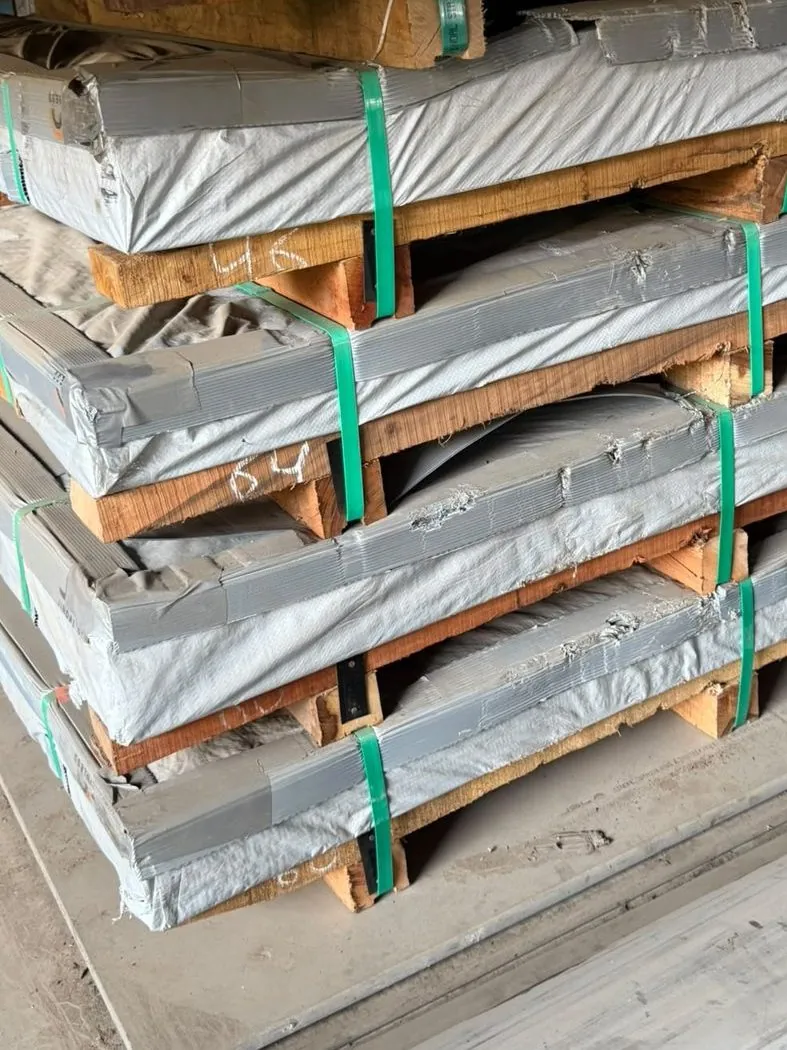
304L comes as sheet, plate and coil, held ex-stock for immediate dispatch. Every piece ships with an EN 10204 3.1/3.2 mill test certificate.
What is 304L stainless steel?
304L is an austenitic chromium-nickel stainless steel, part of the same austenitic stainless steel family as 304 stainless steel. It shares the same nominal 18% chromium and 8% nickel "18-8" chemistry. Nandini Steel stocks it among the austenitic stainless steel grades it carries. The "L" suffix stands for low carbon: carbon tops out at 0.03%, well below the 0.08% ceiling allowed for 304.
That single change isn't accidental. Hold austenitic stainless in the 425–815 °C range, the heat-affected zone during welding, most often, and carbon starts combining with chromium to form chromium carbides at the grain boundaries. That's sensitization. It leaves those boundaries stripped of chromium locally, which opens the door to intergranular corrosion. 304L cuts the carbon out of the equation, so there's no fuel left for the reaction, and the steel stays corrosion-resistant straight out of the weld.
304 vs 304L: the low-carbon decision
Choosing between 304 and 304L comes down to carbon content and welding, not how well the steel resists corrosion. In the annealed condition, both grades stand up to the same media equally well; the gap only shows up once a part gets welded or held at elevated temperature. For the full side-by-side breakdown, see the 304 vs 304L comparison.
| Attribute | 304 | 304L | Verdict |
|---|---|---|---|
| Max carbon | 0.08% | 0.03% | 304L starves the carbide reaction |
| Sensitization risk when welded | Present | Resisted | 304L for welded assemblies |
| Weldability (no post-weld anneal, thin section) | Limited | Good | 304L |
| 0.2% yield strength (min) | 205 MPa | 170 MPa | 304 marginally stronger |
| General corrosion resistance | Baseline | Equal | No difference |
| Relative cost | Baseline | Slight premium | 304 cheaper unwelded |
What does the "L" mean (carbon ≤ 0.03%)
The "L" designation is a hard chemistry limit, not a marketing label. Capping carbon at 0.03% leaves too little of it to precipitate meaningful quantities of chromium carbide during thermal cycling. The chromium stays in solution instead, and it keeps doing its passivating job across the whole section, weld zone included.
What is sensitization and when does it matter
Sensitization sets in when steel sits at 425–815 °C and chromium carbides form along the grain boundaries. The issue shows up whenever a part gets welded, stress-relieved, or run hot. There are three ways to prevent it: pick a low-carbon (L) grade, use a titanium- or niobium-stabilized grade such as 321 stainless steel, or follow welding with a solution anneal. 304L takes the first route.
When plain 304 is still fine (and cheaper)
If a part never gets welded, never gets stress-relieved, and never sits in the sensitization window, cold-formed trim, fasteners, unwelded sheet metal, that sort of thing, standard 304 gives you the same corrosion resistance, with a bit more strength and a lower price tag. The small premium for 304L only pays off where heat enters the picture.
Chemical composition
Composition follows UNS S30403 per ASTM A240, with standard 304 listed alongside it so the carbon ceiling stands out clearly (weight %, balance iron).
| Element | 304L (S30403) | 304 (S30400) |
|---|---|---|
| Carbon (C) | ≤ 0.030 | ≤ 0.08 |
| Chromium (Cr) | 18.0–20.0 | 18.0–20.0 |
| Nickel (Ni) | 8.0–12.0 | 8.0–10.5 |
| Manganese (Mn) | ≤ 2.0 | ≤ 2.0 |
| Silicon (Si) | ≤ 0.75 | ≤ 0.75 |
| Phosphorus (P) | ≤ 0.045 | ≤ 0.045 |
| Sulfur (S) | ≤ 0.030 | ≤ 0.030 |
| Nitrogen (N) | ≤ 0.10 | ≤ 0.10 |
| Iron (Fe) | Balance | Balance |
Why the carbon ceiling matters
Only the carbon content separates these two grades. Chromium and nickel levels match exactly, which explains why 304L and 304 passivate the same way and stand up to the same chemicals. Lowering the carbon serves one purpose: keeping chromium available at the grain boundaries after welding. That buys weld integrity. It doesn't add any corrosion resistance beyond what 304 already has.
Mechanical properties
Minimum properties apply in the solution-annealed condition, per ASTM A240. Lower carbon content costs a bit of strength; that's the price paid for better weldability. If a welded design needs 304-level strength back, specify dual-certified 304/304L, or go with nitrogen-strengthened 304LN.
| Property | 304L minimum |
|---|---|
| Tensile strength | ≥ 485 MPa (70 ksi) |
| 0.2% yield strength | ≥ 170 MPa (25 ksi) |
| Elongation in 50 mm | ≥ 40% |
| Hardness | ≤ 201 HBW / ≤ 92 HRB |
Physical properties
| Property | Value (approx.) |
|---|---|
| Density | 8.0 g/cm³ |
| Melting range | 1400–1450 °C |
| Thermal conductivity (100 °C) | 16.2 W/m·K |
| Mean CTE (0–100 °C) | 17.2 µm/m·°C |
| Elastic modulus | 193 GPa |
| Specific heat (0–100 °C) | 500 J/kg·K |
| Magnetic response | Non-magnetic (annealed) |
In solution-annealed condition, 304L carries no magnetic response. Cold work changes that, deep-drawing, roll-forming, heavy machining, any of these can convert some austenite to martensite, and the surface picks up a slight magnetic pull as a result. That's normal. It doesn't mean you've got the wrong grade, whether you're working with 304L or plain 304.
Corrosion behavior and PREN
304L handles oxidizing acids, fresh water, foods and most mild atmospheres just as well as 304 does. The two grades are metallurgically identical except for carbon content. Chlorides are where it falls short, though. With no molybdenum in the mix, its pitting resistance equivalent number (PREN, Cr + 3.3·Mo + 16·N) lands around 18 to 19. That puts it at the bottom of the corrosion ladder.
Sensitization and intergranular corrosion
This is the reason 304L exists. By holding carbon to ≤ 0.03%, the grade avoids the chromium-carbide precipitation that would otherwise sensitize the heat-affected zone, so welded 304L keeps its resistance to intergranular corrosion without a post-weld solution anneal. Sensitization resistance can be proven by an intergranular-corrosion test to ASTM A262 Practice A or E.
Pitting, crevice corrosion and PREN ~18–19
Because it contains no molybdenum, 304L is as susceptible to pitting corrosion and crevice attack as 304. Where chlorides, crevices or stagnant brines are present, molybdenum-bearing grades are required.
| Grade | PREN (approx.) | Step up when… |
|---|---|---|
| 304 / 304L | ~18 | baseline, no chlorides |
| 316 / 316L | ~24 | moderate chlorides, marine atmosphere |
| 904L | ~34 | sulfuric acid, hot chlorides |
| Duplex 2205 | ~35 | chloride SCC plus strength |
| Super-Duplex 2507 | ~43 | aggressive seawater, high chlorides |
Chloride stress-corrosion cracking
Austenitic 18-8 grades, 304L included, are prone to chloride stress-corrosion cracking above roughly 60 °C when tensile stress and chloride service combine. Once chlorides turn warm, switch to 316/316L or a duplex grade. The 304 vs 316 page covers the molybdenum step-up; for more on the failure mode itself, see chloride stress-corrosion cracking.
Equivalent grades and designations
| System | Designation |
|---|---|
| UNS | S30403 |
| Werkstoff (W.-Nr.) | 1.4307 (legacy 1.4306) |
| EN name | X2CrNi18-9 |
| AISI | 304L |
| JIS | SUS304L |
| BS | 304S11 |
| GB | 022Cr19Ni10 |
Full cross-referencing is on the UNS / Werkstoff cross-reference table.
304L vs the alternatives: when to choose it
vs 304
Choose 304L over 304 when the part will be welded or sits in the sensitization window; pick 304 when it won't, and save yourself the small premium. The details are laid out on 304 vs 304L.
vs 316 / 316L
Step up to 316L or 316 when chlorides are present. The 2–3% molybdenum in the 316 family is what buys the pitting and crevice resistance 304L lacks, this is the molybdenum step-up covered in 304 vs 316. The same low-carbon logic applies within that family, as 316 vs 316L shows.
vs 321
Where the duty's genuinely high-temperature and continuous rather than just welded, the titanium-stabilized 321 holds its structure above the range where an L-grade's benefit fades. 304L handles welding sensitization. 321 handles sustained high-temperature service.
Forms, sizes and availability
Nandini Steel keeps 304L on hand in flat product, ex-stock and ready to ship right away. The material comes from genuine mill plate, sourced from Aperam, Outokumpu, Jindal, POSCO, Nippon Steel and JFE.
304L sheet
Thin-gauge flat product for fabrication, enclosures, hygienic surfaces and lining, check 304L sheet for gauges, widths and finishes.
304L plate
Heavier flat product for tanks, structural fabrication and machined components, check 304L plate for thickness and plate-size ranges.
304L coil
Mill coil for slitting, blanking and continuous production runs ships against an RFQ. Get in touch with the team for widths, thicknesses and coil weights.
Weight and how to calculate
Flat-product weight follows directly from the 8.0 g/cm³ density:
Weight in kilograms equals length in meters times width in meters times thickness in millimeters, all multiplied by 8.0.
A 2.44 m × 1.22 m × 6 mm 304L plate weighs 2.44 × 1.22 × 6 × 8.0 ≈ 143 kg. Need a different size? Try the weight calculator. For the underlying method, see the plate-weight guide.
Finishes
304L flat product is available in the standard mill finishes:
- 2B, smooth, cold-rolled, lightly reflective; the default for sheet.
- No. 1 (HRAP), hot-rolled, annealed and pickled; typical of plate.
- BA, bright-annealed, highly reflective cold-rolled.
- No. 4, directional brushed finish for architectural surfaces.
Finish selection by product is covered in the 2B, BA and No. 4 finishes guide.
Standards and specifications complied
304L flat product meets ASTM A240 for chemistry and mechanical properties, along with its pressure-vessel counterpart, ASME SA-240. Traceability gets certified to EN 10204.
Testing, inspection and certification
Every order comes with an EN 10204 3.1/3.2 mill test certificate that carries full heat and cast traceability. On request, we can supply 304L with positive material identification (PMI), including carbon verification, plus an intergranular-corrosion test to ASTM A262 Practice A or E to prove sensitization resistance holds up. For the full inspection scope, see testing, MTC, NDT and PMI. Need help making sense of the paperwork itself? Check reading a mill test certificate.
Applications of 304L by industry
304L shows up wherever a welded assembly needs 304-grade corrosion resistance: general fabrication, architectural cladding and handrails, food & dairy equipment, pharmaceutical and hygienic process lines, light chemical processing. It's not a marine grade, though. For seawater or coastal chloride duty, step up to 316/316L or higher, as covered under marine service.
Welding and fabrication of 304L
304L is readily welded by all common processes and is normally joined with a matching low-carbon ER308L filler. Because its own carbon is already low, thin-section welds need no post-weld solution anneal to stay corrosion-resistant, the practical advantage the grade is bought for. Like all austenitics, 304L work-hardens, so it draws and forms well but demands sharp tooling and lower machining speeds than free-machining grades. Where heavy section has been welded or cold-worked, a full solution anneal (~1040–1120 °C with rapid quench) restores maximum corrosion resistance; detailed guidance is on how to weld 304L.
The Nandini Steel Engineering Team most often sees people default to 304 for chloride-adjacent or coastal duty, and that's where it pits. Confirm the actual service chlorides before choosing 304 over 316. Stepping up costs far less than a failed part. For welded fabrications held at 425–815 °C, specify 304L to avoid sensitization without post-weld annealing.
Pricing and how we quote
Nandini Steel keeps no price tables on hand, since 304L pricing shifts with mill, size, finish and quantity. Every form sits ex-stock, ready for immediate dispatch. Send an RFQ with grade, form, dimensions and quantity to get live pricing. Nandini Steel has operated as an ISO 9001:2015-certified stockist and supplier since 2003, and in that time it has delivered 307+ projects to 260+ clients across 36+ export countries.
FAQ
Is 304L stainless steel magnetic?
What is the difference between 304 and 304L?
Is 304L food grade?
Does 304L rust?
Can you weld 304L without post-weld heat treatment?
Request a quote
Send your 304L inquiry to Nandini Steel for live pricing and stock confirmation, grade, form (sheet, plate or coil), dimensions, finish and quantity. All material ships ex-stock with an EN 10204 3.1/3.2 mill test certificate.
- Phone: +91 22 43404600 · +91 9920209184
- WhatsApp: +91 99202 09184
- Email: reachus@nandinisteel.com
- Address: 25, Dreamland Building, 601, 6th Floor, Mama Parmanand Marg, Charni Road, Opera House, Girgaon, Mumbai, Maharashtra 400004, India
- GSTIN: 27ADJPA7240C1Z0