
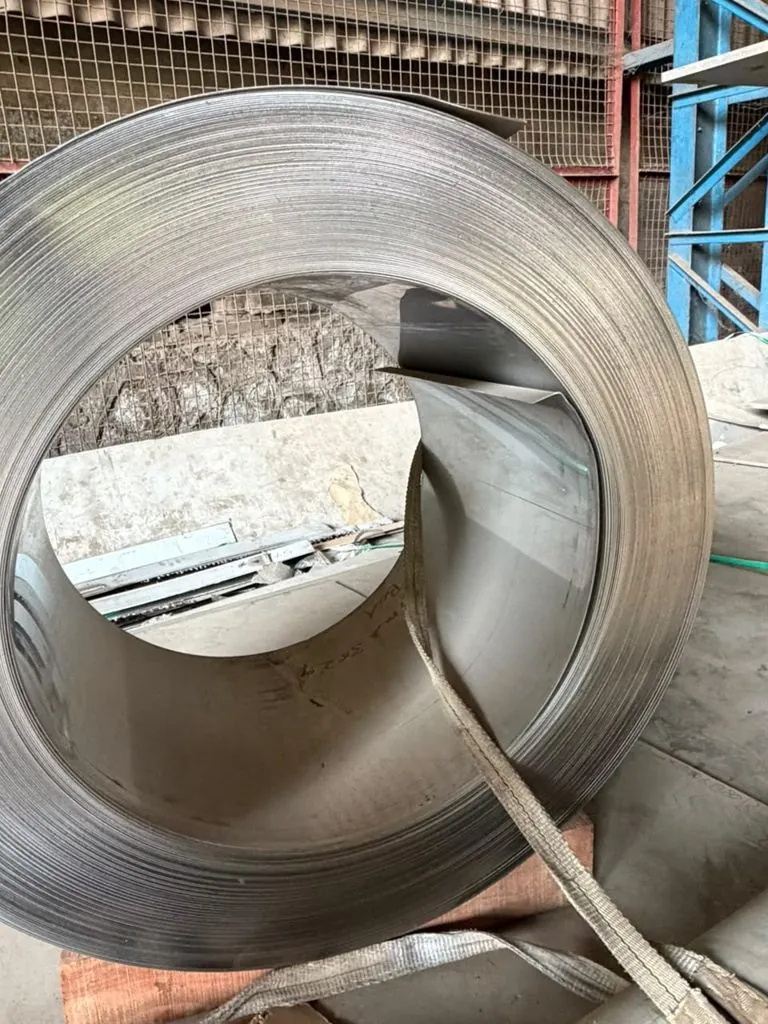
Inconel 625 at a glance
- Designation: UNS N06625, Werkstoff 2.4856, NiCr22Mo9Nb, commonly called alloy 625.
- Family: solid-solution-strengthened Ni-Cr-Mo alloy, Ni ≥58%, with niobium for stabilisation.
- Corrosion: PREN runs about 51, which handles chloride pitting, crevice attack and chloride SCC with room to spare. It also stands up to oxidising and reducing acids, and it's rated for sour service (NACE MR0175).
- Strength: ~827 MPa (120 ksi) tensile, usable from cryogenic temperatures to ~980 °C.
- Supply: all forms supplied to ASTM B443/B446/B444, held ex-stock for immediate dispatch. Every order ships with an EN 10204 3.1/3.2 mill test certificate.
What is Inconel 625?
Inconel 625 belongs to the Ni-Cr-Mo family of nickel-base superalloys. It gets its strength from molybdenum and niobium in solid solution, not from precipitation heat treatment. Nickel makes up at least 58% of the alloy and forms the base. Chromium handles oxidizing resistance. Molybdenum guards against pitting and crevice attack in chloride environments. Niobium, along with tantalum, keeps the structure stable against sensitization. The result: welds resist intergranular corrosion even with no post-weld heat treatment (PWHT).
You reach for Inconel 625 when chlorides, sour hydrocarbons or mixed acids exceed what austenitic and super-austenitic stainless (316L, 904L) and even Incoloy 825 can hold, yet high strength still matters. It sits near the top of the nickel-alloy grade band, above the super-duplex stainless steels and just below Hastelloy C276 on the pitting ladder. Curious where it lands among the Inconel and Hastelloy grades more broadly? The nickel alloys family hub lays that out.
Chemical composition
Molybdenum in UNS N06625 (per ASTM B443) drives its resistance to pitting and crevice attack. Niobium, meanwhile, stabilizes the alloy against sensitization, so welding doesn't call for post-weld heat treatment.
| Element | Content (wt %) | Role |
|---|---|---|
| Nickel (Ni) | ≥ 58.0 | Base, chloride SCC resistance |
| Chromium (Cr) | 20.0 – 23.0 | Oxidising-acid & oxidation resistance |
| Molybdenum (Mo) | 8.0 – 10.0 | Pitting & crevice resistance |
| Niobium + Tantalum (Nb+Ta) | 3.15 – 4.15 | Stabilisation against sensitization |
| Iron (Fe) | ≤ 5.0 | Residual |
| Carbon (C) | ≤ 0.10 | Kept low to limit carbides |
| Manganese (Mn) | ≤ 0.50 | – |
| Silicon (Si) | ≤ 0.50 | – |
| Aluminium (Al) | ≤ 0.40 | – |
| Titanium (Ti) | ≤ 0.40 | – |
| Cobalt (Co) | ≤ 1.0 | – |
| Phosphorus (P) | ≤ 0.015 | – |
| Sulphur (S) | ≤ 0.015 | – |
Mechanical properties
Room-temperature minimums apply to annealed plate meeting ASTM B443 Grade 1. Grade 1, annealed near 980 °C, is the standard choice for corrosion service. Grade 2 is solution-annealed around 1150 °C instead, and it gives up some room-temperature strength in exchange for better creep resistance and elevated-temperature performance above 600 °C.
| Property | Grade 1 (annealed) minimum |
|---|---|
| Tensile strength | ≥ 827 MPa (120 ksi) |
| Yield strength (0.2% offset) | ≥ 414 MPa (60 ksi) |
| Elongation | ≥ 30% |
| Hardness (typical) | ≤ ~240 HB |
Physical properties
| Property | Value |
|---|---|
| Density | 8.44 g/cm³ |
| Melting range | 1290 – 1350 °C |
| Thermal conductivity | ~9.8 W/m·K |
| Mean coefficient of thermal expansion (20–100 °C) | ~12.8 µm/m·°C |
| Elastic modulus | ~207 GPa |
| Magnetic response | Non-magnetic |
Density of 8.44 g/cm³ drives plate and bar weight. To turn a cut size into a mass figure for an RFQ, use the steel plate weight calculator or check the guide on how to calculate steel plate weight.
Corrosion resistance & PREN
Inconel 625 resists chloride pitting and crevice corrosion through its ~9% molybdenum, and its ≥58% nickel content resists chloride stress-corrosion cracking where austenitic 316L and 904L are vulnerable. The combination of chromium and molybdenum lets it resist both oxidising and reducing acids, and it conforms to sour service (NACE MR0175) for H2S-bearing hydrocarbons.
Its PREN of about 51 (Cr 22 + 3.3 × Mo 9 ≈ 51.7) places it near the top of the corrosion-resistant-alloy ladder:
| Grade | PREN (approx.) | Choose when |
|---|---|---|
| 316 / 316L | ~24 | Mild chlorides, general chemical duty |
| 904L | ~34 | Sulphuric acid, moderate chlorides |
| Incoloy 825 | ~31–40 | Mixed acids, sour service at lower strength |
| Super-Duplex 2507 | ~43 | Seawater, high-strength chloride duty |
| Inconel 625 | ~51 | Severe chlorides + acids + sour, with high strength |
| Hastelloy C276 | ~70 | Hot reducing acids beyond the 625 ceiling |
Equivalent grades & designations
| System | Designation |
|---|---|
| UNS | N06625 |
| Werkstoff (W.-Nr.) | 2.4856 |
| DIN | NiCr22Mo9Nb |
| EN | 2.4856 |
| AMS | 5599 (sheet/plate/strip), 5666 (rod) |
| BS | NA21 |
| JIS | NCF625 |
| ASME | SB-443 |
Cross-reference the designations on the purchase order and MTC against the UNS / W.-Nr. / JIS cross-reference. This step heads off disputes at receiving inspection before they start.
Inconel 625 vs the alternatives
Decide by the limiting factor, strength, acid type, or cost:
- vs Inconel 718: 718 is age-hardenable, so it reaches much higher strength and suits fasteners and rotating hardware. 625 wins on general corrosion resistance and welds without any precipitation heat treatment needed. Pick 625 for corrosion. Pick 718 for strength.
- vs Hastelloy C276: C276 carries a higher Mo content and a PREN near 70, and it beats 625 in hot reducing acids and the harshest chloride environments. Only step up to C276 once 625's acid resistance tops out.
- vs Incoloy 825: 825 costs less and works as a Ni-Fe-Cr alloy suited to milder sour service and mixed-acid conditions. When chlorides, strength demands or SCC risk push past what 825 can handle, Inconel 625 is the better choice. See Incoloy 825 vs Inconel 625 for the full comparison.
Available forms, sizes & thickness ranges
Inconel 625 (N06625) sits ex-stock in both flat and long forms, ready for immediate dispatch. Each form links to its own product page, where you can check live stock and sizes.
| Form | Typical standard | Product page |
|---|---|---|
| Plate & sheet | ASTM B443 / SB-443 | Inconel plate & sheet (RFQ) |
| Pipe & tube | ASTM B444 / B167 | Inconel 625 pipe |
| Round bar | ASTM B446 / B574 | Inconel 625 round bar |
| Flanges | ASME B16.5 / B564 | Inconel 625 flanges |
| Pipe fittings | ASTM B366 (WPNCMC) | Inconel 625 pipe fittings |
| Forged fittings | ASME B16.11 / B564 | Inconel 625 forged fittings |
| Fasteners | Bolting per B446/B564 | Inconel 625 fasteners |
Standards & specifications complied
Inconel 625 is supplied against the applicable ASTM/ASME specifications by form:
| Form | ASTM | ASME |
|---|---|---|
| Plate, sheet & strip | ASTM B443 | ASME SB-443 |
| Rod & bar | ASTM B446 | ASME SB-446 |
| Seamless pipe & tube | ASTM B444 / B704 / B705 | ASME SB-444 |
| Fittings | ASTM B366 | ASME SB-366 |
| Forgings | ASTM B564 | ASME SB-564 |
Full requirements for each form are on the ASTM B443 (plate/sheet) and ASTM B446 bar standard pages. For sour hydrocarbon service the heat is supplied in the qualified condition to NACE MR0175 / ISO 15156, see the NACE MR0175 / ISO 15156 standard page.
Testing, inspection & certification
Every Inconel 625 order ships with an EN 10204 3.1/3.2 mill test certificate that ties heat and cast numbers to the physical material (see EN 10204 3.1 mill test certificate). We can also furnish positive material identification (PMI) on request, along with intergranular corrosion testing per ASTM A262, ultrasonic (UT) and hydrostatic testing, and the NACE MR0175 compliance condition. Want the full picture? Check out testing, MTC, NDT & PMI.
Buyers often spec plain "Inconel 625" without thinking about the Grade the service actually calls for. Grade 1 (annealed) belongs on wet corrosion jobs. Grade 2 (solution-annealed) is for sustained high-temperature and creep duty. Put the Grade, the condition and the governing standard on the PO. That way the heat gets supplied correctly the first time.
Weldability & heat treatment
Inconel 625 welds easily with matching filler ERNiCrMo-3 / FM 625. Niobium stabilizes the alloy against sensitization, so weldments resist intergranular corrosion without any post-weld heat treatment. For more, see the guidance on welding stainless and nickel alloys and how to prevent sensitization. Grade 1 gets annealed near 980 °C. Grade 2, meant for elevated-temperature service, is solution-annealed near 1150 °C.
Applications
- Oil & gas (sour service): subsea and wellhead hardware, downhole tubulars and flowlines where H2S and chlorides call for NACE MR0175 compliance with high strength, see oil & gas.
- Chemical & acid processing: reactors, columns and piping that handle oxidising and reducing acids, see chemical processing.
- Marine & seawater: heat exchangers, pumps and fittings exposed to warm chloride and seawater. Pollution-control (FGD) components fall under this category too, see marine.
FAQ
What is Inconel 625?
What is the chemical composition of Inconel 625?
Is Inconel 625 suitable for sour service?
What is the difference between Inconel 625 Grade 1 and Grade 2?
Inconel 625 vs Hastelloy C276, which should I choose?
What filler metal is used to weld Inconel 625?
Does Nandini Steel supply a mill test certificate with Inconel 625?
Request a quote
Nandini Steel holds ISO 9001:2015 certification and stocks, supplies, and exports Inconel 625 (UNS N06625) across plate, sheet, pipe, tube, round bar, flanges, fittings, and fasteners. Everything sits ex-stock, ready for immediate dispatch. The material comes from genuine mills, producers like Aperam, Outokumpu, Jindal, POSCO, Nippon Steel, and JFE. Each order arrives with an EN 10204 3.1/3.2 mill test certificate.
- Phone: +91 22 43404600 · +91 9920209184
- WhatsApp: +91 99202 09184
- Email: reachus@nandinisteel.com
- GSTIN: 27ADJPA7240C1Z0
- Address: 25, Dreamland Building, 601, 6th Floor, Mama Parmanand Marg, Charni Road, Opera House, Girgaon, Mumbai, Maharashtra 400004, India
RFQ for live pricing. Share the form, size, standard and Grade (1 or 2), and we'll respond with availability. For traceability details, see our certifications and quality assurance pages, or just contact us directly.