
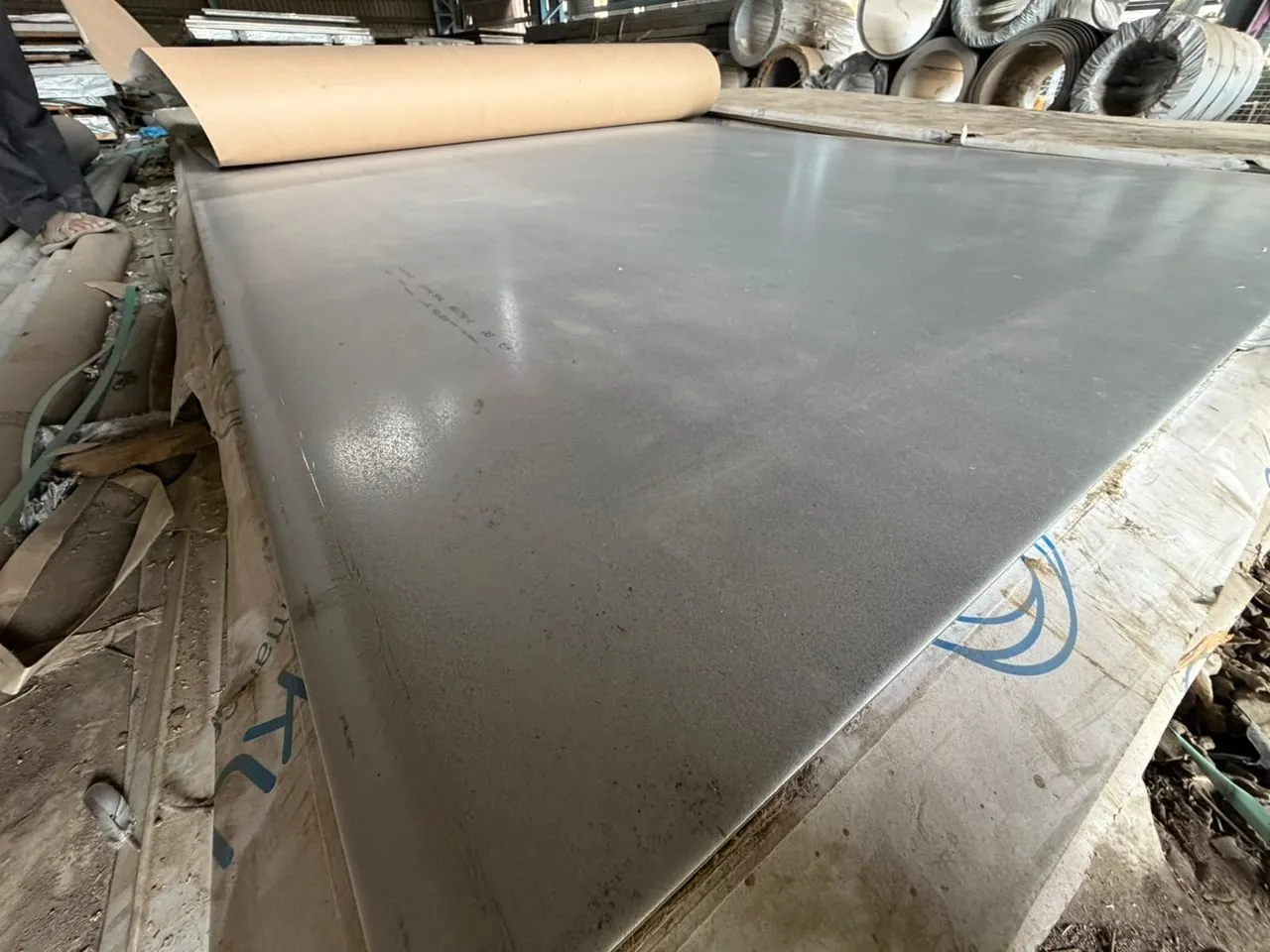
Key takeaways: 904L sheet at a glance
- Designation: UNS N08904, Werkstoff 1.4539, AISI 904L. This is a super-austenitic stainless steel, not a plain austenitic grade.
- Copper-bearing chemistry: ~25% Ni, ~4.5% Mo, ~1.5% Cu, with carbon held to ≤0.02%. The copper is what delivers sulfuric-acid resistance.
- PREN ~34: it resists chloride pitting and crevice attack well beyond 316L, and the high nickel content pushes the chloride stress-corrosion cracking threshold higher.
- Cold-rolled flat product: conforms to ASTM A240 / ASME SA-240 and ASTM B625 for N08904, supplied in 2B or BA finish.
- Traceable and ex-stock: every order ships with genuine mill sheet and an EN 10204 3.1 mill test certificate (MTC), ready for immediate dispatch.
What is 904L stainless steel sheet?
904L is an austenitic stainless steel loaded so heavily with nickel, molybdenum and copper that it stands apart in its own class: the super-austenitic family. In sheet form, it's a cold-rolled, light-gauge flat product used to fabricate and line equipment that handles aggressive acids and chloride-bearing media. The grade exists for one reason. It bridges the gap between standard 316/316L and a nickel-base alloy. When 316L sheet pits or corrodes in sulfuric acid or hot chlorides, but a 625 or titanium lining would be overkill and overpriced, 904L becomes the upgrade that actually justifies its cost.
Its defining feature is chemistry. Around 25% nickel suppresses chloride stress-corrosion cracking, ~4.5% molybdenum drives pitting resistance, and ~1.5% copper gives it genuine resistance to reducing acids, a property plain austenitic grades lack. Nandini Steel is a certified specialist in 904L, holding it as ex-stock flat product alongside Alloy 28, Incoloy 800 and Hastelloy. For the full grade overview, see the 904L stainless steel hub and the primer on what makes 904L super-austenitic.
Sheet vs plate: which 904L form do you need?
Sheet and plate aren't interchangeable terms, and the split matters to anyone actually buying material. Sheet is the lighter-gauge, cold-rolled flat product, typically up to about 6 mm, and it comes in bright, formable 2B/BA finishes. That makes it the right call for tank linings, scrubber internals, ducting, formed vessel components and sheet-metal fabrication. Plate, by contrast, is heavier-gauge and hot-rolled, generally 4.75 mm and up, and gets used for structural sections, tube sheets and thick vessel walls.
So if you're forming, deep-drawing or lining something, specify sheet. If you're machining a part or building a thick-wall pressure boundary, specify 904L plate instead. For continuous light-gauge supply feeding a roll-forming line, there's 904L coil. Our guide to sheet vs plate vs coil covers this in more depth.
Chemical composition
904L (UNS N08904) is an extra-low-carbon grade. Carbon is capped at 0.02%, and that ceiling, combined with solution annealing, keeps the material from sensitizing and prevents the intergranular corrosion that follows. The table below lists the N08904 element ranges per ASTM A240.
| Element | Symbol | Composition (wt%) |
|---|---|---|
| Carbon | C | ≤ 0.020 |
| Chromium | Cr | 19.0 – 23.0 |
| Nickel | Ni | 23.0 – 28.0 |
| Molybdenum | Mo | 4.0 – 5.0 |
| Copper | Cu | 1.0 – 2.0 |
| Manganese | Mn | ≤ 2.0 |
| Silicon | Si | ≤ 1.0 |
| Phosphorus | P | ≤ 0.045 |
| Sulfur | S | ≤ 0.035 |
| Iron | Fe | Balance |
The role of copper and molybdenum
Molybdenum and copper carry 904L's corrosion performance. The roughly 4.5% molybdenum stabilizes the passive film against chloride pitting and crevice attack, the same mechanism that lifts 316 above 304, just taken much further. Copper is the signature addition. At about 1.5%, it markedly slows general corrosion in reducing acids, giving 904L its standout resistance to dilute and intermediate sulfuric acid, a case where molybdenum alone falls short. The roughly 25% nickel underpins the stable austenitic structure and raises resistance to chloride stress-corrosion cracking.
Mechanical properties
Minimum room-temperature properties for solution-annealed 904L sheet, per ASTM A240. The grade is austenitic, so heat treatment won't harden it. Strength comes from composition and cold work instead, and 904L work-hardens noticeably once you start forming it.
| Property | Minimum value (annealed sheet) |
|---|---|
| Tensile strength | ≥ 490 MPa (71 ksi) |
| Yield strength (0.2% proof) | ≥ 220 MPa (32 ksi) |
| Elongation (in 50 mm) | ≥ 35% |
| Hardness | ≤ 90 HRB |
Physical properties
Density gives you the figure you need for sheet weight calculation. Low thermal conductivity and high thermal expansion matter when welding and forming.
| Property | Value |
|---|---|
| Density | 7.95 g/cm³ |
| Melting range | ~1300 – 1390 °C |
| Thermal conductivity (20 °C) | ~11.5 W/m·K |
| Mean coefficient of thermal expansion (20–100 °C) | ~15.3 µm/m·°C |
| Elastic modulus | ~190 GPa |
| Magnetic response | Non-magnetic (austenitic) |
Corrosion behavior & PREN: why 904L sheet exists
Corrosion resistance is the whole reason to specify 904L sheet over a cheaper grade. The grade resists reducing acids and chloride pitting that defeat 316L, and it beats 316L on chloride stress-corrosion cracking resistance too. Its pitting resistance equivalent number (PREN = Cr + 3.3×Mo + 16×N) comes in around 34, which puts it well up the upgrade ladder from 316.
Sulfuric-acid resistance
Copper's what turns 904L into a sulfuric-acid grade. Across broad ranges of dilute to intermediate concentration and moderate temperature, it stays passive where molybdenum-only austenitics corrode. That's the reason it gets picked for acid storage, mixing and handling equipment. Before committing to it, though, always check the specific concentration and temperature against the 904L iso-corrosion limits. For the mechanism behind this, see sulfuric-acid resistance.
Pitting & crevice resistance: PREN ~34
With roughly 4.5% molybdenum in the mix, 904L holds up against pitting and crevice corrosion much better than 316L does in chloride service. The numbers back this up: a PREN near 34, against only about 24 for 316/316L. That gap can decide whether a lining lasts or perforates in hot, chloride-heavy process streams.
Crevice sites are still the weak point, though. Gaskets, lap joints, deposits under scale: these are where failure actually starts. Detailing counts for just as much as the grade you pick. For more on this, see crevice corrosion.
Chloride stress-corrosion cracking
Standard austenitics such as 316L run into chloride stress-corrosion cracking once temperature and chloride levels climb. The nickel content in 904L, roughly 25%, pushes that cracking threshold much higher, which makes it a solid pick for warm chloride environments that would eat right through 316L. It won't hold up to everything, though. Severe conditions still demand duplex or nickel-base alloys. Across a wide middle band, though, 904 effectively takes the risk off the table. See chloride stress-corrosion cracking.
Equivalent grades & designations
904L shows up across every major spec system you'd care about, so put the UNS and Werkstoff numbers on both the purchase order and the MTC. Skip that step and you're asking for a receiving-inspection dispute. Full tables are on the UNS / Werkstoff cross-reference.
| System | Designation |
|---|---|
| UNS | N08904 |
| Werkstoff (W.-Nr.) | 1.4539 |
| EN | X1NiCrMoCu25-20-5 |
| BS | 904S13 |
| AISI | 904L |
| JIS | No direct equivalent |
904L sheet vs the alternatives: when to choose it
904L sits on a clear upgrade ladder. Choose 904L sheet over 316L when sulfuric acid or chlorides exceed 316L's limit; step past it only when a genuinely more aggressive duty demands a 6-Mo or super-duplex grade. The classic spec error: reaching for Alloy 20, 625 or titanium when 904L's copper-bearing ~4.5% Mo chemistry already covers the service at lower cost. Check the acid concentration and temperature against the 904L iso-corrosion limits first. On the flip side, don't under-spec 904L where 254 SMO or super-duplex is genuinely required.
| Grade | Approx. PREN | Choose when… |
|---|---|---|
| 316 / 316L | ~24 | General chloride service within 316L limits; no reducing-acid duty. |
| 904L | ~34 | Sulfuric/reducing acids and higher chlorides than 316L handles, before nickel-base cost is justified. |
| Duplex 2205 | ~35 | Similar pitting resistance with higher strength; where SCC and load both matter. |
| Alloy 20 | ~30+ | Hot concentrated sulfuric acid beyond 904L's comfort band. |
| 254 SMO (6-Mo) | ~43 | Severe seawater and high-chloride pitting beyond 904L. |
| Titanium | – | Oxidizing chlorides and wet chlorine where stainless pits regardless. |
904L vs 316L
316L to 904L is the classic upgrade, and for good reason. 904L's PREN runs roughly double that of 316L, it brings copper to the table for reducing-acid service, and that high nickel content pushes the chloride-SCC threshold well above 316L's. So when a 316L lining starts pitting, or SCC shows up, 904L is usually the right next move. For the full comparison, see 904L vs 316L.
904L vs Duplex 2205
Duplex 2205 hits a similar PREN, around 35, and it beats 904L on both strength and resistance to stress corrosion cracking. Still, the copper in 904L gives it an advantage against reducing acids like sulfuric. So the choice comes down to what you're actually worried about: pick 2205 if strength or SCC is the concern, go with 904L if reducing-acid attack is the bigger threat. For a closer look, see 904L vs duplex 2205.
Forms, sizes & gauge ranges
904L comes as sheet, plate and coil, and the cold-rolled sheet form is what's covered here. Typical cold-rolled 904L sheet ships in the ranges below. Check exact gauge, width and length against your fabrication drawing before you request a quote.
| Attribute | Typical range |
|---|---|
| Thickness / gauge | ~0.5 – 6.0 mm (cold-rolled) |
| Width | 1000 / 1219 / 1250 / 1500 mm |
| Length | 2000 / 2440 / 2500 / 3000 mm |
| Finish | 2B, BA, No.4 (No.1 on thicker gauge) |
| Standard | ASTM A240 / ASME SA-240; ASTM B625 for N08904 |
Other 904L forms
For heavier gauges and structural work, go with 904L plate; for continuous light-gauge runs and roll-forming feedstock, 904L coil is the better fit. Both fall under the 904L grade hub.
Sheet weight & how to calculate
904L sheet weight comes down to density. The alloy's density is 7.95 g/cm³, so use:
- Per square meter: kg/m² = thickness (mm) × 7.95
- Per sheet: kg = thickness (mm) × width (m) × length (m) × 7.95
Worked example: take a 2.0 mm × 1.25 m × 2.5 m sheet. Multiply 2.0 × 1.25 × 2.5 × 7.95 and you get 49.7 kg. Per square meter, that's 2.0 × 7.95 = 15.9 kg/m².
| Thickness | Weight (kg/m²) | Weight of 1.25 × 2.5 m sheet (kg) |
|---|---|---|
| 1.0 mm | 7.95 | 24.8 |
| 2.0 mm | 15.9 | 49.7 |
| 3.0 mm | 23.85 | 74.5 |
| 4.0 mm | 31.8 | 99.4 |
| 6.0 mm | 47.7 | 149.1 |
For other grades and sizes, use our weight calculator.
Finishes
904L sheet comes in standard cold-rolled finishes. 2B is the default mill finish: smooth, lightly reflective, and the usual pick for process and acid-service equipment. BA (bright-annealed) offers a brighter, more reflective, cleanable surface that suits hygienic and pharmaceutical duty. For visible or architectural surfaces, No.4 gives a directional brushed look. Thicker gauge often comes in No.1 (hot-rolled, annealed, pickled). You'll find full detail in our guide to 2B, BA and No.4 finishes.
Which finish for which service
For sulfuric-acid and general process equipment, 2B is the normal, economical pick. Where cleanability and low product entrapment matter, think pharmaceutical, fine-chemical and hygienic surfaces, specify BA instead. Save No.4 for cases where appearance is what counts. There's a side benefit too: a smoother finish trims crevice-trapping sites, which nudges crevice performance up a notch.
Standards & specifications complied
904L sheet conforms to ASTM A240 and its ASME twin ASME SA-240, the governing specifications for chromium-nickel stainless steel sheet, strip and plate for pressure vessels and general application. For N08904 flat product specifically, ASTM B625 / ASME SB-625 also applies.
ASTM A240 vs ASTM B625 / SB-625 for N08904
A240 handles N08904 within the stainless sheet and plate family, and it's the specification most pressure-equipment codes point to. ASTM B625 (adopted by ASME as SB-625) is the dedicated flat-product specification covering several high-nickel austenitic alloys, N08904 among them. Both reference the same composition and the same solution-annealed condition. Which one shows up on the order comes down to your project code or the client's specification, and sheet can be certified to whichever standard applies.
Testing, inspection & certification
Every order of 904L sheet comes with an EN 10204 3.1 mill test certificate; a 3.2 certificate with third-party endorsement is available on request. The MTC records the heat/cast number, chemical analysis and mechanical results, so the material stays traceable from mill to delivery. Intergranular-corrosion testing per ASTM A262, positive material identification (PMI) and dye-penetrant examination can all be furnished on request. We can also arrange third-party inspection by TÜV SÜD, Bureau Veritas, DNV, SGS or ABS. Anyone wanting the fundamentals should see testing, MTC, NDT & PMI.
Applications of 904L sheet by industry
904L sheet gets used in equipment where acid and chloride service defeats standard stainless.
Sulfuric-acid tanks, mixing vessels, heat-exchanger components, and acid-handling linings all fall under chemical and acid processing. In pharmaceutical settings, hygienic process vessels and surfaces need that clean, corrosion-resistant BA finish. For pulp and paper bleaching, think bleach-plant equipment that has to stand up to hot, chloride-bearing liquors. And in fertilizer and acid-regeneration service, the demands fall on phosphoric and sulfuric-acid plant internals along with pickling-line equipment.
- Oil & gas: process equipment and linings in chloride- and acid-exposed duty.
Welding, forming & fabrication of 904L sheet
904L is readily fabricated with the right practice. It is welded with an over-alloyed filler, typically ER385 (904L) for matched service, or a nickel-base filler such as FM 625, because a matching-composition filler would under-match the weld metal and risk preferential attack. Keep heat input and interpass temperature low to limit the time spent in the 425–815 °C sensitization range. Full procedure guidance is in how to weld 904L.
Because this grade work-hardens hard, plan on higher forming forces and more springback than you'd see with 316L. Its ductility stays high though, elongation of 35% or more, so deep drawing and bending sheet are still within reach. After hot forming, or whenever corrosion performance really matters, restore the microstructure through solution annealing at roughly 1070–1150 °C, then quench quickly. That redissolves the precipitates and brings full corrosion resistance back, the same as you'd expect from 316.
Pricing & how we quote
904L sheet pricing tracks nickel, molybdenum and copper input costs, so we quote live against your exact specification rather than publishing a figure that goes stale before it reaches you. Send us the gauge, width, length (or cut sizes), finish, quantity and applicable standard, and we'll return an RFQ with current pricing and lead time. All sheet sits ex-stock for immediate dispatch. It's genuine mill material, sourced from producers such as Aperam, Outokumpu, Jindal, POSCO, Nippon Steel and JFE, and every order ships with the mill MTC.
FAQ
What is 904L stainless steel sheet used for?
Is 904L sheet better than 316L?
What is the PREN of 904L?
What thickness distinguishes 904L sheet from plate?
Is 904L sheet magnetic?
What filler is used to weld 904L sheet?
Do you provide a mill test certificate with 904L sheet?
Request a quote for 904L sheet
Tell us your gauge, width, length or cut sizes, finish, quantity and the applicable standard. The Nandini Steel Engineering Team will send back a firm RFQ with live pricing and dispatch time. All 904L sheet is ex-stock genuine mill material, backed by an EN 10204 3.1 mill test certificate.
- Phone: +91 22 43404600 · +91 9920209184
- WhatsApp: +91 99202 09184
- Email: reachus@nandinisteel.com
Address: 25, Dreamland Building, 601, 6th Floor, Mama Parmanand Marg, Charni Road, Opera House, Girgaon, Mumbai, Maharashtra 400004, India
- GSTIN: 27ADJPA7240C1Z0
Related grades to cross-shop
Part of our steel sheet range and all stainless steel sheet grades.