What Incoloy 825 is: key takeaways
- Family: a nickel-iron-chromium (Ni-Fe-Cr) alloy, not a nickel-chromium Inconel grade.
- Titanium-stabilized: Ti ties up carbon to resist sensitization and intergranular corrosion (IGC) after welding.
- Specification: supplied as plate and sheet to ASTM B424 / ASME SB-424.
- Sour service: conforms to NACE MR0175 / ISO 15156 for H2S / sulfide-stress-cracking duty.
- Dual-acid resistance: resists both reducing acids (sulfuric, phosphoric) and oxidizing acids, the capability that separates it from 316L and 904L.
"Inconel 825" vs Incoloy 825: the name correction
Buyers routinely search for and order "Inconel 825," but no genuine Inconel 825 exists. Incoloy 825 is often incorrectly called Inconel 825; Inconel is a nickel-chromium family, while 825 is a nickel-iron-chromium alloy. Incoloy and Inconel are both Special Metals trademarks, and they cover different alloy systems. Alloy 825 belongs to the Incoloy (Ni-Fe-Cr) line and carries UNS N08825.
Getting the alloy named right on the purchase order and the mill test certificate matters quite a bit. Call it Incoloy 825, Alloy 825, or N08825, correctly, and you avoid receiving-inspection disputes over what actually showed up at the dock. For the broader picture, see our explainer on Incoloy vs Inconel vs Hastelloy vs Monel. If you're just starting out, our primer on what is Incoloy 825 covers the basics.
Chemical composition (UNS N08825)
Incoloy 825 strikes a deliberate balance of nickel, iron and chromium, with molybdenum, copper and titanium added on purpose. Here are the typical element ranges per ASTM B424 / N08825:
| Element | Symbol | Composition (wt %) |
|---|---|---|
| Nickel | Ni | 38.0–46.0 |
| Iron | Fe | Balance (≥ 22) |
| Chromium | Cr | 19.5–23.5 |
| Molybdenum | Mo | 2.5–3.5 |
| Copper | Cu | 1.5–3.0 |
| Titanium | Ti | 0.6–1.2 |
| Carbon | C | ≤ 0.05 |
| Manganese | Mn | ≤ 1.0 |
| Sulfur | S | ≤ 0.03 |
| Silicon | Si | ≤ 0.5 |
| Aluminum | Al | ≤ 0.2 |
Why the composition works
Each addition earns its place, chosen for the specific threat it fights. The 38–46% nickel gives near-immunity to chloride stress-corrosion cracking, a weak spot for austenitic stainless steels. Molybdenum (2.5–3.5%) boosts resistance to reducing acids and pitting. Copper (1.5–3%) is there specifically to fend off sulfuric and phosphoric acid. Titanium stabilizes the alloy by binding with carbon, so chromium stays in solution. That keeps the grain boundaries from sensitizing and falling prey to intergranular corrosion during welding. Chromium (19.5–23.5%) handles the oxidizing end of the acid spectrum.
Mechanical properties (solution-annealed)
Typical minimum room-temperature properties apply to the solution-annealed condition. Check these against the heat's mill test certificate before relying on them.
| Property | Typical value (metric) | Typical value (imperial) |
|---|---|---|
| Tensile strength | ≥ 586 MPa | ≥ 85 ksi |
| Yield strength (0.2% offset) | ≥ 241 MPa | ≥ 35 ksi |
| Elongation (in 2 in / 50 mm) | ≥ 30% | ≥ 30% |
| Hardness | ≈ 75–90 HRB | |
Physical properties
| Property | Value |
|---|---|
| Density | 8.14 g/cm³ (0.294 lb/in³) |
| Melting range | ≈ 1370–1400 °C |
| Modulus of elasticity | ≈ 196 GPa |
| Magnetic response | Essentially non-magnetic (austenitic structure) |
Incoloy 825 is austenitic, so in the annealed condition it's essentially non-magnetic. Buyers ask about this often when they're trying to tell it apart from ferritic or martensitic materials.
Corrosion behavior
Corrosion resistance is the real argument for Incoloy 825 over the cheaper stainless grades. Few alloys stand up to both reducing and oxidizing acids at once, and this one does. Its high nickel content also gives it immunity to chloride cracking, and it's qualified for sour-gas service.
Sour service (NACE MR0175 / ISO 15156)
Incoloy 825 holds up for sour (H2S) service and resists sulfide-stress cracking. On sour orders, cite sour service & NACE MR0175 on the purchase order. That way the heat gets supplied in the qualified, solution-annealed condition instead of some uncontrolled temper.
Acid resistance (reducing + oxidizing)
The copper-and-molybdenum chemistry handles reducing acids, while chromium takes care of oxidizing media. One alloy, mixed-acid plants covered. Here's how it typically behaves:
| Medium | Character | Incoloy 825 resistance |
|---|---|---|
| Sulfuric acid | Reducing | Good across many concentrations (Cu + Mo) |
| Phosphoric acid | Reducing | Good, including commercial wet-process acid |
| Nitric acid | Oxidizing | Good (Cr) |
| Organic acids | Mostly reducing | Good |
See the deeper note on sulfuric-acid corrosion resistance for concentration-and-temperature limits.
Chloride pitting, crevice & SCC
Incoloy 825 owes its resistance to chloride stress-corrosion cracking to its high nickel content; austenitic stainless steels don't share that strength. Its pitting resistance equivalent (PREN) runs around 31, which puts it just behind 904L (~34) when it comes to pitting and crevice attack, though both alloys are a step up from 316. For a closer look at how that figure gets calculated, see PREN pitting resistance. The underlying mechanism is covered at chloride stress-corrosion cracking.
PREN ladder: 304 sits around 18, then 316 climbs to roughly 24. Next comes Incoloy 825 at about 31, then 904L edges it out at about 34. For comparison, duplex 2205 lands near 35, while super-duplex 2507 tops the list at about 43.
Equivalent designations
| System | Designation |
|---|---|
| UNS | N08825 |
| Werkstoff (WNr / DIN) | 2.4858 |
| Common / trade name | Alloy 825 |
| Common misnomer | "Inconel 825" (not a real Inconel grade) |
Full cross-references are in the UNS / WNr / JIS cross-reference.
How Incoloy 825 compares: CRA selection ladder
Incoloy 825 sits between super-austenitic stainless (904L / Alloy 20) and premium Ni-Cr-Mo alloys like Inconel 625. Use the ladder to match the alloy to the actual service conditions, not to whatever you'd default to by habit on either end.
| Grade | Ni % | Mo % | PREN | Sour service | Reducing acids | Oxidizing acids | Relative cost |
|---|---|---|---|---|---|---|---|
| 316L | ~10–14 | ~2–3 | ~24 | Limited | Fair | Good | $ |
| 904L | ~25 | ~4.5 | ~34 | Limited | Good (sulfuric) | Good | $$ |
| Alloy 20 | ~33 | ~2–3 | ~30 | Limited | Very good (sulfuric) | Good | $$$ |
| Incoloy 825 | 38–46 | 2.5–3.5 | ~31–40 | Qualified | Very good | Very good | $$$ |
| Inconel 625 | ≥ 58 | 8–10 | ~50+ | Qualified | Excellent | Excellent | $$$$ |
Compare in detail: Incoloy 825 vs Inconel 625, 904L vs 316L, or jump over to the grade pages themselves: 904L, Alloy 20, 316L and Inconel 625. Prefer something interactive? The grade selector walks you through the same decision.
Forms, sizes & stock
Nandini Steel keeps Incoloy 825 in stock in flat product, ready to ship right away. It's part of our broader nickel alloys range. Each form gets its own dedicated page listing sizes and weights:
- Incoloy 825 plate, the go-to heavy-section form for vessels, tube sheets and acid-plant internals.
- Incoloy 825 sheet, a lighter-gauge flat product used for linings, fabrications and cladding.
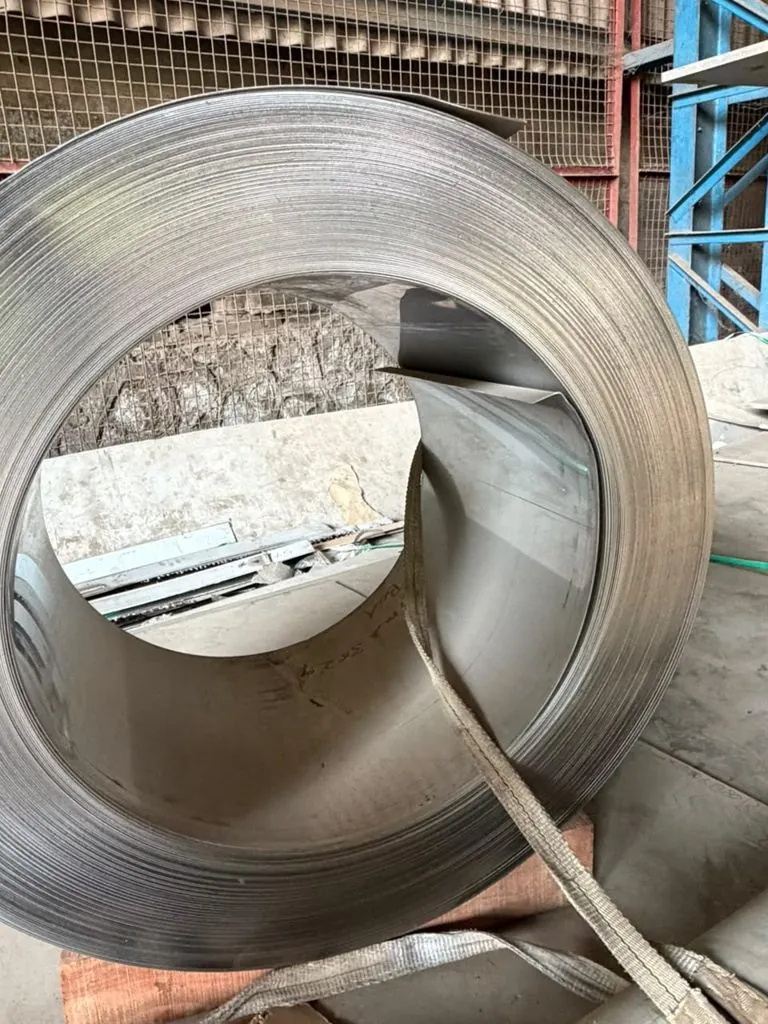
- 825 coil (limited / indent), supplied on an indent basis. Continuous lengths can be arranged where the job calls for them.
Estimate shipping and allowable weights with the Incoloy 825 weight calculator. Every plate is genuine mill stock from nameable producers: Aperam, Outokumpu, Jindal, POSCO, Nippon Steel and JFE.
Finishes
Plate and sheet come standard solution-annealed and pickled. Hot-rolled annealed-and-pickled (No. 1) and cold-rolled 2B finishes are available too, depending on form and thickness. Just specify the finish you need when you submit your RFQ.
Standards & specifications complied
| Scope | Standard |
|---|---|
| Plate, sheet, strip | ASTM B424 / ASME SB-424 |
| Sour service | NACE MR0175 / ISO 15156 |
| IGC test practice | ASTM A262 |
| Filler metal | AWS A5.14 ERNiFeCr-1 (FM 65) |
| Related bar / tube / forgings | ASTM B425 / B423 / B564 (see also) |
The governing flat-product standard is detailed on our ASTM B424 / ASME SB-424 page.
Testing, inspection & certification
Every order ships with an EN 10204 3.1/3.2 mill test certificate, covering heat chemistry and mechanical results, so you can trace the material back to its heat. Standard and optional verification includes:
- MTC: every order comes with an EN 10204 3.1/3.2 mill test certificate (how MTC / NDT / PMI work).
- PMI: positive material identification to confirm grade on receipt.
- IGC: intergranular corrosion testing per ASTM A262.
- NDT: ultrasonic and, where applicable, hydrostatic testing by form.
See the EN 10204 mill test certificate reference for what each certificate type attests.
Weldability & fabrication
Incoloy 825 welds readily with matching ERNiFeCr-1 (Filler Metal 65) consumables using GTAW or GMAW. The alloy is titanium-stabilized, so a post-weld solution anneal usually isn't needed to keep IGC resistance intact in the heat-affected zone for most service conditions. Heavy sour or acid duty is different, though, and should be reviewed case by case. Keep heat input controlled, and hold interpass temperatures low. Full procedure guidance lives in how to weld Incoloy 825 (ERNiFeCr-1).
Applications by industry
- Oil & gas (sour service): downhole and surface components, separators and piping in H2S-bearing fluids under NACE MR0175.
- Chemical / acid processing: sulfuric and phosphoric acid plants, heat exchangers and mixed-acid vessels where reducing and oxidizing media coexist.
- Fertilizer & acid service: phosphoric-acid evaporators, pickling and acid-regeneration equipment.
- Pollution control: scrubbers and flue-gas components handling acidic chloride condensates.
Nandini Steel Engineering Team note: buyers routinely call it "Inconel 825," but it's actually Incoloy / Alloy 825 (UNS N08825), a Ni-Fe-Cr alloy. Getting the designation right on the PO and MTC avoids receiving-inspection disputes. For sour service, cite NACE MR0175 / ISO 15156 on the order so the heat is supplied in the qualified condition. 825's combined resistance to reducing and oxidizing acids is exactly why it gets picked over 316L and 904L in mixed-acid and sour-gas duty.
Pricing
Incoloy 825 tracks live mill and exchange rates, so we price per inquiry rather than publish a table. Send your form, grade, dimensions and quantity and we'll get you an RFQ with current pricing. All stock is ex-stock for immediate dispatch, and every order ships with its EN 10204 3.1/3.2 mill test certificate.
FAQ
What is Incoloy 825 used for?
Is Incoloy 825 the same as Inconel 825?
Is Incoloy 825 corrosion resistant?
Is Incoloy 825 magnetic?
What is the difference between Incoloy 825 and 904L?
Which filler metal is used to weld Incoloy 825?
Request a quote
Tell us the form, the dimensions, the quantity and the service (sour, acid or chloride), and the Nandini Steel Engineering Team will send back an RFQ with live pricing, sizes available ex-stock and the EN 10204 3.1/3.2 mill test certificate. You can reach us on WhatsApp at +91 99202 09184, or drop a line to reachus@nandinisteel.com.