What Makes a Service "Sour"
A production or process stream is classed as sour when it contains hydrogen sulfide in the presence of water. H2S partial pressure, in-situ pH, chloride content, temperature, and applied plus residual stress together decide how aggressive the environment is. These parameters are exactly the axes that NACE MR0175 / ISO 15156 uses to define its environmental limits and material qualification regions.
Sour service matters in oil and gas production, gas gathering, refining, and petrochemical units. Wellhead equipment, separators, amine systems, and sour-gas piping all see wet H2S, and a grade that performs in sweet (H2S-free) service can crack in weeks when the stream turns sour.
The Two Cracking Mechanisms: HIC and SSC
Wet H2S attacks steel by releasing atomic hydrogen at the metal surface. The sulfide ion poisons the normal recombination of hydrogen into harmless gas, so instead the atomic hydrogen diffuses into the steel. From there, two distinct failure modes develop.
| Mechanism | Full name | Driven by | Typical victim | Primary defense |
|---|---|---|---|---|
| HIC | Hydrogen-induced cracking | Hydrogen collecting at elongated manganese-sulfide inclusions and segregation bands, forming internal blisters and step-wise cracks | Carbon steel plate (vessels, pipe) | Clean, low-sulfur, calcium-treated steel tested to NACE TM0284 |
| SSC | Sulfide stress cracking | Absorbed hydrogen embrittling a hard microstructure under tensile stress | High-hardness steels, weld heat-affected zones, high-strength bolting | Hardness control (typically 22 HRC max) and qualified microstructure per NACE MR0175 |
HIC is largely a cleanliness and inclusion-shape problem, so it is fought at the steelmaking stage. SSC is a hardness and stress problem, so it is fought through heat treatment, welding control, and grade selection. A sour-service specification has to address both.
What NACE MR0175 / ISO 15156 Actually Requires
NACE MR0175 / ISO 15156 is the governing standard for metallic materials in H2S-containing environments. For a given material it typically fixes:
- Hardness limits so the microstructure cannot support SSC (carbon and low-alloy steels are commonly held at 22 HRC maximum).
- Microstructure and heat-treatment condition, such as normalized rather than as-rolled carbon-steel plate, or solution-annealed austenitic and nickel alloys.
- Chemical and manufacturing controls, including restrictions that favor clean, low-sulfur, HIC-resistant steel.
- Environmental envelopes of H2S partial pressure, pH, chloride, and temperature inside which a specific grade is qualified.
The practical takeaway for a buyer is simple: cite the standard on the purchase order so the heat is supplied and documented in the qualified condition. On every order from Nandini Steel, an EN 10204 3.1 or 3.2 mill test certificate ships with the material, so the chemistry, mechanicals, and test condition are traceable back to the heat.
Grade Selection for Sour Service
There is no single "sour-service grade." The right choice depends on strength, the corrosivity of the stream beyond H2S, and whether chlorides or oxidizing acids are also present. The table below maps the common structural options.
| Grade | Family | UNS | PREN (approx.) | Where it fits in sour service |
|---|---|---|---|---|
| A516 Gr 70 (NACE-HIC) | PVQ carbon steel | K02700 | n/a | Pressure vessels, separators, and storage where the steel is protected but must resist HIC; supplied HIC-tested to NACE TM0284 |
| 316L | Austenitic SS | ~24 | Mildly sour, low-chloride duty; still susceptible to chloride-SCC, so limited where chlorides and temperature climb | |
| 904L | Super-austenitic SS | ~34 | Sour streams with sulfuric acid or high chloride, where its ~4.5% Mo and copper chemistry resist pitting and acid attack | |
| Incoloy 825 | Ni-Fe-Cr alloy | ~31–40 | Severe sour-gas and mixed-acid duty; qualified to NACE MR0175 / ISO 15156 and resistant to both reducing and oxidizing acids | |
| Inconel 625 | Ni-Cr-Mo alloy | high | The most aggressive sour and chloride environments, including cladding and overlay on carbon-steel substrates |
Carbon Steel: HIC-Tested A516 Gr 70
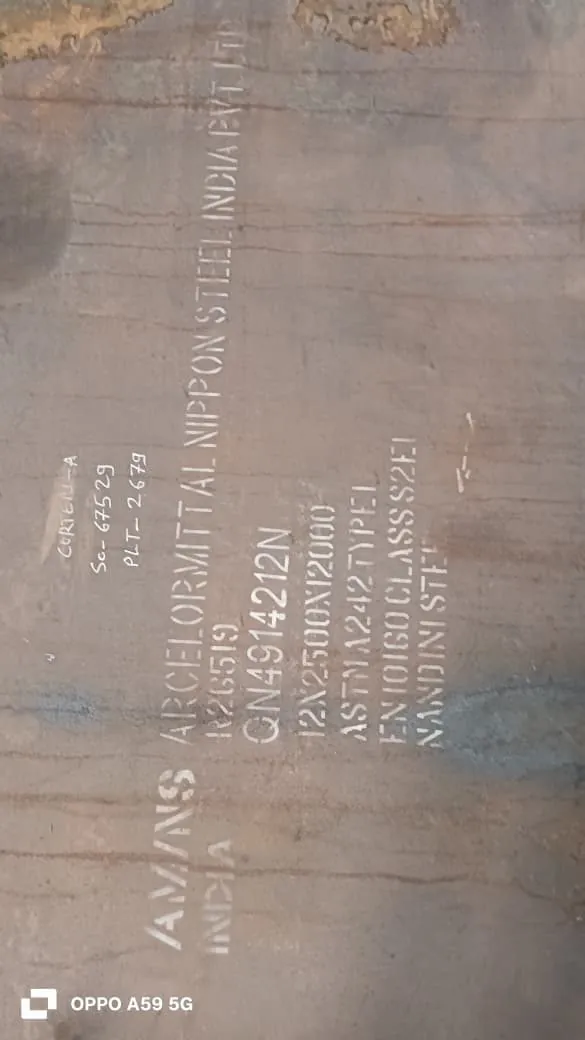
For sour pressure vessels and storage, the workhorse is A516 Gr 70 in its HIC-resistant form. Two things buyers under-specify here. First, call out the HIC-tested plate (NACE TM0284), not plain Gr 70, because ordinary plate can contain the sulfide inclusions that HIC exploits. Second, for low-temperature or thicker sections, specify the normalized plate with Charpy impact testing at the design temperature. State the plate thickness up front, since the mechanical minimums and the normalizing requirement vary with section. Our guide to specifying A516 for a vessel walks through this in detail, and the pressure-vessel steel explainer covers the wider PVQ picture.
Nickel Alloy: Incoloy 825
When the stream is severely sour or carries mixed acids, Incoloy 825 (UNS N08825) is the common step up. Buyers routinely call it "Inconel 825," but it is correctly Incoloy / Alloy 825, a Ni-Fe-Cr alloy, and getting the designation right on the PO and MTC avoids receiving-inspection disputes. Its combined resistance to reducing and oxidizing acids is why it is chosen over 316L and 904L in mixed-acid and sour-gas duty. For sour orders, cite NACE MR0175 / ISO 15156 so the heat is supplied in the qualified condition. See what Incoloy 825 is and how to weld Incoloy 825 with ERNiFeCr-1 filler. Nandini Steel is a certified specialist in Alloy 28, Incoloy 800, 904L, and Hastelloy plate, with Incoloy 825 held ex-stock for immediate dispatch.
Austenitic Stainless and Chloride-SCC
Standard austenitic grades deserve a caution. 316 and 316L resist pitting far better than 304, but like all austenitic stainless they remain susceptible to chloride stress-corrosion cracking. In a hot, chloride-bearing sour stream, chloride-SCC can be the controlling failure mode rather than H2S cracking. That is a major reason specifiers move up to 904L super-austenitic or to nickel alloys, where the higher nickel content sharply reduces SCC risk. Use the PREN and pitting-resistance primer and the 904L vs 316L comparison to size the gap for your service.
Specifying and Documenting a Sour Order
To order with confidence for sour service:
- Define the environment: H2S partial pressure, pH, chloride, temperature, and stress.
- Cite NACE MR0175 / ISO 15156 and, for carbon steel, NACE TM0284 HIC testing on the PO.
- State the delivery condition (normalized, solution-annealed) and hardness limit.
- Require an EN 10204 3.1 or 3.2 mill test certificate and the relevant NDT and PMI records.
Not sure which grade the envelope calls for? The grade selector tool and our how to select a stainless grade guide help you narrow it before you send an RFQ.
FAQ
What is the difference between HIC and SSC?
Does NACE MR0175 apply to stainless and nickel alloys?
Which A516 Gr 70 should I order for sour service?
When should I move from stainless to Incoloy 825 in sour service?
Is 316L safe in sour service?
Request a Quote
Nandini Steel supplies NACE MR0175 / ISO 15156 and HIC-tested material ex-stock for immediate dispatch, with an EN 10204 3.1/3.2 mill test certificate on every order. Send your H2S, pH, chloride, and temperature data to reachus@nandinisteel.com or WhatsApp +91 99202 09184 for live pricing and a qualified grade recommendation. Reviewed by the Nandini Steel Engineering Team, 2026-10-31.