
What is solution annealing?
Solution annealing (also known as solution heat treatment, or the solution-annealed AT condition) is the thermal process that takes everything that's precipitated out of an austenitic or nickel-alloy matrix and puts it back into solid solution. The alloy sits at a high solutionizing temperature until chromium-rich carbides (M23C6) and intermetallic phases dissolve. Then it's cooled fast, fast enough that those phases have no chance to re-form. What you get is a clean, homogeneous, single-phase structure, one that behaves exactly as the grade's chemistry promises.
The word solution matters here. Ordinary annealing softens metal and relieves stress, but solution annealing goes further, it dissolves second phases back into the host lattice. For stainless and nickel alloys, this isn't some optional polish. It's the delivery condition that makes the catalog corrosion numbers real. That's why the austenitic stainless steel and nickel alloy grades you buy from stock come solution-annealed as standard.
Solution annealing vs annealing vs stress relieving vs normalizing
These four processes get treated as interchangeable all the time, and that's where most of the confusion starts. Purpose, temperature, cooling, the metals each one applies to, none of that lines up between them.
| Process | Purpose | Typical temperature | Cooling | Applies to |
|---|---|---|---|---|
| Solution annealing | Dissolve carbides/intermetallics into single-phase solid solution; restore corrosion resistance | ~1010–1150 °C | Rapid / water quench | Austenitic & super-austenitic SS, Ni-Fe-Cr & Ni-Mo-Cr alloys |
| Full (process) annealing | Soften, recrystallize, remove cold work | Grade-dependent | Slow or rapid | Most steels (generic softening) |
| Stress relieving | Reduce residual/welding stress without altering structure | ~400–650 °C (SS, with care) | Slow, uniform | Fabrications, weldments |
| Stabilizing anneal | Tie up carbon as Ti/Nb carbides in 321/347 | ~870–900 °C | Air / controlled | Stabilized austenitic SS (321, 347) |
| Normalizing | Refine grain, improve low-temperature toughness | ~870–920 °C | Still air | PVQ carbon steel (A516), not stainless |
Watch the trap buried at the bottom here: stress relieving an austenitic stainless steel between 400 and 650 °C lands squarely inside the sensitization window. Done wrong, it can actually cause the very problem solution annealing is supposed to fix. Carbon pressure-vessel plate calls for a different process entirely, normalizing of PVQ plate, which is covered elsewhere.
How solution annealing works: the mechanism
Solution annealing works by skipping past the temperature band where chromium carbides form. You heat the steel into the solutionizing range, hold it there until the carbides and secondary phases dissolve, then quench it fast enough to clear the precipitation window on the way down. It's a short sequence. Every step matters, though.
- Heat the material uniformly into the solutionizing range (grade-specific, see table below).
- Soak long enough for chromium-rich M23C6 carbides and intermetallic phases (sigma, chi, Laves) to dissolve into the austenite, the soak time runs roughly proportional to section thickness.
- Quench rapidly through the 815–425 °C band so carbon and chromium stay locked in solid solution.
- Result: a single-phase austenite, uniform throughout, with chromium evenly distributed and corrosion resistance fully restored.
The 425–815 °C sensitization trap: why the quench must be fast
At 425 °C to 815 °C, chromium and carbon pair up and precipitate as chromium carbides along the grain boundaries. That process strips chromium from the metal nearby, pulling it under the roughly 11% threshold passivity requires and leaving behind chromium-depleted zones that corrode first. This is sensitization, and the result is intergranular corrosion. Solution annealing dissolves those carbides back into the metal, and the quench that follows has to outrun the 425–815 °C band before they can form again. Cool too slowly through that range, though, and you've re-sensitized the part you were trying to repair.
What solution annealing restores
A correct solution anneal restores several properties at once. It puts chromium back into uniform solid solution, which restores maximum corrosion resistance and immunity from sensitization-driven intergranular attack. It recrystallizes cold-worked structure, giving back softness, ductility and formability. In duplex and multiphase alloys, it re-establishes the intended phase balance. And it relieves the residual stresses left behind by rolling, forming or welding. That's the full reset behind the clean, defect-free condition every corrosion-resistant grade is supposed to ship in, ready to stand up to pitting and crevice corrosion and chloride stress-corrosion cracking.
Factors that control a good solution anneal
Hitting the target structure depends on five controllable factors. Miss any one and the delivery condition is compromised even if the furnace reached temperature.
Temperature (per family)
Each alloy family has its own solutionizing window, too low and carbides never fully dissolve; too high and grain growth or incipient melting sets in. Austenitic 304/316 solutionize around 1010–1120 °C; 904L super-austenitic needs a higher 1070–1150 °C because its high molybdenum and copper raise the dissolution temperature; Incoloy 825 anneals lower, around 925–980 °C.
Soak time & section thickness
The hold has to run long enough for the core, not just the surface, to come up to temperature and let the carbides dissolve. Heavy plate needs a proportionally longer soak. Under-soak a thick section and you're left with undissolved carbides at the center, and no quench afterward will fix that.
Quench rate & medium
Cooling has to clear the 815–425 °C band quickly. Thin sheet and strip can go forced-air or water quenched. Heavy sections, though, must be water quenched, their thermal mass cools the core too slowly in air, and that risks re-precipitation. The rule of thumb is simple: the thicker the section, the more aggressive the quench needs to be.
Furnace atmosphere, scale, pickling & passivation
High-temperature annealing leaves an oxide scale on the surface, along with a chromium-depleted layer underneath. Getting rid of that scale takes pickling and passivation, which brings back the passive film and restores the bulk metal's full corrosion resistance. For more, see pickling and passivation. If material is supplied "solution annealed and descaled/pickled," this step has already been done.
Prior cold work / work-hardening
Heavily cold-worked or formed parts carry residual stress and distorted grain structure. Solution annealing brings them back to a soft, strain-free condition. That matters for components that were deep-drawn, heavily bent or spun before service.
Which grades need solution annealing (and which don't)
Solution annealing is the required delivery condition for austenitic grades and most nickel alloys. For duplex, it's a controlled process instead. For carbon steel, it's simply the wrong one. Knowing which route each grade takes separates a sound order from a receiving-inspection dispute.
Austenitic stainless (304/304L, 316/316L)
The 304/304L and 316/316L grades are austenitic stainless steels supplied solution-annealed per ASTM A240 / ASME SA-240. The low-carbon "L" variants (C ≤ 0.03%) resist sensitization chemically, but even they ship solution-annealed. A common field observation from our engineering team: for welded fabrications that will sit at 425–815 °C, specify 304L or 316L up front, it avoids sensitization without needing a post-weld anneal.
Super-austenitic stainless (904L)
904L (UNS N08904, 1.4539) carries ~25% Ni, ~4.5% Mo and ~1.5% Cu, which push its solutionizing temperature to 1070–1150 °C with a mandatory rapid water quench. Its high alloy content makes a complete, correctly-quenched anneal essential, incomplete solutioning leaves intermetallics that destroy the sulfuric-acid and chloride resistance that 904L is bought for. Available ex-stock as 904L coil and plate in the annealed condition.
Nickel-iron-chromium alloys (Incoloy 825)
Incoloy 825 (UNS N08825, 2.4858) is a titanium-stabilized Ni-Fe-Cr alloy supplied in the annealed condition per ASTM B424 / ASME SB-424, typically stabilize-annealed around 925–980 °C. Buyers routinely call it "Inconel 825", getting the designation right on the PO and MTC avoids disputes. For sour service, cite NACE MR0175 / ISO 15156 on the order so the heat is supplied in the qualified condition and hardness band. Stocked as Incoloy 825 coil.
Stabilized grades (321/347: stabilizing vs solution anneal)
321 and 347 add titanium or niobium, which tie up carbon as stable carbides so chromium stays available. They can be solution-annealed at roughly 1040–1100 °C, or given a lower stabilizing anneal around 870–900 °C that deliberately forms Ti/Nb carbides to immunize them against later sensitization. Two different heat treatments, aimed at two different goals.
Duplex (controlled anneal + fast quench)
Duplex stainless steel such as 2205 is annealed around 1020–1100 °C with a mandatory fast quench to hold its ~50/50 ferrite-austenite balance and avoid sigma-phase embrittlement. The quench here protects phase balance, not just carbide dissolution.
PVQ carbon steel (A516) uses normalizing, not solution annealing
Carbon pressure-vessel plate such as A516 Gr 70 has no chromium to protect and no austenite to retain. It's normalized instead (~870–920 °C, air-cooled) to refine grain and give it low-temperature impact toughness. Solution annealing just doesn't apply here. See the contrast at normalizing of PVQ plate.
Solution-anneal temperature & condition reference
The table below serves as the orderable reference: grade, family, indicative solution-anneal temperature, quench, and governing standard or condition. Treat the temperatures as indicative metallurgical ranges only. Confirm them against the applicable standard and the mill test certificate for your heat.
| Grade | Family | Solution-anneal temp | Quench | Governing standard / condition |
|---|---|---|---|---|
| 304 / 304L | Austenitic SS | ~1010–1120 °C | Rapid / water quench | ASTM A240 (annealed + descaled) |
| 316 / 316L | Austenitic SS | ~1040–1120 °C | Rapid / water quench | ASTM A240 |
| 904L | Super-austenitic SS (N08904) | 1070–1150 °C | Rapid water quench | ASTM A240 (N08904 flat product) |
| 321 / 347 | Stabilized austenitic SS | ~1040–1100 °C (solution) / ~870–900 °C (stabilizing) | Rapid quench | ASTM A240 |
| Incoloy 825 | Ni-Fe-Cr alloy (N08825) | ~925–980 °C stabilize/anneal | Rapid quench | ASTM B424 |
| Duplex 2205 | Ferritic-austenitic SS | ~1020–1100 °C | Mandatory fast quench (hold ~50/50 phase balance) | ASTM A240 |
| A516 Gr 70 | PVQ carbon steel | Normalized ~870–920 °C (NOT solution-annealed) | Air cool | ASTM A516 / A20, contrast |
Sensitization-control routes
Solution annealing is one of three complementary ways to keep chromium carbides from robbing the grain boundaries. The most robust orders combine all three.
| Route | How it works | When to use | Limitation |
|---|---|---|---|
| Thermal, solution annealing | Dissolves carbides + rapid quench locks chromium in solution | Mill delivery condition; re-treating a sensitized part | Impractical on large finished weldments; needs a furnace + quench |
| Chemistry, low-carbon "L" grade | C ≤ 0.03% leaves too little carbon to form harmful carbides | Welded fabrications held in/through 425–815 °C | Slightly lower strength; not a cure for already-sensitized metal |
| Stabilization, 321 / 347 | Ti/Nb tie up carbon as stable carbides, sparing chromium | High-temperature service where "L" grades still sensitize | Requires correct stabilizing anneal; costlier grades |
For the step-by-step fabrication side, see how to prevent sensitization, this page explains the why, that guide carries the how.
Worked examples
Post-weld: restoring the HAZ of a 904L vessel
Welding re-heats the zone next to the bead right through the 425–815 °C band, sensitizing it locally, classic weld decay. On a 904L vessel the fix is either a full post-weld solution anneal to re-dissolve the heat-affected-zone carbides, or, more practically for site work, an over-alloyed filler such as ER385 that keeps the weld and HAZ corrosion-resistant without re-annealing. For filler selection, see welding 904L and welding Incoloy 825.
Reading "solution annealed, water quenched" on an EN 10204 3.1 MTC
When an EN 10204 3.1 mill test certificate states the delivery condition as solution annealed and water quenched (often abbreviated AT), it is certifying that the heat was taken into the solutionizing range and quenched, the paperwork that stands behind the grade's corrosion claim. Learn to parse it in how to read a mill test certificate.
Verifying the result with ASTM A262 intergranular testing
To prove freedom from sensitization, a sample from the heat goes through an ASTM A262 intergranular corrosion test (Practice A, E or C). A pass means the solution anneal did its job and the grain boundaries haven't lost chromium. That's the physical check behind the certificate statement.
How solution annealing is verified & certified
Verification comes down to four checks, and all four trace back to the heat. The delivery-condition statement on the EN 10204 3.1/3.2 mill test certificate records the anneal and quench against the heat/cast number. ASTM A262 Practice A/E/C rules out intergranular attack. A hardness check confirms the soft annealed condition. For sour service, it also confirms the heat falls inside the NACE MR0175 / ISO 15156 limits. PMI (positive material identification) confirms the grade itself. See PMI and NDT testing.
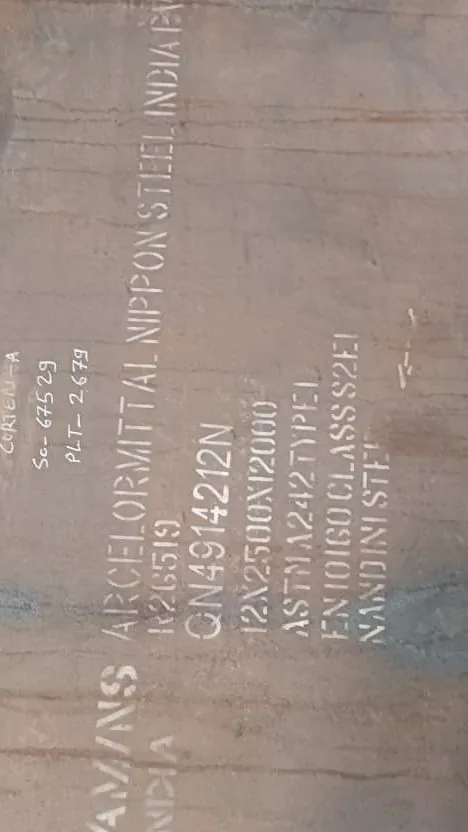
At Nandini Steel, we supply austenitic and nickel-alloy flat products from genuine mill plate, nameable sources including Aperam, Outokumpu, Jindal, POSCO, Nippon Steel and JFE, in the solution-annealed condition as standard. Every order comes with an EN 10204 3.1/3.2 mill test certificate, stating the delivery condition against the heat number. We're an ISO 9001:2015-certified stockist, and a third-party-certified specialist in 904L, Alloy 28, Incoloy 800 and Hastelloy. This material sits ex-stock for immediate dispatch, so the condition behind every corrosion claim is documented. Not assumed.
Related grades & where this matters commercially
The delivery condition only matters on a grade that depends on it. These are the pages where getting the anneal solution right is the whole point:
- 904L super-austenitic, copper-bearing, roughly 4.5% Mo chemistry where sulfuric-acid resistance rests entirely on a complete anneal. Stocked as 904L coil.
- Incoloy 825, a Ni-Fe-Cr alloy built for mixed-acid environments and sour service. Supplied annealed per ASTM B424.
- 316/316L stainless, the molybdenum workhorse. For welded pharma and food work, go with 316L solution-annealed.
- A516 pressure-vessel plate, the carbon-steel contrast here. It's normalized, not solution-annealed.
These grades serve chemical processing, oil and gas, pharmaceutical and pulp and paper duty. Unsure which grade your condition requirements point to? Start with the grade selector or the role of alloying elements. Need plate or coil supplied solution-annealed with a 3.1 MTC? Request a quote on the relevant grade page for live pricing.
FAQ
What is the difference between solution annealing and normalizing?
What temperature is used for solution annealing stainless steel?
Does solution annealing remove sensitization?
Can you weld stainless and then solution anneal it?
What does "solution annealed and pickled" mean?
Citations draw on several public standards, each referenced by its number. ASTM A240 / ASME SA-240 covers the solution-annealed delivery condition for stainless plate, sheet and coil, while ASTM B424 / ASME SB-424 governs the annealed condition for Incoloy 825. ASTM A262 sets out the intergranular corrosion test Practices A, E and C. For PVQ carbon plate, ASTM A516 / A20 addresses normalizing. EN 10204 lays out mill test certificate levels, such as 3.1/3.2. And NACE MR0175 / ISO 15156 specify heat-treat condition and hardness requirements for sour service.