
Key takeaways: 316 stainless steel at a glance
- Designation: UNS S31600, Werkstoff 1.4401, JIS SUS316, AISI 316, a molybdenum-bearing austenitic stainless steel.
- The differentiator: 2–3% molybdenum lifts PREN to ~24, resisting the chloride pitting that attacks 304 (~18).
Marine or chemical environments default to this grade, it's the first step up the pitting ladder above 304, picked when 304 would pit out but a nickel alloy would be overkill.
There's an honest limit here, though. It's still an austenitic grade, which means chloride stress-corrosion cracking is a real risk in hot, concentrated chlorides. Push past that threshold and you move to 904L.
On conformance and traceability: this is flat product to ASTM A240 / ASME SA-240, and every order ships with an EN 10204 3.1/3.2 mill test certificate.
What is 316 stainless steel?
316 is a chromium-nickel-molybdenum austenitic stainless steel, the molybdenum-bearing step up from 304 in the 18-10 austenitic family. Where 304 relies on chromium and nickel alone, 316 adds 2–3% molybdenum, the single alloying change that gives it meaningfully better resistance to chloride pitting and crevice attack.
That one difference is why the grade exists at all. Molybdenum stabilises the passive film against chloride ions, so 316 shrugs off seawater spray, chlorinated process streams and acidic media where plain 304 pits. That's why specifiers reach for 316 in marine, chemical, pharmaceutical and food service work. Paying extra for the molybdenum only makes sense when chlorides are actually in the picture. For dry, indoor, non-chloride duty, 304 does the same job for less.
Chemical composition
Element ranges cover UNS S31600 flat product under ASTM A240. The low-carbon variant, 316L, shares this chemistry but caps carbon at ≤0.03% to resist sensitization during welding.
| Element | Symbol | 316 (S31600), wt% |
|---|---|---|
| Carbon | C | ≤ 0.08 |
| Chromium | Cr | 16.0–18.0 |
| Nickel | Ni | 10.0–14.0 |
| Molybdenum | Mo | 2.0–3.0 |
| Manganese | Mn | ≤ 2.0 |
| Silicon | Si | ≤ 0.75 |
| Phosphorus | P | ≤ 0.045 |
| Sulfur | S | ≤ 0.030 |
| Nitrogen | N | ≤ 0.10 |
| Iron | Fe | Balance |
The role of molybdenum
Molybdenum is what separates 316 from 304. At 2–3%, it widens the range of chloride concentrations and temperatures the passive film can tolerate before breaking down, which lifts the pitting resistance equivalent from roughly 18 in 304 to roughly 24 in 316. We verify the molybdenum content on every incoming heat through positive material identification (PMI). A short-moly heat is just 304 dressed up with a 316 label, and it will pit in precisely the service conditions the buyer paid for 316 to withstand.
Mechanical properties
Minimum room-temperature properties for annealed 316 sheet and plate, as specified in ASTM A240.
| Property | Minimum (SI) | Minimum (imperial) |
|---|---|---|
| Tensile strength | ≥ 515 MPa | ≥ 75 ksi |
| Yield strength (0.2% offset) | ≥ 205 MPa | ≥ 30 ksi |
| Elongation in 50 mm | ≥ 40% | ≥ 40% |
| Hardness | ≤ 217 HBW | ≤ 95 HRB |
Physical properties
| Property | Typical value |
|---|---|
| Density | ~8.0 g/cm³ |
| Melting range | ~1375–1400 °C |
| Thermal conductivity (100 °C) | ~16.3 W/m·K |
| Mean coefficient of thermal expansion (0–100 °C) | ~16.0 µm/m·°C |
| Modulus of elasticity | ~193 GPa |
| Magnetic response | Essentially non-magnetic (austenitic; slight response if heavily cold-worked) |
Corrosion behavior & PREN: why 316 exists
316 beats 304 on pitting resistance because molybdenum shores up the passive film against chloride attack. That's the practical upshot of its higher PREN. The formula is Cr + 3.3·Mo + 16·N, and for S31600 it works out to about 24, versus roughly 18 for 304.
Pitting & crevice resistance: the PREN ~24 position
The molybdenum directly improves resistance to pitting corrosion and crevice corrosion, the two localized mechanisms that defeat 304 in chloride service. The selection ladder below places 316 as the first molybdenum-bearing rung, and shows when its pitting resistance is no longer enough.
| Grade | PREN (approx.) | Choose / upgrade when |
|---|---|---|
| 304 | ~18 | Dry, indoor, non-chloride service |
| 316 | ~24 | Marine, chemical, pharma, mild chlorides |
| 904L | ~34 | Hot/concentrated chlorides, sulfuric acid |
| Duplex 2205 | ~35 | Higher strength + chloride resistance |
| Incoloy 825 | ~31–40 | Mixed acids, sour service |
| Super-Duplex 2507 | ~43 | Seawater, aggressive brines |
316 in seawater & chlorides: the limit
316 wears the marine-grade label well, and for splash-zone fittings, coastal architecture and ambient seawater contact it holds up fine. It's not bulletproof, though. In warm, stagnant or concentrated chloride conditions, heated seawater, brine, bleach lines, 316 will pit and develop crevice corrosion. When chloride levels push past its limit, the honest fix is 904L over 316L or a duplex grade. A thicker section of 316 won't save you there.
Chloride stress-corrosion cracking
Like every austenitic stainless, 316 is susceptible to chloride stress-corrosion cracking, cracking under the combination of tensile stress, chlorides and temperature (typically above ~60 °C). The added molybdenum helps pitting but does little for SCC resistance; when hot chlorides and sustained stress coincide, duplex or high-nickel grades are the correct answer.
Sensitization & why 316L exists
Held in the 425–815 °C range, most commonly in a weld heat-affected zone, standard 316 (C ≤0.08%) can precipitate chromium carbides at grain boundaries, leaving them chromium-depleted and prone to sensitization / intergranular corrosion. This is sensitization, and it is prevented by using the low-carbon 316L (C ≤0.03%), a stabilized grade such as 316Ti, or post-weld solution annealing.
316 vs 316L: the low-carbon / sensitization decision
Same molybdenum, same PREN. Carbon is the only metallurgical difference, and it matters at the weld.
| Attribute | 316 (S31600) | 316L (S31603) |
|---|---|---|
| Molybdenum | 2–3% | 2–3% (same) |
| PREN | ~24 | ~24 (same) |
| Carbon | ≤ 0.08% | ≤ 0.03% |
| Sensitization risk on welding | Higher | Lower |
| Room-temp strength | Slightly higher | Slightly lower |
| When to specify | Unwelded or annealed parts | Welded parts in corrosive service |
Specify 316L for welded fabrications in corrosive or hygienic duty, where the heat-affected zone must stay corrosion-resistant without a post-weld anneal. For the full breakdown see 316 vs 316L and the 316L stainless steel grade hub.
316 vs 304: when the molybdenum is worth it
| Attribute | 304 | 316 |
|---|---|---|
| Molybdenum | None | 2–3% |
| PREN | ~18 | ~24 |
| Chloride / marine service | Pits | Resists |
| Relative cost | Lower | Higher |
Choose 316 over 304 when chlorides are present, coastal air, seawater, chlorinated or acidic process streams. Where service is dry and non-chloride, 304 is the economical choice. The full decision is owned by our 304 vs 316 stainless steel comparison.
Equivalent grades & designations
| System | Designation |
|---|---|
| UNS | S31600 |
| Werkstoff (W.-Nr.) | 1.4401 |
| JIS | SUS316 |
| EN | X5CrNiMo17-12-2 |
| BS | 316S31 |
| AISI | 316 |
| GB | 06Cr17Ni12Mo2 |
Our full UNS / Werkstoff / JIS cross-reference maps these designations across the catalog, so you can trace a single grade through every numbering system without digging.
316 forms we stock
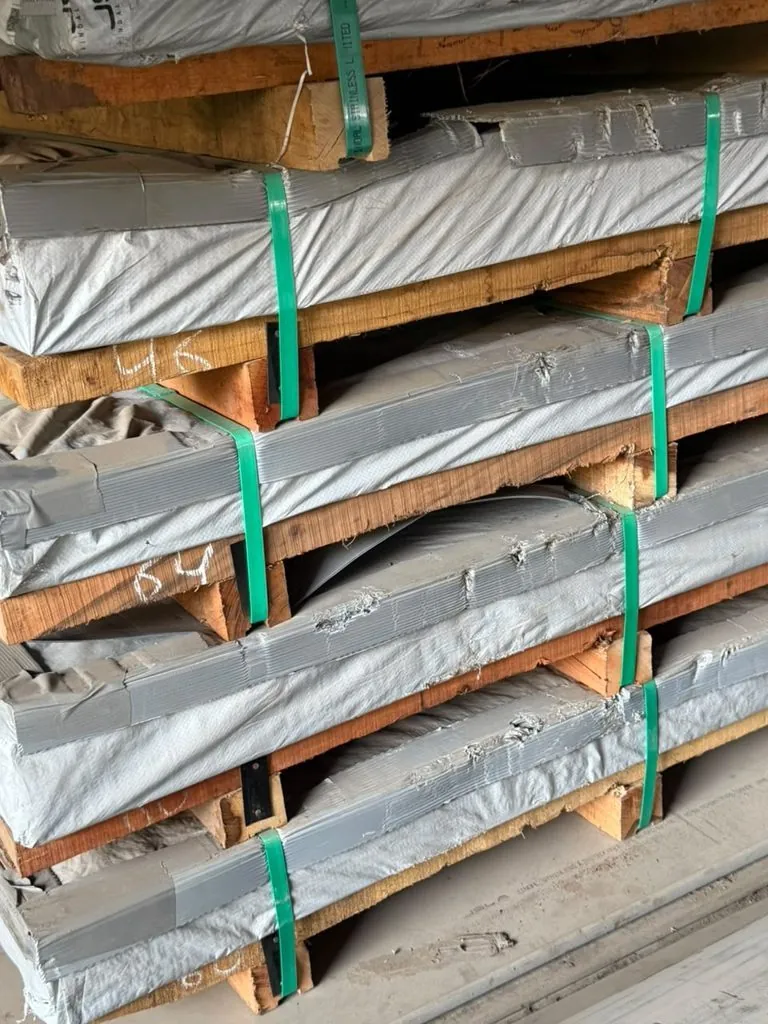
316 is in stock as flat product, ready for immediate dispatch. Each piece comes with genuine mill plate and an EN 10204 3.1/3.2 mill test certificate.
Sheet
Cold-rolled 316 in thin-gauge flat product works well for enclosures, hygienic surfaces and fabrication. See 316 stainless steel sheet.
Plate
Hot-rolled 316 holds up well in structural work, pressure applications and heavier fabrication jobs. For details, see 316 stainless steel plate.
Coil and other forms
316 coil, available in our 316 coil range, is used for slitting and blanking. The grade also comes as pipe, round bar, fittings and flanges across our wider stainless steel range, available on request.
Sizes, thickness ranges & weight
We keep 316 flat product ex-stock, across the standard range of sheet and plate sizes. Tell us the thickness, width and length you need, and we'll confirm availability from current stock by return. Mass figures are theoretical, calculated from density at 8.0 g/cm³:
Plate weight in kilograms comes from multiplying thickness in millimeters by width in meters, then by length in meters, then by 8.0.
A worked example: take a plate 6 mm thick, 1.25 m by 2.5 m. Multiply it out: 6 × 1.25 × 2.5 × 8.0, and you land on 150 kg. Need different dimensions? Our weight calculator handles that.
Finishes
316 sheet and plate are supplied in form-dependent finishes:
- 2B, smooth, reflective cold-rolled finish (sheet); the general-purpose default.
- No.1 / HRAP, hot-rolled, annealed and pickled matte finish (plate).
- BA, bright annealed, mirror-like cold-rolled finish (sheet).
- No.4, directional brushed finish for architectural and hygienic surfaces.
See our guide to stainless steel finishes for selection detail.
Standards & specifications complied
316 flat product meets ASTM A240 and its boiler-and-pressure-vessel counterpart ASME SA-240. Together these set the chemical and mechanical requirements for S31600 plate, sheet and strip. We supply material to these specifications with full heat and cast traceability.
Testing, inspection & certification
Every 316 order ships with an EN 10204 3.1 mill test certificate (3.2 on request) reporting the heat chemistry and mechanical results against ASTM A240. On request we add intergranular corrosion testing per ASTM A262, positive material identification (PMI) to confirm the 2–3% molybdenum, and ultrasonic testing. Our testing, MTC, NDT & PMI overview explains each check.
Applications of 316 by industry
Splash-zone fittings, coastal architecture, deck hardware: wherever chloride pitting defeats 304, you'll find it under Marine & coastal.
Chemical processing covers tanks, piping and vessels handling mildly acidic and chloride-bearing streams.
Clean-in-place vessels and process surfaces fall under Pharmaceutical / hygienic. These are usually welded in 316L.
Food & dairy rounds things out: hygienic equipment and surfaces, built where corrosion resistance and cleanability actually matter.
Welding & fabrication of 316
316 welds easily with matching low-carbon filler, ER316L or 316LSi, which keeps the weld metal's carbon low enough to resist sensitization. For welded fabrications in corrosive service, pair 316L base metal with 316L filler. 316 machines more readily than most austenitics, but it still work-hardens. That makes it less forgiving than the sulfur-bearing 303, so stick with sharp tooling, positive feeds, and flood coolant. Our guide on how to weld 316 covers filler selection, heat input, and post-weld practice.
Price & how we quote
Mill offers, form, thickness, finish, quantity, 316 pricing shifts with all of it, so we don't publish price tables. Send an RFQ and we'll come back with live pricing against your exact specification. All 316 flat product sits ex-stock for immediate dispatch. It's cut from genuine mill plate (Aperam, Outokumpu, Jindal, POSCO, Nippon Steel or JFE) and comes with its EN 10204 3.1/3.2 mill test certificate.
From the Nandini Steel Engineering Team
Buyers often pay for 316 where dry, indoor, non-chloride 304 would do the job, or they under-specify 316 for hot, concentrated chlorides where 904L or a duplex grade is actually needed. The 2–3% molybdenum is the thing you're really paying for. Match it to the actual pitting risk. For welded pharma and food work, use 316L, since it keeps the heat-affected zone corrosion-resistant.
FAQ
What is 316 stainless steel?
Is 316 stainless steel magnetic?
What is the difference between 316 and 316L?
Is 316 stainless steel corrosion resistant in seawater?
What is the PREN of 316 stainless steel?
Does 316 stainless steel come with a mill test certificate?
Request a quote for 316 stainless steel
Nandini Steel has carried ISO 9001:2015 certification since its founding in 2003, and it's spent over 20 years as a stockist and supplier of 316 stainless steel. The numbers speak for themselves: 307+ projects completed, 260+ clients served, shipments reaching more than 36 export countries. Every bit of 316 flat product sits ex-stock, ready to ship at once, backed by an EN 10204 3.1/3.2 mill test certificate.
- Call: +91 22 43404600 · +91 9920209184
- WhatsApp: +91 99202 09184
- Email: reachus@nandinisteel.com
- Address: 25, Dreamland Building, 601, 6th Floor, Mama Parmanand Marg, Charni Road, Opera House, Girgaon, Mumbai, Maharashtra 400004, India
- GSTIN: 27ADJPA7240C1Z0