
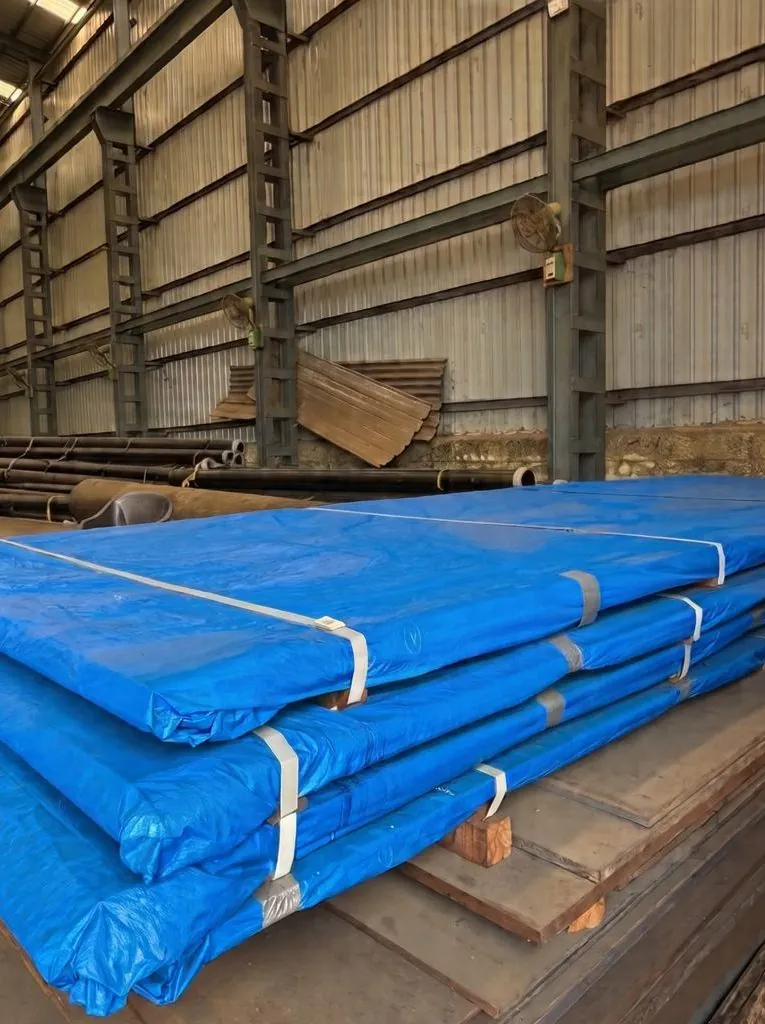
The calculator and grade selector
This tool pairs two flows against one shared, grade-aware density dataset. The weight calculator answers "how much metal am I buying?" The grade selector answers "which grade fits my service?" Steel gets priced and freighted by weight, so the kilogram figure is the commercial pivot of every RFQ, and it's only correct if the density matches the actual grade. Already know your grade and just want a quick number? The companion steel weight calculator is the grade-known fast path. This page is the grade-first, advisory door.
Weight calculator
Inputs flow from grade (304/304L, 316/316L, 904L, Incoloy 825, A516 Gr 70, duplex 2205 and catalog grades) to form (plate, sheet, coil, round bar, pipe/tube, flat bar) to dimensions (thickness, width, length, or diameter and wall). Output: weight per piece and total weight in kilograms, computed as volume times the density stored for that specific grade. This is a calculated, theoretical figure. The actual mill weight on your EN 10204 3.1 mill test certificate is what governs the invoice.
Grade selector
Inputs are the medium (general, marine/chloride, acid, sour gas), temperature, chloride level and pressure/vessel duty. The output is one or more recommended corrosion-resistant grades with the metallurgical reason behind each pick, PREN, molybdenum content, acid or sour-service fit, and every one routes to the grade's money page so you can specify and source it. The logic maps service conditions to grades the way a specifier actually would. First match the pitting risk and the acid chemistry, then confirm the form and standard.
How to calculate metal weight in 4 steps
- Pick the grade. Choose your alloy, say 904L or Incoloy 825, and the tool pulls that grade's verified density automatically. 904L comes in at 7.95 g/cm³, Incoloy 825 sits at 8.14 g/cm³, and A516 Gr 70 runs 7.85 g/cm³. The result is grade-correct every time, not some generic 7.85 shortcut stretched across materials it doesn't fit.
- Pick the form. Choose plate/sheet, round bar, pipe/tube or flat bar. Each form carries its own volume formula.
- Enter the dimensions. Key in thickness, width and length for flat products, or diameter (and wall, for pipe) for long products. Use millimeters for thickness and meters for length.
- Read the weight. The tool gives you kilograms per piece and the total weight. Add the item to an RFQ, and that weight turns into a quoted delivery backed by an MTC.
The weight formula and the data behind it
Universal formula
Weight (kg) = Volume (m³) × Density (kg/m³)
Every version here is just another route to the same volume; what sets the density is the grade. That's the whole case for a grade-aware tool over a calculator stuck on one constant.
Form-specific formulas
| Form | Formula | Inputs |
|---|---|---|
| Plate / sheet / coil | length(m) × width(m) × thickness(mm) ÷ 1000 × density(kg/m³) | length, width, thickness |
| Round bar | (π ÷ 4) × diameter(m)² × length(m) × density(kg/m³) | diameter, length |
| Pipe / tube | (π ÷ 4) × [OD(m)² − ID(m)²] × length(m) × density(kg/m³) | OD, ID (or wall), length |
| Flat bar | width(m) × thickness(m) × length(m) × density(kg/m³) | width, thickness, length |
| Hex bar | 0.866 × across-flats(m)² × length(m) × density(kg/m³) | across-flats, length |
Why grade-specific density matters
A generic calculator applies 7.85 g/cm³, the density of carbon steel, to everything, and that under- or over-states corrosion-resistant grades every time. Take super-austenitic 904L: 7.95 g/cm³. Duplex 2205 comes in lighter at 7.80, while the Ni-Fe-Cr alloy Incoloy 825 runs heavier at 8.14. Nickel alloys push the number higher still, with Inconel 625 at roughly 8.44 and Hastelloy C276 at roughly 8.89. On a tonne of plate, using 7.85 for Incoloy 825 undercounts the real weight by about 4%, and that's enough to throw off a budget or an RFQ. This tool stores the correct density for each grade, so the figure holds up both technically and commercially.
Density and PREN reference table
This is the tool's core data set: a grade-aware density and PREN reference pulled together from the governing standards and recognized mill datasheets. PREN (pitting resistance equivalent) works out to Cr + 3.3 × Mo + 16 × N. It ranks how well a grade resists chloride pitting, and it puts weight and corrosion fit side by side in one table. The values are published metallurgical facts. We cite them; we don't copy them.
| Grade | Family | Density (g/cm³) | Density (kg/m³) | PREN (approx.) | Governing standard |
|---|---|---|---|---|---|
| 304 / 304L | Austenitic SS | 8.0 | 8000 | ~18 | ASTM A240 |
| 316 / 316L | Austenitic SS | 8.0 | 8000 | ~24 | ASTM A240 |
| 321 | Austenitic SS (Ti-stabilized) | 8.0 | 8000 | ~17 | ASTM A240 |
| 310 / 310S | Austenitic SS (heat-resistant) | 8.0 | 8000 | ~24 | ASTM A240 |
| 904L | Super-austenitic SS (UNS N08904 / 1.4539) | 7.95 | 7950 | ~34 | ASTM A240 |
| Duplex 2205 | Duplex SS | 7.80 | 7800 | ~35 | ASTM A240 |
| Alloy 20 | Super-austenitic / Ni-Fe-Cr | 8.05 | 8050 | ~30 | ASTM B463 |
| Incoloy 825 | Ni-Fe-Cr alloy (UNS N08825 / 2.4858) | 8.14 | 8140 | ~31–40 | ASTM B424 |
| Inconel 625 | Ni-Cr-Mo alloy | 8.44 | 8440 | ~51 | ASTM B443 |
| Hastelloy C276 | Ni-Mo-Cr alloy | 8.89 | 8890 | ~68 | ASTM B575 |
| A516 Gr 70 | PVQ carbon steel | 7.85 | 7850 | n/a (carbon) | ASTM A516 |
PREN values rank these grades in a clear order: 304 sits around 18, 316 climbs to about 24, and 904L reaches roughly 34, putting it on par with Incoloy 825's range of 31 to 40. Duplex 2205 comes in near 35. Super-duplex 2507 tops the list at about 43. The full breakdown lives under PREN (pitting resistance equivalent).
Worked examples
Each row works out Weight as Volume times Density, using the grade's own density value, so you can check the tool's output against a hand calculation.
| Item | Inputs | Calculation | Weight |
|---|---|---|---|
| 316L plate | 6 mm × 1.5 m × 3 m | 1.5 × 3 × 0.006 = 0.027 m³ × 8000 | 216 kg |
| 904L plate | 10 mm × 1.25 m × 2.5 m | 1.25 × 2.5 × 0.010 = 0.03125 m³ × 7950 | ≈ 248 kg |
| Incoloy 825 sheet | 3 mm × 1 m × 2 m | 1 × 2 × 0.003 = 0.006 m³ × 8140 | ≈ 49 kg |
| A516 Gr 70 plate | 12 mm × 2 m × 6 m | 2 × 6 × 0.012 = 0.144 m³ × 7850 | ≈ 1130 kg |
| 316 round bar | 50 mm dia × 1 m | (π/4) × 0.05² × 1 × 8000 | ≈ 15.7 kg |
How the grade selector decides
Selection inputs (medium, temperature, chloride, pressure)
The selector turns four service conditions into a defensible grade. Medium sets the corrosion mechanism, general, chloride, acid or sour gas. Temperature shifts the pitting and stress-corrosion-cracking risk, and for vessels it sets the impact-testing requirement too. Chloride level is what drives the PREN you need. And pressure/vessel duty decides whether you land in corrosion-resistant territory or in PVQ carbon-steel territory. The logic matches real pitting risk and acid chemistry to the lowest grade that safely covers it, stepping up only when the service actually demands it.
Decision map
| Service condition | Recommended grade | Why (metallurgical fit) | Specify / source |
|---|---|---|---|
| General fabrication, no significant chloride | 304 / 304L | Austenitic, PREN ~18; suitable for architectural, food and dairy duty | 304 / 304L |
| Marine / chloride / pharma / food | 316 / 316L | 2–3% Mo resists pitting (PREN ~24); the mainstream choice for marine / seawater and chemical duty | 316 / 316L stainless |
| High chloride + sulfuric / reducing acids | 904L | Copper-bearing ~4.5% Mo chemistry (PREN ~34) resists sulfuric acid and chloride pitting/crevice; outperforms 316L in chloride SCC | 904L super-austenitic |
| Sour service / oil & gas / mixed acids | Incoloy 825 | Ni-Fe-Cr alloy resisting reducing and oxidizing acids; conforms to NACE MR0175 / ISO 15156 for sour duty | Incoloy 825 |
| Pressure vessel / boiler, non-corrosive | A516 Gr 70 | PVQ carbon steel for vessels, boilers, storage and separators; normalize for low-temperature impact duty | A516 Gr 70 pressure-vessel plate |
A common mistake the selector catches is defaulting to 304 for chloride-adjacent or coastal duty, where it pits. Check the grade against your chloride level before picking 304 over 316. For a fuller walk-through, see the guide on how to select a stainless steel grade.
Grades and forms this tool covers
Every grade in the dataset carries a verified density, and the selector maps each one to the forms it's actually supplied in.
- 304 / 304L, 316 / 316L, 321, 310/310S, 904L, available as sheet, plate and coil; conform to ASTM A240.
- Incoloy 825, available as sheet and plate (coil limited); conforms to ASTM B424.
- A516 Gr 70, available primarily as plate; conforms to ASTM A516.
Nickel alloys (Inconel 625, Hastelloy C276, Alloy 20) and duplex 2205 sit in the catalog as density rows, used for weight estimation.
If you're not sure which flat product fits your needs, the guide to sheet vs plate vs coil lays out the difference between them. For picking the right section, see choosing plate thickness. Every product listed is held ex-stock, so dispatch is immediate.
Standards the weights and grades reference
The densities and grade designations here come straight from the governing standards.
- ASTM A240 covers plate, sheet and strip for 304, 316, 904L and other chromium-nickel stainless grades.
- ASTM B424, Ni-Fe-Cr-Mo-Cu plate, sheet and strip, governing Incoloy 825.
- ASTM A516, carbon-steel pressure-vessel plate built for moderate and lower-temperature service (A516 Gr 70).
- UNS / Werkstoff cross-reference, use this to convert a grade across UNS, Werkstoff (W.-Nr.) and JIS designations before you raise a PO.
From estimate to order
A weight and a grade together make for a quoted, traceable delivery. Feed the tool a kilogram figure and a confirmed grade, raise an RFQ, and Nandini Steel supplies genuine mill plate, sourced from mills such as Aperam, Outokumpu, Jindal, POSCO, Nippon Steel and JFE, ex-stock for immediate dispatch. Every order comes with an EN 10204 3.1/3.2 mill test certificate, giving you full heat and cast traceability. Pricing gets quoted live against your specification; no indicative price tables here. Want to see how the paperwork works? Check the EN 10204 3.1 mill test certificate reference, then raise an RFQ with your grade, form, dimensions and quantity.
Related tools and guides
- steel weight calculator, the grade-known fast path when you already have the alloy.
- how to calculate plate weight, the formula explained step by step.
- stainless steel weight chart, ready-reckoner weights per square meter.
- PREN (pitting resistance equivalent), how the corrosion ranking gets derived.
- sour service (NACE MR0175), the reason the selector sends sour duty toward Incoloy 825 and HIC-tested plate.
- Industry destinations: oil & gas (sour), chemical / acid processing, pressure vessels & boilers.
Frequently asked questions
Is it accurate to use 7.85 density for all steel?
What is the difference between theoretical and actual weight?
Which stainless steel grade should I use for chlorides or seawater?
How do I calculate the weight of a steel pipe?
Does the weight come with a mill test certificate?
Raise an RFQ for ex-stock material with MTC: send us your grade, form, dimensions and quantity, and we'll get back with a live quote. Call +91 22 43404600, WhatsApp +91 99202 09184, or email reachus@nandinisteel.com.