
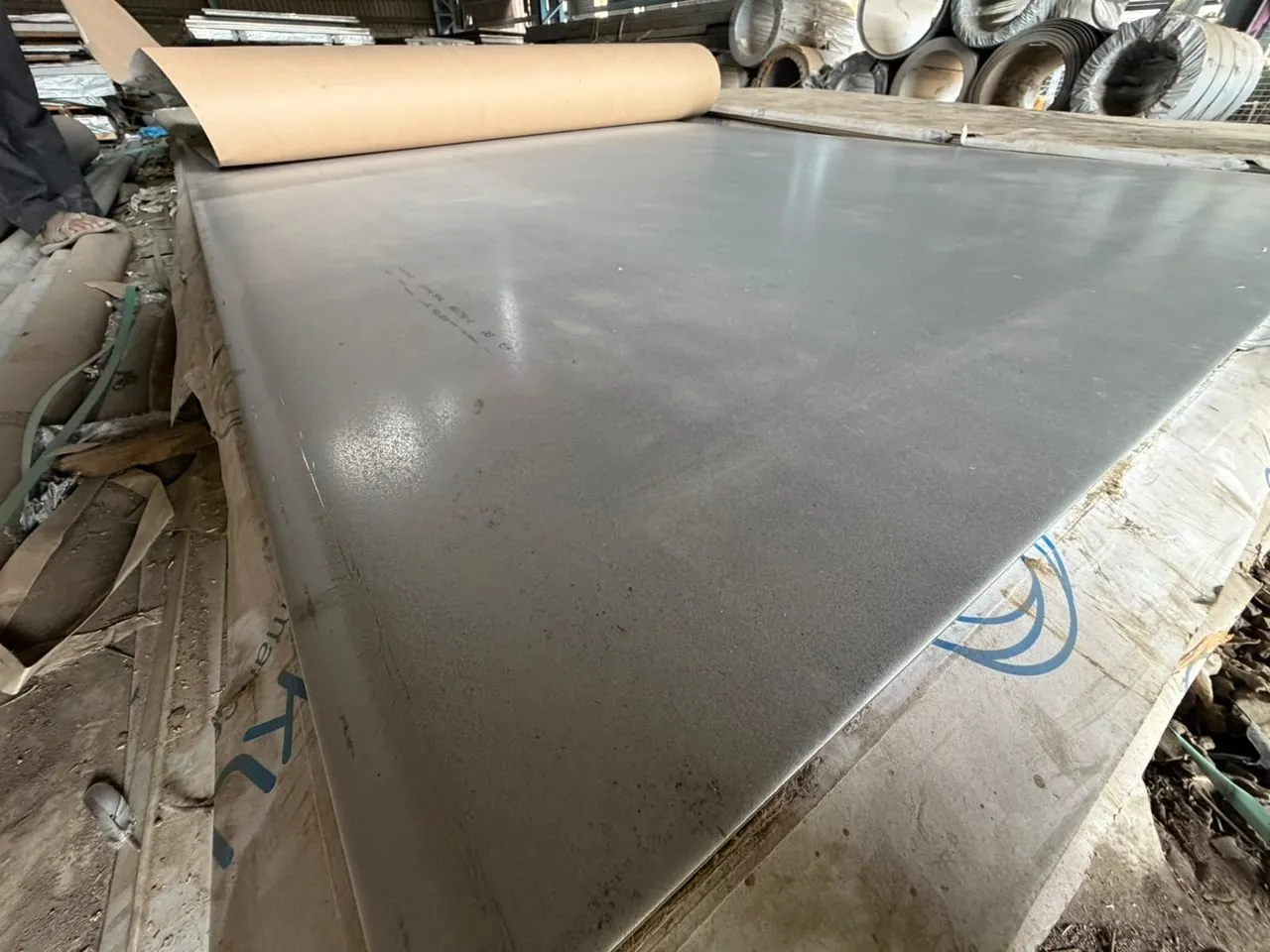
The goal: what a correct 904L weld must achieve
904L is a fully austenitic, high-molybdenum super-austenitic stainless steel. You bought it for a PREN of about 34 and its resistance to sulfuric acid and chloride pitting. The weld only earns its keep if the joint and the heat-affected zone stay as corrosion-resistant as the plate. A correct 904L weld has to meet four tests. It holds a finished PREN of roughly 34 across weld metal and base metal. It's free of hot (solidification) cracks. The HAZ shows no sensitization or weld decay. And it suffers no preferential weld-metal corrosion from under-alloyed filler.
Two failure modes threaten every one of those goals. First, 904L is fully austenitic with no delta ferrite to tolerate solidification stress, and molybdenum segregates as the weld freezes. Matching or under-alloyed filler leaves the weld metal poorer in Mo than the base, and that creates a local weak point. Second, uncontrolled heat causes hot cracking, sensitization and heat tint. The whole procedure below exists to beat those two mechanisms: over-alloyed filler, low heat input, an inert back-purge, and post-weld pickling and passivation.
Before you start: prerequisites and inputs
Material and traceability
Weld to the material you actually specified. 904L flat product conforms to ASTM A240 / ASME SA-240 (and ASTM B625 / SB-625 for N08904), and genuine mill plate carries a matching heat chemistry, Nandini Steel supplies 904L as ex-stock 904L plate from the 904L grade hub, rolled from genuine mill material (Aperam, Outokumpu, Jindal, POSCO, Nippon Steel or JFE) with an EN 10204 3.1/3.2 mill test certificate provided with every order. Confirm the heat's composition from that certificate before you qualify a procedure, because your filler choice is driven by the real Mo and Cu content, not the nominal grade name.
Choosing the filler: the decision that protects the PREN
This is the money question. Molybdenum segregates during solidification, so a matching-composition weld would come out leaner in Mo than the base metal and pit first. The rule here is simple: over-match. The filler has to equal or exceed 904L's alloy content so the as-welded joint still lands at PREN ~34 or better.
| Filler | AWS class | UNS | Base / over-match | When to use |
|---|---|---|---|---|
| ER385 (94L) | AWS A5.9 ER385 | W88904 | Matching, slightly over-alloyed | Standard 904L-to-904L welds in sulfuric-acid, pharma and pulp & paper service |
| ERNiCrMo-3 (FM 625 / Alloy 625) | AWS A5.14 ERNiCrMo-3 | N06625 | Over-alloyed nickel-base | Higher-chloride or crevice duty, restrained/thick joints, and dissimilar 904L-to-nickel-alloy or 904L-to-carbon-steel welds |
| ERNiCrMo-4 (C276) | AWS A5.14 ERNiCrMo-4 | N10276 | Over-alloyed nickel-base | The most aggressive reducing-acid and chloride service |
ER385 (94L): the matching, over-alloyed choice
ER385 is the default choice for routine 904L-to-904L joints. It carries extra nickel, molybdenum and copper over the base, so the weld pool, once segregation has occurred, still lands at or above the plate's PREN. In acid and chloride service where 904L was the specified material, ER385 keeps the weld on the same corrosion footing as the surrounding metal.
ERNiCrMo-3 (FM 625) and ERNiCrMo-4 (C276): the nickel-base upgrade
Step up to a nickel-base filler when the joint is heavily restrained, the section is thick, the chloride or crevice load is severe, or you're joining 904L to a dissimilar metal. ERNiCrMo-3 (FM 625) handles dilution better than a matching filler would, and it gives you weld metal that clearly beats 904L on pitting resistance. ERNiCrMo-4 (C276) pushes that even further for reducing acids.
Why never 316L or matching-composition filler
A 316L filler is under-alloyed for 904L: its ~2–3% Mo cannot restore the ~4.5% Mo you paid for, so the weld bead becomes the pitting and crevice initiation site. Autogenous (no-filler) welds and any strictly matching deposit fail for the same reason once Mo segregates. 904L outperforms 316L in chloride SCC precisely because of that molybdenum and copper, don't throw the advantage away at the weld. For the underlying theory, see weld decay and filler selection and the general guide to welding stainless & nickel alloys.
Process selection, shielding and backing gas
GTAW (TIG), GMAW (MIG), SMAW (E385 covered electrode), SAW and PAW can all weld 904L. GTAW with cut-length ER385 or FM 625 gives the cleanest root, with the lowest dilution, and is what most shops reach for on pipe and pressure work. Shield with argon or an argon-based gas. Always back-purge the root with argon too, so the underside doesn't oxidize and "sugar." Keep purge oxygen low, generally under a few hundred ppm, until the root and hot pass are done.
| Parameter | Guidance for 904L |
|---|---|
| Process | GTAW (root), GMAW / SMAW (E385) / SAW (fill & cap) |
| Shielding gas | Argon or argon-based (GTAW); low-oxidizing mixes for GMAW |
| Backing gas | Argon back-purge until root + hot pass complete |
| Heat input | Low, stringer beads preferred, minimal weave |
| Interpass temperature | Keep low, commonly ≤150 °C (≈300 °F) |
| Preheat | None (fully austenitic) |
| PWHT | None routine; solution-anneal only to fully restore corrosion resistance |
Why 904L needs no preheat and no routine PWHT
Because 904L is fully austenitic, it has no hardenable transformation to manage: it requires no preheat. It also needs no routine post-weld heat treatment. Only where full corrosion resistance must be re-established, for example after heavy cold work or when code demands it, is a solution anneal at roughly 1070–1150 °C with rapid quench used, and that is a mill or dedicated furnace operation, not shop stress-relief.
Step-by-step 904L welding procedure
- Clean and isolate. Degrease the joint and strip out every trace of iron contamination, grease, and marking ink. Stick to dedicated stainless-only brushes, grinding discs and tools; iron pickup from carbon-steel tooling seeds rust and pitting.
- Prepare and fit up the joint. Bevel for full penetration and set a low-dilution root, with a tight, consistent gap, so base-metal dilution into the first bead stays controlled.
- Set up the back-purge. Dam the root side and purge with argon until oxygen drops low enough to prevent root oxidation. Keep the purge running through the root and hot pass.
- Select filler and parameters. Load ER385 for matching welds, or FM 625 / C276 for higher-chloride or dissimilar joints. Dial in a low-heat-input schedule.
- Run the root pass. Deposit the GTAW root with over-alloyed filler into the purged joint. Keep dilution and heat low throughout.
- Fill and cap. Build up with stringer beads, adding filler on every pass. Never run matching-composition or autogenous beads here.
- Control heat input and interpass temperature. Let each pass cool below the interpass limit, commonly ≤150 °C, before starting the next. Hold time in the 425–815 °C sensitization range to a minimum.
- Clean the finished weld. Remove heat tint and oxide scale by pickling, then passivate to rebuild the chromium-rich film (see the restoration section below).
Pitfalls and warnings: how 904L welds fail
904L solidifies fully austenitic, with no delta ferrite to absorb shrinkage strain. That makes it more prone to hot cracking than 304 or 316. Clean metal, low heat input, limited restraint and an over-alloyed filler keep it in check.
Holding the HAZ between 425 and 815 °C lets chromium carbides precipitate out. That's sensitization, and it strips chromium from the grain boundaries. At the same time, molybdenum segregates in the freezing weld. Keep the interpass temperature low and use 94L or 625 filler, and both problems go away. For background, see weld decay and filler selection and sensitization.
Heat tint. That blue or straw-colored oxide scale next to a weld isn't just surface discoloration. It's a chromium-depleted layer, and it gives pitting exactly the spot it needs to start. Wire-brushing it won't help. It has to come off entirely.
Preferential weld-metal corrosion. Drop the Mo content of the deposit below that of the base metal, the under-alloyed-filler trap, and the weld goes first, even on a perfectly good plate. Over-matching the filler is the only fix.
Dissimilar welds. When joining 904L to 316L or carbon steel, use a nickel-base filler (FM 625) to bridge the chemistry and watch for galvanic corrosion in service, since the dissimilar couple can drive attack on the less noble side. Chloride stress-corrosion cracking remains the reason 904L was chosen over 316L, so keep the weld on the high-alloy side.
| Failure mode | Cause | Prevention |
|---|---|---|
| Hot (solidification) cracking | Fully austenitic, no delta ferrite; high restraint/heat | Low heat input, clean metal, over-alloyed filler |
| Weld decay / sensitization | HAZ held at 425–815 °C → chromium-carbide precipitation | Low interpass temp, fast through the range, L-grade base |
| Heat-tint pitting | Chromium-depleted oxide scale left on the surface | Pickle and passivate to bare, repassivated metal |
| Preferential weld-metal corrosion | Under-alloyed (e.g. 316L) filler, Mo segregation | Over-match with ER385 or nickel-base filler |
| Galvanic attack (dissimilar) | 904L coupled to carbon steel / 316L | Nickel-base filler; isolate or design the couple |
Verification and inspection: proving the weld
Qualify the completed weld against the properties you specified, not just its appearance. Here's a practical checklist.
- Visual and heat-tint inspection, confirm a clean, bright root and no residual oxide scale.
- PMI on the weld metal, positive material identification confirms the deposit really does carry the expected molybdenum, the single most useful check against a wrong-filler error.
- Dye-penetrant (PT), surface crack detection on root and cap.
- RT / UT, radiographic or ultrasonic volumetric inspection for pressure-retaining work.
- ASTM A262 (IGC), intergranular-corrosion testing (Practice E, for instance) on a weld coupon proves the HAZ hasn't sensitized.
- EN 10204 3.1/3.2 documentation, tie base metal, filler and test results back to traceable certificates.
The base plate ships with an EN 10204 3.1/3.2 mill test certificate on every order, so the base-metal half of that trail is already covered. For the methods, see PMI, NDT and MTC.
Post-weld corrosion restoration: pickling and passivation
Welding leaves heat tint behind, along with a disturbed oxide layer that no longer protects the steel. Pickling strips away the scale and the chromium-depleted skin underneath it. Passivation then rebuilds the clean, chromium-rich passive film, so the weld zone gets back the base metal's corrosion resistance. On 904L, treat this as a mandatory step, not a cosmetic one. Follow the method in pickling and passivation and the step-by-step passivate the weld guide. ASTM A967 covers the passivation practice and acceptance criteria.
Related grades, guides and when to solution-anneal
This over-alloyed-filler logic applies specifically to super-austenitic 904L. Welding 316 calls for a matching ER316L deposit, since 316 carries delta ferrite and considerably less molybdenum. Welding Incoloy 825, by contrast, depends on an ERNiFeCr-1 (FM 65) nickel-base filler. For keeping an L-grade HAZ corrosion-resistant without post-weld annealing, see prevent sensitization. Where full properties must be restored, a solution anneal is the proper route. 904L welded equipment serves pharmaceutical, pulp & paper bleaching and fertilizer / acid-regeneration service applications. That's precisely why weld-zone integrity matters so much.
904L composition reference (abbreviated)
| Element | Cr | Ni | Mo | Cu | C |
|---|---|---|---|---|---|
| N08904 / 1.4539 (wt %) | 19–23 | 23–28 | 4.0–5.0 | 1.0–2.0 | ≤0.02 |
The ~4.5% molybdenum and ~1.5% copper are exactly what give it resistance to sulfuric acid and chlorides, and exactly what the filler has to over-match once segregation sets in. Full specifications live on the 904L grade hub.
FAQ
What filler do you use to weld 904L?
Can you weld 904L with 316L filler?
Does 904L need preheat or post-weld heat treatment?
How do you stop 904L welds from losing corrosion resistance?
Why does 904L crack more easily when welded?
How do you verify a 904L weld is sound?
Need 904L with matching filler and a 3.1 MTC?
Nandini Steel is an ISO 9001:2015-certified stockist and supplier. The company was established in 2003 and specializes in 904L, Alloy 28, Incoloy 800 and Hastelloy. Every bit of 904L sits ex-stock, ready for immediate dispatch. It's rolled from genuine mill plate sourced from Aperam, Outokumpu, Jindal, POSCO, Nippon Steel and JFE, and each order ships with an EN 10204 3.1/3.2 mill test certificate. Over more than 20 years, the company has delivered 307+ projects for 260+ clients spread across 36+ export countries. For a request for quotation, send drawings or a grade-and-quantity list; pricing runs live by RFQ.
- Phone: +91 22 43404600 · +91 9920209184
- WhatsApp: +91 99202 09184
- Email: reachus@nandinisteel.com
- Address: 25, Dreamland Building, 601, 6th Floor, Mama Parmanand Marg, Charni Road, Opera House, Girgaon, Mumbai, Maharashtra 400004, India
- GSTIN: 27ADJPA7240C1Z0