
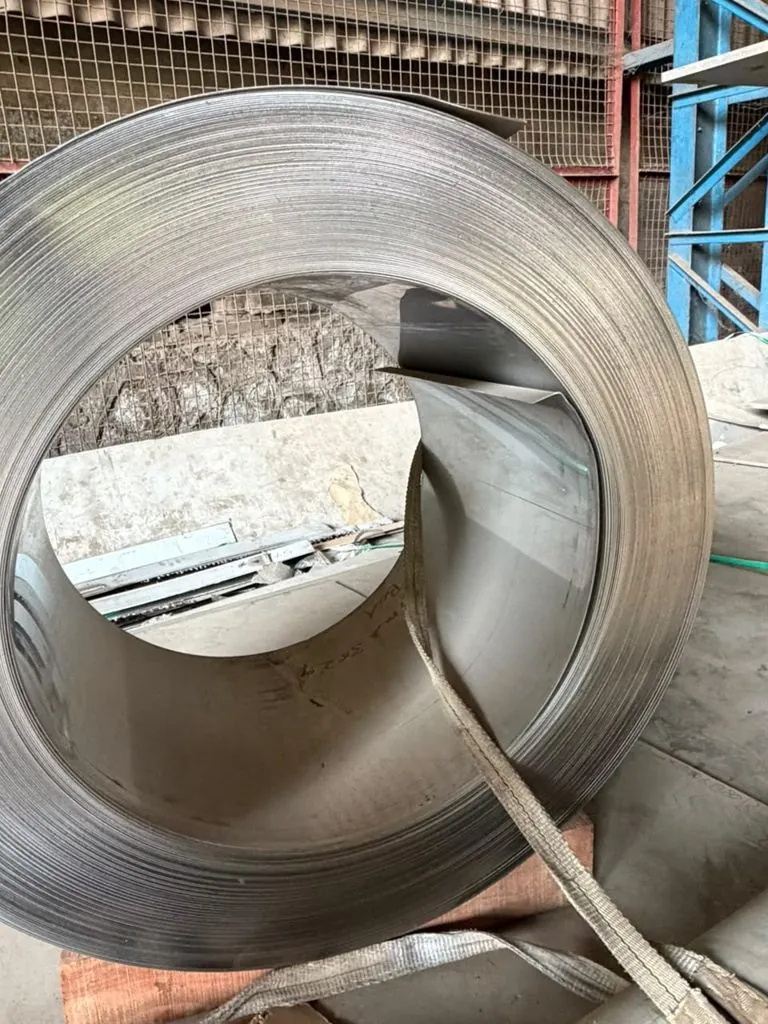
Alloy 20 at a glance
- Designations: UNS N08020 · Werkstoff 2.4660 · trade name Carpenter 20Cb-3 / Alloy 20Cb-3.
- Family: a niobium-stabilized nickel-iron-chromium (Ni-Fe-Cr) alloy, with copper and molybdenum added. Think of it as a "super-stainless," sitting somewhere between austenitic stainless and the full nickel alloys.
- Signature: engineered for sulfuric-acid and mixed-acid service, with a PREN of roughly 28.
- Primary standard: ASTM B463 / ASME SB-463 for plate, sheet and strip.
- Supply: Nandini Steel is a Mumbai-based stockist and supplier holding genuine mill plate, sheet, pipe, tube, round bar, flanges and forged fittings across India, all ex-stock for immediate dispatch. Every order ships with an EN 10204 3.1/3.2 mill test certificate.
What is Alloy 20?
Alloy 20 is a nickel-iron-chromium alloy, built specifically to resist corrosion in sulfuric acid. It carries a "20" designation and often turns up on lists of stainless grades. Look at the numbers, though, and a different picture emerges: ~35% iron sits alongside roughly 32–38% nickel and 19–21% chromium. That balance means it isn't a conventional austenitic stainless steel at all; it's classed instead as a nickel-iron-chromium alloy. The high nickel content, combined with copper and molybdenum, is what pushes it past grades such as 316L and into true acid-service territory. Not stainless-steel territory anymore. It belongs among the nickel alloys, yet it keeps the austenitic trait of being non-magnetic.
Carpenter 20Cb-3 is the common trade name for the same N08020 chemistry. The "Cb" refers to columbium, the older name for niobium, which is the stabilizing element added to control intergranular corrosion. On a purchase order and mill test certificate, UNS N08020 and Carpenter 20Cb-3 describe the same grade. Stating both avoids receiving-inspection disputes.
Chemical composition
The Alloy 20 datasheet begins with chemistry. Element ranges per ASTM B463 for UNS N08020, in weight percent:
| Element | Symbol | Composition (wt%) |
|---|---|---|
| Carbon | C | ≤ 0.07 |
| Manganese | Mn | ≤ 2.00 |
| Silicon | Si | ≤ 1.00 |
| Phosphorus | P | ≤ 0.045 |
| Sulfur | S | ≤ 0.035 |
| Chromium | Cr | 19.0 – 21.0 |
| Nickel | Ni | 32.0 – 38.0 |
| Molybdenum | Mo | 2.0 – 3.0 |
| Copper | Cu | 3.0 – 4.0 |
| Niobium (columbium) | Nb (Cb) | 8 × C min – 1.00 max |
| Iron | Fe | Balance (~35) |
Role of copper, molybdenum and niobium stabilization
Three elements define Alloy 20's behavior. Copper (3–4%) is the element most responsible for its resistance to reducing acids, especially sulfuric acid across a wide concentration-temperature window. Molybdenum (2–3%) adds pitting and crevice resistance, contributing to the PREN. Niobium (8 × C minimum) ties up carbon as stable niobium carbide, keeping it from forming chromium carbides at grain boundaries during welding, the mechanism that prevents sensitization and intergranular corrosion in the heat-affected zone.
Mechanical properties
Typical minima for solution-annealed Alloy 20 plate to ASTM B463:
| Property | Value (metric) | Value (imperial) |
|---|---|---|
| Tensile strength | ≥ 551 MPa | ≥ 80 ksi |
| Yield strength (0.2% offset) | ≥ 241 MPa | ≥ 35 ksi |
| Elongation in 2 in. | ≥ 30% | ≥ 30% |
| Hardness | ~ 95 HRB max | ~ 95 HRB max |
Physical properties
| Property | Value |
|---|---|
| Density | ~ 8.05 g/cm³ (0.291 lb/in³) |
| Melting range | ~ 1368 – 1427 °C |
| Thermal conductivity | ~ 11.8 W/m·K |
| Mean coefficient of thermal expansion (20–100 °C) | ~ 14.9 µm/m·°C |
| Elastic modulus | ~ 193 GPa |
| Magnetic response | Non-magnetic (austenitic) |
Density drives delivered weight. Before placing an order, run the plate or bar mass through our weight calculator to get a solid estimate.
Corrosion resistance and PREN: why Alloy 20 exists
Alloy 20 earns its place in one job: fighting sulfuric acid. It fills the gap where 316L austenitic steel starts corroding but a full nickel-base alloy would cost more than the application calls for. Copper, molybdenum and a high nickel content work together in it, and that combination buys three separate kinds of protection.
Sulfuric-acid resistance
Copper-bearing Alloy 20 holds up against sulfuric acid across a wide range of concentration and temperature, conditions where stainless steels corrode freely. That's the behavior that made it the purpose-built sulfuric-acid alloy. It's the grade to reach for once 316L starts getting attacked by sulfuric acid, but before the job calls for 904L or Incoloy 825. Check the actual acid concentration and temperature against published iso-corrosion data for the grade every time; see our note on sulfuric-acid resistance for how those limits shift.
Pitting, crevice corrosion and PREN ~28
With chromium near 20% and molybdenum 2–3%, Alloy 20 lands at a PREN of roughly 28 (PREN = Cr + 3.3 × Mo). That beats 316/316L on pitting and crevice resistance. The nickel content, around 35%, pushes the threshold for chloride stress-corrosion cracking higher too, compared with 316L. On the pitting ladder, the grade falls between 316 and 904L:
| Grade | Approx. PREN | Position |
|---|---|---|
| 304 | ~18 | Base austenitic |
| 316 / 316L | ~24 | Mo-bearing austenitic |
| Alloy 20 | ~28 | Acid-service bridge |
| 904L | ~34 | Super-austenitic |
| Incoloy 825 | ~31–40 | Ni-Fe-Cr alloy |
| Super-duplex 2507 | ~43 | High-alloy duplex |
For the underlying index, see PREN.
Intergranular corrosion: niobium stabilization
Welding can sensitize unstabilized austenitic grades, since chromium carbides precipitate at grain boundaries and leave them open to intergranular attack. Alloy 20 heads this off through niobium (columbium) stabilization. Niobium forms niobium carbide instead, which protects the chromium and keeps the heat-affected zone corrosion-resistant, no post-weld solution anneal needed on thin sections. For the mechanism and how to verify it, see our guide on how to prevent sensitization.
Equivalent grades and designations
| System | Designation |
|---|---|
| UNS | N08020 |
| Werkstoff (W.-Nr.) | 2.4660 |
| DIN | NiCr20CuMo |
| Trade names | Carpenter 20Cb-3 / Alloy 20Cb-3 |
| AISI / JIS | No direct equivalent |
Cross-reference designations against our UNS / W.-Nr. / JIS table before you raise a purchase order.
Alloy 20 vs the alternatives
Alloy 20 is a bridge grade, and the right choice comes down to the acid and chloride load. The ladder below shows when to step up or down.
| Grade | Approx. PREN | Signature medium | Choose when |
|---|---|---|---|
| 316L | ~24 | General pitting / mild chlorides | 316L is attacked by the process acid |
| Alloy 20 | ~28 | Sulfuric and mixed acids | Reducing-acid duty above 316L's limit |
| 904L | ~34 | High-chloride + sulfuric | Higher chloride plus acid than Alloy 20 covers |
| Incoloy 825 | ~31–40 | Mixed reducing + oxidizing / sour | Both acid types, or sour-service duty |
| Alloy 28 | ~38 | Phosphoric / sulfuric acid regeneration | Acid-regeneration and fertilizer acids |
Step up to 904L super-austenitic once chloride and sulfuric loads together push past what Alloy 20 can handle. Where the service mixes reducing and oxidizing acids, or turns sour, consider Incoloy 825. For acid-regeneration duty, weigh Alloy 28 against it.
If the chlorides involved are mild, 316L will often do the job for less.
Available forms and sizes
Alloy 20 is stocked and supplied as:
- Plate and sheet, No.1 and 2B finishes
- Seamless and welded pipe and tube
- Round bar, hot-worked and polished
- Flanges, ASME B16.5 / B16.47
- Forged fittings, ASME B16.11
- Fasteners, bolts, nuts and studs
All forms are genuine mill material, held ex-stock for immediate dispatch. Need exact plate thickness, pipe schedule or bar diameter against your drawing? Request a quotation.
Standards and specifications complied
| Form | ASTM | ASME equivalent |
|---|---|---|
| Plate, sheet, strip | ASTM B463 | ASME SB-463 |
| Round bar | ASTM B473 | ASME SB-473 |
| Seamless pipe and tube | ASTM B729 | ASME SB-729 |
| Welded pipe | ASTM B464 | ASME SB-464 |
| Forgings | ASTM B462 | ASME SB-462 |
| Fittings | ASTM B366 | ASME SB-366 |
Testing, inspection and certification
Every Alloy 20 order ships with an EN 10204 3.1 (or 3.2 on request) mill test certificate, traceable to the original heat and cast. N08020 is a niobium-stabilized acid grade, so intergranular-corrosion testing per ASTM A262 is the key qualification test. Alongside it sits positive material identification (PMI) to confirm the N08020 chemistry, hydrostatic or ultrasonic testing on pipe and tube, and chemical and mechanical verification against the grade minima. Our overview of mill test certificates, NDT and PMI covers how each test maps to the certificate. The certificate traces back to a nameable mill such as Aperam, Outokumpu, Jindal, POSCO, Nippon Steel or JFE.
Applications of Alloy 20
Alloy 20's copper-and-niobium chemistry targets three families of service:
- Sulfuric-acid plants, reactors, piping, heat-exchanger components and tanks that sit in contact with hot and dilute sulfuric acid.
- Chemical and pharmaceutical processing, mixing vessels, agitators and lines that handle mixed and reducing acids, part of the broader chemical and acid processing duty.
- Pickling and plating, pickling tanks, hooks and fixtures exposed to acid baths, along with synthetic-fiber and plastics production equipment.
Welding and fabrication
Alloy 20 welds readily enough with an over-alloyed filler, either ER320LR (also known as FM 20) or ER320. The point of picking these is to make sure the deposited weld metal matches or beats the base alloy's corrosion resistance, offsetting the niobium lost across the arc. ER320LR's controlled low-residual chemistry cuts the risk of hot cracking. Because the alloy work-hardens, machining calls for positive-rake tooling, slower speeds, and firm feeds. Heavy sections or critical acid service often need a post-fabrication solution anneal afterward: roughly 925–1010 °C, then a rapid quench, which restores a fully homogenized, corrosion-optimized structure. General practice is covered in welding stainless and nickel alloys.
Frequently asked questions
Is Alloy 20 stainless steel or a nickel alloy?
Alloy 20 vs 904L, which should I choose?
Why is Alloy 20 used in sulfuric acid?
Can Alloy 20 be welded?
Where can I get the Alloy 20 datasheet and a supplier in India?
How much does Alloy 20 cost?
Request a quotation
Nandini Steel keeps Alloy 20 (UNS N08020 / Carpenter 20Cb-3) on hand in plate, sheet, pipe, tube, round bar, flanges and forged fittings. Send over your specification and you'll get live pricing. The company has held ISO 9001:2015 certification since it was founded in 2003, and over 20 years it has supplied 307+ projects, 260+ clients and 36+ export countries. Stock ships immediately from inventory, and every order comes with an EN 10204 3.1/3.2 mill test certificate.
- Phone: +91 22 43404600 · +91 9920209184
- WhatsApp: +91 99202 09184
- Email: reachus@nandinisteel.com
- Address: 25, Dreamland Building, 601, 6th Floor, Mama Parmanand Marg, Charni Road, Opera House, Girgaon, Mumbai, Maharashtra 400004, India
- GSTIN: 27ADJPA7240C1Z0