
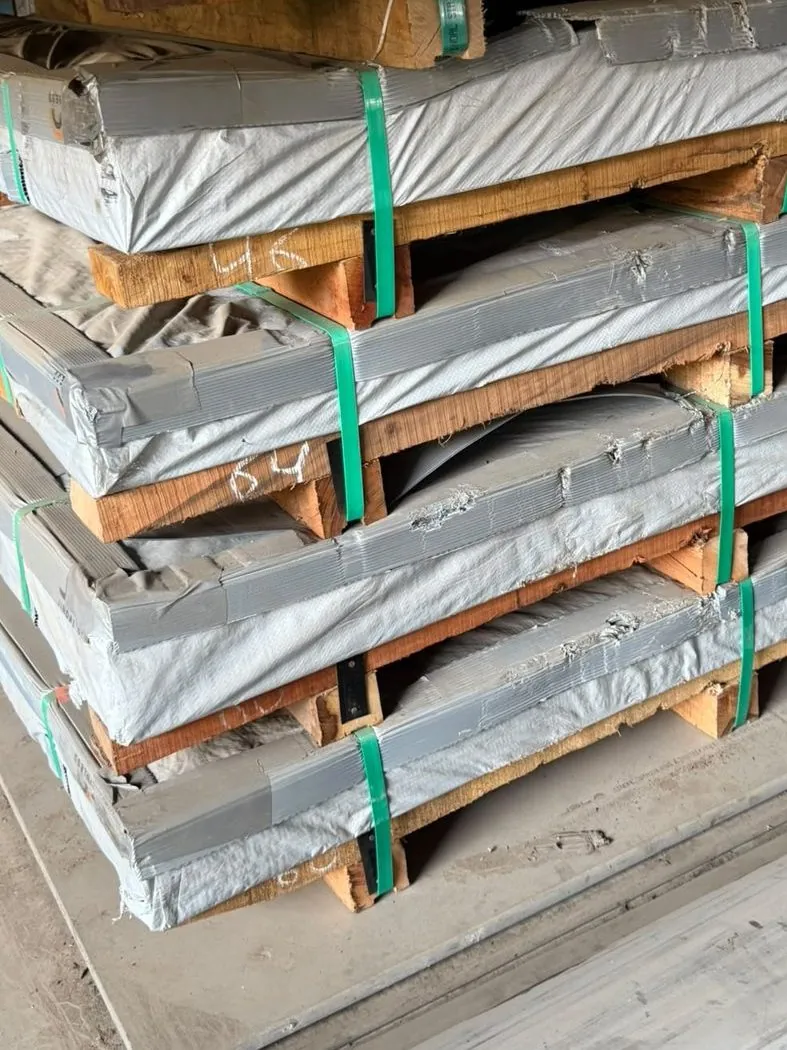
Key takeaways: 304L plate at a glance
- Designation: UNS S30403, Werkstoff 1.4307, JIS SUS304L, the low-carbon variant of 304.
- Why the "L": keep carbon at 0.03% or below and you suppress chromium-carbide precipitation. The heat-affected zone doesn't sensitize. That's why 304L welds without post-weld solution annealing.
- Corrosion class: PREN sits around 18, with no molybdenum in the mix. It handles mild, atmospheric and freshwater service well enough. Once chlorides show up, though, step up to 316 or 316L.
- Structure: austenitic (18-8 chromium-nickel), non-magnetic in the annealed condition.
- Standards & traceability: ASTM A240 / ASME SA-240 plate, supplied ex-stock. Every order ships with an EN 10204 3.1 mill test certificate (MTC).
What is 304L stainless steel plate?
304L is a member of the austenitic stainless steel family, the 18-8 chromium-nickel group that also contains 304, 321 and 347. It is not a different alloy from 304 so much as a controlled-carbon version of it: the chromium (18–20%) and nickel (8–12%) ranges overlap, but carbon is capped at ≤0.03% instead of ≤0.08%.
That single change explains why 304L plate exists at all. Hold plain 304 in the 425–815 °C band, exactly what happens in the heat-affected zone of a weld, and carbon starts combining with chromium, forming chromium carbides at the grain boundaries. The depleted zone loses its passive film. It corrodes intergranularly. Cap carbon at 0.03% or below, though, and 304L starves that reaction before it gets going. Welded fabrications stay corrosion-resistant, no post-weld solution anneal required. For the grade in all its forms, see the 304L stainless steel grade hub.
Chemical composition
Plate marked 304L meets the UNS S30403 chemistry spelled out in ASTM A240. The comparison column lists plain 304 (S30400) alongside it; the carbon ceiling is the only difference that actually matters.
| Element | 304L (S30403) wt% | 304 (S30400) wt% |
|---|---|---|
| Carbon (C) | ≤ 0.030 | ≤ 0.08 |
| Chromium (Cr) | 18.0 – 20.0 | 18.0 – 20.0 |
| Nickel (Ni) | 8.0 – 12.0 | 8.0 – 10.5 |
| Manganese (Mn) | ≤ 2.00 | ≤ 2.00 |
| Silicon (Si) | ≤ 0.75 | ≤ 0.75 |
| Phosphorus (P) | ≤ 0.045 | ≤ 0.045 |
| Sulfur (S) | ≤ 0.030 | ≤ 0.030 |
| Nitrogen (N) | ≤ 0.10 | ≤ 0.10 |
| Iron (Fe) | Balance | Balance |
Why the ≤0.03% carbon matters (sensitization)
Sensitization happens when chromium carbides precipitate at grain boundaries between 425 and 815 °C, stripping the chromium from the nearby metal and leaving it vulnerable to intergranular corrosion (sensitization). One way to stop it is simple: cap carbon at ≤0.03%, the low-carbon route. The other options are a stabilized grade like 321/347, or a post-weld solution anneal. 304L plate already starts with carbon low enough that it can be welded in thick section and put straight into service as-welded, no extra treatment needed. For the full mechanism and how to prevent it, see our guide on how to prevent sensitization.
Mechanical properties
Minimum room-temperature properties for annealed 304L plate per ASTM A240. The low-carbon chemistry costs a little yield strength against plain 304, the trade-off you accept for weldability.
| Property | 304L (S30403) | 304 (S30400) |
|---|---|---|
| Tensile strength, min | 485 MPa (70 ksi) | 515 MPa (75 ksi) |
| Yield strength (0.2% offset), min | 170 MPa (25 ksi) | 205 MPa (30 ksi) |
| Elongation in 50 mm, min | 40% | 40% |
| Hardness, max | 201 HBW / 92 HRB | 201 HBW / 92 HRB |
304L vs 304 strength (the trade-off)
The ≤0.03% carbon that makes 304L weldable also drags its minimum 0.2% yield down to 170 MPa, compared with 205 MPa for 304. For most tanks, enclosures and architectural panels, that gap doesn't matter. But if a design is genuinely yield-governed and still has to be welded, specify a dual-certified 304/304L heat: a single cast meeting both the 304L carbon limit and the 304 strength minima. See the full decision in 304 vs 304L.
Physical properties
| Property | Value (annealed 304L) |
|---|---|
| Density | 8.0 g/cm³ (8000 kg/m³) |
| Melting range | ~1400 – 1455 °C |
| Thermal conductivity (100 °C) | ~16.2 W/m·K |
| Mean coefficient of thermal expansion (0–100 °C) | ~17.2 µm/m·°C |
| Elastic modulus | ~193 – 200 GPa |
| Magnetic response | Non-magnetic (austenitic, annealed) |
Corrosion behavior & PREN
304L and 304 land in the same corrosion envelope. The "L" buys weld integrity, not extra pitting resistance. With roughly 18% chromium and no molybdenum, 304L handles mild, atmospheric and freshwater exposure well. Its defenses run out in three directions, though.
Sensitization & intergranular corrosion: why 304L resists it
This is the one place 304L outperforms 304. Because carbon is ≤0.03%, the welded heat-affected zone does not deplete of chromium, so it stays immune to intergranular corrosion (sensitization) without a corrective anneal. That property is why 304L is the default for any austenitic plate that will be welded.
Pitting & PREN ~18 (no molybdenum)
304L has a PREN of about 18, calculated as %Cr + 3.3 × %Mo + 16 × %N, with the molybdenum term at zero. That places it at the bottom of the austenitic ladder and makes it susceptible to pitting corrosion in chloride service. The molybdenum-bearing grades sit above it:
| Grade | PREN (approx.) | Choose when |
|---|---|---|
| 304 / 304L | ~18 | Mild, atmospheric, freshwater, and welded (304L) |
| 316 / 316L | ~24 | Chlorides present, marine, de-icing, process brines |
| 904L | ~34 | Hot chlorides and sulfuric acid |
| Incoloy 825 | ~31 – 40 | Sour service, mixed reducing/oxidizing acids |
Chloride stress-corrosion cracking: where 304L stops
Like all standard austenitics, 304L is susceptible to chloride stress-corrosion cracking under tensile stress in warm chloride environments. It is not a seawater or marine grade. Once service chlorides are in play, coastal air, brines, de-icing salts, move up to 316 plate or 316L; for hot or concentrated chlorides, to 904L plate. The full chloride/molybdenum decision is set out in 304 vs 316.
Equivalent grades & designations
| System | Designation |
|---|---|
| UNS | S30403 |
| Werkstoff (W.-Nr.) | 1.4307 |
| EN name | X2CrNi18-9 |
| JIS | SUS304L |
| BS | 304S11 |
| AISI | 304L |
Cross-reference these against the full UNS / Werkstoff / JIS cross-reference before raising a purchase order. The designation on the PO needs to match the one on the mill certificate.
304L plate vs the alternatives: when to choose it
vs 304: the sensitization decision
Choose 304L over plain 304 whenever the plate gets welded and won't be solution-annealed afterward. Metallurgically the two grades are nearly identical otherwise; 304L just takes the sensitization risk off the table. The one catch is yield, covered above and in 304 vs 304L.
vs 316 / 316L: the chloride / molybdenum decision
316 and 316L carry 2–3% molybdenum, which lifts PREN to roughly 24 and buys real pitting resistance that 304L lacks. The question is never "which is better" but "are there chlorides present." If yes, pay for the molybdenum. If not, 304L does the job at lower cost. See 304 vs 316.
vs 321: the stabilized high-temperature alternative
| Need | Reach for |
|---|---|
| Welded plate, ambient to moderate temperature | 304L (low-carbon route) |
| Sustained service above ~500 °C | 321 (titanium-stabilized) |
304L's low-carbon protection works fine from cold to moderate heat, but above roughly 500 °C the carbon can still migrate over time. For duty that stays hot for extended periods, the titanium-stabilized 321 is the stronger austenitic choice.
Forms, sizes & thickness ranges
304L plate comes off the hot-rolling line, which sets it apart from thinner cold-rolled sheet. Nandini Steel keeps 304L on hand ex-stock across a wide range of thicknesses, widths and lengths, and will cut it to size on request.
| Dimension | Typical plate range |
|---|---|
| Thickness | Light to heavy hot-rolled plate |
| Width | Standard mill widths (e.g. 1000 / 1250 / 1500 mm) |
| Length | Standard mill lengths, cut-to-size available |
| Availability | Ex-stock, immediate dispatch |
Other 304L forms
Thinner cold-rolled flat product comes as 304L sheet; coil and strip show up on the 304L grade hub. Not sure which flat form a drawing calls for? Check sheet vs plate vs coil.
304L plate weight & how to calculate
Since density is fixed at 8.0 g/cm³, plate weight falls straight out of the dimensions.
Weight (kg) = thickness (mm) × width (m) × length (m) × 8.0
| Thickness | Size | Weight |
|---|---|---|
| 6 mm | 1.25 m × 2.5 m | 6 × 1.25 × 2.5 × 8.0 = 150 kg |
| 10 mm | 1.5 m × 3.0 m | 10 × 1.5 × 3.0 × 8.0 = 360 kg |
| 12 mm | 2.0 m × 6.0 m | 12 × 2.0 × 6.0 × 8.0 = 1152 kg |
Run any size through our weight calculator, or work through the method step by step in how to calculate steel plate weight.
Finishes
304L plate usually ships hot-rolled, annealed, and pickled, the No.1 (HRAP) finish, a uniform matte surface with the mill scale stripped off. Thinner plate that crosses into cold-rolled territory can come as 2B instead, which is smooth and lightly reflective. If you need a particular surface for architectural or hygienic work, spell it out on the RFQ. Our stainless steel finishes guide breaks down the finish families for 304 and related grades.
Standards & specifications complied
304L plate meets the requirements of ASTM A240, which sets out chemistry and mechanical requirements for chromium and chromium-nickel stainless plate. It also satisfies ASME SA-240, the pressure-vessel twin of that standard.
ASTM A240 vs ASME SA-240 dual certification
Both specs call for the same technical requirements; SA-240 is simply the version pulled into the ASME Boiler & Pressure Vessel Code. Plate certified to both, dual-certified A240/SA-240, works for general fabrication as well as code vessel work, and that's the form Nandini Steel ships. Confirm the required code stamp on your order.
Testing, inspection & certification
Every 304L plate order comes with an EN 10204 3.1 (or 3.2) mill test certificate that traces the heat back to its chemical and mechanical results. See EN 10204 3.1 mill test certificate and material traceability for more on this. When the application calls for it, we can also arrange:
- Intergranular corrosion testing to ASTM A262 (sensitization / weld-decay verification).
- Positive material identification (PMI) to confirm grade.
- Ultrasonic testing (UT) for internal soundness on heavier plate.
The available test and inspection regimes are summarized in testing: MTC, NDT & PMI.
Applications of 304L plate by industry
304L is the workhorse austenitic grade for welded fabrication where chlorides aren't a concern, unlike 304.
- Food, dairy & hygienic, welded tanks, hoppers and process vessels, where the weld area has to stay free of corrosion; see pharmaceutical duty.
- Architectural & structural, cladding, frames and welded assemblies in atmospheric exposure.
- General fabrication, enclosures, chutes, freshwater and non-aggressive storage tanks.
- Chemical & process equipment, vessels and components rated for mild service; see chemical processing.
The boundary is chlorides. 304L is not a seawater or marine grade, for coastal or brine duty use 316/316L, and for pressure-retaining plate confirm the code route in pressure vessels.
Welding & fabrication of 304L plate
304L takes well to all the common fusion welding processes. Match it with a low-carbon filler, ER308L, so the weld metal ends up carrying the same 0.03% carbon ceiling as the base plate. Don't substitute a higher-carbon rod. No pre-heat is needed, and post-weld heat treatment isn't required either, which keeps the heat-affected zone corrosion-resistant. That's the whole point of the low-carbon grade. Because the alloy work-hardens, tooling needs to stay sharp and feeds positive when forming or machining it. For more on filler choice and avoiding weld decay, see weld decay and filler selection.
Pricing & how we quote
Nandini Steel prices 304L plate against nickel and the mill market, so quotes get built live from your exact thickness, size and quantity rather than pulled off a fixed table. Send over your plate schedule for a current RFQ. All stock sits ex-stock, ready for immediate dispatch. Genuine mill plate comes from producers like Aperam, Outokumpu, Jindal, POSCO, Nippon Steel and JFE, and the mill MTC is passed through with every order.
FAQ
Is 304L the same as 304?
Is 304L plate good for welding?
Does 304L plate rust or corrode?
Can I use 304L plate in seawater or marine environments?
What filler metal is used to weld 304L plate?
What certification comes with 304L plate?
Request a quote for 304L plate
Send your 304L plate schedule, grade, thickness, size, quantity and any test requirements, for a current RFQ. All plate ships ex-stock for immediate dispatch. It's dual-certified A240/SA-240 where the application calls for it, and comes with an EN 10204 3.1/3.2 mill test certificate.
- Phone: +91 22 43404600 · +91 9920209184
- WhatsApp: +91 99202 09184
- Email: reachus@nandinisteel.com
- Address: 25, Dreamland Building, 601, 6th Floor, Mama Parmanand Marg, Charni Road, Opera House, Girgaon, Mumbai, Maharashtra 400004, India
- GSTIN: 27ADJPA7240C1Z0
Nandini Steel, ISO 9001:2015-certified stockist and supplier since 2003: 307+ projects, 260+ clients, 36+ export countries, 20+ years.
Related grades to cross-shop
Part of our steel plate range and all stainless steel plate grades.