
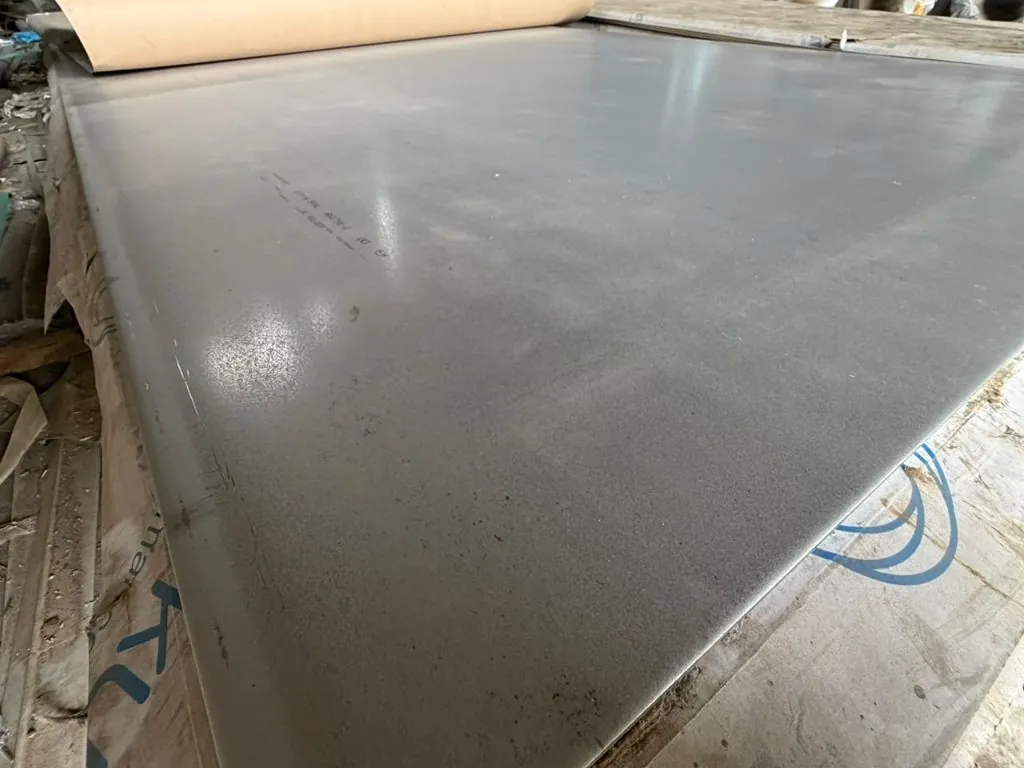
2B, BA and No.4 are the three most-specified stainless steel surface finishes. 2B is a smooth, lightly reflective cold-rolled mill finish; BA (bright annealed, EN 2R) is a mirror-bright finish with the lowest roughness; No.4 is a directional brushed satin finish. Lower surface roughness (Ra) means better corrosion resistance and easier cleaning, so BA cleans best and No.4 least.
Finishes at a glance: 2B vs BA vs No.4
This is the fast comparison for specifiers choosing between the three cold-rolled finishes on stainless sheet and coil.
| Finish | EN code | Production route | Typical Ra (µm) | Appearance | Directional? | Typical use |
|---|---|---|---|---|---|---|
| 2B | 2B | Cold-rolled → annealed → pickled → light skin/temper pass | ~0.1–0.5 | Smooth, lightly reflective matte-bright | No | General fabrication, process equipment |
| BA (bright annealed) | 2R | Cold-rolled → bright annealed in a reducing/protective atmosphere (no pickling) | ~0.05–0.1 | Mirror-bright, highly reflective | No | Reflective, hygienic, CIP-cleaned surfaces |
| No.4 | ≈2J / 2K | Mechanical abrasive polishing (≈120–180 grit) | ~0.2–1.0 | Satin brushed, unidirectional lines | Yes | Architectural, food, appliance panels |
What is a stainless steel surface finish?
A stainless steel surface finish is the controlled surface condition of a flat product: its roughness, reflectivity and texture, produced by whatever rolling, annealing and polishing route the mill applies after the metal is made. This is a distinct specification from grade, which is the alloy chemistry, and from form, whether that's sheet, plate or coil. You specify a finish by a standard code (2B, BA, No.4), and for critical work, by a target surface roughness Ra in micrometres.
Finish is what matters most after grade and form: it drives corrosion performance, how easy the surface is to clean, how it looks, and what it costs. Take the same 304 or austenitic stainless steel sheet. It performs differently in service depending on whether it leaves the mill as 2B, BA or No.4.
Why finish matters as much as grade
Corrosion starts at the surface. The surface is what meets the medium first, forms the passive layer, and either sheds contaminants or traps them, not the bulk alloy chemistry. A rougher surface carries more micro-crevices, and those hold chlorides, deposits and moisture, which seeds pitting and crevice attack. A smoother, cleaner surface builds a more uniform passive layer and cleans up far more easily. Put two sheets of the same grade side by side, and they can behave nothing alike if one carries a low-Ra BA finish and the other a coarse brushed No.4.
How mill finishes are produced
The production route decides what each finish becomes. It drives the roughness, the reflectivity, the directionality, all of it.
2B finish
2B is the standard cold-rolled finish. The mill cold-rolls the strip, anneals it, then pickles it to strip away the oxide scale that annealing leaves behind, finishing with a light final pass, a skin or temper pass, on polished rolls. What you get is a smooth, lightly reflective matte-bright surface, typically running about 0.1–0.5 µm Ra. It's the balanced, general-purpose baseline most process and fabrication work starts from.
BA finish (bright annealed, EN 2R)
BA is produced by cold rolling followed by bright annealing, which means annealing in a reducing or protective atmosphere (hydrogen or cracked ammonia) so that no oxide scale forms on the surface. There's no scale, so there's no pickling step, and the surface keeps the smooth, mirror-bright condition of the polished rolls. BA carries the lowest roughness of the three. Typically that's Ra ~0.05–0.1 µm, which makes it the most reflective and the easiest to clean. Bright annealing is a high-temperature anneal, and correct, rapid cooling through the 425–815 °C range is what avoids sensitization (see below).
No.4 finish
No.4 finish comes from a mechanical process: the surface gets abrasive-polished or brushed with belts or wheels at roughly 120–180 grit, which leaves fine, unidirectional satin lines. It's directional, meaning the polish lines all run one way, and the typical Ra lands around 0.2–1.0 µm depending on the grit used. That satin texture hides handling marks and scratches well. That's exactly why architects and appliance makers favor it for surfaces people actually see.
2B vs BA vs No.4: the real differences
Side by side on the attributes that drive a specification decision:
| Attribute | 2B | BA (2R) | No.4 |
|---|---|---|---|
| Reflectivity | Lightly reflective matte-bright | Mirror-bright, highest | Low, satin, non-reflective |
| Surface roughness (Ra) | ~0.1–0.5 µm | ~0.05–0.1 µm (lowest) | ~0.2–1.0 µm (highest, grit-dependent) |
| Directionality | Non-directional | Non-directional | Directional (visible grain) |
| Relative cost | Base | Above 2B | Above 2B |
| Corrosion / cleanability | Good | Best, lowest Ra, easiest to passivate & clean | Lowest of the three; grooves can trap contaminants |
| Weld / forming tolerance | Forgiving; blends easily | Marks and scuffs show readily | Weld seams and scratches must be re-grained to match |
| Choose when… | General fabrication, balanced cost | Hygiene, CIP, maximum corrosion & cleanability | Appearance matters and marks must be hidden |
What determines finish choice: the influencing factors
The right finish is a trade-off across several factors:
Surface roughness, or Ra, is the one number that links finish to actual performance. Drop the Ra and you get fewer crevices, easier cleaning, and a passive layer that forms more evenly.
Smoother surfaces shed contaminants and passivate more evenly. If the job involves chlorides or acids, go with a low-Ra finish.
Hygiene matters a lot in CIP work. Pharmaceutical and food surfaces that get cleaned in place need low Ra, because there's nowhere left for product residue or bacteria to hide. That's why BA and fine No.4 get specified here, often against a target Ra ceiling.
Appearance tells its own story. BA gives mirror brightness, No.4 gives a uniform satin with no glare, and 2B is the choice when looks don't matter much.
Cost and lead time pull in the other direction. 2B is the cheap option, sitting in stock and ready to ship. BA and No.4 cost more because of the polishing or bright-annealing involved, and they're often made to order.
Forming and welding change the finish, too. Drawing, bending and welding all leave their mark locally. Weld a No.4 panel and you'll need to re-grain it to match the surrounding surface; BA, meanwhile, scuffs easily the moment fabrication starts.
One more point on form: 2B, BA and No.4 only apply to cold-rolled sheet and coil. Hot-rolled plate comes as No.1 instead, hot-rolled, annealed and pickled, not 2B, BA or No.4.
Finish and corrosion resistance: the metallurgy
This is where finish earns its place in the specification. A smoother finish (lower Ra) presents fewer surface micro-crevices for chlorides and deposits to collect in, and lets the chromium-oxide passive layer re-form cleanly and uniformly. The practical result is better resistance to pitting corrosion and crevice corrosion, and easier, more reliable passivation, which is why hygienic and chemical-service specifications set a maximum Ra.
One point must be stated plainly to avoid a common misconception: finish modifies the surface, not the grade's alloy chemistry. A mirror BA or No.8 finish doesn't raise the Pitting Resistance Equivalent Number (PREN). 304 stays susceptible to pitting (PREN ~18). 316 resists it better (PREN ~24), and finish has nothing to do with that. Polish either grade all you like; the chemistry underneath doesn't budge. A smoother finish helps a given grade live up to its potential. It won't turn 304 into 316, no matter how far you take it. Pick the grade for the corrosion environment first. Only then pick the finish, so that grade's surface has a fighting chance of staying clean.
Bright annealing and solution annealing both run at high temperature, so sensitization is worth flagging here. Proper cooling keeps the material out of the 425–815 °C range where sensitization occurs. If a welded fabrication has to sit in that range during processing, call for a low-carbon L grade (C ≤ 0.03%) instead, or solution-anneal afterward. Either path keeps the surface resistant to corrosion.
Which grades and forms these finishes apply to
2B, BA, and No.4 are finishes applied to austenitic stainless flat product, the cold-rolled grades you buy as sheet and coil:
- 304 / 304L and 316 / 316L, the workhorse austenitic grades, routinely stocked in 2B.
- 321 and 904L, stabilized and super-austenitic grades, also sold as sheet and 904L coil.
All of these conform to ASTM A240 / ASME SA-240 for the flat product, with finish general requirements defined by ASTM A480/A480M and EN finishes by EN 10088-2.
Form matters: 2B, BA and No.4 belong to cold-rolled sheet and coil. Hot-rolled plate comes as No.1 (HRAP, hot-rolled, annealed, pickled), which has a duller, rougher surface. Need a 2B or polished finish on a thick section? Confirm the form first. See sheet vs plate vs coil and the full stainless steel grades range.
Finish standards and the ASTM ↔ EN cross-reference
ASTM A480/A480M covers the general requirements for A240 flat product, while EN 10088-2 labels the same surfaces with different codes. This cross-reference clears up the confusion, so an order stays unambiguous no matter which standard the drawing calls out.
| ASTM (A480 / A240) | EN 10088-2 | Description |
|---|---|---|
| No.1 (HRAP) | 1D | Hot-rolled, annealed, pickled, plate surface |
| 2B | 2B | Cold-rolled, annealed, pickled, skin-passed, smooth matte-bright |
| BA (bright annealed) | 2R | Cold-rolled, bright annealed, mirror-bright, no pickling |
| No.4 | 2J / 2K | Brushed / satin, abrasive-polished, directional |
| No.8 (mirror) | 2P | Highly polished reflective mirror finish |
For the Ra side of the specification, the orderable ladder is simple. Lower Ra means smoother, more cleanable and more corrosion-friendly.
| Finish | Typical Ra (µm) | Relative smoothness |
|---|---|---|
| BA (2R) | ~0.05–0.1 | Smoothest, best cleanability & corrosion behavior |
| 2B | ~0.1–0.5 | Intermediate |
| No.4 | ~0.2–1.0 | Roughest, directional grooves, grit-dependent |
How to specify and order a finish
Specify the finish just as explicitly as the grade. Follow these five steps, and the surface you get will be the one you wanted, and the one the certificate shows.
- State the grade, e.g. 304, 304L, 316, 316L, 321 or 904L, chosen for the corrosion environment first.
- State the form, sheet or coil for 2B/BA/No.4; remember plate is No.1.
- Spell out the finish code: 2B, BA (EN 2R) or No.4 (EN 2J/2K). Cite ASTM A480/A240 or EN 10088-2 so there's no doubt which designation applies.
- Set a target Ra as well, for hygienic work or jobs where corrosion resistance is critical, specify a maximum Ra in µm rather than trusting the code alone to carry that meaning.
- Nail down surface protection too, using PVC laser film or paper interleaving for BA/No.4 polished product, and insist the finish designation appears on the EN 10204 3.1 mill test certificate (MTC).
At Nandini Steel, the finish designation shows up on the EN 10204 3.1/3.2 mill test certificate that comes with every order, right alongside the grade, heat number and chemistry. That means the surface condition is traceable, not just something stated out loud.
Finishes by application
Finish selection follows the duty of the surface:
- Pharmaceutical, hygienic and food, low Ra is the priority so cleaning-in-place works and nothing lodges in the surface. BA, fine No.4 or electropolish are specified, often to a maximum-Ra ceiling. See pharmaceutical / hygienic service.
- Chemical and marine, favor low-Ra 2B or BA so chlorides and deposits cannot seed pitting and crevice attack; match the grade to the medium. See chemical processing and marine duty.
- Architectural and appliance, No.4's uniform satin hides marks and gives a consistent look across large panels; BA is chosen where a mirror appearance is wanted.
An observation from the Engineering Team
A recurring specification error: over-specifying a No.8 mirror finish for hygiene when a BA (2R) surface already meets the required maximum Ra, at lower cost and with easier re-passivation. Buyers sometimes go the other way, too, choosing No.4 for a wet-process interior because it looks good, then finding the directional grooves trap deposits. Decide from the Ra the duty actually requires. Then pick the lowest-cost finish that meets it. Use our grade selector to pair the grade and the finish to the service before you raise the RFQ.
FAQ
What is 2B finish on stainless steel?
What is BA (bright annealed) finish?
What is No.4 finish?
2B vs BA, which finish is better for corrosion resistance?
Does a smoother finish change the steel grade's corrosion rating?
What finish does stainless steel plate come in?
Can the finish and Ra be shown on the mill test certificate?
Request a quote with the finish you need
Nandini Steel is an ISO 9001:2015-certified stockist and supplier, in business since 2003, with 20+ years behind it, 307+ projects delivered and 260+ clients spread across 36+ export countries. We supply genuine mill material from Aperam, Outokumpu, Jindal, POSCO, Nippon Steel and JFE. Tell us the grade, form, finish code and target Ra, and we'll quote from ready stock, backed by an EN 10204 3.1/3.2 mill test certificate.
Everything we hold is ex-stock, ready for immediate dispatch. We're also a certified specialist in 904L, Alloy 28, Incoloy 800 and Hastelloy plate. Pricing runs by RFQ against live stock.
- Phone: +91 22 43404600 · +91 99202 09184
- WhatsApp: +91 99202 09184
- Email: reachus@nandinisteel.com
- Address: 25, Dreamland Building, 601, 6th Floor, Mama Parmanand Marg, Charni Road, Opera House, Girgaon, Mumbai, Maharashtra 400004, India
- GSTIN: 27ADJPA7240C1Z0
Size up your order with the steel weight calculator and the stainless steel weight chart. Then read how to passivate stainless steel to keep your specified finish performing in service.