
Key takeaways: 304 vs 316 stainless steel
Molybdenum is the only real chemistry difference between the two. 304 contains none of it; 316 carries 2–3% Mo, and that's what buys the added corrosion resistance.
PREN comes in around 18 for 304 versus 24 for 316. The pitting resistance equivalent number puts 316 ahead for chloride and acid exposure, and honestly, that's the single number that should drive the choice.
Strength, though, is nearly identical. Both grades meet the same roughly 515 MPa tensile and 205 MPa yield minimums under ASTM A240. So no, 316 isn't "stronger" than 304, don't let anyone tell you otherwise.
Both are austenitic, and both are vulnerable to chloride stress-corrosion cracking. 316 holds up better against pitting, sure, but neither grade escapes hot-chloride SCC. That's where 904L or duplex steel comes into play.
316 costs more because of the molybdenum and the higher nickel content, not because it's some inherently "better quality" steel. Pay the premium only where the environment actually demands it.
Chemical composition compared: 304 vs 316
Both grades are austenitic stainless steels supplied to ASTM A240 / ASME SA-240. The real dividing line is molybdenum: 304 has none, while 316 carries 2–3%. 316 also runs slightly lower in chromium and a bit higher in nickel.
| Element (wt %) | 304 (S30400) | 316 (S31600) |
|---|---|---|
| Chromium (Cr) | 18.0–20.0 | 16.0–18.0 |
| Nickel (Ni) | 8.0–10.5 | 10.0–14.0 |
| Molybdenum (Mo) | – | 2.0–3.0 |
| Carbon (C) | ≤ 0.08 | ≤ 0.08 |
| Manganese (Mn) | ≤ 2.00 | ≤ 2.00 |
| Silicon (Si) | ≤ 0.75 | ≤ 0.75 |
| Nitrogen (N) | ≤ 0.10 | ≤ 0.10 |
| Phosphorus (P) | ≤ 0.045 | ≤ 0.045 |
| Sulfur (S) | ≤ 0.030 | ≤ 0.030 |
The low-carbon variants, 304L and 316L, hold carbon at ≤ 0.03% to prevent sensitization during welding, see 304 vs 304L and 316 vs 316L.
The molybdenum difference (why 2–3% Mo changes everything)
Molybdenum stabilizes the passive chromium-oxide film against chloride attack, which raises the pitting resistance equivalent number. The formula is PREN = %Cr + 3.3×%Mo + 16×%N. Each point of molybdenum carries a weight of 3.3×, so 316's 2–3% Mo pushes its PREN to roughly 24, well above 304's ~18, even though 316 actually has less chromium. That's the whole argument for 316: the molybdenum you're paying for buys pitting and crevice resistance that 304 simply doesn't have. For the full method, see PREN and pitting resistance explained.
Mechanical properties compared
A persistent myth holds that 316 is "stronger" than 304. It isn't. Both grades carry the same minimum tensile and yield values under ASTM A240 in the solution-annealed condition, so their mechanical properties are nearly identical. What sets them apart is corrosion resistance, not strength.
| Property (annealed) | 304 | 316 |
|---|---|---|
| Tensile strength, min | 515 MPa (75 ksi) | 515 MPa (75 ksi) |
| Yield strength (0.2%), min | 205 MPa (30 ksi) | 205 MPa (30 ksi) |
| Elongation, min | 40% | 40% |
| Hardness, max | 201 HB / 92 HRB | 217 HB / 95 HRB |
Physical properties compared
Density, modulus and thermal behavior track closely. Both grades stay non-magnetic in the solution-annealed condition, which is exactly why a magnet can't tell 304 from 316.
| Property | 304 | 316 |
|---|---|---|
| Density | 8.0 g/cm³ | 8.0 g/cm³ |
| Melting range | ~1400–1450 °C | ~1375–1400 °C |
| Thermal conductivity (100 °C) | ~16.2 W/m·K | ~16.3 W/m·K |
| Coefficient of thermal expansion (0–100 °C) | ~17.3 µm/m·°C | ~15.9 µm/m·°C |
| Elastic modulus | ~193–200 GPa | ~193 GPa |
| Magnetic response (annealed) | Non-magnetic | Non-magnetic |
Corrosion resistance: 304 vs 316
Corrosion is where the two grades genuinely part ways, and it's the only axis the decision should hinge on. 316 holds up better than 304 against chloride-driven pitting and crevice attack. In any chloride-bearing medium, 304 simply falls short of 316. Both are austenitic, though, so they share the same chloride-SCC limit.
| Corrosion attribute | 304 | 316 | Upgrade path |
|---|---|---|---|
| PREN (approx.) | ~18 | ~24 | 904L ~34 · Duplex 2205 ~35 |
| Pitting / crevice (chlorides) | Susceptible | Resists (better) | 904L / duplex for hot chlorides |
| Chloride stress-corrosion cracking | Susceptible | Susceptible | Duplex / super-austenitic |
| Sulfuric / reducing acids | Limited | Moderate | 904L (Cu-bearing) |
Pitting and crevice corrosion (PREN ~18 vs ~24)
In chloride environments, seawater, coastal air, de-icing salts, process brines, the passive film breaks down locally and pits form. 304 carries a PREN of around 18, so it gives way at low chloride thresholds. 316's PREN of roughly 24 pushes that threshold higher, and that's the reason coastal and marine duty calls for 316. When chlorides turn hot and concentrated, though, even 316 can't keep up, and the ladder climbs to 904L or duplex. For background on the mechanisms at work, see pitting corrosion and crevice corrosion.
Chloride stress-corrosion cracking (the shared limit)
Both 304 and 316 are austenitic, and both can suffer chloride stress-corrosion cracking when tensile stress, chlorides and heat (usually above 60 °C) all show up together. Moving from 304 to 316 doesn't make that threat go away; it's the limit baked into the whole austenitic family. If hot-chloride SCC is a real possibility, the right answer is duplex or super-austenitic steel, not another step up the 304/316 ladder. See stress-corrosion cracking and the 904L vs 316L comparison.
Sensitization and intergranular corrosion (why 304L / 316L exist)
In held heat, somewhere between 425 and 815 °C, the kind of range you'd find in the heat-affected zone of a weld, chromium carbides precipitate at grain boundaries. That strips chromium from the surrounding area and leaves the steel vulnerable to intergranular attack. Low-carbon "L" grades (C ≤ 0.03%) prevent this sensitization. So do stabilized grades like 321/347, and so does post-weld solution annealing. For welded fabrication, specify 304L or 316L. See intergranular corrosion and sensitization and how to prevent sensitization.
Weldability and filler selection
Both grades weld easily with the common arc processes, and both belong to the austenitic stainless family. The filler has to match the base. 304 takes ER308L; 316 takes ER316L, so the weld metal's molybdenum content and corrosion resistance stay in line with the parent plate. Pair low-carbon filler with the low-carbon "L" base grades, and the heat-affected zone stays corrosion-resistant too. For the full procedure, see how to weld 316 stainless.
Equivalents and designations
316 austenitic steel comes in a few flavors. 304 is the classic "18-8" grade; 316 adds molybdenum and sits one step further up the chloride resistance ladder.
| System | 304 | 316 |
|---|---|---|
| UNS | S30400 | S31600 |
| Werkstoff (WNr) | 1.4301 | 1.4401 |
| EN name | X5CrNi18-10 | X5CrNiMo17-12-2 |
| JIS | SUS304 | SUS316 |
| AISI / common | 304 (18-8) | 316 |
A full cross-reference lives at the UNS / WNr / JIS cross-reference.
When to choose 304 vs 316
The decision comes down to environment. Map the real service conditions, chlorides, salt, acids, temperature, to the grade, and pay the molybdenum premium only when the exposure actually calls for it.
| Environment / service | Recommended grade |
|---|---|
| Dry, indoor, architectural | 304 / 304L |
| Food, dairy, general fabrication | 304 / 304L |
| Marine, coastal, salt-laden air | 316 / 316L |
| Chemical, pharma, hygienic process | 316 / 316L |
| Hot concentrated chlorides / sulfuric acid | Upgrade: 904L |
| High-chloride with SCC risk | Upgrade: duplex 2205 |
The PREN ladder is orderable: 304 (~18) < 316 (~24) < 904L (~34) ≈ duplex 2205 (~35). When 316 is no longer enough, step to 904L or compare the routes directly: 904L vs 316L and 904L vs duplex 2205. To screen a grade against your conditions, use the grade selector.
Nandini Steel Engineering Team, selection note: the costliest mistake, and the most common one, is defaulting to 304 for chloride-adjacent or coastal duty. It pits there. Confirm the actual service chlorides before choosing 304 over 316, stepping up a grade costs far less than replacing a failed part. The reverse mistake happens just as often: buyers pay for 316 when dry, indoor, non-chloride conditions mean 304 would do the job fine. Match the 2–3% molybdenum to the genuine pitting risk. No more, no less.
Forms, sizes and stock
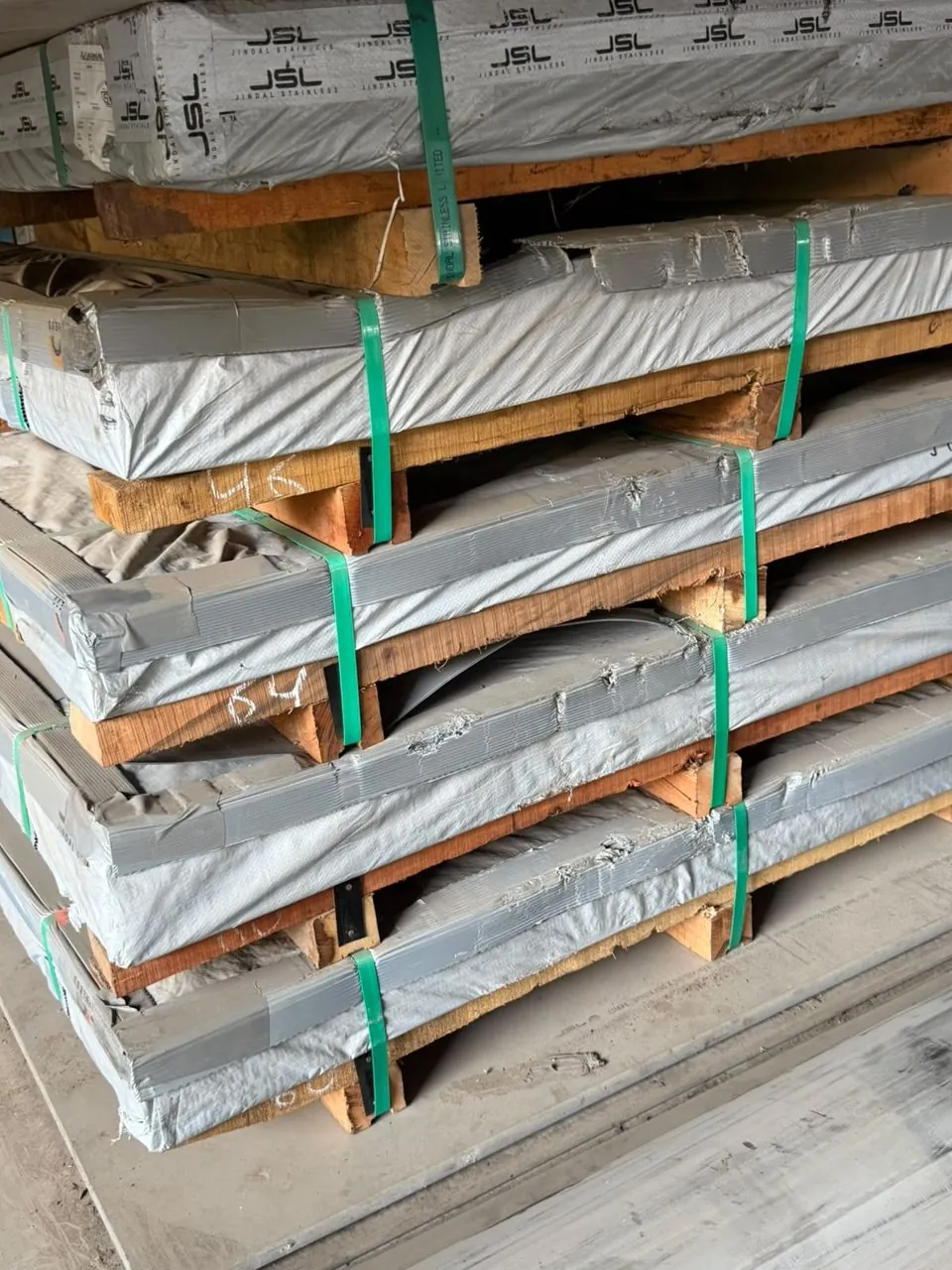
Both grades, along with their 304L / 316L variants, sit in stock as sheet, plate and coil to ASTM A240 / ASME SA-240. Everything ships ex-stock and is ready to go out the door immediately. The material itself is genuine mill plate, sourced from Aperam, Outokumpu, Jindal, POSCO, Nippon Steel and JFE.
| Form | Grades | Standard | Common finishes |
|---|---|---|---|
| Sheet | 304 / 304L / 316 / 316L | ASTM A240 | 2B, BA, No.4 |
| Plate | 304 / 304L / 316 / 316L | ASTM A240 | No.1 (hot-rolled, annealed, pickled) |
| Coil | 304 / 304L / 316 / 316L | ASTM A240 | 2B, BA |
Browse the grade hubs, 304 stainless steel and 316 stainless steel, or check the form pages for 304 sheet and 316 plate. Finish codes get explained in stainless steel finishes: 2B, BA, No.4. Flat-rolled stainless falls under HSN 7219/7220.
Standards and specifications
For flat products, both grades conform to ASTM A240 / ASME SA-240, which sets the chemistry and mechanical minimums used throughout this page. Other forms fall under related product standards: A213/A312 for tube and pipe, A276 for bar, A182 for forged fittings. See ASTM A240 and its pressure-grade equivalent, ASME SA-240.
Testing, MTC and traceability
Every order ships with an EN 10204 3.1/3.2 mill test certificate that ties the plate to its heat number, chemistry and mechanical results. Both 304 and 316 are non-magnetic once annealed, so a magnet won't tell them apart. Only the certified chemistry can do that. Positive material identification (PMI) confirms the molybdenum assay on receipt. ASTM A262, meanwhile, verifies resistance to intergranular attack where sensitization is a concern. See EN 10204 mill test certificates, the testing, MTC, NDT and PMI overview, and how a mill test certificate works.
Cost difference: why 316 is more expensive
316 costs more than 304, and the reason comes down to two chemistry factors: its 2–3% molybdenum and its higher nickel content. Both track volatile alloy markets. That gap reflects raw materials, not quality. 316 isn't a "better steel," just a more alloyed one, built for tougher service. Specify it where chlorides, salt or acids come into play, and stick with 304 where they don't. Alloy surcharges shift constantly, so rather than publish price tables, we quote live pricing per order. Request a quote for current 304 and 316 figures.
Applications by industry
304 and 316 cover complementary territory. 304/304L handles general fabrication, architectural work and food/dairy service. 316/316L is the default where chlorides or acids show up, marine, chemical processing and pharmaceutical duty, since its molybdenum keeps the passive film intact where 304 would pit. Push the chloride load past what 316 can handle, and the application moves to 904L or duplex. It doesn't drop back down to 304.
FAQ
What is the difference between 304 and 316 stainless steel?
Is 316 stainless steel better than 304?
Why is 316 more expensive than 304?
Which is better for marine or coastal use, 304 or 316?
Can you tell 304 from 316 with a magnet?
Is 316 stronger than 304?
Does 304 stainless steel rust, and will 316?
Get a quote
Specifying 304 or 316 in sheet, plate or coil? All grades are ex-stock for immediate dispatch, supplied as genuine mill plate with an EN 10204 3.1/3.2 mill test certificate on every order. With 307+ projects delivered to 260+ clients across 36+ export countries over 20+ years, Nandini Steel can match the grade to your service and ship it certified. Request a quote for live 304 and 316 pricing, or reach us on WhatsApp at +91 99202 09184.