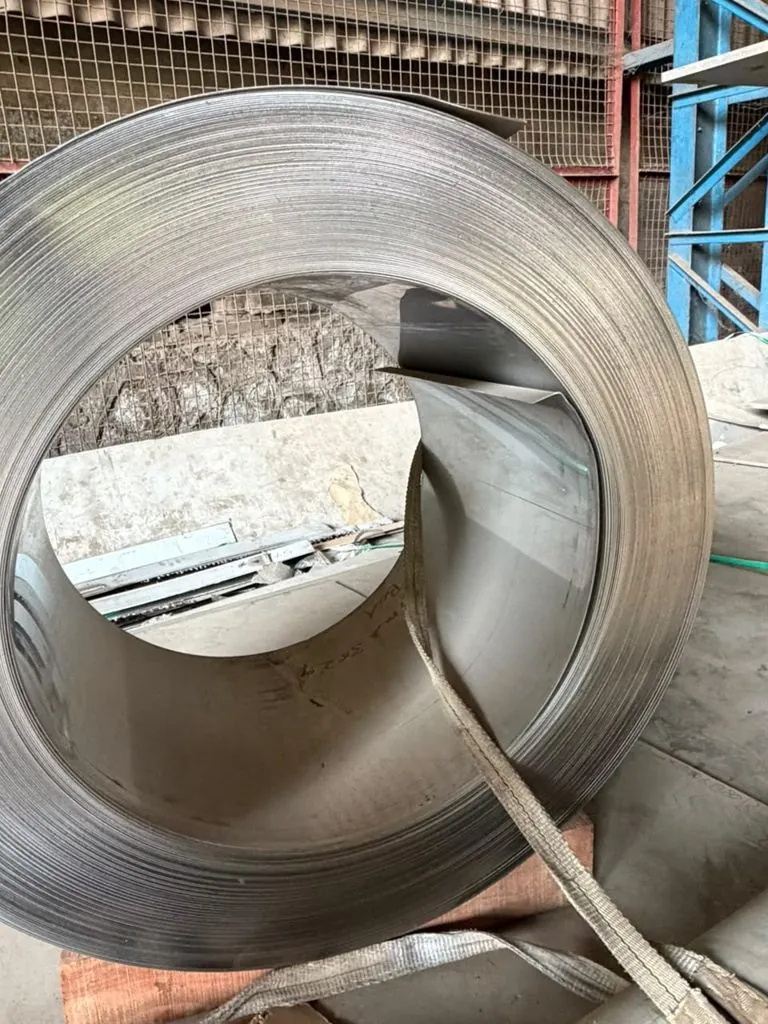
What is steel coil and strip?
Steel coil is flat-rolled steel supplied continuously rather than cut to length, wound onto a core with a standard inside diameter of 508 mm or 610 mm. Mother coil is slit down to narrower strip widths to match a buyer's line or tooling, which is why coil is often called slit coil once it leaves the mill width. Steel coil sits in the same thickness range as sheet, under 3 mm, and the same base metal supplied thicker becomes plate instead. As an ISO 9001:2015 certified (Certificate No. 1283438) stockist and supplier based in Mumbai, operating since 2003, Nandini Steel holds SS coil ex-stock across the core stainless and nickel-alloy grades for immediate dispatch, with every coil shipped against an EN 10204 3.1 or 3.2 mill test certificate.
Steel coil grades and materials
Our steel coil stock follows the same grade logic as our sheet and plate ranges. 304 coil and 304L coil cover general fabrication and continuous-process lines, while 316 coil and 316L coil add molybdenum for chloride-bearing environments, with the low-carbon L coil preferred for welded continuous processing. For sulfuric acid and high-chloride duty beyond what 316L resists, 904L coil steps up with its copper-bearing, super-austenitic chemistry, a grade named on our ISO certification scope. Incoloy 825 coil is also available in limited widths and thicknesses for sour-service and mixed-acid applications where a continuous nickel-alloy strip is required.
Slitting: widths and tolerances
| Slit width range | Typical thickness tolerance |
|---|---|
| Under 50 mm | Tighter tolerance band, finer slitting line setup |
| 50-300 mm | Standard slitting tolerance per ASTM A480 |
| 300-600 mm | Standard slitting tolerance per ASTM A480 |
| 600 mm and above | Full-width or near mother-coil width |
Exact slit width tolerance depends on grade, thickness and the slitting line used, and we confirm the applicable tolerance band against ASTM A480 before processing a coil order.
Coil vs sheet vs plate
Coil, sheet and plate are the same base metal in three different delivery formats rather than three different materials. Coil is continuously rolled and supplied by weight on a core, sheet is cut flat pieces under 3 mm thickness, and plate is cut flat pieces at 3 mm thickness and above. Choosing between them usually comes down to how the material will be processed downstream: coil suits continuous or high-volume lines, while sheet and plate suit piece-by-piece fabrication. Our coil versus sheet versus plate guide walks through the decision in more detail.
Standards: ASTM A240 / A480
Stainless steel coil and strip from our stock conform to ASTM A240 for chemical and mechanical requirements and ASTM A480 for general requirements on flat-rolled stainless products, including slit width and thickness tolerances. These standards apply whether the coil ships at mother-coil width or is slit to a narrower strip width. Every coil shipment carries an EN 10204 3.1 or 3.2 mill test certificate traceable to the heat.
How we quote steel coil
Steel coil pricing is RFQ-only because coil pricing tracks the base metal market along with the slit width, thickness and coil weight ordered. Send us the grade, thickness, slit width, coil weight or length, and quantity, and we build the quote from a base price, a nickel and molybdenum alloy surcharge for grades carrying those elements, thickness and width extras for non-standard slitting, and a quantity-based adjustment. Quotes go out the same day the RFQ is received, and we ship steel coil to more than 36 countries with export packing and documentation included.
Jump to stainless steel coil →
Stainless steel coil
Nickel alloy coil