
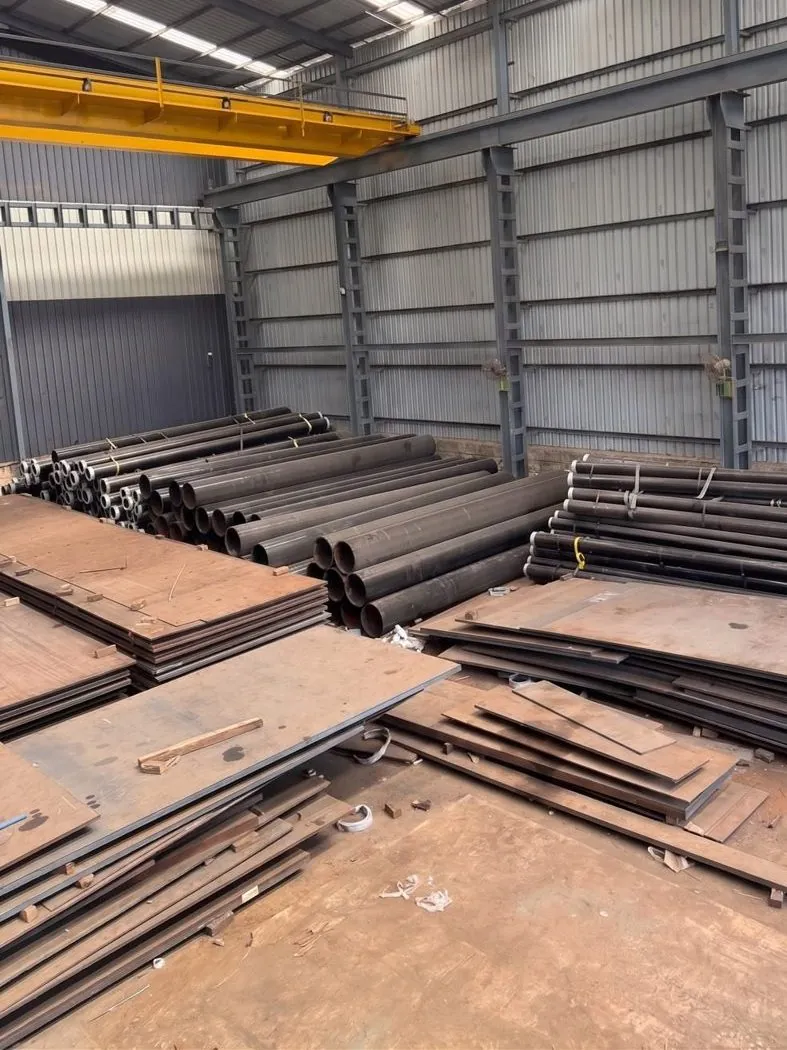
Quality assurance at a glance
- ISO 9001:2015 quality management system, Certificate No. 1283438, issued by Unitas Certification Services (UCS-UK), valid to 11 January 2028. See our ISO 9001:2015 certification.
- Genuine mill material, plate, sheet and coil come from named mills (Aperam, Outokumpu, Jindal, POSCO, Nippon Steel, JFE). We don't substitute open-market stock.
- Full heat and cast traceability, the heat number stamped on the plate matches the one on its certificate, unbroken from mill to dispatch.
- EN 10204 3.1/3.2 mill test certificate with every order, composition and mechanicals are certified against the grade standard.
- PMI plus code-required testing, positive material identification, intergranular corrosion (IGC) per ASTM A262, UT/RT, hydrostatic testing, and NACE MR0175 hardness, whatever the code calls for.
- Independent third-party inspection on request, TÜV SÜD, Bureau Veritas, DNV, SGS or ABS witness and release.
Nandini Steel has held ISO 9001:2015 certification since it was founded in 2003, working as a stockist-supplier. Every product ships ex-stock, ready for immediate dispatch, and the paperwork is built to pass straight through your QA department or a third-party inspector, whether the load is headed for a vessel or a sour-service line.
Our quality management system (ISO 9001:2015)
Nandini Steel runs a certified quality management system registered to ISO 9001:2015. The certificate, No. 1283438, was issued by Unitas Certification Services (UCS-UK). It was registered on 12 February 2025, passed surveillance on 11 January 2026, and stays valid through 11 January 2028.
For a stockist and supplier, that certification isn't decoration. It governs how incoming material gets inspected and identified, how heat identity survives cutting and marking, how certificates get matched to physical stock, and how non-conforming material sits in quarantine before it can ever reach an order. The certified scope covers stainless steel, carbon steel and alloy-steel pipes, fittings and flanges, plus stocked rods, sheets and plates in all shapes and sizes. That same certificate lists a certified specialty in 904L, Alloy 28 / Sanicro 28, Incoloy 800 and Hastelloy plate, a differentiator verified by a third party, not something we're simply claiming for ourselves. You'll find the scanned certificate and scope statement on our certifications page.
Material traceability: the heat and cast-number chain
Every plate, sheet and coil we ship ties back to a single mill heat (and its cast/lot number). The chain works like this: the mill rolls a heat, issues its mill test certificate against that heat, and stamps the heat number onto the material. Nandini keeps that identity intact through receiving, storage, cutting and marking. The result is simple: the heat number on the plate equals the heat number on the certificate you receive.
This matters most where a code demands it. A pressure vessel built to ASME, or a sour-service line qualified to NACE MR0175, is only as defensible as its paper trail. A rejected or mis-identified heat can scrap the fabrication. Unbroken traceability is what lets your inspector accept the material without re-testing. For the full mechanism, see how we handle material traceability and how to read a mill test certificate.
Mill test certificates (EN 10204 3.1 vs 3.2)
A mill test certificate (MTC) is the document that carries the proof, it records the heat's chemical composition and mechanical properties and declares conformance to the grade standard. Nandini supplies an EN 10204 3.1 or 3.2 mill test certificate with every order. The two levels differ in who validates the result, as set out in EN 10204 3.1 / 3.2.
| Certificate level | What it certifies | Who validates / signs | Typical use |
|---|---|---|---|
| EN 10204 2.2 | Test results on the basis of non-specific inspection | The manufacturer | Non-critical, non-coded material |
| EN 10204 3.1 | Specific test results on the material supplied, declared compliant with the order | The mill's authorized inspection representative, independent of the production department | Most CRA and PVQ orders, the standard for 904L, Incoloy 825, A516 |
| EN 10204 3.2 | The 3.1 results, countersigned after independent verification | The mill representative and an independent inspector (your nominated TPI or an authorized body) | Code-critical / sour-service / client-witnessed orders |
When you need 3.2 (independent) vs 3.1 (mill)
A 3.1 certificate, validated by a mill representative independent of production, covers the large majority of corrosion-resistant and pressure-vessel orders. Need an independent inspector to witness and countersign the results because a project specification, an end-client, or a code such as NACE MR0175 calls for it? Step up to a 3.2. We arrange either one. The sample MTC format is explained on our mill test certificate page.
Testing and inspection capability
Material gets released against whatever tests its grade and code call for. The report for each test comes with the mill test certificate, and where the spec demands witnessed or independent results, an accredited laboratory or third-party inspector steps in. Want the mechanics behind each method? See MTC, NDT and PMI testing.
| Test | Standard | What it proves | How furnished |
|---|---|---|---|
| Positive material identification (PMI) | Spectrometric | The alloy in hand matches the stamp and the MTC | Confirmed before dispatch; third-party witnessed on request |
| Intergranular corrosion (IGC) | ASTM A262 (Practice A / E) | No sensitization / susceptibility to IGC attack | Certified on the mill MTC or via accredited lab |
| Ultrasonic testing (UT) | Per vessel code | Internal soundness of plate | Report per order specification |
| Radiographic testing (RT) | Per vessel code | Weld / section integrity | Report per order specification |
| Hydrostatic test | Per product code | Pressure integrity of pipe / fitting | Report per order specification |
| Charpy V-notch impact | Per plate code | Low-temperature toughness | Certified on the MTC at the design temperature |
| NACE MR0175 hardness | NACE MR0175 / ISO 15156 | Hardness within sour-service limits | Certified for sour-service heats |
| Hydrogen-induced cracking (HIC) | NACE TM0284 | Resistance to HIC in wet H₂S | Certified for HIC-tested A516 plate |
Positive material identification (PMI)
PMI confirms the delivered alloy matches what the certificate claims, it's the fastest way to catch a mixed or mis-stamped heat before it goes into a fabrication. This matters most with nickel alloys, where grades that look identical on the surface can perform very differently against corrosion.
Intergranular corrosion (IGC) per ASTM A262
Austenitic and super-austenitic grades held in the 425–815 °C range can sensitize. Chromium carbides precipitate at grain boundaries, and that opens the door to intergranular attack. Low-carbon ("L") grades and solution-annealed delivery prevent this. ASTM A262 Practice A or E verifies the heat is clean. See intergranular corrosion (sensitization).
Ultrasonic (UT), radiographic (RT) and hydrostatic testing
Pressure-vessel and boiler plate goes out only after it clears the non-destructive testing its code demands: UT for internal soundness, RT for integrity, and hydrostatic testing on pipe and fittings. Each result gets reported against the governing code.
NACE MR0175 / ISO 15156 hardness and HIC per NACE TM0284
For sour service, heats go out in the qualified condition, hardness certified to NACE MR0175 / ISO 15156. For wet-H₂S pressure plate, the HIC-tested A516 variant carries certification to NACE TM0284; see the A516 Gr 70 NACE-HIC plate.
Independent and third-party inspection
Nandini can arrange witness and stage inspection by the major third-party agencies, TÜV SÜD, Bureau Veritas, DNV, SGS and ABS, wherever a specification calls for independent oversight. The inspector checks heat identity against the MTC, witnesses the nominated tests, and issues a release note before dispatch. That's the practical basis of a 3.2 certificate, and it's arranged on request for code-critical, sour-service and client-witnessed orders.
Genuine mill provenance
Corrosion-resistant alloys are a market where re-stamped and substitute-grade material is a real risk, so provenance is part of QA. Nandini sources from named primary mills, Aperam, Outokumpu, Jindal, POSCO, Nippon Steel and JFE, and keeps the original mill MTC intact end-to-end, rather than re-issuing a trader's certificate. What you get is quality control you can trace back to the roll: genuine mill material, its own certificate, its own heat number.
Standards we certify material to
Each form ships against the spec your drawing calls out. The core corrosion-resistant and PVQ grades map out below; for cross-designation to the UNS, Werkstoff and JIS systems, see the UNS / Werkstoff / JIS cross-reference.
| Grade | Forms | Standards certified to |
|---|---|---|
| 904L (UNS N08904) | Sheet, plate, coil | ASTM A240 / ASME SA-240 |
| Incoloy 825 (UNS N08825) | Sheet, plate | ASTM B424 / ASME SB-424 |
| A516 Gr 70 | Plate | ASTM A516 / ASME SA-516 + ASTM A20 |
| 304 / 316 / 316L | Sheet, plate, coil | ASTM A240 / ASME SA-240 |
This is the same QA chain running behind every grade we stock. You can see it at work on a 904L coil order, where IGC and 3.1 MTC come standard, or on an Incoloy 825 coil order qualified for NACE MR0175 sour service.
How we assure quality on every order
A repeatable, ordered sequence runs on every order. The documentation matches the metal.
- Confirm the grade, standard and test scope against your specification. For instance, 904L to ASTM A240 with IGC per ASTM A262 Practice E, or A516 Gr 70 to SA-516 with HIC per NACE TM0284.
- Select the heat from genuine mill stock and pull its original mill test certificate.
- Verify incoming material, visual, dimensional and PMI checks confirm the alloy matches both the stamp and the certificate.
- Match the documentation, the heat/cast number on the plate has to equal the heat number on the MTC. Composition and mechanicals get cross-checked against the standard minima.
- Run or witness code-required tests, IGC, UT/RT, hydrostatic and NACE hardness as the specification applies.
- Arrange independent third-party inspection where it's called for, TÜV SÜD, Bureau Veritas, DNV, SGS or ABS witness and release.
- Mark, cut and pack preserving heat identity, and issue the full document set with dispatch.
Need the right grade before this begins? Try the grade selector or the weight calculator to scope your requirement.
Our QA team and technical review
Nandini Steel's in-house engineering team owns and runs the quality chain. They set the test scope for each order, match certificates to physical stock, and review the technical content published on this site. That's why every technical page here, this one included, carries the byline "Reviewed by the Nandini Steel Engineering Team." Operations have run since 2003, spanning 307+ projects, 260+ clients and 36+ export countries. That track record is what stands behind the review: two decades of specifying and shipping corrosion-resistant and pressure-vessel steel. Learn more about Nandini Steel.
The documentation set you receive
Your document set is put together to match your grade and code. The MTC is always part of it; the other documents get added only when the material or the destination calls for them.
| Document | When included | Grade / code trigger |
|---|---|---|
| EN 10204 3.1 / 3.2 mill test certificate | Every order | All grades and forms |
| PMI report | On request | Alloy confirmation (nickel alloys, CRA) |
| IGC report (ASTM A262) | Per specification | Austenitic acid service, e.g. 904L, 316L |
| NACE MR0175 hardness report | Per specification | Sour service, e.g. Incoloy 825 |
| HIC report (NACE TM0284) | Per specification | A516 Gr 70 HIC-tested plate |
| UT / RT / hydrostatic report | Per code | Pressure-vessel and boiler plate, pipe, fittings |
| Inspection release note | When TPI specified | Third-party witnessed orders |
| Export documentation | Export orders | Shipments to overseas destinations |
Frequently asked questions
Is Nandini Steel ISO 9001:2015 certified?
Do you provide a mill test certificate with every order?
What is the difference between an EN 10204 3.1 and 3.2 certificate?
How does Nandini guarantee material traceability?
Do you supply NACE MR0175 sour-service and HIC-tested material?
Can a third-party inspector witness my order?
Is your material genuine mill product?
Request our QA document pack
Need to vet us before you order? Request the QA document pack: the ISO 9001:2015 certificate, a sample mill test certificate, and the capability matrix. Or just send your specification and we'll quote it. Every product sits ex-stock for immediate dispatch. Pricing stays live and gets quoted on RFQ.
- Request a quote or QA pack: contact Nandini Steel
- Call / WhatsApp: +91 99202 09184 · Phone: +91 22 43404600
- Email: reachus@nandinisteel.com
- Address: 25, Dreamland Building, 601, 6th Floor, Mama Parmanand Marg, Charni Road, Opera House, Girgaon, Mumbai, Maharashtra 400004, India · GSTIN 27ADJPA7240C1Z0