
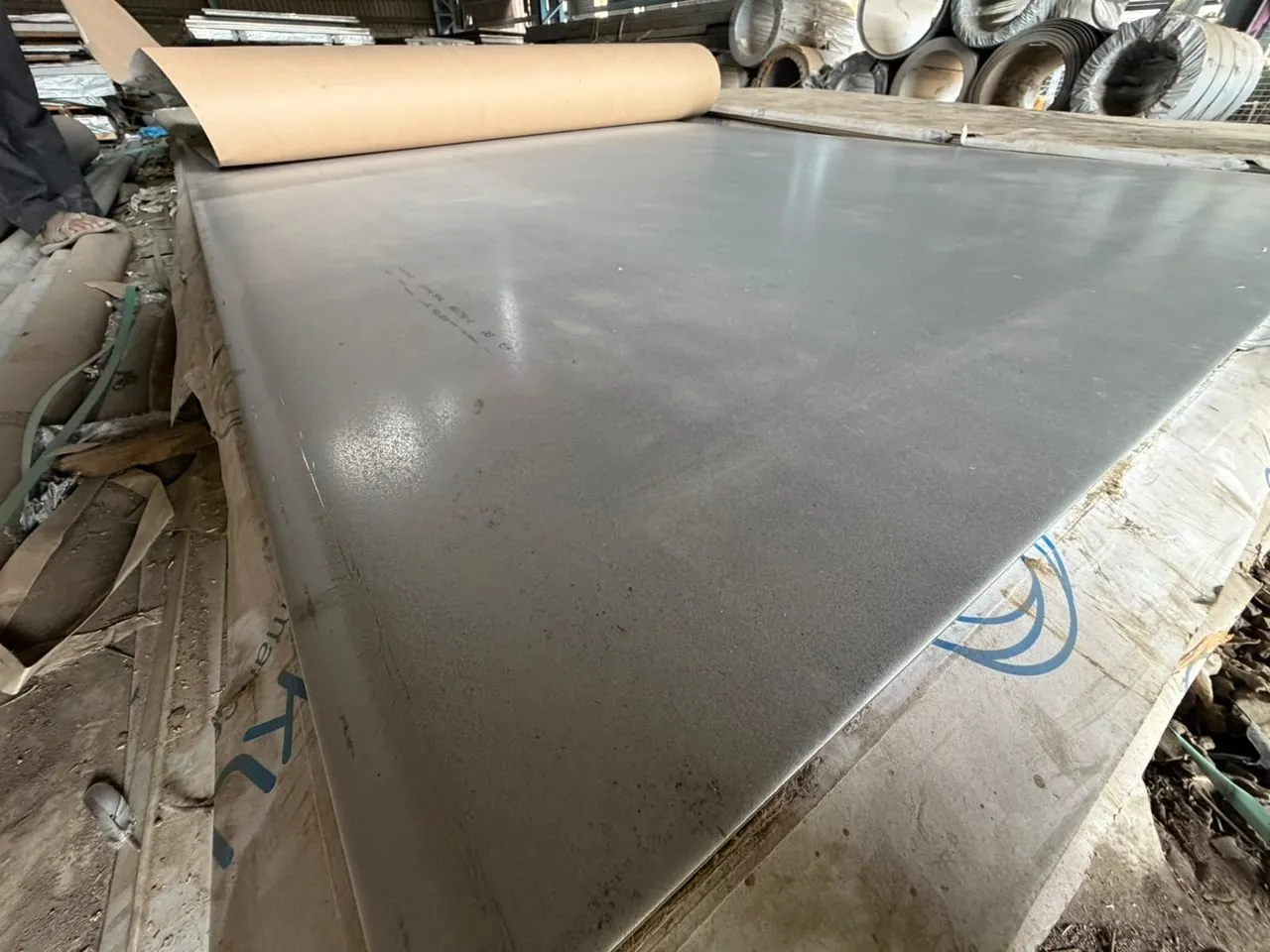
Key takeaways: 316 sheet at a glance
- Designation: UNS S31600, Werkstoff 1.4401, JIS SUS 316, AISI 316, an austenitic stainless steel, non-magnetic in the annealed condition.
- Why it exists: add 2–3% molybdenum and pitting resistance climbs to a PREN near 24. That's what lets 316 shrug off chloride and marine exposure that would pit 304.
- Where it falls short: like any austenitic grade, 316 can still crack under chloride stress-corrosion cracking in hot chloride service.
- Standard: flat-rolled sheet meets ASTM A240 / ASME SA-240.
- Traceability: every sheet ships ex-stock with an EN 10204 3.1/3.2 mill test certificate.
What is 316 stainless steel sheet?
316 sits one step up from 304 in the austenitic 18-8-plus family: it's the molybdenum-bearing version, the grade you reach for once chlorides, marine air or mild acids enter the picture. 304 gets by on chromium and nickel alone. 316 adds 2–3% molybdenum on top of that, and that single element is what pushes pitting and crevice resistance into chloride territory, sparing you the cost of a super-austenitic or duplex grade.
As cold-rolled sheet, it's the workhorse flat product for tank skins, enclosures, panels and hygienic surfaces. For grade background and the full cluster, see the 316 stainless steel grade hub. The low-carbon variant for welded work lives at 316L stainless steel.
Chemical composition
Composition for UNS S31600 per ASTM A240, weight percent.
| Element | Symbol | Content (wt %) |
|---|---|---|
| Carbon | C | ≤ 0.08 |
| Chromium | Cr | 16.0 – 18.0 |
| Nickel | Ni | 10.0 – 14.0 |
| Molybdenum | Mo | 2.0 – 3.0 |
| Manganese | Mn | ≤ 2.0 |
| Silicon | Si | ≤ 0.75 |
| Phosphorus | P | ≤ 0.045 |
| Sulfur | S | ≤ 0.030 |
| Nitrogen | N | ≤ 0.10 |
| Iron | Fe | Balance |
The low-carbon sibling 316L shares this chemistry but caps carbon at ≤ 0.03%. Check out the difference between 316 and 316L for more detail.
The role of molybdenum
Molybdenum is what separates 316 from 304. Add 2–3% Mo and you stabilize the passive film against chloride ions, pushing the pitting resistance equivalent number (PREN = Cr + 3.3·Mo + 16·N) from about 18 for 304 up to about 24 for 316. That molybdenum is essentially the premium you're paying for. Match it to the actual chloride risk instead of reaching for 316 by default on dry, indoor service, where 304 would do the job just fine.
Mechanical properties
Minimum room-temperature properties for annealed 316 sheet per ASTM A240.
| Property | Minimum |
|---|---|
| Tensile strength | ≥ 515 MPa (75 ksi) |
| Yield strength (0.2% proof) | ≥ 205 MPa (30 ksi) |
| Elongation (in 50 mm) | ≥ 40% |
| Hardness | ≤ 95 HRB / ≤ 217 HB |
Physical properties
| Property | Value |
|---|---|
| Density | 7.98–8.00 g/cm³ |
| Melting range | ~1370–1400 °C |
| Thermal conductivity (100 °C) | ~16.3 W/m·K |
| Mean coefficient of thermal expansion (0–100 °C) | ~16.0 µm/m·°C |
| Elastic modulus | ~193 GPa |
| Magnetic response | Non-magnetic (annealed); slight magnetism possible after cold work |
Corrosion behavior & PREN: why choose 316 over 304
316 resists corrosion because its molybdenum-bearing passive film stands up to chloride ions far better than 304's. That one difference carries the entire case for the grade. Below are the mechanisms that matter when you're specifying a sheet for chloride-bearing, marine or mild-acid service, plus the honest limit past which you need to step up.
Chloride & marine pitting
In coastal air, splash zones and chloride-dosed process water, 304 develops localized chloride pitting that perforates thin sheet. The 2–3% Mo in 316 raises the chloride threshold the passive film can tolerate, which is why 316 is the default for marine panels, tank skins and enclosures a rung above general 304.
Crevice corrosion
Under gaskets, lap joints and deposits, oxygen depletion drives crevice corrosion at lower chloride levels than open-surface pitting. Molybdenum improves 316's crevice resistance over 304, but tight crevices in warm chlorides still demand good design detailing or a higher-PREN grade.
PREN ~24 & where it sits on the ladder
The PREN places 316 at about 24, clearly above 304 (~18) and well below 904L (~34) or the duplex grades. 316 is therefore the base rung from which chloride-driven upgrades start, not the end of the ladder.
| Grade | Approx. PREN | Choose when |
|---|---|---|
| 304 / 304L | ~18 | No chlorides, general, indoor, architectural |
| 316 / 316L | ~24 | Chlorides, marine air, mild acids |
| 904L | ~34 | Sulfuric acid, stronger chlorides |
| Duplex 2205 | ~35 | Chloride-SCC risk plus higher strength |
| Incoloy 825 | ~31–40 | Sour service, reducing & oxidizing acids |
| Super-Duplex 2507 | ~43 | Severe chloride / seawater duty |
Chloride stress-corrosion cracking: the austenitic limit
316 is susceptible to chloride stress-corrosion cracking like all standard austenitics: under tensile stress in hot (roughly > 60 °C) chloride environments it can crack despite good pitting resistance. Where chloride-SCC is the governing risk, a duplex grade or a nickel alloy is the correct answer, not more 316.
Sensitization & the 316L question
Holding standard 316 in the 425–815 °C range, as a weld heat-affected zone does, can cause sensitization, where chromium carbides precipitate and leave the grain boundaries prone to intergranular attack. For welded pharma and food fabrications, specify low-carbon 316L (C ≤ 0.03%) to keep the HAZ corrosion-resistant. That weldment decision is owned by the 316 vs 316L comparison.
Equivalent grades & designations
| System | Designation |
|---|---|
| UNS | S31600 |
| Werkstoff (W.-Nr.) | 1.4401 |
| EN name | X5CrNiMo17-12-2 |
| JIS | SUS 316 |
| BS | 316S31 |
| AISI | 316 |
The titanium-stabilized variant 316Ti is Werkstoff 1.4571. For a full system-to-system map, see the UNS / Werkstoff / JIS cross-reference.
316 sheet vs the alternatives: when to choose it
vs 304
This is the core call. Pick 304 for dry, indoor work with no chlorides around; bump up to 316 the moment chlorides, coastal air, or mild acids enter the picture. Molybdenum accounts for the whole difference, and it pushes PREN from roughly 18 up to about 24. See 304 vs 316.
vs 316L
316 and 316L carry the same molybdenum content and the same corrosion resistance; carbon is the only real difference between them. Standard 316 handles most mechanical work and lightly-welded service fine. For heavy or hygienic weldments, though, you want 316L, since standard grade would sensitize under those conditions. The full comparison sits at 316 vs 316L.
vs 904L / duplex 2205
When the chlorides run hot or get concentrated, or chloride-driven stress corrosion cracking takes over, 316 just isn't up to it. The super-austenitic step up to 904L (PREN ~34, copper-bearing for sulfuric acid) or a duplex grade is the economical fix in that case. Don't push 316, or 316L, past its limit.
Forms, sizes, gauges & thickness ranges
316 sheet comes cold-rolled across the common gauge range, and heavier sections ship in hot-rolled No.1 finish. The table below maps gauge to thickness against standard sheet sizes.
| Gauge (ga) | Thickness (mm) | Typical standard sizes |
|---|---|---|
| 22 | ~0.8 | 1250 × 2500 mm, 1500 × 3000 mm (≈ 4 × 8 ft, 4 × 10 ft) |
| 20 | ~1.0 | |
| 18 | ~1.2 | |
| 16 | ~1.5 | |
| 14 | ~2.0 | |
| 12 | ~2.5 |
All sizes sit ex-stock and ready for immediate dispatch, with cut-to-size available on request. Heavier sections run into plate territory, check the 316 plate listing below. Gauge-to-mm values are nominal, so confirm exact thickness and tolerance on your RFQ.
Other 316 forms
Beyond sheet, 316 comes as 316 plate for heavier sections and as 316 coil for continuous and slit-strip supply. Need the same molybdenum chemistry in a low-carbon sheet? Check 316L sheet. Not sure which form fits your job, read sheet vs plate vs coil.
Sheet weight & how to calculate
Sheet weight tracks density directly. Take 7.98 g/cm³ for 316, and here's what that gives you:
Weight in kilograms equals thickness in millimeters times width in meters times length in meters times 7.98.
| Example sheet | Calculation | Weight |
|---|---|---|
| 2 mm × 1.25 m × 2.5 m | 2 × 1.25 × 2.5 × 7.98 | ≈ 49.9 kg |
| 1.5 mm × 1.25 m × 2.5 m | 1.5 × 1.25 × 2.5 × 7.98 | ≈ 37.4 kg |
| 3 mm × 1.5 m × 3.0 m | 3 × 1.5 × 3.0 × 7.98 | ≈ 107.7 kg |
For any size, use the site weight calculator.
Finishes
| Finish | Description | Typical service |
|---|---|---|
| 2B | Cold-rolled, annealed, pickled, lightly skin-passed, smooth matte | General fabrication, process equipment |
| BA (bright annealed) | Reflective cold-rolled | Reflective architectural, hygienic |
| No.4 | Brushed / satin directional grit | Visible sanitary and food surfaces |
| No.8 (mirror) | Highly polished reflective | Decorative, architectural feature panels |
| No.1 | Hot-rolled, annealed, pickled, dull | Heavier-gauge industrial plate-like sheet |
For a closer look, check out the guide to stainless steel finishes 2B, BA and No.4.
Standards & specifications complied
316 sheet is supplied to ASTM A240 (chromium-nickel-molybdenum stainless flat product) and its pressure-vessel twin ASME SA-240, which fix the S31600 chemistry and mechanical minima tabulated above. Ordering against the correct standard on the purchase order ensures the heat is supplied and certified in the right condition.
Testing, inspection & certification
Every 316 sheet ships with an EN 10204 3.1/3.2 mill test certificate traceable to the heat/cast number, see EN 10204 3.1 mill test certificate. Positive material identification (PMI) confirms the molybdenum content that sets genuine 316 apart from 304, and intergranular corrosion testing per ASTM A262 can be supplied when low-carbon material is ordered. For background on all three, check testing, MTC, NDT & PMI.
From the Nandini Steel Engineering Team: buyers often pay for 316 where dry, indoor, non-chloride conditions mean 304 would do the job fine. Other times they under-spec 316 for hot, concentrated chlorides when 904L or duplex is what's actually needed. The 2–3% molybdenum content is the thing you're paying for, so match it to the real pitting risk. For welded pharma and food work, use 316L to keep the heat-affected zone corrosion-resistant. A quick PMI check at receiving inspection will also catch 304 that got mistakenly supplied as 316.
Applications of 316 sheet by industry
- Marine & offshore: coastal panels, splash-zone skins and fittings where 304 would pit.
- Chemical processing: tank linings, ducting, and equipment skins for mild-acid and chloride service.
- Pharmaceutical / hygienic: clean surfaces and vessel skins, with 316L specified for welded assemblies.
- Food & dairy: sanitary No.4 and 2B surfaces that hold up against chloride-bearing wash-downs.
- Architectural: coastal cladding and feature panels. These need BA or mirror finishes that can actually last outdoors.
Welding & fabrication of 316 sheet
316 welds without much trouble using ER316L filler. Fabricators reach for the low-carbon filler even on standard 316, since it keeps carbon down in the weld zone and protects the HAZ from corrosion. Sheet bends, roll-forms and deep-draws well enough, though austenitic grades work-harden, so expect to need more power and wider radii than you would with carbon steel. Laser and plasma cutting are routine. Once heavy fabrication wraps up, solution annealing at roughly 1010–1120 °C followed by a rapid quench brings the passive structure back. See how to weld 316.
How we quote
We hold 316 sheet ex-stock for immediate dispatch and quote live pricing against your RFQ. Just tell us the grade, finish, gauge, sheet size and quantity, plus whether you need EN 10204 3.1 or 3.2 certification. All material is genuine mill sheet from Aperam, Outokumpu, Jindal, POSCO, Nippon Steel or JFE, and it comes with its mill test certificate.
FAQ
Is 316 stainless steel sheet good for saltwater and marine use?
What is the difference between 316 and 316L sheet?
What is the PREN of 316 stainless steel?
Does 316 stainless steel sheet rust?
What sizes and gauges does 316 sheet come in?
Do you provide a mill test certificate with 316 sheet?
Request a quote for 316 stainless steel sheet
Nandini Steel has been around since 2003, an ISO 9001:2015-certified stockist and supplier. We hold 316 sheet ex-stock, ready for immediate dispatch. In 20 years we've delivered 307+ projects to 260+ clients, reaching across 36+ export countries.
- Call: +91 22 43404600 · +91 9920209184
- WhatsApp: +91 99202 09184
- Email: reachus@nandinisteel.com
Address: 25, Dreamland Building, 601, 6th Floor, Mama Parmanand Marg, Charni Road, Opera House, Girgaon, Mumbai, Maharashtra 400004, India
- GSTIN: 27ADJPA7240C1Z0
Related grades to cross-shop
Part of our steel sheet range and all stainless steel sheet grades.