
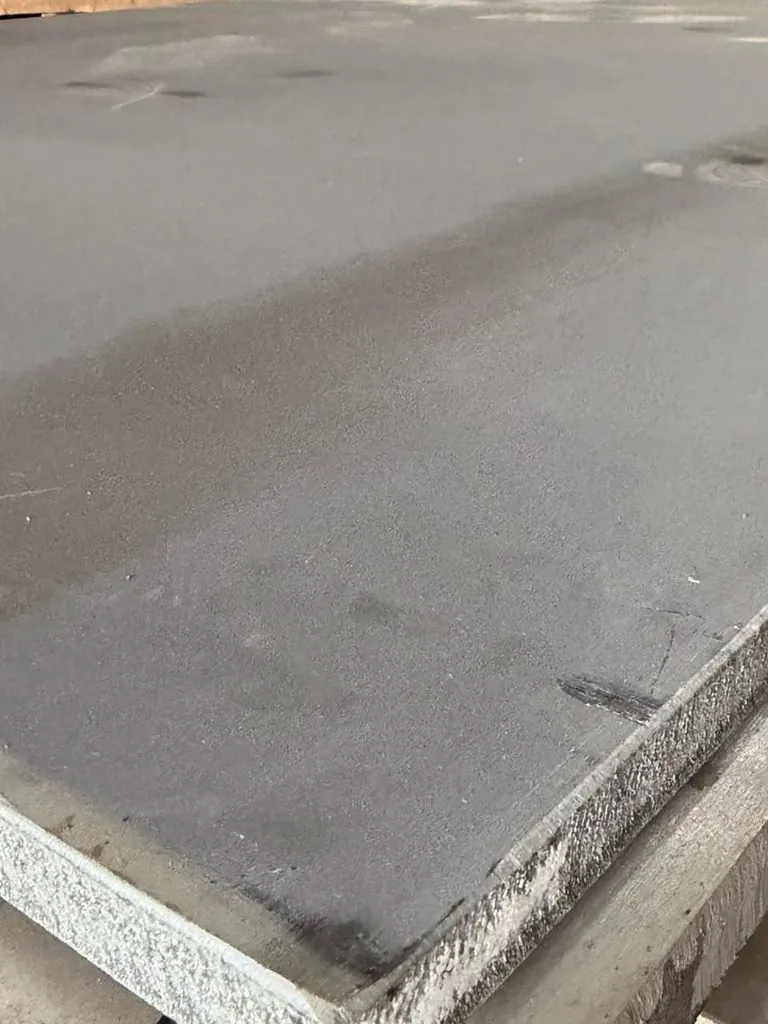
Key takeaways: 316L plate at a glance
- Designation: UNS S31603, Werkstoff 1.4404, JIS SUS316L, the low-carbon variant of 316 austenitic stainless.
- Low carbon (C ≤0.03%): keeps chromium-carbide precipitation in check, so the heat-affected zone won't sensitize once you've welded it.
- Molybdenum-bearing (2–3% Mo): lifts the pitting resistance equivalent to PREN ~24, well above 304's ~18.
- Austenitic, non-magnetic (annealed), supplied solution-annealed to ASTM A240 / ASME SA-240.
- Fully traceable: genuine mill plate dispatched ex-stock with an EN 10204 3.1/3.2 mill test certificate on every order.
What is 316L stainless steel plate?
316L is a molybdenum-bearing austenitic stainless steel and the controlled-carbon member of the 316 family. The "L" stands for a maximum carbon content of 0.03%, roughly a third of standard 316's 0.08% ceiling. That one change in chemistry is the whole reason the grade exists. During welding, carbon above about 0.03% combines with chromium at grain boundaries and forms chromium carbides, which strips the surrounding area of the chromium it needs for corrosion resistance. Keep carbon low, and 316L resists this intergranular corrosion (sensitization) without needing a post-weld solution anneal. Welded plate fabrications stay corrosion-resistant all the way across the heat-affected zone.
316L in plate form is the grade you specify for welded tanks, pressure-vessel shells, marine structures and hygienic process equipment. Anywhere chromium alone (304/304L) can't stand up to the chlorides, and the part will be joined by welding, that's where it goes.
Chemical composition
Composition follows UNS S31603 / ASTM A240 (wt %). Standard 316 appears alongside it, so the carbon difference, which is the heart of this page, stands out clearly.
| Element | 316L (S31603) | 316 (S31600) |
|---|---|---|
| Carbon (C) | ≤ 0.030 | ≤ 0.08 |
| Chromium (Cr) | 16.0–18.0 | 16.0–18.0 |
| Nickel (Ni) | 10.0–14.0 | 10.0–14.0 |
| Molybdenum (Mo) | 2.00–3.00 | 2.00–3.00 |
| Manganese (Mn) | ≤ 2.00 | ≤ 2.00 |
| Silicon (Si) | ≤ 0.75 | ≤ 0.75 |
| Phosphorus (P) | ≤ 0.045 | ≤ 0.045 |
| Sulfur (S) | ≤ 0.030 | ≤ 0.030 |
| Nitrogen (N) | ≤ 0.10 | ≤ 0.10 |
| Iron (Fe) | Balance | Balance |
Why ≤0.03% carbon: and why the molybdenum matters
Carbon and molybdenum each do a distinct job here. Low carbon governs weldability: below 0.03%, there's too little carbon to form the chromium carbides that cause sensitization when plate sits in the 425–815 °C range during welding. Molybdenum, on the other hand, governs corrosion. A 2–3% Mo content strengthens the passive film against chloride attack, and that's precisely what 304 lacks.
Nandini Steel has seen both sides of this mistake play out. Buyers often pay for 316/316L where dry, indoor, non-chloride 304 would do the job just fine. Other times they under-specify 316L for hot, concentrated chlorides when what they actually need is 904L or a duplex grade. That 2–3% molybdenum is the thing you're paying for. Match it to the real pitting risk, not to habit.
Mechanical properties
Minima for annealed 316L plate per ASTM A240 / ASME SA-240.
| Property | 316L (S31603) minimum |
|---|---|
| Tensile strength | ≥ 485 MPa (70 ksi) |
| Yield strength (0.2% proof) | ≥ 170 MPa (25 ksi) |
| Elongation (in 50 mm) | ≥ 40% |
| Hardness | ≤ 95 HRB / ≤ 217 HBW |
Why 316L's yield is slightly below 316
The lower carbon content that keeps 316L weld-safe also strips away some interstitial strengthening. That's why its specified minimum yield sits at 170 MPa, versus 205 MPa for standard 316. For most welded vessel and tank work, this hardly matters. Design is governed by the welded condition anyway, and there 316L's resistance to sensitization is worth far more than 35 MPa of parent-metal yield. But if the extra yield genuinely matters and the section won't be welded, 316 plate is the better choice. The trade-off is laid out in 316 vs 316L.
Physical properties
| Property | Value (annealed) |
|---|---|
| Density | ~7.98 g/cm³ |
| Melting range | ~1375–1400 °C |
| Thermal conductivity (100 °C) | ~16.3 W/m·K |
| Mean coefficient of thermal expansion (0–100 °C) | ~16.0 µm/m·°C |
| Elastic modulus | ~193 GPa |
| Magnetic response | Non-magnetic (austenitic, annealed) |
The density of around 7.98 g/cm³ drives the plate weight calculation below.
Corrosion behavior & PREN: where 316L plate fits
316L owes its reputation to molybdenum. Its pitting resistance equivalent (PREN), worked out as Cr + 3.3 × Mo + 16 × N, comes in at roughly 24, compared with about 18 for 304. That gap is the real reason to move up from a chromium-only austenitic in chloride service.
Pitting & crevice resistance: the molybdenum dividend
The 2–3% molybdenum content stabilizes the passive film against chloride breakdown. That's why 316L resists pitting corrosion and crevice corrosion far better than 304, sitting at a PREN of roughly 24. Think of it as the austenitic baseline with molybdenum added in. It holds up well for most marine splash-zone work, brackish water and mild-acid duty. Still, it remains an austenitic grade, not a super-austenitic one.
Chloride stress-corrosion cracking: the austenitic limit
Like all standard austenitics, 316L remains susceptible to chloride stress-corrosion cracking under tensile stress in hot (typically >60 °C) chloride environments. Molybdenum does not remove this limit. Where hot concentrated chlorides or combined acid/chloride duty exceed 316L's envelope, the upgrade path is a super-austenitic, see 904L vs 316L.
Intergranular corrosion & sensitization: why low carbon
At 425–815 °C, holding 316 in that range lets chromium carbides form along grain boundaries. That strips chromium from the surrounding metal and leaves the steel vulnerable to intergranular corrosion, the kind of thing you see in a weld heat-affected zone. 316L's carbon content, capped at 0.03%, chokes off that reaction before it gets going. Welded plate holds onto its corrosion resistance all through the HAZ, and you don't need a post-weld solution anneal to make that happen.
Equivalent grades & designations
| System | Designation |
|---|---|
| UNS | S31603 |
| Werkstoff (W.-Nr.) | 1.4404 |
| EN name | X2CrNiMo17-12-2 |
| JIS | SUS316L |
| BS | 316S11 |
| AISI | 316L |
Full cross-referencing appears in the UNS / Werkstoff / JIS cross-reference.
316L plate vs the alternatives: when to choose it
vs 316: the carbon/welding decision
316 and 316L share the same chromium, nickel and molybdenum content, so their corrosion resistance is effectively the same. The real difference comes down to carbon. Pick 316L whenever the plate will be welded and can't be solution-annealed afterward, since that keeps the HAZ from sensitizing. Go with 316 only where you need the higher parent-metal yield and welding isn't part of the picture. For the full breakdown, see 316 vs 316L.
vs 304L: the molybdenum/chloride decision
304L and 316L are both low-carbon, weld-safe austenitics, and the difference comes down to molybdenum. 304L plate (PREN ~18) is the economical pick for non-chloride fabrication. 316L's Mo content is what you're paying for when chlorides enter the picture. Where the 304-vs-316 split actually matters, the point where molybdenum earns its keep, gets covered in 304 vs 316.
vs 904L: when chlorides or acids exceed 316L's limit
When hot chlorides drive pitting or stress-corrosion risk past 316L, or sulfuric/phosphoric acids are involved, the super-austenitic 904L plate (PREN ~34, with ~4.5% Mo and copper) is the step up. Don't over-specify it where 316L already covers the service, compare the two in 904L vs 316L.
PREN ladder: choose by service
| Grade | PREN (approx.) | Choose when |
|---|---|---|
| 304 / 304L | ~18 | General, non-chloride fabrication |
| 316 / 316L | ~24 | Welded chloride, marine & pharma service (316L) |
| 904L | ~34 | Sulfuric acid, hot/high chlorides |
| Duplex 2205 | ~35 | Higher strength + chloride-SCC resistance |
| Incoloy 825 | ~31–40 | Sour service, mixed reducing/oxidizing acids |
Forms, sizes & thickness ranges
316L is available as sheet, plate and coil, with the plate form detailed here. Typical plate dimensions supplied are shown below, all held ex-stock for immediate dispatch, with other sizes available to order.
| Dimension | Typical range |
|---|---|
| Thickness | 3–100 mm (heavier sections to order) |
| Width | 1000 / 1219 / 1500 / 2000 mm |
| Length | 2000 / 2440 / 3000 / 6000 mm |
| Condition | Hot-rolled, solution-annealed & pickled |
Other 316L forms
For thinner gauges, see 316L sheet or 316L coil. Or head back to the 316L grade hub, where you'll find the full range of 316L products and data.
Plate weight & how to calculate
Plate weight follows directly from the ~7.98 g/cm³ density:
Weight (kg) equals thickness in millimeters times width in meters times length in meters times 7.98.
Worked example: a 10 mm × 1.5 m × 6.0 m plate = 10 × 1.5 × 6.0 × 7.98 = ~718 kg.
| Thickness | Size | Approx. weight |
|---|---|---|
| 6 mm | 1.5 × 6.0 m | ~431 kg |
| 10 mm | 1.5 × 6.0 m | ~718 kg |
| 12 mm | 2.0 × 6.0 m | ~1149 kg |
| 20 mm | 2.0 × 6.0 m | ~1915 kg |
Use the weight calculator for any size.
Finishes
316L plate normally ships as No.1, meaning hot-rolled, annealed and pickled (HRAP), which gives the standard matt finish used on heavy plate. Thinner cold-rolled 316 plate can come as 2B instead, a smooth, reflective surface, when the job calls for something cleaner, hygienic equipment being a good example. The finish won't touch the chemistry or how the alloy resists corrosion. It does, however, change what you need to do for cleaning and passivation afterward.
Standards & specifications complied
ASTM A240 / ASME SA-240: dual-certified S31600 / S31603
316L plate gets supplied to ASTM A240 and its pressure-vessel counterpart, ASME SA-240. These two standards set the chemistry, mechanical minima, and testing requirements for chromium-nickel-molybdenum austenitic plate. Since 316L chemistry often meets the 316 (S31600) carbon limit as well, mills frequently dual-certify a single heat to both S31603 and S31600. That matters when a drawing calls out one designation but your process needs the other.
Testing, inspection & certification
Every order of 316L plate ships with an EN 10204 3.1/3.2 mill test certificate that records the actual heat chemistry, including the measured carbon, which confirms the low-carbon condition, along with the mechanical results and full heat/cast traceability. Read more about the EN 10204 3.1 mill test certificate. Plate can also be supplied on request with intergranular corrosion testing to ASTM A262, positive material identification (PMI) and ultrasonic testing (UT).
Applications of 316L plate by industry
316L plate is specified across chloride- and hygiene-sensitive sectors:
- Marine & offshore, hulls, splash-zone structures and seawater equipment.
- Chemical / acid processing, reactors, tanks and piping that see mild acid and chloride service.
- Pharmaceutical & hygienic, process vessels and clean-in-place equipment, where welds have to stay free of corrosion.
- Food & dairy, hygienic process, storage and clean-in-place equipment.
- Pulp & paper, bleaching and digester equipment exposed to chlorides.
Because 316L keeps the heat-affected zone corrosion-resistant, it's the default choice wherever welded fabrication meets hygienic or chloride duty. Use 316L for welded pharma and food work to keep the HAZ resistant.
Welding & fabrication of 316L plate
316L takes well to TIG, MIG, SMAW and submerged-arc welding, usually paired with a matching ER316L filler. Standard sections need no post-weld solution anneal, that's the entire point of the low-carbon grade, as long as good practice keeps time in the sensitizing range short. For procedure details, see how to weld 316L.
Forming tells a different story. The alloy work-hardens, and machinists often describe it as "gummy," so sharp tooling, positive feeds and enough power matter. After heavy cold work, a full solution anneal (1040–1110 °C, then a rapid quench) brings the material back to a fully softened state where its corrosion resistance is at its best.
Pricing & how we quote
RFQ-only pricing for 316L plate, mill and stock prices shift constantly, and grade, thickness, size, finish and quantity all move the final number, so we don't publish indicative tables. Send over your specification and you'll get a same-day quotation on ex-stock material. Request a quote or message us on WhatsApp at +91 99202 09184.
FAQ
What is the difference between 316 and 316L plate?
Is 316L plate good for seawater?
Does 316L plate need annealing after welding?
What is the PREN of 316L?
How do I calculate the weight of a 316L plate?
What certification comes with 316L plate?
Request a quote
Nandini Steel is an ISO 9001:2015-certified stockist and supplier of genuine mill 316L plate, sourcing from producers like Aperam, Outokumpu, Jindal, POSCO, Nippon Steel and JFE. Founded in 2003. That's over 20 years in the trade, with 307+ projects completed, 260+ clients served and 36+ export countries reached. 316L plate stays on hand, ready for immediate dispatch, and every order ships with an EN 10204 3.1/3.2 mill test certificate.
Send your specification for a same-day quotation:
- Email: reachus@nandinisteel.com
- Phone: +91 22 43404600 · +91 9920209184
- WhatsApp: +91 99202 09184
Address: 25, Dreamland Building, 601, 6th Floor, Mama Parmanand Marg, Charni Road, Opera House, Girgaon, Mumbai, Maharashtra 400004, India
- GSTIN: 27ADJPA7240C1Z0
Related grades to cross-shop
Part of our steel plate range and all stainless steel plate grades.