
Key takeaways
- PVQ is a discipline, not a single grade. Pressure-vessel quality (PVQ) describes how a plate is made, heat-treated, and tested, not one fixed chemistry.
- A516 / SA-516 is the carbon workhorse. It conforms to ASTM A516 / ASME SA-516 and is written under the ASTM A20 umbrella specification.
- Normalizing buys low-temperature toughness. Grain refinement raises Charpy impact energy at sub-ambient design temperatures.
- Sour service needs the HIC-tested variant. Where wet H2S is present, plain Gr 70 will not do; specify the NACE TM0284 HIC-tested plate.
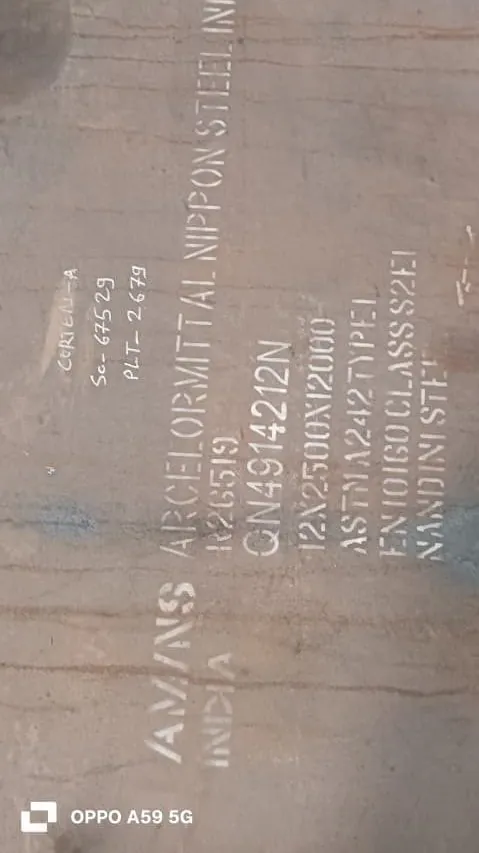
- Paperwork proves it. Every heat is reported on an EN 10204 3.1/3.2 mill test certificate tied to the stamped heat number.
What is pressure-vessel steel?
Pressure-vessel steel is plate made and certified to contain pressure safely in boilers, vessels, drums, separators, and reactors. In the carbon-steel world the common label is pressure-vessel quality, or PVQ, plate. It is fully killed (deoxidized) and made to fine-grain practice, with guaranteed mechanical minimums and, where the design calls for it, Charpy V-notch impact testing. Ordinary commercial or structural plate simply does not guarantee those things.
The point to hold onto is that PVQ is a quality discipline rather than a chemistry. Two plates can carry near-identical carbon content, yet only the one that is killed, fine-grained, impact-tested, and certified to a pressure-vessel standard earns the label. For the plain-language version of the same idea, see boiler quality plate explained.
PVQ plate vs commercial / structural plate
The practical gap between PVQ and ordinary plate shows up in five places: deoxidation, grain practice, impact testing, the governing standard, and the certificate supplied.
| Attribute | PVQ (pressure-vessel) plate | Commercial / structural plate |
|---|---|---|
| Deoxidation | Fully killed (fully deoxidized) | Often rimmed or semi-killed |
| Grain practice | Fine-grain practice (grain refinement) | Typically as-made / coarse |
| Notch toughness | Charpy V-notch impact testing available or required | Usually not impact-tested |
| Governing standard | ASTM A516 / ASME SA-516 under ASTM A20 | General structural plate grades |
| Typical MTC level | EN 10204 3.1 / 3.2 (test results) | EN 10204 2.1 / 2.2 (statement of compliance) |
The metallurgy that makes plate "pressure-vessel quality"
Four things in the metallurgy separate PVQ plate from ordinary plate. Together they give a vessel the predictable strength and the resistance to brittle fracture it has to have.
Killed, fully-deoxidized steel
PVQ plate is killed steel, deoxidized (typically with silicon and aluminum) so dissolved oxygen cannot form gas porosity as the steel solidifies. The result is a sound, homogeneous plate with consistent properties through the section, which is the baseline every pressure part needs.
Fine-grain practice and notch toughness
Fine-grain practice refines the microstructure, and a finer grain raises notch toughness and improves weldability. Grain refinement is the metallurgical lever behind a plate's resistance to brittle fracture, which is why fine-grain steel is written into pressure-vessel specifications. For how composition drives this, see the role of alloying elements.
Charpy V-notch impact testing
A pressure vessel must not fail in a brittle manner, so PVQ plate is validated by the Charpy V-notch impact test, which measures the energy a sample absorbs at a defined test temperature. The temperature you specify matters a great deal: a plate certified tough at 0 °C has not been proven for service at -45 °C. For the wider picture on strength and toughness, see mechanical properties explained.
Clean chemistry and tight sulfur
A lower carbon equivalent, with tight sulfur and phosphorus, improves weldability and cuts cracking risk. Low sulfur, combined with inclusion-shape control, is also the basis for resistance to hydrogen-induced cracking in wet H2S service, which is why sour-service PVQ plate exists as its own controlled variant.
ASTM A20: the umbrella specification
A516 does not stand alone. It is written under ASTM A20, the general-requirements specification for steel plate used in pressure vessels. A20 sets the common rules that every PV plate specification inherits: sampling, tolerances, heat and product analysis, marking, certification, and the supplementary tests you can invoke. When you order A516, you are also ordering to A20 whether or not the PO spells it out.
The "ASME SA-" prefix, as in ASME SA-516, means the material has been adopted into the ASME Boiler and Pressure Vessel Code. SA-516 is A516 as it appears in BPVC Section II, intended for Code vessels built to Section VIII. Specify SA- rather than the plain ASTM designation when the plate is for Code construction.
ASTM A516 / ASME SA-516: the carbon PVQ workhorse
A516 belongs to the PVQ carbon-steel family and is the default choice for most vessel and boiler work. The product specification ASTM A516 / ASME SA-516 defines chemistry, mechanical minimums, and testing for fine-grain carbon plate across grades 55, 60, 65, and 70. Grade 70 is the usual pick when you want the stronger strength-to-toughness balance.
| Property | A516 Gr 60 | A516 Gr 70 |
|---|---|---|
| Family | PVQ carbon steel | PVQ carbon steel |
| Tensile strength | 415–550 MPa (60–80 ksi) | 485–620 MPa (70–90 ksi) |
| Yield strength (0.2%, min) | 220 MPa (32 ksi) | 260 MPa (38 ksi) |
| Elongation | Specified minimum (gauge dependent) | Specified minimum (gauge dependent) |
| Charpy V-notch impact | Supplementary; specify temperature | Supplementary; specify temperature |
| Standard | ASTM A516 / ASME SA-516 | ASTM A516 / ASME SA-516 |
For ordering detail and section ranges, start at the A516 Gr 70 hub or the A516 Gr 70 plate leaf, and for the lighter-strength option see A516 Gr 60 plate.
Heat treatment: as-rolled, normalized, and N+T
Supply condition changes the toughness you get from the same chemistry. Normalizing is the standard route to low-temperature notch toughness, and thicker sections that cool slowly often need it to meet the same Charpy requirement.
| Condition | Microstructure | Low-temperature impact toughness | Where it applies |
|---|---|---|---|
| As-rolled | As-rolled grain | Baseline; may miss low-temp Charpy | Ambient vessels, thinner sections |
| Normalized | Refined, uniform grain | Markedly improved; the usual low-temp route | Low-temperature and thicker-section vessels |
| Normalized & tempered (N+T) | Refined grain, tempered | High toughness with controlled strength | Demanding or heavier sections |
The full treatment lives in normalizing of PVQ plate, and for low-temperature vessels the A516 Gr 70 normalized plate route is the one to specify. Section thickness drives both the mechanical minimums and whether heat treatment is called for, so state it up front; see how to choose plate thickness.
HIC resistance and sour service
Where plate will see wet hydrogen sulfide (sour service), plain A516 Gr 70 is not qualified. You specify the HIC-tested variant, which resists hydrogen-induced cracking through low sulfur and inclusion-shape control, and is tested per NACE TM0284. It conforms to NACE MR0175 / ISO 15156 for sour service, and it is a different purchase from plain Gr 70 that has to be named explicitly on the order.
For the sour-service plate itself, see A516 Gr 70 NACE / HIC plate. The two things buyers most often under-specify on vessel plate are the impact-test temperature on normalized plate and the HIC requirement on sour duty, so pin both down before you buy.
Beyond carbon: Cr-Mo, stainless, and clad plate
Carbon PVQ covers most ambient and moderate-temperature work. When the service pushes past that, the grade changes.
| Driver | Grade / family | Standard | Why |
|---|---|---|---|
| Strength and low-temp toughness | A516 Gr 70 (PVQ carbon) | ASTM A516 / ASME SA-516 | Workhorse for vessels, boilers, separators |
| Elevated temperature, hydrogen | SA387 Gr 11 / 22 (Cr-Mo) | ASTM A387 / ASME SA-387 | Chromium-molybdenum gives creep and hydrogen resistance |
| Sulfuric acid, high chloride | 904L (super-austenitic) | ASTM A240 | Copper-bearing ~4.5% Mo chemistry, PREN ~34 |
| Sour and mixed-acid duty | Incoloy 825 (Ni-Fe-Cr) | ASTM B424 | Resists reducing and oxidizing acids, sour service |
For the elevated-temperature route, see SA387 Cr-Mo alloy plate and the standard at ASTM A387. Where corrosion rather than pressure is the controlling requirement, carbon plate is replaced or clad with corrosion-resistant grades such as 904L plate or Incoloy 825 plate. For how the three base families compare, see carbon vs stainless vs alloy steel. Where a vessel needs bar for internals or trim, ASTM A479 bar for pressure vessels is the relevant spec.
Standards and specifications behind PV steel
| Standard | Role |
|---|---|
| ASTM A20 | General requirements for PV plate (the umbrella over A516) |
| ASTM A516 / ASME SA-516 | Fine-grain carbon PVQ plate, grades 55–70 |
| ASTM A387 | Cr-Mo alloy plate for elevated-temperature pressure parts |
| EN 10204 | Mill test certificate types (3.1 / 3.2) |
| NACE MR0175 / ISO 15156 | Materials for sour (H2S) service |
If a drawing names a grade under a national system, the UNS, Werkstoff and JIS cross-reference maps the designations across to their ASTM/ASME equivalents.
Testing, inspection, and the mill test certificate
Pressure-vessel quality only counts once it is written down. A PVQ plate is tested for chemistry and tensile properties, plus Charpy V-notch impact when the spec calls for it. Ultrasonic testing confirms the plate is free of laminations, and HIC testing per NACE TM0284 applies to sour service. Every result is reported heat by heat on an EN 10204 3.1 / 3.2 mill test certificate that ties back to the actual cast.
The traceability is the point. See testing, MTC, NDT and PMI and material traceability for how the heat number stamped on the plate matches the certificate, and how to read a mill test certificate for reading one. A common field problem is commercial plate sold as "pressure-vessel quality" with no impact testing and no 3.1 certificate behind it. The paperwork is exactly what separates the two.
Where pressure-vessel steel is used
PVQ plate forms the pressure-containing skin of equipment across the process industries.
- Pressure vessels and boilers and pressure vessels: shells, heads, and drums built to ASME Section VIII.
- Storage tanks and separators: large-diameter shells where weldability and consistent plate quality matter.
- Heat exchangers and reactors in oil and gas, petrochemical, and chemical processing service, often as the HIC-tested variant for sour duty.
How to specify and order PV plate
To receive plate that is genuinely pressure-vessel quality, specify these in order on the inquiry and the PO:
- Grade such as A516 Gr 70 (or Gr 60, or SA387 Gr 11 / 22).
- Specification: ASTM A516 vs ASME SA-516 (state SA- for Code vessels), under ASTM A20.
- Heat-treatment condition: as-rolled, normalized, or normalized & tempered.
- Impact-test temperature: the Charpy V-notch temperature your design requires.
- HIC / sour service: call out the NACE TM0284 HIC-tested variant if wet H2S is present.
- MTC level: EN 10204 3.1, or 3.2 with third-party witness.
- Thickness and size: state section thickness up front, since minimums and heat-treatment needs vary with it.
For the full worked method, see how to specify A516 for a vessel and the longer how to specify A516 for pressure vessels. To estimate mass for a given size, use the plate weight calculator, and if plate, sheet, and coil terms still trip you up, sheet vs plate vs coil sorts it out.
Nandini Steel keeps PVQ grades ex-stock for immediate dispatch, and every piece ships with its EN 10204 3.1 / 3.2 mill test certificate and full heat traceability. We supply genuine mill plate from nameable mills including Aperam, Outokumpu, Jindal, POSCO, Nippon Steel, and JFE.
FAQ
Is pressure-vessel steel the same as PVQ plate?
Is PVQ a grade?
Why is pressure-vessel plate normalized?
What is the difference between A516 Gr 60 and Gr 70?
Which grade do I need for sour service?
What certificate proves a plate is pressure-vessel quality?
For live pricing on A516 / SA-516 and other PVQ plate, request a quotation with the grade, condition, impact temperature, HIC requirement, and thickness, or reach us at reachus@nandinisteel.com.