
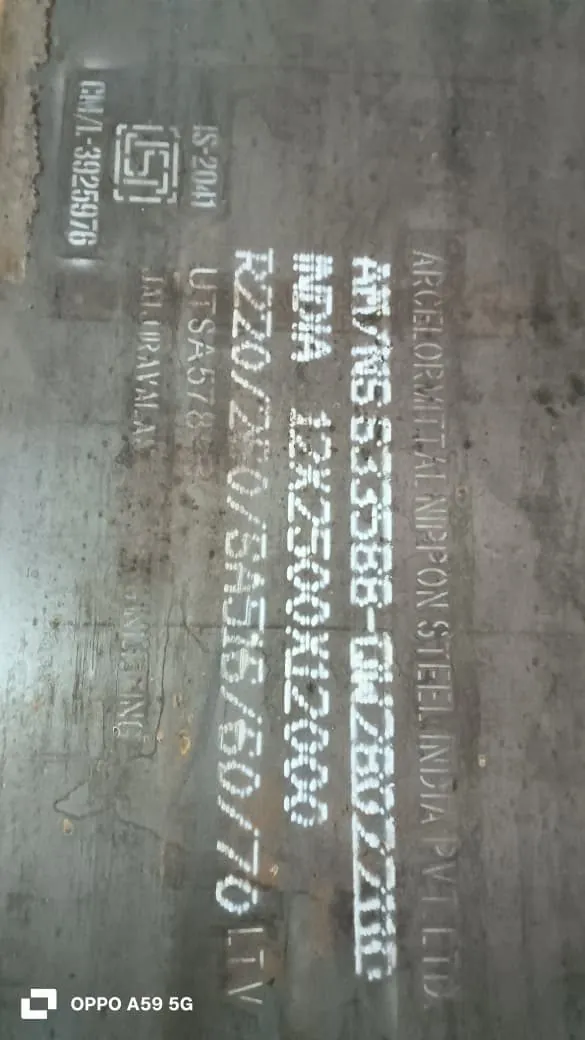
What A516 Grade 70 Plate Is: Key Takeaways
A516 Grade 70 is the default workhorse plate for welded pressure vessels, boilers and storage tanks. The grade itself is basically a commodity. Where sourcing goes right or wrong comes down to the condition you specify and the paperwork you actually get back.
Pressure-vessel-quality (PVQ) carbon steel is made under tight chemistry and testing controls for code-stamped fabrication, covering ASME Section VIII and PED work.
ASME SA-516 and ASTM A516 aren't two different grades. They're the same steel under two naming systems, and both sit on the ASTM A20 general requirements for plate.
"Grade 70" doesn't signal a change in chemistry at all. It's a strength class, naming the 485-620 MPa tensile band, sitting above Grades 55, 60 and 65.
- Killed steel, made to fine-grain practice for sound, clean plate with good weldability and toughness.
It is carbon steel, not corrosion-resistant. It carries no chromium or nickel, so corrosive media call for a corrosion-resistant alloy (CRA) instead.
SA-516 vs A516: the ASME/ASTM Twin Designation
ASTM A516 is the ASTM designation; ASME SA-516 is the same specification, carried into the ASME Boiler & Pressure Vessel Code (Section II, Part A) for code work. Chemistry, mechanical minimums, and grades don't change between the two, a mill certificate will often list ASTM A516 / ASME SA-516 side by side. When the vessel carries a code stamp, order to SA-516, and confirm the PED requirements that apply to the job.
Why "Grade 70" (Strength Class vs Gr 55/60/65)
A516 comes in four strength grades: 55, 60, 65 and 70. What separates them is tensile range, not the alloy mix. Grade 70 is the strongest, and it's the one most often specified, since it allows the highest stress per unit thickness. That means thinner walls, and lighter vessels. The lower grades step down in tensile strength wherever design pressures don't demand more.
Chemical Composition
A516 Grade 70 is a killed, fine-grain carbon-manganese steel. Under ASTM A516 Table 1, the carbon and manganese limits climb as plate thickness increases. HIC-tested variants go further, holding sulfur and phosphorus down and adding calcium treatment, which gives cleaner plate that resists cracking better. Here's the heat (ladle) analysis, typical maxima:
| Element | Symbol | Heat analysis (%) | Note |
|---|---|---|---|
| Carbon | C | 0.27–0.31 max | Thickness-dependent per A516 Table 1 |
| Manganese | Mn | 0.85–1.20 | Rises in thicker sections |
| Silicon | Si | 0.15–0.40 | Killed-steel deoxidation |
| Phosphorus | P | 0.025 max | Lower for HIC grades |
| Sulfur | S | 0.025 max | Controlled + Ca-treated for HIC |
The chemistry sits under UNS K02700. Every order ships with an EN 10204 3.1/3.2 mill test certificate covering the full heat/ladle analysis plus whatever came out of the actual test run.
Mechanical Properties
Grade 70 marks the strength tier here. Values are given for the as-rolled or normalized condition, and Charpy impact testing qualifies it for low-temperature service.
| Property | Value (metric) | Value (imperial) |
|---|---|---|
| Tensile strength | 485–620 MPa | 70–90 ksi |
| Yield strength (min) | 260 MPa | 38 ksi |
| Elongation in 200 mm (min) | 17% | 17% |
| Elongation in 50 mm (min) | 21% | 21% |
| Typical hardness | ≤ 170–200 HB | – |
Low-Temperature Impact Toughness (Charpy, Normalizing)
For vessels running below ambient temperature, A516 Gr 70 gets qualified with Charpy V-notch impact tests at the design temperature. As-rolled plate doesn't hold up well in the cold; normalizing refines the grain and pushes the ductile-to-brittle transition downward. That's why sub-zero service calls for normalized A516 Gr 70 plate with impact testing at the qualifying temperature, never as-rolled. Impact energy acceptance gets set against plate thickness and the design temperature specified on the order.
Physical Properties
| Property | Value |
|---|---|
| Density | 7.85 g/cm³ |
| Elastic modulus | ~200 GPa |
| Thermal conductivity | ~52 W/m·K |
| Coefficient of thermal expansion | ~12 ×10⁻⁶ /K |
| Specific heat | ~470 J/kg·K |
Condition & Heat Treatment: As-Rolled, Normalized, PWHT
A516 Gr 70 ships in several different conditions, and it's the condition, not the grade name, that actually governs toughness and code acceptance.
- As-rolled, the default choice for ambient, moderate-thickness vessels, where low-temperature impact values aren't required.
- Normalized, grain-refined to give reliable low-temperature toughness. Required for thicker sections and cold service, and the safer pick whenever Charpy minimums are tight.
- Post-weld heat treated (PWHT), stress relief applied after fabrication, typically mandated above code thickness thresholds. The base plate has to tolerate the PWHT cycle without losing its properties.
When to Specify Normalized A516 Gr 70
Specify normalized plate whenever the vessel will see below-ambient temperatures. The same goes for sections heavy enough that as-rolled toughness can't be trusted, or when the code or client datasheet demands impact testing at a set temperature. For the metallurgy behind this, see normalizing PVQ plate. If you need a step-by-step order checklist, how to specify A516 for a pressure vessel walks through it.
Sour Service & HIC Resistance (NACE MR0175 / TM0284)
Wet-H₂S (sour) service leaves plate vulnerable to hydrogen-induced cracking (HIC), and plain Grade 70 isn't qualified for it. For sour duty, order the NACE-HIC A516 Gr 70 plate variant instead. It's made with controlled sulfur and phosphorus plus calcium treatment, which resists hydrogen-induced cracking, and it's tested to NACE TM0284, with crack-length, crack-thickness and crack-sensitivity ratios reported. Cite NACE MR0175 / ISO 15156 on the order so the heat gets supplied in the qualified condition. For background, see sour service (NACE MR0175).
Corrosion Note: A516 Is Carbon Steel (When to Move to a CRA)
A516 Gr 70 contains no chromium or nickel, so it brings no built-in resistance to corrosion. Whatever protection it gets comes from coatings, linings, cladding, or a corrosion allowance. When the process medium turns actively corrosive, think acids, high chlorides, oxidizing environments, the better move is to route to a corrosion-resistant alloy rather than stretch carbon steel past its limits. Start with when carbon steel isn't enough (PREN), then weigh CRA options like 904L or Incoloy 825. For matching the medium to the right material, the grade selector does the job.
Equivalent Grades
A516 Gr 70 lines up closely with the common international PVQ grades, but treat those equivalents as nominal. Confirm the exact specified spec on the order.
| System | Equivalent |
|---|---|
| ASTM / ASME | ASTM A516 Gr 70 / ASME SA-516 Gr 70 |
| UNS | K02700 |
| EN 10028-2 | P355GH (1.0473) |
| DIN (older) | 17Mn4 / H II |
| JIS G3118 | SB480 (≈ SG295) |
A full cross-reference lives in the UNS / W.-Nr. / JIS cross-reference.
A516 Gr 70 vs Gr 60 (and When to Step Up to SA387 / A537)
Grade is a strength decision. Condition and base metal are separate calls entirely. Use the table to place A516 Gr 70 against its neighbors.
| Choice | Tensile | When to choose |
|---|---|---|
| A516 Gr 70 | 485–620 MPa | Default PVQ workhorse; highest allowable stress, thinner walls |
| A516 Gr 60 | 415–550 MPa | Lower design pressure; slightly better formability/weldability at lower strength |
| A537 Cl.1/2 | higher YS | Normalized/QT for higher yield and low-temp toughness than A516 |
| SA387 Cr-Mo | grade-dependent | Elevated-temperature, high-temperature hydrogen/creep service |
Drop down to A516 Grade 60 plate for lower-pressure vessels. When the service gets hot enough that carbon steel's allowable stress starts to drop off, move up to SA387 Cr-Mo plate (elevated temperature).
Forms, Thickness Ranges & Plate Sizes
Plate's the main form A516 Gr 70 comes in. Its companion, A516 Gr 70 sheet, gets folded to the grade hub. Coil, though, isn't a standard form for this grade, so it isn't supplied.
| Form | Typical range | Conditions |
|---|---|---|
| Plate (this page) | 5–200 mm thickness | As-rolled, normalized, NACE-HIC |
| Width / length | Standard plate widths and cut lengths | Cut-to-size on request |
All plate is ex-stock and ready for immediate dispatch. For the full grade range and compliance variants, see the A516 Grade 70 hub.
Plate Weight (How to Calculate)
Plate weight works out to length times width times thickness times density, and for A516 Gr 70 that density is 7.85 g/cm³. Want a quick figure? Use the plate weight calculator. If you'd rather work it by hand, say for shipping and nesting estimates, follow calculate plate weight.
Standards Complied
A516 Gr 70 plate ships to meet the material and general-requirement standards listed below:
- ASME SA-516 / ASTM A516, pressure-vessel plate for moderate and lower temperature service. See ASTM A516 / ASME SA-516.
- ASTM A20, general requirements governing plate for pressure vessels.
- Ultrasonic examination, to ASTM A435/A577 where through-thickness soundness is specified.
NACE MR0175 / ISO 15156, use this for sour-service (HIC) orders; details are at NACE MR0175 / ISO 15156.
Testing, NDT & Certification
Every heat is documented and traceable to its heat number:
Mill test certificate, every order ships with an EN 10204 3.1/3.2 mill test certificate, covering ladle chemistry along with tensile, yield and elongation figures. For a walkthrough, see how to read a mill test certificate.
- Charpy V-notch impact, reported at the specified test temperature for low-temperature and normalized plate.
- Ultrasonic examination (UT), per ASTM A435/A577 on request for lamination-sensitive applications.
- HIC testing, NACE TM0284 on sour-service heats, with crack-ratio results.
Nandini Steel holds ISO 9001:2015 certification as a stockist (Certificate No. 1283438, Unitas Certification Services UCS-UK, valid to 11 January 2028) and supplies genuine mill plate from producers such as Jindal, POSCO, Nippon Steel and JFE. For more on testing, see testing, MTC, NDT, PMI.
Applications by Industry
A516 Gr 70 shows up in pressure vessels, boilers, storage tanks and separators across the process industries:
- Pressure vessels, the primary application; the grade's defining use.
- Oil and gas, separators, drums and sour-service vessels (HIC variant).
- Petrochemical, reactors, columns and heat-exchanger shells.
- Chemical processing, tanks and vessels, with linings or a CRA where media are corrosive.
For the fundamentals, see pressure-vessel-quality (PVQ) steel and boiler-quality plate.
Price
A516 Gr 70 plate ships against a request for quotation, RFQ for live pricing only. Price hinges on thickness, condition (as-rolled, normalized, or NACE-HIC), tonnage and the scope of testing, so there's no fixed price table to point to. Send over your plate size, condition and certification needs, and we'll get back with a current quote on tested stock.
Engineering Note from the Nandini Steel Team
Two buyers' blind spots show up again and again on A516 Gr 70. The first is impact testing: vessels meant for low-temperature service need normalized plate with Charpy testing at the design temperature, not as-rolled material. Both the normalizing requirement and the mechanical minimums shift with section thickness, so state the plate thickness up front. The second is sour service. Spell out the HIC-tested (NACE TM0284) variant explicitly. Don't just order plain Grade 70 and assume it's sour-qualified.
FAQ
Is A516 Grade 70 carbon steel or alloy steel?
What is the difference between SA516 and A516?
What is the tensile and yield strength of A516 Gr 70?
When should A516 Gr 70 plate be normalized?
Is A516 Gr 70 suitable for sour (H₂S) service?
What is the equivalent grade for A516 Gr 70?
Request a Tested-Stock Quote
Send your plate thickness, condition (as-rolled, normalized or NACE-HIC) and certification requirements for an ex-stock A516 Grade 70 plate quotation with an EN 10204 3.1/3.2 mill test certificate. Nandini Steel, reachus@nandinisteel.com · +91 22 43404600 · WhatsApp +91 99202 09184.
Related grades to cross-shop
Part of our steel plate range.