
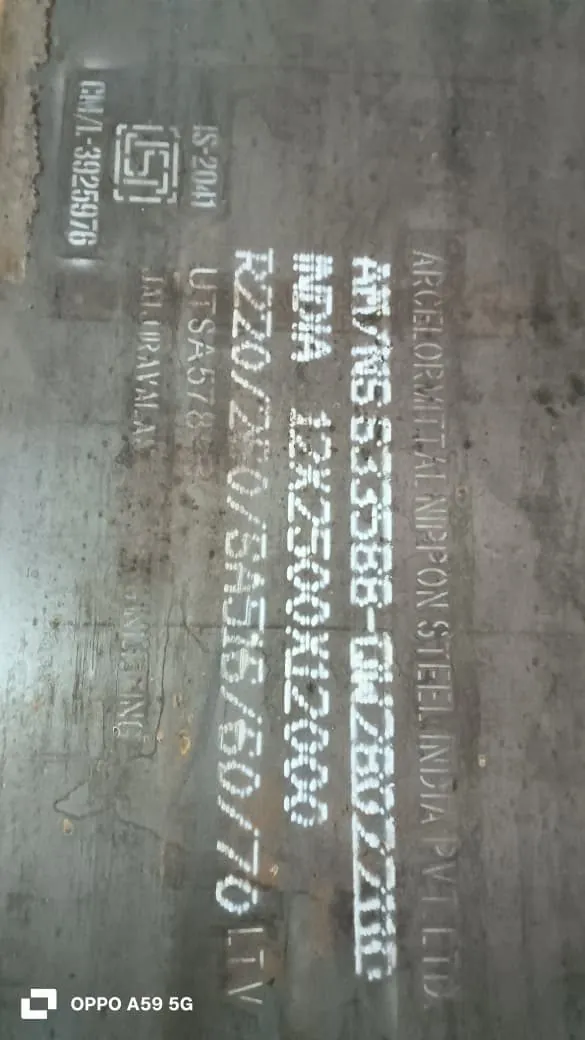
A516 Grade 70 is the default pressure-vessel-quality (PVQ) steel for ASME Section VIII vessels, boilers, storage tanks and separators. But "A516 Gr 70" alone is not a buyable line. Specifying it correctly is four linked decisions, grade, thickness, impact toughness, and heat-treat condition, plus the documentation that lets a mill roll and certify exactly what the code needs. Get the clause right and the plate becomes sourceable; leave it vague and you either over-pay or receive plate your vessel cannot use.
What you'll decide: goal and key takeaways
Specifying A516 is one unambiguous line on the PO. Getting there means settling a few things first:
Grade (strength). Gr 55, 60, 65, and 70 are tensile-strength classes. Gr 70 is the default. Gr 60 is the lower-strength sibling and bends more easily.
Thickness and ASTM A20 tolerance. Section thickness comes straight from your stress calculation. ASTM A20 is what governs dimensional tolerances and the general ordering requirements for PV plate.
Impact toughness. You'll need a Charpy V-notch requirement at your MDMT, the minimum design metal temperature. This is usually the thing that forces heat treatment.
Heat-treat condition. As-rolled, normalized, or normalized-and-tempered (N+T). A low MDMT paired with heavy section pushes you toward normalized.
Documentation. That means the ASTM A20 supplementary requirements (S4, S5, S8, S20, HIC), plus an EN 10204 3.1 or 3.2 mill test certificate to back it all up.
Before you start: prerequisites and inputs you need
A516 conforms to ASTM A516 / ASME SA-516. The ASTM A20 general requirements (SA-20) supply the ordering rules for pressure-vessel plate. Before you write the grade line, gather the vessel's design inputs first. The clause sits downstream of those inputs; it doesn't stand apart from them.
- Design code, almost always ASME Boiler & Pressure Vessel Code, Section VIII, Division 1.
- MAWP and design pressure, these, with diameter and allowable stress, set the required plate thickness.
- MDMT, the minimum design metal temperature. This figure decides whether impact testing, and therefore normalizing, is mandatory.
- Plate thickness, taken from the stress calculation. See choose plate thickness.
- Service, sweet or sour (H₂S-bearing), which decides whether you need HIC-resistant plate.
- PWHT intent, whether the fabrication will see post-weld heat treatment, which can soften a Gr 70 base plate.
With those in hand, the seven steps below turn the vessel's physics into a specification string you can actually buy against.
Step 1: Choose the A516 grade (strength: 55 / 60 / 65 / 70)
A516 grades mark tensile-strength classes, not fundamentally different chemistries, the "Gr N" number is the tensile class. Every one of them is a killed, fine-grain-practice carbon-manganese-silicon steel. Pick whichever grade meets your allowable-stress requirement at the design temperature. That's the real decision: the tensile and impact properties behind each class.
| Grade | Tensile strength | Min yield strength | Typical use |
|---|---|---|---|
| A516 Gr 55 | 55–75 ksi (380–515 MPa) | ~30 ksi (205 MPa) | Light-duty vessels |
| A516 Gr 60 | 60–80 ksi (415–550 MPa) | ~32 ksi (220 MPa) | Lower strength, easier forming |
| A516 Gr 65 | 65–85 ksi (450–585 MPa) | ~35 ksi (240 MPa) | Intermediate |
| A516 Gr 70 | 70–90 ksi (485–620 MPa) | ~38 ksi (260 MPa) | Default pressure-vessel plate |
Why Grade 70 is the default
Gr 70 sits at the top of the family for allowable stress, so it handles the most pressure per unit of wall thickness. That's why most ASME Section VIII vessels, boilers and separators get drawn in it. When you're ready to buy, the deep datasheet and stock condition live on the A516 Grade 70 grade hub. Order A516 Grade 70 plate in the certified condition there. Step down to A516 Grade 60 only when a thinner, more formable, lower-strength plate suits the duty better.
Indicative Gr 70 chemistry (check the mill test certificate for the exact ladle analysis per thickness):
| Element | Indicative limit (A516 Gr 70) | Role |
|---|---|---|
| Carbon (C) | ≤ ~0.27% (thickness-dependent) | Strength; kept controlled for weldability |
| Manganese (Mn) | ~0.85–1.20% | Strength, toughness |
| Silicon (Si) | 0.15–0.40% | Deoxidation (killed steel) |
| Phosphorus (P) | ≤ 0.025% | Residual, kept low for toughness |
| Sulfur (S) | ≤ 0.025% | Residual, low for toughness/HIC |
A516 is a killed steel, made to fine-grain practice, and that choice isn't incidental. It's precisely what lets the material hold notch toughness, and that toughness is the metallurgy behind Step 3 and Step 4.
Step 2: Set the plate thickness and call the A20 tolerances
ASTM A20 (or SA-20) governs the general requirements for the plate once your stress calculation fixes the nominal section: dimensional and thickness tolerances, flatness, edge condition, test-specimen location, and the supplementary-requirement menu. Always cite the A20 or SA-20 reference together with the A516 grade, so the mill applies the correct general requirements.
ASTM A20 general requirements and thickness tolerance
Thickness isn't just a stress-check variable. It drives both the mechanical minimums you're allowed and whether Step 4's normalizing trigger kicks in. Heavier sections cool more slowly after rolling and lose toughness as a result, so they're far more likely to need normalizing. Put the plate thickness on the inquiry up front, since both the mechanical acceptance criteria and the heat-treat requirement change with section size. Once you know the plate size, turn it into a shipping weight for the RFQ using the guide to calculate plate weight.
Step 3: Define the impact-toughness requirement (Charpy V-notch at MDMT)
This vessel can run cold, and buyers under-specify this decision more than any other. The code requires notch toughness proof for that case: a Charpy V-notch impact test at or below the design temperature. Skip it and you get as-rolled plate with no toughness data, and that plate has no place in a low-temperature vessel.
What MDMT means and where it comes from (UCS-66)
MDMT, or minimum design metal temperature, is the coldest metal temperature a vessel has to handle while still carrying its full load. ASME Section VIII Div 1 covers impact testing under UG-84, and the UCS-66 curves tell you whether a given grade and thickness is exempt at a given MDMT. A516 usually falls on Curve B in the as-rolled condition. Normalize it, though, and it jumps to the tougher Curve D. That shift can raise the exemption temperature and settle the question of whether testing is even required.
Charpy acceptance and test temperature
When impact testing applies, spell out the acceptance criteria plainly. A typical PV requirement calls for 27 J (20 ft-lb) average across three transverse specimens, tested at the stated temperature, which should be the MDMT or lower. Always write the test temperature as a number; never leave it as "ambient." For the methods behind these minimums, and how they get measured and reported, see tensile and impact properties.
Step 4: Decide heat treatment: as-rolled, normalized, or N+T
A516 Gr 70 gets its boost in low-temperature impact resistance through normalizing, which is the central heat-treat decision in the specification. Normalizing refines the ferrite-pearlite grain structure, and that's what raises toughness at low temperatures. For the underlying metallurgy, see normalizing PVQ plate.
When normalizing is mandatory (thickness + low-temperature MDMT)
Two things push you from as-rolled to normalized: a heavy section, or a low MDMT. The table below spells out the decision logic, so map it to your own UCS-66 result rather than to a rule of thumb.
| Thickness band | MDMT | Typical required condition |
|---|---|---|
| Thin / moderate (≲ 1.5 in) | Ambient / warm | As-rolled often acceptable per UCS-66 exemption |
| Any | Low / sub-zero | Normalized + Charpy at MDMT |
| Heavy (≳ 1.5 in) | Any | Commonly normalized to restore toughness |
What normalizing does to grain size and toughness
Normalizing reheats the plate above the upper transformation temperature, then air-cools it, turning a coarse as-rolled grain into a fine, uniform ferrite-pearlite structure. Finer grain lowers the ductile-to-brittle transition temperature. That means better Charpy energy at cold MDMT. When you need that benefit, order normalized A516 plate in the certified condition rather than buying as-rolled plate and heat-treating it yourself later. One thing to watch: heavy PWHT can soften a Gr 70 base plate, so factor the fabrication thermal history in before you set the acceptance criteria.
Step 5: Specify sour / HIC service if applicable
If the vessel sees wet H₂S in refinery, sour-gas or oil & gas separators, plain Gr 70 won't cut it. You need the HIC-resistant variant. It resists hydrogen-induced cracking, and it's supplied against a HIC test.
HIC-resistant A516 (NACE TM0284) and NACE MR0175
Specify A516 Gr 70 that requires a HIC test per NACE TM0284 and conforms to NACE MR0175 / ISO 15156 for sour service. This forces tighter sulfur and inclusion-shape control at the mill; you can't bolt it onto ordinary plate after the fact. For background, read up on sour service / NACE MR0175. Then order the HIC-resistant A516 plate in the qualified condition.
Step 6: Call the ASTM A20 supplementary requirements
ASTM A20 / SA-20 lays out optional supplementary requirements that you call up by code. These are the mechanism for attaching impact, NDT and cleanliness clauses to the order. Call up only what the design actually needs, each one tacks on cost and lead time.
| Supplement | What it adds | When to call it |
|---|---|---|
| S4 | Additional tension test (per plate / heat) | When extra mechanical assurance is required |
| S5 | Charpy V-notch impact test | Whenever MDMT requires impact testing (Step 3) |
| S8 | Ultrasonic examination (UT) | Heavy sections / critical vessels, internal soundness |
| S20 | Vacuum-degassed steel | Cleaner steel for toughness / HIC service |
| HIC (TM0284-type) | Hydrogen-induced-cracking test | Sour / wet-H₂S service (Step 5) |
| Grain size / heat-treat condition | Fine-grain practice; as-rolled vs normalized stated | Always state the heat-treat condition explicitly |
Step 7: Specify documentation and traceability (EN 10204 3.1 / 3.2 MTC)
The spec is only as good as its proof. Require an EN 10204 3.1/3.2 mill test certificate recording the heat analysis, mechanical results, Charpy values at the stated temperature, heat-treat condition and any HIC/UT results, tied to the heat and plate number for full heat / cast traceability. Learn to read a mill test certificate so you can verify it on receiving, and see MTC, NDT & PMI testing for how the test chain hangs together. A 3.1 certificate is issued by the manufacturer's own competent authority; a 3.2 adds an independent third-party inspector, typically required for sour or critical service.
Common pitfalls and warnings
No MDMT means no impact clause. Skip stating the Minimum Design Metal Temperature and the mill skips Charpy testing too, your cold vessel ends up with untested plate.
Then there's the wrong normalizing trigger. Some assume as-rolled plate is fine at low temperature, while others call for normalizing when UCS-66 already grants an exemption, paying for heat treatment they never needed.
"SA516" with no grade is probably the most common incomplete line we see on incoming POs. Writing "SA516" by itself, with no grade, no ASTM A20 reference, and no condition specified, leaves far too much open to interpretation.
PWHT can quietly soften Gr 70. Ignore the fabrication thermal history and post-weld heat treatment will pull the base-plate properties below the design allowable.
Ordering plate that can't take HIC is another trap. Specifying plain Gr 70 for sour duty won't work, since HIC resistance comes down to mill-side cleanliness, a decision that can't be bolted on after the fact.
Finally, don't miss the A20 reference. Leave out ASTM A20 / SA-20 and the general requirements, tolerances, and supplement menu all stay undefined.
Verify before you release the PO: the specification checklist
Run the line you're about to issue against this checklist. Every box needs an answer, not a guess.
- Grade, Gr 55 / 60 / 65 / 70 stated.
- Thickness + A20 tolerance, section fixed; ASTM A20 / SA-20 referenced.
- MDMT + Charpy acceptance, test temperature and energy (e.g. 27 J / 20 ft-lb avg) stated where required.
- Heat-treat condition, as-rolled / normalized / N+T stated explicitly.
- Sour / HIC, HIC per NACE TM0284 + NACE MR0175 called if wet-H₂S service.
- Supplements, S4 / S5 / S8 / S20 / HIC invoked as the design needs.
- MTC level, EN 10204 3.1 or 3.2.
- Standard string, the full call-out, e.g. `ASME SA-516 Gr 70 + SA-20`.
A copy-ready A516 specification line
For a standard ASME Section VIII vessel, a complete line reads:
``` ASME SA-516 Gr 70, normalized, to ASTM A20, Charpy V-notch per UG-84 at [MDMT], EN 10204 3.1 MTC ```
Worked example #2: low-temperature / sour variant
For a cold, sour-service vessel, tighten it to:
``` ASME SA-516 Gr 70 N, HIC-tested per NACE TM0284 (NACE MR0175 / ISO 15156), ASTM A20 S5 + S8, EN 10204 3.2 MTC ```
Replace `[MDMT]` with the actual minimum design metal temperature, expressed as a number. These two strings come straight out of the seven steps above. Paste either one into an inquiry, and the condition is unambiguous.
Related grades and when to switch
A516 Gr 70 is the default, but it isn't the only answer. Know when to step sideways or up, and when carbon steel is the wrong family entirely. For the broader picture, see carbon vs stainless vs alloy steel.
A516 Grade 60 (lower strength / forming)
Drop to A516 Grade 60 when you don't need Gr 70's allowable and want easier cold forming of heads or shells, it's the lower-tensile-class sibling. For background on the whole family, see boiler-quality plate.
SA387 Cr-Mo (elevated temperature)
A516 handles moderate temperatures just fine. Push past roughly 400 °C, though, and creep and oxidation start to dominate, so A516 gets replaced by chrome-moly plate. For elevated-temperature reactors and hydroprocessing vessels common in petrochemical service, step up to SA387 chrome-moly plate.
When a CRA replaces carbon for corrosion
A516 is a structural grade, not a corrosion-resistant one. When the process fluid eats carbon steel, strong chlorides, fertilizer / acid-service vessels, aggressive mixed acids, the answer is a corrosion-resistant alloy (stainless, 904L, Incoloy 825) or a clad or lined vessel. A thicker carbon plate won't fix that problem.
FAQ
Is A516 the same as SA516?
What does the grade number in A516 mean?
Does A516 Grade 70 need to be normalized?
When do I need Charpy impact testing on A516?
How do I specify A516 for sour service?
What mill certificate should I ask for with A516 plate?
Send us the spec line: we quote the exact grade, thickness, heat-treat and MTC
Nandini Steel can quote your exact plate once you send the finished specification string: grade, thickness, MDMT and Charpy acceptance, heat-treat condition, any NACE/HIC clause, A20 supplements and MTC level. The company is an ISO 9001:2015-certified stockist and supplier, established in 2003. More than 20 years in the business, 307+ projects completed, 260+ clients served, and shipments to 36+ export countries. It supplies A516 Gr 70, Grade 60, normalized and HIC-resistant plate for pressure-vessel fabrication. Everything sits ex-stock for immediate dispatch. The plate itself comes from genuine mill stock rolled by named producers such as POSCO, Nippon Steel and JFE, and every order ships with an EN 10204 3.1/3.2 mill test certificate. Export buyers should also check the import documentation & Incoterms guide. Send an RFQ for live pricing.
Contact us at +91 22 43404600, or on WhatsApp at +91 99202 09184, or by email at reachus@nandinisteel.com. You'll find us at 25, Dreamland Building, 601, 6th Floor, Mama Parmanand Marg, Charni Road, Opera House, Girgaon, Mumbai, Maharashtra 400004, India. Our GSTIN is 27ADJPA7240C1Z0.