
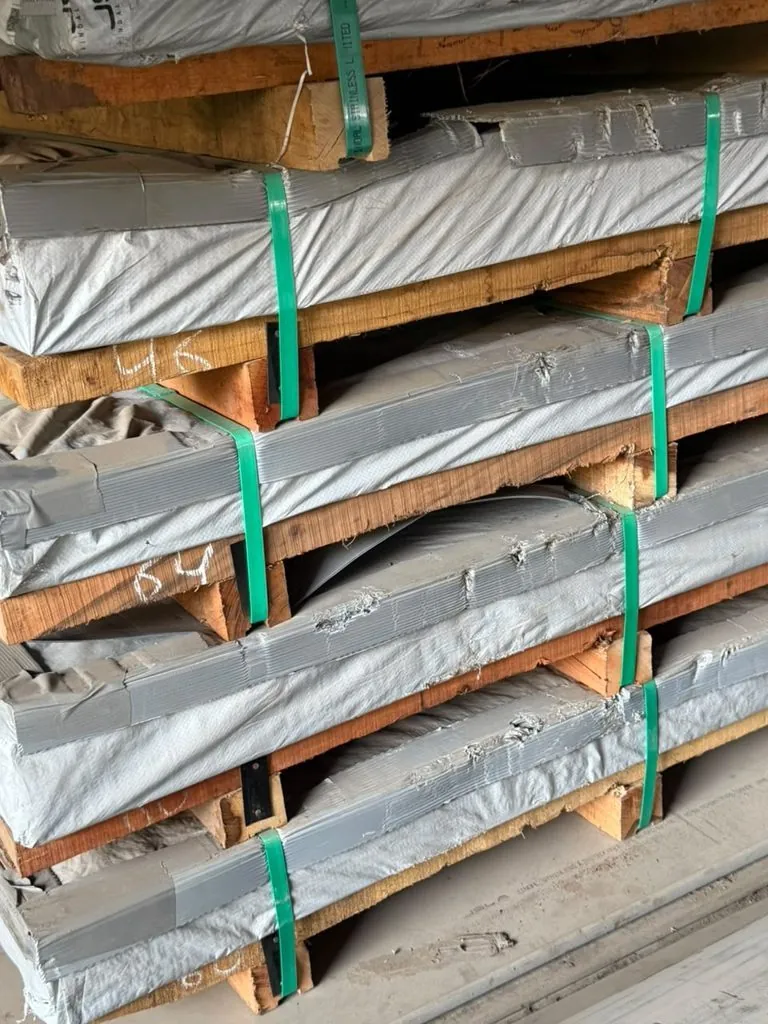
Key takeaways
- "Boiler quality" is not a grade, it is a quality discipline. It describes how a plate is made and tested, not a single chemistry.
- Killed and fine-grain. The steel is fully deoxidised (killed) and made to fine-grain practice for weldability and notch toughness.
- Made and tested to a pressure-vessel standard. The workhorse is ASTM A516 / ASME SA-516, written under the ASTM A20 general requirements for plate.
- Impact-tested, and normalized when toughness demands it. Charpy V-notch impact testing proves notch toughness; normalizing refines grain for low-temperature service.
- Proven by paperwork. A plate is boiler-quality only when an EN 10204 3.1 mill test certificate reports the chemistry, tensile, and impact results for the actual heat.
What is boiler quality plate? (PVQ defined)
Boiler quality plate is carbon or low-alloy steel plate made and certified for pressure-containing equipment, boilers, steam drums, and pressure vessels. People use the term interchangeably with pressure vessel quality (PVQ) plate. Both describe plate built to a recognized pressure-vessel specification, with deoxidation, grain practice, mechanical minima, and testing that an ordinary commercial plate just doesn't guarantee.
The discipline is what defines it, not the chemistry. Two plates can share identical nominal carbon content, yet only one earns the label "boiler quality": the one that's killed, fine-grained, impact-tested, and certified to a pressure-vessel standard. That's why the concept sits under the broader family of pressure vessel steel rather than tied to any single grade.
Boiler quality vs commercial / structural quality plate
The practical difference between boiler-quality and commercial/structural plate shows up in five places: deoxidation, grain practice, impact testing, the governing standard, and the mill certificate supplied.
| Attribute | Boiler quality (PVQ) plate | Commercial / structural plate |
|---|---|---|
| Deoxidation practice | Fully killed (fully deoxidised) | Often rimmed or semi-killed |
| Grain practice | Fine-grain practice (grain refinement) | Typically coarse / as-made |
| Notch toughness | Charpy V-notch impact testing available / required | Usually not impact-tested |
| Governing standard | ASTM A516 / ASME SA-516 under ASTM A20 | Structural plate specs (e.g. general structural grades) |
| Typical MTC level | EN 10204 3.1 / 3.2 (independent test results) | EN 10204 2.1 / 2.2 (statement of compliance) |
"BQ", "PVQ", "IS 2002": the naming
BQ and PVQ mean roughly the same thing, even though the terminology shifts from one market to the next. Boiler quality, boiler plate, PV plate, pressure vessel quality - a drawing might use any of these, or just cite the spec outright. India has long worked from IS 2002 for boiler-plate grades, but the specs most people reach for worldwide are the ASTM/ASME ones. So when an inquiry says "boiler quality," take it to mean this: supply plate to a pressure-vessel specification, with impact testing and a 3.1 certificate. Then go back and pin down the exact grade, the heat-treat condition, and the test temperature. If a drawing names a grade under a national system, the grade cross-reference will map UNS, Werkstoff and JIS designations over to their ASTM/ASME equivalents.
What makes a plate "boiler quality"? (the mechanism)
Four things in the metallurgy set PVQ plate apart from ordinary plate. Put together, they're what gives a pressure vessel the predictable strength and the resistance to brittle fracture it needs.
Killed, fully-deoxidised steel
Boiler-quality plate is killed steel: deoxidised, typically with silicon and aluminum, so dissolved oxygen doesn't form gas porosity as the steel solidifies. What you get is a sound, homogeneous plate with consistent properties through the section. That's the baseline any pressure part needs.
Fine-grain practice (grain refinement → toughness)
Fine-grain practice refines the microstructure. A finer grain raises notch toughness and improves weldability. Grain refinement is the metallurgical lever behind a plate's ability to resist brittle fracture, and that's why fine-grain steel shows up in pressure-vessel specifications. See carbon and alloying elements for how composition drives this.
Notch toughness & Charpy V-notch impact testing
A pressure vessel can't fail in a brittle manner, which is why boiler-quality plate gets validated through the Charpy V-notch impact test. That test measures the energy a sample absorbs at a defined impact test temperature. The temperature you specify matters quite a bit: a plate certified tough at 0 °C hasn't been proven for service at −45 °C. Anyone wanting the broader picture on strength and toughness can check out notch toughness and impact testing.
Clean chemistry & tight sulfur/phosphorus
Lower carbon equivalent (CE), along with tight sulfur and phosphorus, improves weldability and cuts down on the risk of cracking. Low sulfur, paired with inclusion-shape control, is also what resistance to hydrogen-induced cracking (HIC) in wet H₂S service is built on. That's why sour-service PVQ plate exists as its own variant, held to tighter controls than the rest.
The factors that influence boiler-plate quality
Chemistry (carbon equivalent, killed / fine-grain)
Chemistry sets the ceiling on everything else. A killed, fine-grain composition with controlled carbon equivalent gives you weldable plate that can be heat-treated to the toughness you need. For more on how each element contributes, see carbon and alloying elements. For where carbon PVQ stands against stainless and alloy steel, see carbon vs stainless vs alloy steel.
Heat treatment: as-rolled vs normalized vs N+T
Supply condition changes the toughness you get from the same chemistry:
| Condition | Grain / microstructure | Low-temperature impact toughness | Where it applies |
|---|---|---|---|
| As-rolled | As-rolled grain | Baseline; may not meet low-temp Charpy | Ambient-temperature vessels, thinner sections |
| Normalized | Refined, uniform grain | Markedly improved, the usual low-temp route | Low-temperature and thicker-section vessels |
| Normalized & tempered (N+T) | Refined grain + tempered | High toughness with controlled strength | Demanding / heavier sections |
Normalizing is the standard route to low-temperature notch toughness. The detail lives in normalizing of PVQ plate.
Thickness & its effect on toughness and heat-treatment
Section thickness matters because it drives both the mechanical minimums and whether heat treatment is called for. Thicker plate cools more slowly, so it more often needs normalizing to hit the same impact requirement, and some property minimums drop in heavier gauges. State the plate thickness up front, it changes the grade decision and the heat-treat condition alike. See choosing plate thickness.
Sour-service / HIC requirement when wet H₂S is present
Where plate will see wet hydrogen sulfide (sour service), plain A516 Gr 70 won't do. You need to specify the HIC-tested variant: it resists hydrogen-induced cracking and gets tested per NACE TM0284, conforming to NACE MR0175 / ISO 15156 for sour service. That's a different purchase from plain Gr 70, and it has to be called out on the order.
Which grades are boiler quality plate?
"Boiler quality" comes down to a short list of carbon and Cr-Mo grades. A516 is the carbon workhorse. A515 is its coarse-grain sibling. SA387 handles elevated temperature. Stainless or clad plate steps in once corrosion, rather than pressure, becomes the driver.
| Grade | Family | Tensile | Yield (min) | Typical use | Standard |
|---|---|---|---|---|---|
| A516 Gr 60 | PVQ carbon steel | 415–550 MPa (60–80 ksi) | 220 MPa (32 ksi) | Moderate-strength vessels, tanks | ASTM A516 / ASME SA-516 |
| A516 Gr 70 | PVQ carbon steel | 485–620 MPa (70–90 ksi) | 260 MPa (38 ksi) | The workhorse PVQ plate, boilers, vessels, separators | ASTM A516 / ASME SA-516 |
| A515 Gr 70 | PVQ carbon steel (coarse-grain) | 485–620 MPa (70–90 ksi) | 260 MPa (38 ksi) | Higher-temperature, non-impact service | ASTM A515 |
| SA387 Cr-Mo (Gr 11/12/22) | Cr-Mo alloy steel | Grade/class dependent | Grade/class dependent | Elevated-temperature pressure parts | ASTM A387 / ASME SA-387 |
| Stainless / clad (e.g. 904L, Incoloy 825) | Austenitic / Ni-alloy | Grade dependent | Grade dependent | When corrosion is the driver | ASTM A240 / B424 |
ASTM A516 / ASME SA-516: the workhorse carbon PVQ
A516 belongs to the PVQ carbon steel family and conforms to ASME SA-516 / ASTM A516 (under ASTM A20). Plate is the primary form it's available as, and it shows up in pressure vessels, boilers, storage tanks, and separators. Grade 70 is the default choice when you need a stronger strength-to-toughness balance. For section ranges and ordering detail, check the A516 Gr 70 boiler quality plate leaf. If you're dealing with low-temperature service, the normalized A516 plate route is the one to look at. And for sour service, there's HIC-tested A516 for sour service.
A516 Gr 60 vs Gr 70
Grade number tracks strength. The minima below are per ASTM A516:
| Property | A516 Gr 60 | A516 Gr 70 |
|---|---|---|
| Tensile strength | 415–550 MPa (60–80 ksi) | 485–620 MPa (70–90 ksi) |
| Yield strength (0.2%, min) | 220 MPa (32 ksi) | 260 MPa (38 ksi) |
| Elongation | Specified minimum (gauge dependent) | Specified minimum (gauge dependent) |
| Charpy V-notch impact | Supplementary, specify temperature | Supplementary, specify temperature |
A515 (coarse-grain sibling) & where A516 is preferred
A515 is coarse-grain, silicon-killed, built for intermediate- and higher-temperature service. A516 uses a fine-grain practice instead, and it's the one you want wherever low-temperature notch toughness matters. That covers most modern vessel work. No surprise, then, that A516 Gr 70 has become the default PVQ carbon plate.
SA387 Cr-Mo alloy plate for elevated temperature
Where carbon PVQ runs out of temperature, SA387 takes over, a Cr-Mo alloy steel used in elevated-temperature pressure parts, including hydrogen and high-temperature service. The chromium-molybdenum additions give it creep and hydrogen resistance that carbon steel simply doesn't have. See SA387 Cr-Mo alloy plate.
Stainless & clad options when corrosion is the driver
When the controlling requirement is corrosion rather than pressure, boiler-quality carbon plate gets replaced or clad with corrosion-resistant grades. Take 904L plate for sulfuric-acid and high-chloride duty, for instance, or Incoloy 825 plate for sour and mixed-acid service.
Standards & specifications behind boiler quality plate
ASTM A516 / ASME SA-516 product spec
The product specification ASTM A516 / ASME SA-516 defines the chemistry, mechanical minima, and testing for fine-grain carbon PVQ plate across grades 55/60/65/70. It is the specification that makes a plate "boiler quality" in the first place.
ASTM A20 general requirements (the umbrella)
A516 doesn't stand on its own. It's written under ASTM A20, the general-requirements specification for steel plate used in pressure vessels. A20 lays out the common rules that every PV plate specification inherits: sampling, tolerances, marking, certification, and supplementary tests.
ASME BPVC Section II / VIII context (what "ASME SA-" means)
The "ASME SA-" prefix means the material has been adopted into the ASME Boiler and Pressure Vessel Code. SA-516 is simply A516 as it appears in ASME BPVC Section II, intended for Code vessels built to Section VIII. Specify SA-516 rather than A516, and you're signaling that the plate is meant for Code construction.
Testing, inspection & the mill test certificate
Boiler quality only counts once it's written down. A PVQ plate gets tested for chemistry and tensile properties, plus Charpy V-notch impact when the spec calls for it. Ultrasonic testing (lamination check) confirms soundness, and HIC testing per NACE TM0284 comes into play for sour service. Every result gets reported heat by heat, on an EN 10204 3.1 / 3.2 mill test certificate that ties back to the actual cast.
Nandini Steel's traceability is the moat here: testing, MTC and NDT and material traceability walk through how the heat number stamped on the plate matches the certificate. A common problem in the field is commercial plate sold as "boiler quality" with no impact testing and no 3.1 certificate to back it up, the paperwork is exactly what separates the two. Nandini Steel supplies genuine mill plate from nameable mills (Aperam, Outokumpu, Jindal, POSCO, Nippon Steel, JFE), and every order comes with an EN 10204 3.1/3.2 mill test certificate. Need help reading one? See how to read a mill test certificate.
How boiler quality plate is used (examples by industry)
Boiler-quality plate forms the structural skin of pressure-containing equipment across the process industries.
- Pressure vessels, shells, heads, and drums built to ASME Section VIII.
- Boilers and steam drums, the original use case, where notch toughness under pressure and temperature matters most.
- Storage tanks and separators, large-diameter shells where weldability and consistent plate quality matter.
- Heat exchangers and reactors, in oil & gas, petrochemical, and chemical processing service, often as the HIC-tested variant for sour duty.
How to order boiler quality plate (and prove it is)
To receive plate that's genuinely boiler-quality, and not just called so, specify these in order on the inquiry and the PO:
- Grade, e.g. A516 Gr 70 (or Gr 60, SA387 Gr 11/12/22).
- Specification, ASTM A516 vs ASME SA-516 (state SA- for Code vessels), under ASTM A20.
- Heat-treatment condition, as-rolled, normalized, or normalized & tempered.
- Impact test temperature, the Charpy V-notch test temperature your design requires.
- HIC / sour service, call out the NACE TM0284 HIC-tested variant if wet H₂S is present.
- MTC level, EN 10204 3.1 (or 3.2 with third-party witness).
- Thickness and size, state section thickness up front, since minima and heat-treatment needs vary with it.
For the full worked method, check out our guides on how to specify A516 for a vessel and choosing plate thickness. Need to estimate mass for a given size? The plate weight calculator handles that. And if plate, sheet, and coil terminology still trips you up, sheet vs plate vs coil sorts it out.
Nandini Steel keeps boiler-quality grades ex-stock for immediate dispatch, and every piece ships with its EN 10204 3.1/3.2 mill test certificate and full heat traceability. Request a quotation for A516 / PVQ plate, give the grade, condition, impact temperature, HIC, and thickness, and we'll get you live pricing.