
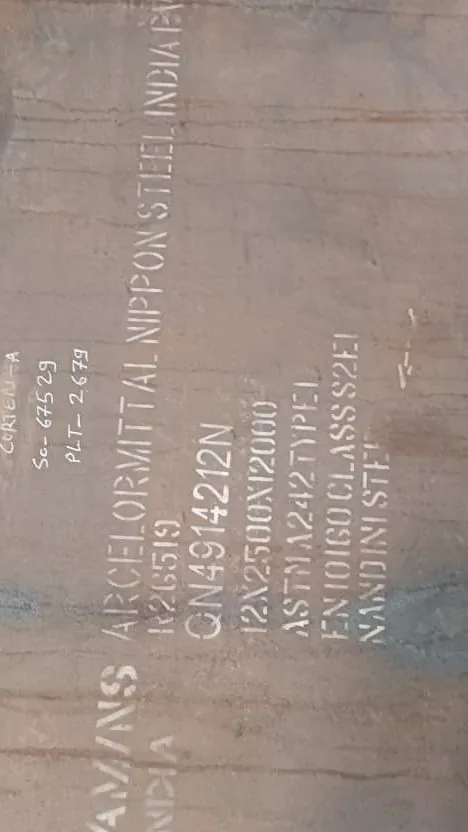
What ASME SA-516 is: the code edition of A516
ASME SA-516 is published in the ASME Boiler and Pressure Vessel Code, Section II, Part A (ferrous material specifications). It adopts ASTM A516/A516M word for word: the same four strength grades, the same chemistry tables, the same mechanical minimums. The only thing that changes is the prefix. A516 becomes SA-516, and that SA- designation is what the rest of the BPVC, Section VIII Division 1 in particular, refers to when it lists acceptable plate materials for a stamped vessel.
So when a design engineer builds a code vessel, the material appears on the drawing and the data report as SA-516, not A516. The plate is the same killed, fine-grain carbon steel either way. The prefix tells the Authorized Inspector that the material is being bought to the ASME-adopted rule set, which is what the code stamp requires. For the metric naming, SA-516M carries the SI values, exactly as A516M does on the ASTM side.
ASME SA-516 vs ASTM A516: which do I specify?
Specify SA-516 when the plate goes into an ASME code-stamped pressure vessel or boiler, because Section VIII and the vessel data report reference the SA- designation. Specify A516 for non-code fabrication, structural pressure parts outside BPVC jurisdiction, or where a customer spec calls out the ASTM number. "SA516-70" and "A516-70" describe one and the same plate. The dual-marked certificate most mills issue satisfies both at once. For the ASTM-side detail, see the ASTM A516 specification, and for the general plate rules that sit above both, see ASTM A20.
| Question | ASME SA-516 | ASTM A516 |
|---|---|---|
| Published in | ASME BPVC Section II, Part A | ASTM book of standards |
| Referenced by | ASME Section VIII, I (code vessels) | general / customer specs |
| Chemistry & mechanicals | identical to A516 | identical to SA-516 |
| Use it for | code-stamped vessels and boilers | non-code fabrication |
| Metric form | SA-516M | A516M |
Grades covered: 55, 60, 65 and 70
SA-516 lists four grades. The two-digit number is the minimum tensile strength in ksi, so Grade 70 means a minimum ultimate tensile of 70 ksi. It has nothing to do with thickness or carbon content. As the grade number climbs, strength rises and the carbon-manganese chemistry gets slightly richer, which nudges the carbon equivalent up and asks a little more of your welding procedure. The tensile and yield minimums below are the governing acceptance values; confirm them against the current SA-516/A20 edition at order time.
| Grade | Tensile strength | Min. yield (0.2%) | Elongation (typ.) |
|---|---|---|---|
| SA-516 Gr 55 | 380–515 MPa (55–75 ksi) | ≥205 MPa (30 ksi) | ≈27% in 50 mm |
| SA-516 Gr 60 | 415–550 MPa (60–80 ksi) | ≥220 MPa (32 ksi) | ≈25% in 50 mm |
| SA-516 Gr 65 | 450–585 MPa (65–85 ksi) | ≥240 MPa (35 ksi) | ≈23% in 50 mm |
| SA-516 Gr 70 | 485–620 MPa (70–90 ksi) | ≥260 MPa (38 ksi) | ≈21% in 50 mm |
Which SA-516 grade should I specify?
Grade 70 is the workhorse of code pressure-vessel plate, and it is the default for most vessels, boilers and storage tanks because it gives the best strength-to-thickness ratio, so the thinnest allowable shell. Grade 60 comes in where a lower design stress, easier weldability, or an existing code calculation calls for it. Order the lowest grade that satisfies the design stress. Stepping up adds carbon, raises the carbon equivalent, and can tighten your preheat and welding controls.
Chemical requirements
SA-516 plate is killed, meaning fully deoxidized, and made to fine-grain practice. That is what gives it the even, low-temperature-capable microstructure a pressure vessel needs. The chemistry depends on both grade and thickness: carbon and manganese ceilings climb as section thickness increases under the SA-516/A20 tables, so a 50 mm plate is allowed richer chemistry than a 12 mm plate of the same grade. Treat the row below as the governing rule, not a frozen specification.
| Element | Limit, SA-516 Gr 70 (≤12.5 mm basis, wt%) | Note |
|---|---|---|
| Carbon (C) | ≤0.27 (rising to ~0.31 at higher thickness) | killed steel |
| Manganese (Mn) | 0.85–1.20 (wider band at higher thickness) | fine-grain practice |
| Phosphorus (P) | ≤0.025 | residual limit |
| Sulfur (S) | ≤0.025 (lower for HIC service) | low S aids toughness and HIC resistance |
| Silicon (Si) | 0.15–0.40 | deoxidation |
Because carbon and manganese drive the carbon equivalent, SA-516's chemistry is really a weldability story. A controlled carbon equivalent is why it welds predictably under common fabrication practice. For how carbon content separates SA-516 from stainless and Cr-Mo grades, see carbon vs stainless vs alloy steel.
Mechanical requirements
The mechanical acceptance values, the tensile range, minimum yield and minimum elongation, come from the per-grade table in SA-516, applied through the tension-test rules of ASTM A20: orientation, specimen size, and the elongation basis by thickness. Tensile is given as a range, 485–620 MPa for Grade 70, rather than a single floor, so both under- and over-strength heats get caught. Yield is a floor: at least 260 MPa (38 ksi) for Grade 70. Each heat is checked against these values and the results land on the mill test certificate.
Heat treatment and impact toughness: normalizing
SA-516 ships as-rolled by default. It can be, and often must be, normalized: reheated above the upper critical temperature and air-cooled to refine the grain and lift notch toughness for colder service. Under A20/SA-516, normalizing turns mandatory past certain section thicknesses, and it is required as a matter of course whenever the plate is impact-tested for a cold design temperature. For the mechanism and the thickness logic, see normalizing of PVQ plate.
The most common buyer error here is ordering as-rolled plate for a low-temperature vessel, then discovering at inspection that it cannot meet the Charpy requirement. If the design metal temperature falls below ambient, specify normalized plate with Charpy testing at the design temperature from the start. Notch toughness cannot be retrofitted. State the plate thickness on the inquiry too, since both the mechanical minimums and the normalizing trigger shift with section.
Charpy V-notch impact testing
Low-temperature capability is proven through Charpy V-notch impact testing, invoked as a supplementary requirement under A20. You state the test temperature (for example −20 °C or −46 °C) and the minimum absorbed energy; the plate then qualifies for service down to that temperature. This is the heart of SA-516's lower-temperature claim. The grade number fixes strength, but it is the normalizing-plus-Charpy call-out that fixes toughness. Normalized fine-grain SA-516 is the standard route to a verified −46 °C vessel plate. For the full background, see pressure-vessel steel explained.
Supplementary requirements and sour-service (HIC) options
SA-516, read with A20, is a menu as much as a specification: you bolt on supplementary requirements whenever the job calls for them. A few matter most for code vessels.
- Vacuum degassing for cleaner steel and improved toughness and HIC performance.
- Ultrasonic examination (UT) to SA578 (or A435/A577) for internal soundness, commonly called on thick or critical plate.
- Simulated post-weld heat treatment (PWHT), where test coupons run through the vessel's actual PWHT cycle so reported properties reflect the plate in its final condition.
- HIC testing per NACE TM0284 for resistance to hydrogen-induced cracking in wet H₂S, sour service.
For plate exposed to wet H₂S (sour service), plain Grade 70 is not enough. Specify the HIC-tested variant, evaluated per NACE TM0284 and supplied to meet NACE MR0175 / ISO 15156 where that route is called out. This is a distinct plate, with tighter sulfur and inclusion control, and must be ordered as such. See NACE MR0175 / ISO 15156 and the detail on sour service and HIC. The typical failure we see is a wet-H₂S separator shell ordered as standard Gr 70 and rejected at review because no HIC report accompanies the heat. Call out HIC on the purchase order, not after rolling.
| Supplementary | Reference | What it adds, when to call it out |
|---|---|---|
| Vacuum degassing | A20 S-series | cleaner steel; low-temp and HIC service |
| Charpy V-notch impact | A20 supplementary | qualifies plate for a stated low temperature |
| Ultrasonic examination (UT) | SA578 / A435 / A577 | internal soundness; thick or critical plate |
| HIC test | NACE TM0284 | wet-H₂S / sour service resistance |
| Simulated PWHT | A20 | properties reported in post-weld condition |
Forms covered
SA-516 is a plate specification. Plate is the primary and canonical form in which the material is produced and certified. Thinner material exists as sheet, but SA-516 is written for and governs plate; coil and long forms sit outside its scope. For help choosing between flat forms and sections, see how to choose plate thickness.
Nandini Steel keeps SA-516 / A516 plate in stock across Grade 60 and Grade 70, including normalized and NACE-HIC variants, all ex-stock for immediate dispatch. Tell us the thickness on your inquiry, since that figure drives both the chemistry band and whether normalizing applies, and we will confirm available thickness, width and length against current stock by return.
Equivalent specifications
SA-516 maps approximately onto European and Japanese pressure-vessel plate specifications, not identically. Treat the equivalents below as a starting point for cross-reference and short-listing, and check the actual chemistry and mechanical minimums against the governing specification before substituting. For the full designation map, see the UNS / W.Nr. / JIS cross-reference.
| ASME | ASTM | EN 10028-2 (approx.) | JIS G3115 (approx.) |
|---|---|---|---|
| SA-516 Gr 70 | A516 Gr 70 | P355GH | SPV315 |
| SA-516 Gr 60 | A516 Gr 60 | P265GH | SPV235 |
SA-516 has a counterpart built for higher heat: SA387 Cr-Mo alloy plate, covered by ASTM A387. One is the carbon PVQ grade for moderate- and lower-temperature service; the other is a chromium-molybdenum alloy for elevated-temperature, high-pressure duty. They are distinguished, not interchanged. On the stainless side, the ASME companion plate specification is ASME SA-240.
Testing, inspection and the mill test certificate
Every SA-516 plate ships with a mill test certificate (EN 10204 3.1) carrying the heat/cast number, the full ladle chemistry, the mechanical results (tensile, yield, elongation and any Charpy data), and the heat-treatment condition (as-rolled or normalized). If an independent third-party release is required, specify EN 10204 3.2 instead.
The document's structure is laid out in how to read a mill test certificate, while the standard itself is covered in the EN 10204 mill test certificate node. The stamped heat number on the plate ties straight back to the certificate and the mill, which is where heat/cast traceability becomes real. Nandini Steel includes the EN 10204 3.1/3.2 MTC with every order and supports additional release documentation when those supplementary requirements are called out: UT per SA578, PMI, and HIC reports per NACE TM0284. See testing, MTC and NDT and material traceability for the inspection chain.
Applications: where SA-516 plate is used
SA-516, and its ASTM twin A516, is the go-to plate for welded carbon-steel pressure equipment built to code.
- Pressure vessels and boilers: shells, heads and drums, the primary use, with boiler-quality plate explained covering the boiler case.
- Oil and gas: separators, knock-out drums and sour-service vessels, the HIC-tested route.
- Petrochemical: process columns, exchangers and storage.
- Storage tanks and separators for moderate- and lower-temperature service.
How to order SA-516 plate to spec
SA-516 orders live or die at the call-out. Get these right, in order, and the plate arrives certified to exactly what the code vessel needs:
- Grade, 55 / 60 / 65 / 70 (70 is the default).
- Designation, SA-516 for an ASME code-stamped vessel, or A516 for non-code work.
- Heat-treat condition, as-rolled or normalized (normalized for low-temperature or thick section).
- Charpy requirement, test temperature and minimum energy, if impact-tested.
- HIC / sour service, HIC per NACE TM0284 to MR0175 / ISO 15156, if wet H₂S.
- MTC level, EN 10204 3.1 or 3.2.
- UT, per SA578 acceptance class, if required.
- Thickness, width, length and quantity, thickness drives chemistry and the normalizing trigger.
| Call-out | Options | Default / note |
|---|---|---|
| Grade | 55 / 60 / 65 / 70 | 70, the workhorse |
| Designation | SA-516 / A516 | SA-516 for code vessels |
| Condition | as-rolled / normalized | normalized for low-temp / thick |
| Charpy | temp + energy | e.g. −46 °C |
| HIC | NACE TM0284 | wet-H₂S only |
| MTC | 3.1 / 3.2 | 3.1 standard |
Order to this spec from the conforming plate pages. The A516 / SA-516 Grade 70 hub gathers variants and sizes, with A516 Gr 70 plate as the workhorse, A516 Gr 60 plate, normalized A516 plate for low-temperature vessels, and HIC-tested plate for sour service. For the step-by-step, see how to specify A516 for a vessel, and size any plate with the plate weight calculator.
FAQ
Is SA-516 the same as A516?
Why does ASME use the SA- prefix instead of A?
What does the number in SA-516 Grade 70 mean?
When does SA-516 plate have to be normalized?
How do I order SA-516 for sour (wet H2S) service?
What is the European equivalent of SA-516 Grade 70?
Request a quote for SA-516 plate
Nandini Steel is an ISO 9001:2015-certified stockist and supplier of SA-516 / A516 pressure-vessel plate. The company carries Grade 60 and Grade 70, including normalized and NACE-HIC variants, and keeps them ex-stock for immediate dispatch. Every order ships with an EN 10204 3.1/3.2 mill test certificate.
Founded in 2003, the company now has more than 20 years behind it in corrosion-resistant and PVQ steel, with 307+ projects, 260+ clients and 36+ export countries served.
- Call / WhatsApp: +91 22 43404600 · +91 99202 09184
- Email: reachus@nandinisteel.com
- Address: 25, Dreamland Building, 601, 6th Floor, Mama Parmanand Marg, Charni Road, Opera House, Girgaon, Mumbai, Maharashtra 400004, India
- GSTIN: 27ADJPA7240C1Z0
Send your grade, condition, Charpy/HIC and MTC call-outs with thickness and quantity for a live quote. Or contact us to get started.