
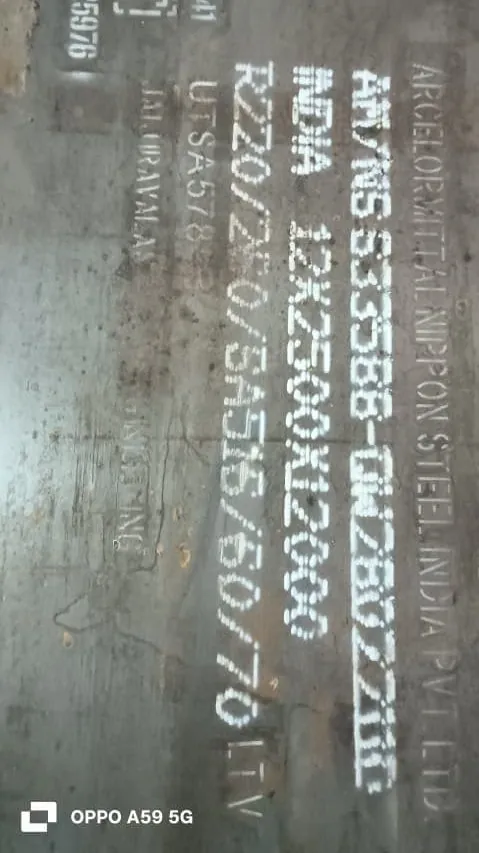
What ASTM A20 Covers
ASTM A20, titled "Standard Specification for General Requirements for Steel Plates for Pressure Vessels," is the umbrella document that sits above the product specifications for carbon and alloy pressure-vessel plate. You never order plate to A20 alone. Instead you order to a grade specification, for example A516 Grade 70 or A387 Grade 11, and that specification invokes A20 for everything it does not define itself.
Think of it as the rulebook that keeps PVQ plate uniform. The grade spec tells the mill what chemistry and strength the plate must reach. A20 tells the mill how to prove it: how to take the test specimens, how to report the heat analysis, what thickness tolerances apply, how to mark the plate, and what kind of mill test certificate to issue. Because of this split, two plates rolled at different mills to the same grade still arrive with comparable, auditable documentation.
The umbrella relationship
A single ASME Section VIII vessel might use several plate grades at once. A20 is what lets a fabricator apply one consistent set of ordering, testing and certification rules across all of them.
| Document | Role | What it defines |
|---|---|---|
| ASTM A20 | General requirements (umbrella) | Heat analysis, test specimens, tolerances, marking, MTC rules |
| ASTM A516 | Grade / product specification | Carbon-silicon plate chemistry and tensile properties for moderate and lower-temperature service |
| ASTM A387 | Grade / product specification | Chromium-molybdenum plate for elevated-temperature service |
| ASME SA-20 / SA-516 | ASME boiler-code editions | Code-stamped vessels built to ASME Section VIII and Section I |
Which Specifications Reference A20
A20 is the common parent for the full family of carbon and low-alloy pressure-vessel plate specs. The best-known of these is ASTM A516 carbon steel plate, the workhorse grade for drums, separators and storage vessels. For elevated-temperature duty where creep and hydrogen attack matter, fabricators move to ASTM A387 chrome-moly plate and its ASME equivalent covered on our SA387 Grade 11 and 22 hub.
When the vessel carries a code stamp, the equivalent ASME documents apply: SA-20 mirrors A20 and ASME SA-516 mirrors A516. The chemistry and testing are essentially identical. The ASME edition simply carries the authority of the Boiler and Pressure Vessel Code.
Key Requirements Set by ASTM A20
Chemical analysis
A20 requires a heat (ladle) analysis for every heat of steel, reported on the certificate. It also defines the rules and permissible tolerances for product (check) analysis taken from the finished plate, so a buyer can verify chemistry independently of the mill's ladle numbers.
Heat treatment and condition
The individual grade spec states the delivery condition, but A20 defines the vocabulary and the reporting. Pressure-vessel plate is supplied as-rolled, normalized, or quenched and tempered depending on the service. For low-temperature vessels the normalized condition is what restores grain refinement and the impact toughness the design needs. If you are selecting between conditions, our guide on normalizing PVQ plate explains why.
Mechanical testing
A20 specifies how tension and bend specimens are oriented, machined and tested, and how results are rounded and reported. It also governs supplementary impact (Charpy V-notch) testing, which is ordered as a supplementary requirement when a vessel will see low design temperatures. Getting the impact requirement right at order time is one of the most common A516 specification errors, covered in how to specify A516 for a vessel.
Tolerances and dimensions
Plate thickness, flatness, width, length and camber tolerances all come from A20, not the grade spec. This matters for plate-weight estimates and edge-prep allowances. Our plate weight calculation guide and the choosing plate thickness guide both work from these A20 tolerance bands.
Marking and certification
A20 defines how each plate is identified, by heat number and specification, so material stays traceable from the mill to the finished weld seam. Every plate Nandini Steel supplies ships with an EN 10204 mill test certificate, type 3.1 or 3.2, so the heat analysis and mechanical results travel with the steel. If you are new to reading one, see how to read a mill test certificate.
Supplementary Requirements Buyers Should Know
The real power of the A20 system is its supplementary requirements. These are optional clauses you add to the purchase order to tighten quality for demanding service. Specify them up front, because they change how the plate is produced and tested.
| Supplementary need | What it adds | When to call it out |
|---|---|---|
| Charpy impact testing | Notch toughness verified at the design temperature | Low-temperature vessels and storage |
| Normalizing | Grain refinement for toughness and uniformity | Low-temperature or thick-section service |
| HIC testing (NACE TM0284) | Resistance to hydrogen-induced cracking | Sour (wet H2S) service |
| Ultrasonic examination | Internal soundness check per thickness | Thick plate, critical vessels |
For sour-service vessels, the HIC-tested variant is ordered as a specific plate rather than plain Grade 70. See our A516 Gr 70 NACE HIC plate and the background on sour service and NACE MR0175.
Pressure-Vessel Plate We Stock Under the A20 System
Nandini Steel is an ISO 9001:2015-certified stockist and supplier of PVQ plate, with all material held ex-stock for immediate dispatch. Common grades ordered under the A20 umbrella include the following.
| Grade | Specification | Typical use |
|---|---|---|
| A516 Grade 70 plate | ASTM A516 / ASME SA-516 + A20 | Drums, separators, storage vessels |
| A516 Gr 70 normalized plate | A516 + A20, normalized | Low-temperature toughness |
| A516 Gr 70 NACE HIC plate | A516 + A20 + NACE TM0284 | Sour-service vessels |
| A516 Grade 60 plate | ASTM A516 / ASME SA-516 + A20 | Lower-strength vessel sections |
| SA387 Gr 11 / 22 plate | ASTM A387 + A20 | Elevated-temperature, hydrogen service |
To see how these grades fit a build, read our overview of pressure-vessel steel and the pressure vessels and boilers application guide. For the certificate and inspection side, our testing, MTC and NDT reference covers what A20 documentation should contain.
Frequently Asked Questions
Is ASTM A20 a grade you can order plate to?
What is the difference between ASTM A20 and ASME SA-20?
Does ASTM A20 require impact testing?
How does A20 relate to A516?
Does Nandini Steel supply A20-governed plate ex-stock?
Request a Quote
For PVQ plate ordered under ASTM A20, with the grade, condition and supplementary tests you need, contact Nandini Steel at reachus@nandinisteel.com or WhatsApp +91 99202 09184 for live pricing and stock. Every order includes an EN 10204 3.1/3.2 mill test certificate.