
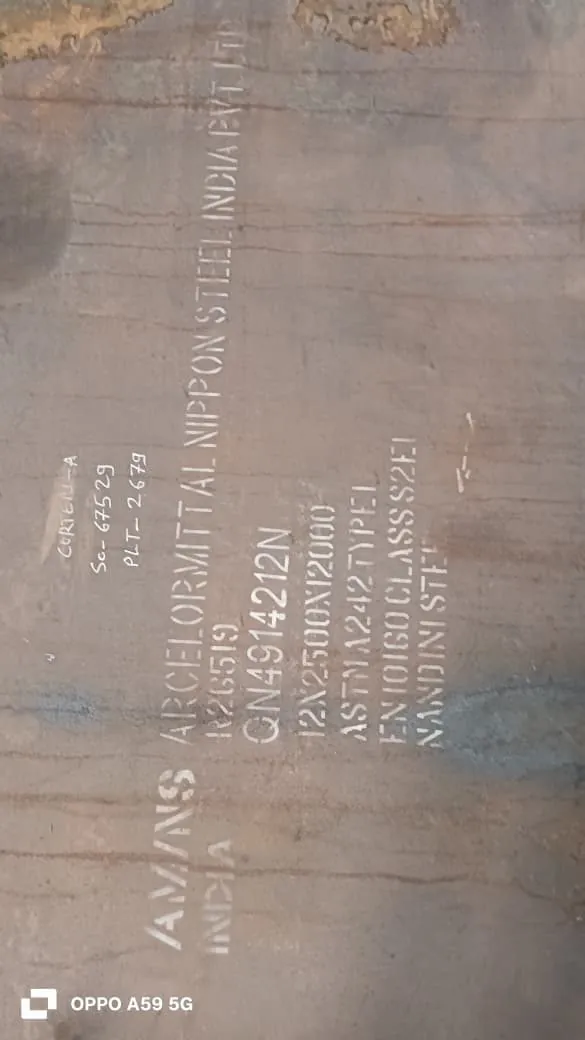
The three families aren't a quality ladder. They're a corrosion-and-environment decision, priced out in chromium and nickel. Carbon and low-alloy steels, the chrome-moly grades, win on strength-per-cost whenever the service is dry, benign, or hot and dry. Stainless and nickel alloys exist for a narrower reason: chromium builds a passive film that can survive wet, chloride-laden, or acidic conditions that plain carbon steel simply can't handle.
Don't confuse the names. "Alloy steel" isn't shorthand for "stainless." Alloy steel is tuned for strength and heat resistance; stainless is tuned for corrosion resistance. These are different jobs.
So pick the family by looking at the environment first. Only after that should you climb the grade ladder, and only as far as the corrosion load actually demands. Every rung up costs more.
The three families at a glance
The snapshot below sorts the families by the one factor that drives most selections: does the steel carry a chromium passive film? Nickel alloys show up as the next step past stainless, meant for service conditions iron-based grades simply can't handle.
| Family | Defining element(s) | Passive film? | Corrosion resistance | Strength / high-temp | Relative cost | Typical standard | Example grade |
|---|---|---|---|---|---|---|---|
| Carbon steel (incl. PVQ) | Iron + carbon (≤~2% C) | No | Low, rusts freely | High strength per cost; limited hot strength | Lowest | ASTM A516 / ASME SA-516 | A516 Gr 70 |
| Alloy steel (Cr-Mo / chrome-moly) | Cr, Mo, V added for strength & heat | No | Low, still corrodes in wet service | High; strong at elevated temperature | Low–moderate | ASME SA-387 | SA387 Gr 11/12/22/91 |
| Stainless steel (austenitic) | Chromium ≥10.5% (+ Ni, Mo) | Yes | High, resists rust, pitting, acids | Moderate; good hot strength/oxidation | Moderate–high | ASTM A240 / ASME SA-240 | 304/304L, 316/316L, 904L |
| Nickel alloy (Ni-Fe-Cr / Ni-Mo-Cr) | Nickel-rich + Cr, Mo, Cu | Yes | Highest, hot acids, sour, high chloride | High; excellent across temperature | Highest | ASTM B424 / ASME SB-424 | Incoloy 825 |
What is carbon steel?
Carbon steel is simply an iron-carbon alloy: iron with up to roughly 2% carbon and no corrosion alloying added on purpose. Carbon is what drives its strength and hardenability. More carbon means a harder, stronger steel, and that's why carbon steel offers more strength per dollar than any other family out there. What it lacks is a passive film. So when moisture and oxygen show up, it corrodes evenly across the surface. It rusts.
- Iron + carbon; strength comes from carbon content, not from a corrosion-resistant layer.
- No passive film, susceptible to general (uniform) corrosion wherever it meets water and oxygen.
- The lowest-cost family; the default where service is dry, benign, or protected by paint, coating or galvanizing.
Where PVQ / boiler plate fits
Pressure-vessel-quality (PVQ) plate like A516 Gr 70 is a killed, fine-grain carbon steel made to tight chemistry and toughness controls for boilers, storage tanks, separators and pressure vessels. It's still carbon steel. Toughness comes from wall thickness and, for cold service, normalizing, not from any resistance to corrosion. For low-temperature vessels, specify normalized plate with Charpy impact testing at the design temperature rather than as-rolled material. For wet sour (H₂S) duty, call out the HIC-tested variant (hydrogen-induced-cracking test per NACE TM0284) instead of plain Gr 70. See our pressure-vessel steel explained note and the A516 Gr 70 plate grade page.
What is alloy steel?
Alloy steel starts as carbon steel, then picks up deliberate additions: chromium, molybdenum, vanadium, nickel. Engineers add them to raise strength, hardenability, and, just as important, performance at elevated temperatures. Here's the point to remember when selecting a grade: these additions shape mechanical and heat behavior. They do not improve resistance to aqueous corrosion.
Low-alloy steels, which carry only a few percent total alloying content, handle most pressure-service work. High-alloy steels are a different animal. Once chromium content crosses the passive-film threshold, the material moves into stainless territory.
- Carbon steel + Cr/Mo/V/Ni for strength, hardenability and hot strength.
- Corrosion resistance is largely unchanged, alloy steel still rusts in wet service.
- "Alloy steel" is not a synonym for "stainless", the purpose is different.
Chromium-molybdenum (chrome-moly) steel
Chrome-moly grades, SA387 Gr 11, 12, 22 and 91, carry roughly 1–9% chromium with molybdenum added to hold strength and resist hydrogen attack at high temperature. Engineers specify them for elevated-temperature pressure vessels, boilers and hydrogen service, where dry heat governs, not aqueous corrosion. Their chromium content sits below the stainless threshold, so they won't hold up in wet or chloride service. See the chrome-moly (SA387) alloy steel grade page.
What is stainless steel?
Stainless steel is an iron-chromium alloy with a minimum chromium content of 10.5%. At that level and above, chromium reacts with oxygen and builds a thin, adherent, self-healing chromium-oxide film across the surface. That's the passive layer responsible for the family's corrosion resistance. Technically, stainless counts as a high-alloy steel. It gets classed on its own anyway, because its defining purpose is resisting corrosion, not adding strength. Nickel, molybdenum, copper and nitrogen get added from there to extend that resistance to specific media.
- Iron + chromium ≥10.5% by definition, the dividing line between "rusts" and "resists."
- The passive chromium-oxide film repassivates when scratched, as long as oxygen is present.
- A high-alloy steel, but classed separately because corrosion resistance is the point.
The stainless sub-families
Stainless steel splits into families by microstructure, austenitic, ferritic, martensitic, duplex and super-austenitic. Each balances corrosion resistance, strength and weldability differently. Of these, the austenitic grades (304, 316, 904L) get specified most often for corrosion service.
For the full picture, see stainless steel metallurgy, austenitic stainless steel, super-austenitic grades and duplex stainless steel.
And beyond stainless: nickel alloys
Nickel alloys take over when iron-based stainless hits its ceiling: very high chloride, sour (H₂S) service, hot concentrated acids. Raising the nickel content stabilizes the structure against chloride stress-corrosion cracking. Add chromium, molybdenum and copper, and the alloy resists both reducing and oxidizing acids. Incoloy 825 (a Ni-Fe-Cr alloy, UNS N08825 / Werkstoff 2.4858, roughly 38–46% Ni, 2.5–3.5% Mo and 1.5–3% Cu, titanium-stabilized) is the usual step up. Engineers reach for it in sour oil and gas work and mixed-acid chemical duty, right where 316L or 904L stops being enough. See nickel alloys explained and the Incoloy 825 grade page.
The mechanism: why one family resists corrosion and another rusts
The whole split between the families comes down to one surface phenomenon: the passive film. In stainless and nickel alloys, chromium at 10.5% or more reacts with oxygen to form a dense chromium-oxide (Cr₂O₃) layer only a few atoms thick. That film heals itself. Scratch it, and as long as oxygen is present, it repassivates in seconds, sealing the metal underneath. That's why stainless resists rust, and why passivation and clean, oxygen-rich conditions matter in service.
Plain carbon and alloy steel don't have that film. The iron oxide that forms on them, ordinary rust, is porous and flakes off rather than protecting anything, so corrosion just keeps eating inward. Piling on more carbon or alloying for strength won't change that. Only chromium above the threshold does.
Why alloy steel still rusts
Chrome-moly alloying boosts strength, hardenability and hot strength, but at 1–9% chromium it never crosses the 10.5% threshold needed for a passive film. That's why SA387 holds up beautifully in dry, high-temperature pressure service, yet corrodes just like plain carbon steel once chlorides or moisture show up. Strength alloying and corrosion alloying solve different problems. That's precisely why "alloy steel" and "stainless steel" sit in separate families.
What decides the differences: the alloying elements
Each family's chemistry decides how it behaves. The table lines up the elements that matter with what they actually do, from carbon driving strength to chromium building the passive film. For a deeper look, see the role of alloying elements.
| Element | What it does |
|---|---|
| Carbon (C) | Raises strength and hardenability; above ~0.03% it can promote sensitization in welded stainless. |
| Chromium (Cr) | Forms the passive film at ≥10.5%; the dominant term in PREN. |
| Nickel (Ni) | Stabilises the austenitic structure; improves resistance to chloride SCC and reducing acids. |
| Molybdenum (Mo) | Boosts pitting and crevice resistance (and PREN); adds high-temperature strength in Cr-Mo steel. |
| Copper (Cu) | Improves resistance to reducing acids, notably sulfuric acid (as in 904L). |
| Nitrogen (N) | Adds strength and raises PREN; important in duplex and super-austenitic grades. |
| Titanium / Niobium (Ti/Nb) | Stabilise against sensitization by tying up carbon (as in 321/347). |
PREN: ranking corrosion resistance on one number
For pitting and crevice resistance, chemistry is reduced to a single orderable number, the pitting resistance equivalent number: PREN = Cr + 3.3 × Mo + 16 × N. It lets you rank grades on one scale, a higher PREN means more resistance to chloride pitting. Carbon and alloy steel have no passive film, so they have no PREN and sit below the ladder entirely. See PREN for the full method, and pitting corrosion for the failure mode it predicts.
| Grade | Family | Approx. PREN |
|---|---|---|
| Carbon / alloy steel | No passive film | N/A, below the ladder |
| 304 / 304L | Austenitic SS | ~18 |
| 316 / 316L | Austenitic SS | ~24 |
| Incoloy 825 | Ni-Fe-Cr alloy | ~31–40 |
| 904L | Super-austenitic SS | ~34 |
| Duplex 2205 | Duplex SS | ~35 |
| Super-duplex 2507 | Super-duplex SS | ~43 |
How the families compare on the things you're choosing between
Set side by side on the properties that actually drive a real selection, corrosion resistance, strength, hot behavior, weldability, magnetism and cost, the trade-offs come into sharp focus. Carbon and alloy steel win on strength-per-cost. Stainless and nickel alloys take over wherever the environment turns wet, chloride-bearing or acidic.
| Property | Carbon steel | Alloy steel (Cr-Mo) | Austenitic stainless | Nickel alloy |
|---|---|---|---|---|
| Corrosion resistance | Poor, rusts | Poor in wet service | High | Highest |
| Strength (per cost) | Highest | High | Moderate | High |
| High-temperature behavior | Limited | Excellent (dry heat, H₂) | Good (oxidation resistance) | Excellent |
| Weldability | Good (preheat for thick/alloyed) | Good with preheat/PWHT | Good (match filler, control sensitization) | Good with over-alloyed filler |
| Magnetism | Magnetic | Magnetic | Essentially non-magnetic | Essentially non-magnetic |
| Relative cost | Lowest | Low–moderate | Moderate–high | Highest |
Which grades belong to each family
This is where the taxonomy becomes a purchase. The map below pairs each family with the grades we hold ex-stock, the standard that governs them and the service each is built for. Every grade links to its own page for the full chemistry, properties and forms.
| Family | Example grade(s) | Governing standard | Signature use |
|---|---|---|---|
| PVQ carbon steel | A516 Gr 70 PVQ plate | ASTM A516 / ASME SA-516 (+ ASTM A20) | Pressure vessels, boilers, storage, separators |
| Cr-Mo alloy steel | SA387 Gr 11/12/22/91 | ASME SA-387 | Elevated-temperature vessels, hydrogen service |
| Austenitic stainless | 304 stainless, 316 stainless (+ L) | ASTM A240 / ASME SA-240 | General fabrication, marine, chemical, food |
| Super-austenitic stainless | 904L super-austenitic | ASTM A240 / ASME SA-240 | Sulfuric acid, high chloride, FGD |
| Duplex / super-duplex | 2205 / 2507 | ASTM A240 / A790 | High strength with chloride resistance |
| Ni-Fe-Cr alloy | Incoloy 825 | ASTM B424 / SB-424 + NACE MR0175 | Sour service, hot and mixed acids |
A common and expensive selection mistake runs in both directions across this map. Buyers specify "alloy steel" such as SA387 and expect it to resist corrosion. It won't, because its chromium content sits below the passive-film threshold. Others reach for a nickel alloy where 316 or 904L would have done the job just fine, paying for resistance the environment never demanded. Confirm the actual service chemistry first: chlorides, acid concentration and temperature, H₂S. Do that before you climb the ladder. Stepping up one deliberate rung costs far less than a wrong-family failure. Grade equivalents across UNS, Werkstoff and JIS systems are set out in our grade equivalents reference.
Worked examples: picking the family for the job
The method stays constant: read the environment first, then settle on the family, and only after that pick the grade.
| Environment | Family | Grade | Why |
|---|---|---|---|
| Dry, high-pressure vessel; strength governs | PVQ carbon / Cr-Mo alloy | A516 Gr 70 or SA387 | No corrosion driver, buy strength per cost; see pressure vessels. |
| Coastal / marine, chloride splash | Austenitic stainless | 316 / 316L | Its 2–3% molybdenum resists chloride pitting 304 cannot, though both austenitic grades stay susceptible to chloride SCC; see marine service. |
| Sulfuric acid / high chloride process | Super-austenitic stainless | 904L | Copper-bearing ~25% Ni, ~4.5% Mo chemistry (UNS N08904 / 1.4539) resists reducing acids; see chemical processing and acid service. |
| Sour (H₂S) oil & gas; mixed acids | Ni-Fe-Cr alloy | Incoloy 825 | Resists reducing and oxidizing acids and sour cracking; see oil & gas. |
How to choose: a quick decision path
Match the family to the environment first, then climb the grade ladder only as far as corrosion demands
- Define the environment. Is it dry or wet? Does it carry chlorides? Acidic, and if so, which acid, at what concentration and temperature? Sour, meaning H₂S is present? Or high-temperature and dry?
- Pick the family. For dry, strength-driven, hot-dry conditions, go with carbon or Cr-Mo alloy steel. For wet, chloride-laden, or acidic conditions, go with stainless or a nickel alloy.
- Climb only as far as needed. Within stainless, move from 304 to 316 to 904L to a nickel alloy as the corrosion load increases, and stop there. Every step up costs more.
- Confirm form and thickness, then request the mill test certificate on the order.
Our grade selector and the how to select a stainless grade guide cover the same logic, step by step. Once you've picked a plate or sheet, the weight calculator turns it into a delivered weight.
How these grades are certified and traceable
A family and a grade are claims, and claims have to be proven, not assumed, before they go into a vessel or a sour-service line. Every order from Nandini Steel ships with an EN 10204 3.1/3.2 mill test certificate that ties the delivered heat to its chemistry and mechanical results. The grade on the purchase order is the grade in the steel. Material comes from genuine mill plate producers such as Aperam, Outokumpu, Jindal, POSCO, Nippon Steel and JFE. Positive material identification confirms the alloy content on receipt.
Sour service under NACE MR0175 / ISO 15156, acid duty, or pressure vessel work: this is exactly where family choice stops being academic. Pick the wrong one and you've got a safety issue, not just a spec mismatch. Our EN 10204 mill test certificate page walks through that standard. For how we track material through the supply chain, see material traceability. The testing, MTC, NDT and PMI page covers that whole workflow. Nandini Steel holds ISO 9001:2015 certification as a stockist and supplier, Cert. No. 1283438, through Unitas Certification Services UCS-UK. Details sit under quality assurance and certifications.
FAQ
Is stainless steel an alloy steel?
How much chromium makes steel stainless?
Does alloy steel rust?
Which is stronger, carbon, alloy or stainless steel?
Is carbon steel cheaper than stainless steel?
Related reading: stainless steel metallurgy · role of alloying elements · types of corrosion · nickel alloys explained · pressure-vessel steel explained.
Specifying for a project? Use the grade selector to match family and grade to your service, then request a quote. Every grade ships ex-stock, and a mill test certificate comes with every order.