
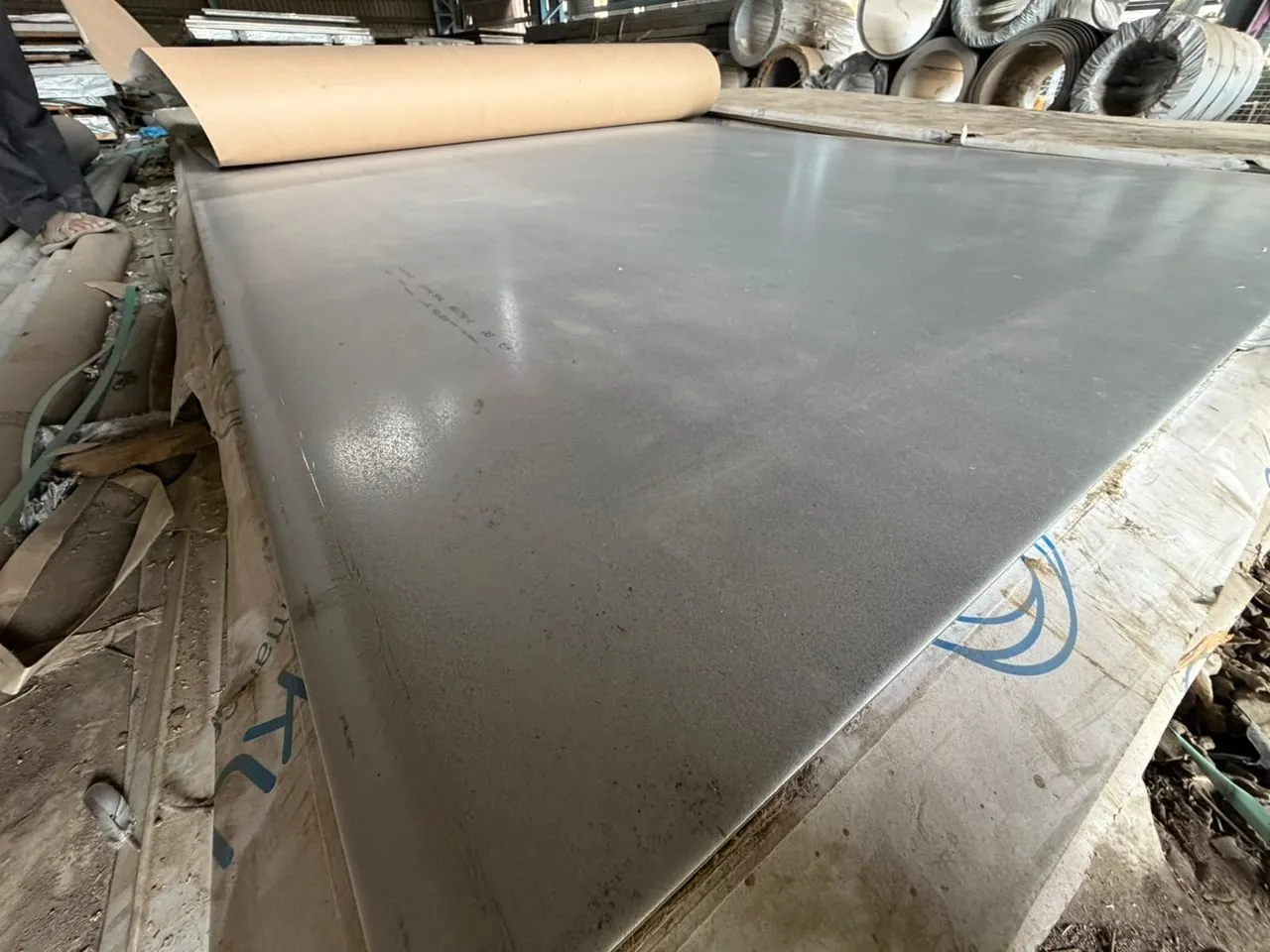
SA387 plate at a glance
Chromium-molybdenum (Cr-Mo) pressure-vessel quality (PVQ) alloy steel plate forms this family. It's the elevated-temperature step up from A516 carbon-steel PVQ plate.
Grades run 5, 9, 11, 12, 21, 22 and 91, spanning roughly 1Cr-0.5Mo through 9Cr-1Mo-V-Nb. The choice comes down to service temperature and hydrogen partial pressure.
Class 1 and Class 2 differ in heat treatment and strength level. Class 2 gives you higher tensile and yield.
This plate serves elevated-temperature and hydrogen-bearing duty: refinery hydroprocessing, power boilers, petrochemical reactors.
On conformance and traceability, it meets ASME SA-387 / ASTM A387 with ASTM A20 general requirements, and every order ships with an EN 10204 3.1/3.2 mill test certificate. All plate sits ex-stock, ready for immediate dispatch.
What is SA387 alloy steel plate?
SA387 belongs to the chromium-molybdenum family of pressure-vessel steels, and it's the plate form of that lineup. Engineers reach for it when plain carbon steel can't handle two things: creep strength at elevated temperature and resistance to high-temperature hydrogen attack. Chromium is what gives it resistance to oxidation, sulfidation and hydrogen attack. Molybdenum, meanwhile, pushes up creep and creep-rupture strength. The combination lets the plate hold pressure at metal temperatures well past what plain PVQ carbon steel can manage.
This is why SA387 sits directly above A516 Gr 60 pressure-vessel plate in the pressure-vessel ladder: you move up from carbon steel to Cr-Mo when temperature or hydrogen partial pressure exceeds carbon steel's limit, then pick the chromium level (Gr 11 → 22 → 91) by how hot and how hydrogen-rich the service is. SA387 is one node in the wider family documented on our alloy steel grades hub, which also covers the matching P-grade pipe and F-grade forgings.
Note on PREN: the pitting-resistance-equivalent number, the one used for stainless steels, doesn't apply to SA387. Cr-Mo alloy steel is an elevated-temperature creep-and-hydrogen material. It isn't a chloride-corrosion-resistant stainless. Grade selection comes down to temperature, hydrogen partial pressure and strength class, not a PREN score.
SA387 grades & classes
Each grade carries its own nominal chromium-molybdenum content. Chromium is what buys resistance to higher temperatures and hydrogen partial pressures; molybdenum, along with vanadium and niobium in Grade 91, supplies the creep strength.
| Grade | Nominal Cr-Mo | Typical service |
|---|---|---|
| Gr 12 | 1Cr-0.5Mo | Moderate elevated-temperature vessels and exchangers |
| Gr 11 | 1.25Cr-0.5Mo-Si | General refinery and boiler service, mild hydrogen duty |
| Gr 21 | 3Cr-1Mo | Higher hydrogen partial pressure than 1.25Cr grades |
| Gr 22 | 2.25Cr-1Mo | Hydrocracker/hydrotreater reactors, high-temperature workhorse |
| Gr 5 | 5Cr-0.5Mo | High-temperature oxidation and sulfidation resistance |
| Gr 9 | 9Cr-1Mo | High-temperature, high-sulfidation refinery duty |
| Gr 91 | 9Cr-1Mo-V-Nb | Creep-strength-enhanced ferritic plate for power/boiler drums |
Class 1 vs Class 2
Within a grade, Class 1 and Class 2 differ by heat treatment and strength level. Class 1 is typically supplied annealed or normalized-and-tempered to the lower tensile/yield band. Class 2 gets heat-treated (normalized-and-tempered, or quenched-and-tempered where permitted) to the higher strength band. Pick the grade based on temperature and hydrogen exposure first. Then pick the class according to the mechanical minimums your vessel design calls for.
Chemical composition
Typical element ranges follow ASTM A387 / ASME SA-387, with the balance made up of iron; phosphorus and sulfur fall under the general requirements of ASTM A20. Check these against the current standard edition at the time of order.
| Element (wt%) | Gr 11 | Gr 22 | Gr 5 | Gr 9 | Gr 91 |
|---|---|---|---|---|---|
| Carbon (C) | 0.05–0.17 | 0.05–0.15 | ≤0.15 | ≤0.15 | 0.08–0.12 |
| Manganese (Mn) | 0.40–0.65 | 0.30–0.60 | 0.30–0.60 | 0.30–0.60 | 0.30–0.60 |
| Silicon (Si) | 0.50–0.80 | ≤0.50 | ≤0.50 | 0.25–1.00 | 0.20–0.50 |
| Chromium (Cr) | 1.00–1.50 | 2.00–2.50 | 4.0–6.0 | 8.0–10.0 | 8.0–9.5 |
| Molybdenum (Mo) | 0.45–0.65 | 0.90–1.10 | 0.45–0.65 | 0.90–1.10 | 0.85–1.05 |
| Vanadium (V) | – | – | – | – | 0.18–0.25 |
| Niobium (Nb) | – | – | – | – | 0.06–0.10 |
| Nitrogen (N) | – | – | – | – | 0.030–0.070 |
Mechanical properties
Room-temperature mechanical minimums by grade and class, per ASTM A387. The figures below are indicative only, so check them against the current standard edition at the time of order.
| Grade / Class | Tensile strength | Yield strength (0.2%) | Elongation |
|---|---|---|---|
| Gr 11/22, Class 1 | 415–585 MPa (60–85 ksi) | ≥240 MPa/35 ksi (Gr 11), ≥205 MPa/30 ksi (Gr 22) | ≥22% |
| Gr 12, Class 1 | 380–550 MPa (55–80 ksi) | ≥220 MPa (32 ksi) | ≥22% |
| Gr 11/12/22, Class 2 | 515–690 MPa (75–100 ksi) | ≥310 MPa (45 ksi) | ≥18% |
| Gr 5 / Gr 9 | 415–585 MPa (60–85 ksi) | ≥205 MPa (30 ksi) | ≥18% |
| Gr 91 | 585–760 MPa (85–110 ksi) | ≥415 MPa (60 ksi) | ≥18% |
Physical properties
| Property | Typical value (Gr 11 / Gr 22) |
|---|---|
| Density | ~7.85 g/cm³ |
| Thermal conductivity | ~37–42 W/m·K |
| Mean coefficient of thermal expansion | ~12–13 µm/m·°C |
| Modulus of elasticity | ~205 GPa |
| Magnetic response | Ferromagnetic |
Elevated-temperature & hydrogen behavior
SA387 earns its spot through three linked traits: resistance to hydrogen attack, creep strength, and controlled toughness after welding. PREN and chloride-pitting logic simply don't apply here.
High-temperature hydrogen attack (HTHA) & API 941 Nelson curves
High-temperature hydrogen attack happens when atomic hydrogen diffuses into steel under elevated temperature and hydrogen partial pressure, then reacts with carbides to form methane. The result is decarburization and fissuring. SA387 resists HTHA because chromium stabilizes the carbides. You select the required chromium level, and therefore the grade, against the API 941 Nelson curves for the design temperature and hydrogen partial pressure. Push the hydrogen duty higher, and you move to a higher chromium grade.
Creep strength & molybdenum
Above roughly 400–450 °C, time-dependent creep takes over as the governing design factor. Molybdenum boosts the creep and creep-rupture strength of the ferritic matrix. In creep-strength-enhanced ferritic Grade 91, vanadium and niobium precipitates add another big jump in rupture strength. That's the reason 9Cr-1Mo-V-Nb gets specified for the hottest power-boiler and header service.
Temper embrittlement & post-weld heat treatment (PWHT)
Thick 2.25Cr-1Mo (Gr 22) sections can suffer temper embrittlement when they cool slowly through a critical range. You manage it with chemistry limits (J-factor / X-bar control) and the right heat treatment. SA387 welds need post-weld heat treatment, and the filler has to be a matching Cr-Mo grade. That does two things: it relieves residual stress and tempers the heat-affected zone. Specify the PWHT condition up front, so the plate and the procedure get qualified together.
Equivalent grades & cross-form designations
The SA387 plate grades line up directly with the P-grade pipe (ASTM A335), the F-grade forgings (ASTM A182), and their European Werkstoff/EN designations.
| SA387 grade | Pipe (A335) | Forging (A182) | EN / Werkstoff | EN plate spec |
|---|---|---|---|---|
| Gr 11 | P11 | F11 | 13CrMo4-5 (1.7335) | EN 10028-2 |
| Gr 22 | P22 | F22 | 10CrMo9-10 (1.7380) | EN 10028-2 |
| Gr 91 | P91 / T91 | F91 | X10CrMoVNb9-1 (1.4903) | EN 10028-2 |
Choosing between SA387 grades
Grade selection follows the elevated-temperature ladder, not a corrosion score:
Gr 11 (1.25Cr-0.5Mo) covers general elevated-temperature vessels and exchangers with mild hydrogen duty. It's the first step up from carbon steel.
Gr 22 (2.25Cr-1Mo) is the hydrocracker/hydrotreater workhorse. It handles higher temperature and hydrogen partial pressure than the 1.25Cr grades, but watch for temper embrittlement in thick sections.
- Gr 5 / Gr 9 (5Cr–9Cr): where high-temperature oxidation and sulfidation resistance dominate.
Gr 91 (9Cr-1Mo-V-Nb): here, creep-rupture strength at the highest temperatures is what matters most, power-boiler drums, headers, and steam service all depend on it.
In moderate temperature and hydrogen partial pressure conditions, Gr 11 does the job and costs less. Only step up when the Nelson curve or the creep design calls for it.
Available forms & sizes
SA387 is a plate spec, and here it's supplied as plate. We quote thickness, width and length against your vessel drawing for the grade and class you need, and all plate is ex-stock for immediate dispatch. Send over your grade, class, thickness and plate size and we'll get you a cut-to-requirement quote.
| Form | Grades / classes | Supply |
|---|---|---|
| Plate (SA387 / A387) | Gr 11, 22, 5, 9, 91, Class 1 & Class 2 | Ex-stock, cut to drawing; EN 10204 3.1/3.2 MTC |
Other Cr-Mo forms
The matching long and forged products in the same Cr-Mo grades ship right alongside the plate.
- P11 / P22 alloy-steel pipe, ASTM A335 seamless pipe in the same grades.
- F11 / F22 / F91 alloy-steel flanges, forged from ASTM A182 to ASME B16.5 / B16.47.
- Alloy-steel forged fittings, ASME B16.11 / A182 Cr-Mo forged fittings.
Plate weight & how to calculate
Plate weight uses the steel density of 7.85 g/cm³:
Weight in kilograms equals thickness in millimeters times width in meters times length in meters, times 7.85.
| Thickness | Width × Length | Calculation | Weight |
|---|---|---|---|
| 20 mm | 2.0 m × 6.0 m | 20 × 2.0 × 6.0 × 7.85 | 1,884 kg |
| 40 mm | 2.5 m × 8.0 m | 40 × 2.5 × 8.0 × 7.85 | 6,280 kg |
For other sizes, check our steel plate weight guide. If the section's still open, see how to choose plate thickness too.
Standards & specifications
- Plate: ASME SA-387 / ASTM A387 (chromium-molybdenum alloy steel plates for pressure vessels). ASTM A20 sets the general requirements governing pressure-vessel plate.
- European equivalent plate: EN 10028-2 (13CrMo4-5 / 10CrMo9-10 / X10CrMoVNb9-1).
- Matching forms: ASTM A335 (P-grade pipe), ASTM A182 (F-grade forgings/flanges), ASTM A234 (WP-grade fittings).
- Supplementary tests: ASTM A578 ultrasonic examination; API 941 for HTHA grade selection.
Testing, inspection & certification
Every heat ships with an EN 10204 3.1/3.2 mill test certificate provided with every order, reporting chemistry and mechanical results against SA-387 / A20. On SA387 plate, inspection options include Charpy impact testing at the specified temperature, ultrasonic testing per ASTM A578, and a check of the PWHT / heat-treatment condition recorded on the certificate. The plate itself is genuine mill material, sourced from mills such as Aperam, Outokumpu, Jindal, POSCO, Nippon Steel and JFE. Each piece carries a stamped heat number, so it can be traced back to the MTC in full.
Applications of SA387 plate
Refinery hydroprocessing: hydrocracker and hydrotreater reactors and exchangers run under high-temperature hydrogen partial pressure, using Gr 22 and Gr 11.
Pressure vessels and reactors: elevated-temperature petrochemical reactors and separators are another case, since carbon steel just doesn't hold up under that kind of creep strength demand.
- Power & boiler plant: boiler drums, headers and steam piping, Grade 91 where creep-rupture strength is decisive.
- Petrochemical processing: high-temperature oxidation/sulfidation duty served by the 5Cr–9Cr grades.
FAQ
What is the difference between SA387 Grade 11 and Grade 22?
What is the difference between SA387 Class 1 and Class 2?
Does SA387 plate need post-weld heat treatment?
Is PREN relevant to SA387 alloy steel?
What is SA387 Grade 11 equivalent to in pipe and forging form?
What mill test certificate comes with SA387 plate?
Request a quote
For SA387 Cr-Mo alloy steel plate, any grade and class, cut to your vessel drawing with an EN 10204 3.1/3.2 mill test certificate, reach out to the Nandini Steel Engineering Team for live pricing. All plate sits ex-stock, ready for immediate dispatch.
- Phone: +91 22 43404600 · +91 9920209184
- WhatsApp: +91 99202 09184
- Email: reachus@nandinisteel.com
- Address: 25, Dreamland Building, 601, 6th Floor, Mama Parmanand Marg, Charni Road, Opera House, Girgaon, Mumbai, Maharashtra 400004, India
- GSTIN: 27ADJPA7240C1Z0
Nandini Steel has held ISO 9001:2015 certification as a stockist and supplier since it was founded in 2003. Over those 20+ years the company has delivered 307+ projects, served 260+ clients and shipped to 36+ export countries.