
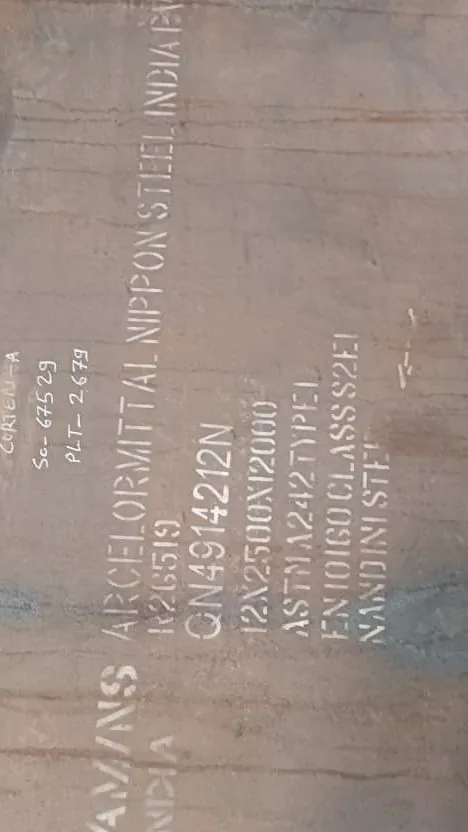
Key takeaways: SA-516 Gr 70 normalized plate at a glance
- Same chemistry as the hub: identical killed, fine-grain Grade 70 composition as the A516 Grade 70 plate you already know, the difference is the heat-treat condition, not the alloy.
- Normalizing = austenitize + air cool: heating above the A3 transformation point (roughly 870–920 °C) and cooling in still air refines the ferrite-pearlite grain.
- Low-temperature toughness: that grain refinement buys guaranteed Charpy V-notch impact energy at sub-ambient temperatures, often specified to about -46 °C, which plain as-rolled plate cannot reliably meet.
- Designation & standards: UNS K02700, supplied to ASME SA-516 / ASTM A516 with the ASTM A20 general requirements governing plate, including Supplementary Requirement S5 impact testing.
- Furnished with proof: a Charpy V-notch impact-test report plus an EN 10204 3.1/3.2 mill test certificate provided with every order, ex-stock for immediate dispatch.
What is normalized A516 Gr 70 plate?
A516 Grade 70 is the workhorse grade of pressure-vessel-quality (PVQ) steel. It's a killed, fine-grain carbon steel made to ASME SA-516 / ASTM A516, built specifically for welded pressure vessels, boilers and storage tanks. In plate form, designated UNS K02700, it's the flat product most vessel and boiler engineers reach for first whenever the service is pressurized but not corrosive.
The normalized variant is that same Grade 70 chemistry supplied in a defined heat-treated condition. Buyers write it several ways, "SA-516 70N", "SA 516 Gr 70 normalized", "A516-70 normalized condition", all meaning plate that has been austenitized and air-cooled after rolling. That extra process is not cosmetic: it is the supplementary condition you order when the vessel's minimum design metal temperature (MDMT) drops below ambient and the code no longer grants an impact-test exemption. This page owns that single decision, normalizing for low-temperature toughness, while the general as-rolled grade lives on the A516 Grade 70 plate hub and the sour-service story lives on the A516 Gr 70 NACE-HIC plate sibling. For the wider grade and its other forms, see the A516 Grade 70 grade hub.
Why normalize A516 Gr 70: grain refinement for low-temperature toughness
As-rolled carbon steel runs into a ductile-to-brittle transition. Drop below a certain temperature and it loses toughness, which means it can fail by brittle fracture under load. Normalizing shifts that transition colder, and that's really the whole point of this variant. Below, you'll find the mechanism, the toughness gained, and the thickness-and-MDMT triggers that call for it. For the underlying metallurgy, see our note on normalizing PVQ plate.
What normalizing does to the microstructure
Normalizing is a three-step thermal process:
- Austenitize the plate by heating it above the upper transformation temperature (A3), typically around 870–920 °C, so the structure fully transforms to austenite.
- Hold at temperature long enough for the section to equalize and the prior grain structure to dissolve.
- Air-cool it in still air, quicker than furnace cooling, but nowhere near as fast as a quench. This lets the steel re-transform into a fine, uniform ferrite-pearlite grain.
Finer grain is what boosts toughness. More grain boundaries means more area to stop cleavage cracks from spreading, which pulls down the ductile-brittle transition temperature. The alloy chemistry never has to change.
Charpy impact and MDMT: what you gain
Normalizing guarantees Charpy V-notch impact energy at a set low test temperature. An as-rolled plate might only carry a room-temperature certificate, but normalized Grade 70 can be qualified with impact testing at 0 °C, -20 °C, or around -46 °C. The exact temperature and minimum energy come from your design code and the MDMT. Under ASME BPVC Section VIII Division 1, UCS-66 governs when impact testing becomes mandatory for a given grade, thickness, and MDMT. Once the exemption curves stop covering you, normalizing paired with impact testing is what gets you a code-compliant plate.
Normalized vs as-rolled: when you must normalize
You specify normalized Grade 70 instead of as-rolled whenever any of these apply: the MDMT drops below ambient and UCS-66 calls for impact testing, the section's thick enough that rolled-in grain is too coarse to pass Charpy at temperature, or the purchaser or code case simply mandates the normalized supplementary condition. When service runs at or above ambient and the code allows an exemption, as-rolled plate from the A516 Grade 70 plate hub is the cheaper route.
Chemical composition
Normalized Grade 70 is supplied within the Grade 70 heat-analysis ranges of ASTM A516 / ASME SA-516, a killed steel made to fine-grain practice. Carbon and manganese limits shift by thickness. The table gives representative ranges, so confirm the exact thickness-tiered limits against the governing specification edition on the mill test certificate.
| Element | A516 Gr 70 (heat analysis, wt%) | Role |
|---|---|---|
| Carbon (C) | 0.27–0.30 max (tiered by thickness) | Strength; kept controlled for weldability |
| Manganese (Mn) | 0.85–1.20 (varies with thickness) | Strength, toughness, deoxidation |
| Silicon (Si) | 0.15–0.40 | Killed-steel deoxidizer |
| Phosphorus (P) | ≤ 0.025 | Residual, limited for toughness |
| Sulfur (S) | ≤ 0.025 | Residual, limited for toughness |
| Iron (Fe) | Balance | Base |
Carbon equivalent (CE) and weldability
Grade 70 keeps its carbon and manganese deliberately low, which holds the carbon equivalent (CE = C + Mn/6 + (Cr+Mo+V)/5 + (Ni+Cu)/15) to a moderate level. That's the reason it welds well with low-hydrogen consumables. Normalizing doesn't hurt weldability in any real way, since it refines grain structure rather than changing the alloy itself. The same preheat and filler logic that applies to as-rolled plate carries over to normalized plate without adjustment. Work to the CE value shown on your actual heat's MTC, not a nominal figure.
Mechanical properties
Minimum room-temperature tensile properties for A516 Grade 70 plate, per ASTM A516 / ASME SA-516. These minima don't change between as-rolled and normalized plate. What normalizing does add is guaranteed low-temperature impact performance, covered in the table that follows.
| Property | A516 Gr 70 minimum |
|---|---|
| Tensile strength | 485–620 MPa (70–90 ksi) |
| Yield strength (0.2% offset) | ≥ 260 MPa (≥ 38 ksi) |
| Elongation in 200 mm (8 in) | ≥ 17% |
| Elongation in 50 mm (2 in) | ≥ 21% |
Impact (Charpy V-notch) properties in the normalized condition
This is the signature trait of the variant. Normalized Grade 70 gets ordered with Charpy V-notch impact testing as ASTM A20 Supplementary Requirement S5, reported on the MTC. We provide impact testing at the test temperature your code case calls for, with minimum energy values set by the governing standard.
| Parameter | Normalized Gr 70 + S5 |
|---|---|
| Test method | Charpy V-notch (CVN), per ASTM A20 Supplementary Requirement S5 |
| Specimen orientation | Longitudinal or transverse (state on the PO) |
| Test temperature | To your specified MDMT, commonly 0 °C, -20 °C or about -46 °C |
| Minimum energy | Per the governing code / ASTM A20 S5 acceptance criteria |
| Reporting | Impact-test report issued with the EN 10204 3.1/3.2 MTC |
Physical properties
A516 Grade 70 is a ferritic, ferromagnetic carbon steel. Its density is what drives the plate-weight calculation.
| Property | Value (approximate) |
|---|---|
| Density | 7.85 g/cm3 |
| Elastic modulus | ~200 GPa |
| Thermal conductivity (RT) | ~52 W/m·K |
| Mean CTE (20–100 °C) | ~12 µm/m·°C |
| Specific heat | ~470 J/kg·K |
| Magnetic response | Ferromagnetic |
Equivalent grades and designations
UNS K02700 remains the governing identity. The grades listed below are nearest equivalents only, not identical matches, so confirm against the governing specification before substituting any of them.
| System | Nearest designation |
|---|---|
| UNS | K02700 |
| ASME / ASTM | SA-516 Gr 70 / A516 Gr 70 |
| EN 10028-2 | ≈ P355GH (1.0473) |
| JIS | ≈ SGV480 / SB480 |
| DIN (legacy) | ≈ 17Mn4 / HII |
Normalized A516 Gr 70 vs the alternatives: when to choose it
The decision ladder starts with as-rolled Grade 70, moves up to normalized Grade 70 (70N), and ends with a quenched-and-tempered grade once the MDMT drops further still.
| Condition / grade | Typical MDMT reach | Strength | When to choose |
|---|---|---|---|
| A516 Gr 70 as-rolled | At / above ambient (per UCS-66 exemption) | 70–90 ksi tensile | Ambient-service vessels where impact testing is exempt |
| A516 Gr 70 normalized (70N) | To about -46 °C with S5 impact testing | 70–90 ksi tensile | Low-temperature vessels needing guaranteed Charpy toughness |
| SA-537 Cl.1 / Cl.2 (Q&T) | Colder than 70N | Higher yield | Colder MDMT or higher-strength upgrade path |
vs A516 Gr 70 as-rolled
As-rolled and normalized are the same grade with a different heat-treat condition. As-rolled is the economical default when the code grants an impact-test exemption. Normalized costs more, but you need it when the MDMT falls below ambient and guaranteed Charpy values are required. For the as-rolled baseline, see the A516 Grade 70 plate hub.
vs A516 Grade 60
Grade 60 belongs to the same PVQ family, but it's the lower-strength sibling, with tensile running 415–550 MPa (60–80 ksi). Pick Grade 70 if your design needs higher allowable stress. If the thinner, lower-strength plate will do, drop down to A516 Grade 60 instead. Either one can be ordered normalized for low-temperature service.
vs SA-537 Class 1 / Class 2
When normalized Grade 70 can't hit a cold enough MDMT, the upgrade path is SA-537, a quenched-and-tempered carbon-manganese plate. It gives higher yield and colder toughness, but it costs more. Specify it only when the normalized Grade 70 toughness window truly falls short.
Note on sour service: resistance to hydrogen-induced cracking is a separate requirement entirely, and plain normalized Grade 70 doesn't have it built in. If you're dealing with wet H2S or sour service, order the HIC-tested A516 Gr 70 NACE-HIC plate variant instead, tested to NACE TM0284. Not this plate.
Forms, sizes and thickness ranges
A516 Grade 70 comes primarily as a plate product. We typically supply normalized plate across the common vessel-plate thickness band, cut to whatever width and length your drawing calls for. Normalizing refines the grain, and that benefit matters most in heavier sections, where as-rolled grain runs coarsest and least tough. Send us your thickness, width and length and we'll confirm exact ex-stock availability.
| Attribute | Detail |
|---|---|
| Primary form | Plate (PVQ) |
| Thickness | Common vessel-plate band; confirm against your drawing |
| Width / length | Standard mill widths, cut to length |
| Condition | Normalized (70N) with S5 impact testing |
| Availability | Ex-stock for immediate dispatch |
Plate weight and how to calculate
Plate weight is density-based. Using 7.85 g/cm3 for carbon steel:
Weight in kilograms equals thickness in millimeters times width in meters times length in meters times 7.85.
For example, a 20 mm × 1.5 m × 6 m plate weighs 20 × 1.5 × 6 × 7.85 = 1413 kg. Our online weight calculator handles any size you throw at it automatically. Need the method behind the math? The plate-weight guide walks through it.
Standards and specifications complied
Normalized A516 Grade 70 is supplied to the ASTM A516 / ASME SA-516 grade specification together with the ASTM A20 general requirements for pressure-vessel plate, which cover the supplementary impact requirements.
ASTM A516 vs ASME SA-516
ASTM A516 is the base material specification; ASME SA-516 is its adoption into the ASME Boiler and Pressure Vessel Code. The chemistry and mechanical minima are the same, the SA-516 designation signals the plate is intended for code construction under the BPVC.
ASTM A20 general requirements and supplementary (impact) requirements
ASTM A20 is the umbrella specification for steel plate used in pressure vessels. It lays out the general requirements: tolerances, test frequency, marking, and the supplementary requirements that go with it. Supplementary Requirement S5 covers Charpy V-notch impact testing, and it's what qualifies normalized Grade 70 for low-temperature service. That's the clause you'd cite on the PO for this variant.
Testing, inspection and certification
Every order comes with documented proof of grade and condition. See material traceability and our testing, MTC, NDT and PMI notes for how the paperwork fits together.
- Mill test certificate, every order ships with an EN 10204 3.1/3.2 mill test certificate, and heat and plate numbers are fully traceable.
- Charpy V-notch impact-test report, this is the document that defines the variant. It reports energy at your specified test temperature per ASTM A20 S5.
- Ultrasonic testing (UT), lamination checks follow the A20 supplementary requirements, or SA-578 where specified for the plate.
- Hardness and PMI, hardness survey and positive material identification available on request.
Applications of normalized A516 Gr 70 plate by industry
Normalized Grade 70 gets called out wherever a pressure-containing carbon-steel part has to stay ductile below ambient.
- Pressure vessels and boilers, low-temperature vessels, columns and drums where UCS-66 calls for impact-tested plate.
- Oil and gas separators and storage, separators built for cold climates, plus LPG and light-hydrocarbon storage vessels.
- Chemical process vessels, refrigerated or sub-ambient process tanks and reactors.
Welding, PWHT and fabrication
Normalized Grade 70 fabricates like standard PVQ carbon steel. Stick to low-hydrogen carbon-steel consumables, E7018 for SMAW, with matching SAW wire and flux, and scale preheat to section thickness and carbon equivalent so you avoid hydrogen cracking. Post-weld heat treatment gets applied per the code and thickness. Since PWHT sub-critical soaking can slightly temper the normalized structure, though, confirm the final toughness after PWHT still meets your MDMT when you place the order. For thickness, impact and normalizing choices, our guide on how to specify A516 plate for pressure vessels and the boiler-quality-plate explainer walk through all of it.
How we quote
We quote normalized A516 Grade 70 plate on an RFQ basis, for live pricing only. We price each inquiry against your exact thickness, size, quantity and impact-test temperature rather than publishing a band that would be stale on the day you read it. All plate is ex-stock for immediate dispatch, supplied as genuine mill PVQ plate from producers such as Jindal, POSCO, Nippon Steel or JFE. Every order comes with a Charpy impact-test report and an EN 10204 3.1/3.2 mill test certificate. Send your sizes and MDMT for a quote.
One practical note from our stock experience: buyers under-specify two things on Grade 70 PVQ orders. First, impact testing. For a low-temperature vessel, you need normalized plate with Charpy tested at the design temperature, not as-rolled. Second, sour service. If H2S is present, call out the HIC-tested (NACE TM0284) variant, not plain Grade 70. State the plate thickness up front, since the mechanical minimums and the normalizing response both shift with section.
FAQ
What is SA-516 Gr 70 normalized plate?
Why normalize A516 Grade 70?
What is the difference between SA-516 70 and SA-516 70N?
Down to what temperature can normalized A516 Gr 70 be used?
Does normalizing affect the weldability of A516 Gr 70?
What certification comes with normalized A516 Gr 70 plate?
Request a quote
Nandini Steel has been in the trade since 2003, more than 20 years now, and holds ISO 9001:2015 certification as a stockist and supplier of stainless steel, nickel-alloy, alloy-steel and PVQ carbon-steel products. The firm has delivered 307+ projects for 260+ clients across 36+ export countries. Send over your normalized A516 Grade 70 plate thickness, sizes, quantity and MDMT, and you'll get a same-day RFQ. A Charpy impact-test report comes with it, along with an EN 10204 3.1/3.2 mill test certificate on dispatch.
- Phone: +91 22 43404600 · +91 99202 09184
- WhatsApp: +91 99202 09184
- Email: reachus@nandinisteel.com
- GSTIN: 27ADJPA7240C1Z0
Related grades to cross-shop
Part of our steel plate range.