
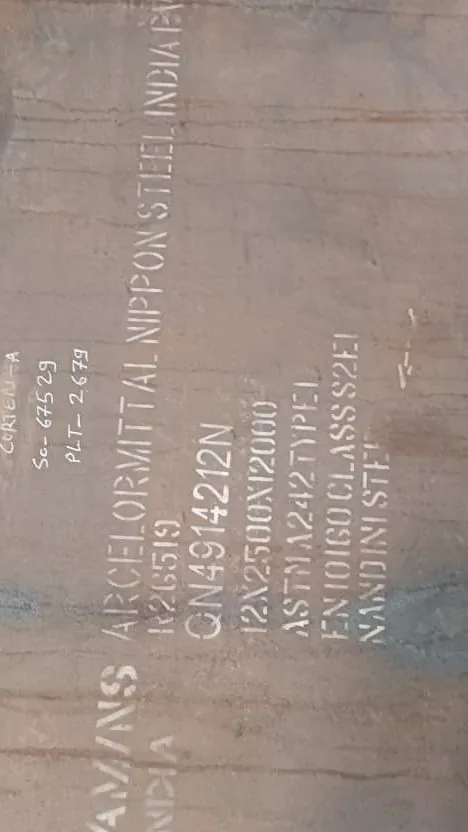
A516 Grade 60 plate at a glance
- Designation: UNS K02100, pressure-vessel-quality (PVQ) carbon steel, not a mild or structural grade.
- Strength: tensile runs 60–80 ksi (415–550 MPa), with a minimum yield of 32 ksi (220 MPa). It sits at the lower-strength end of the SA-516 family.
- Metallurgy: killed, fine-grain practice for notch toughness; ferritic-pearlitic and magnetic.
- Standards: ASTM A516 / ASME SA-516 plus ASTM A20 general plate requirements.
Options available in two forms: as-rolled, or normalized for better toughness at low temperatures. We also offer HIC testing per NACE TM0284 for sour-service applications.
Every order ships with a mill test certificate per EN 10204 3.1/3.2. All plate sits ex-stock, so dispatch happens right away.
What A516 Grade 60 plate is, and why specify it
A516 Grade 60 is the lower-carbon cousin in the SA-516 pressure-vessel family, more weldable and easier to form than its sibling grade. You reach for it when the design doesn't call for Grade 70's 70-ksi tensile strength, and you'd rather give up some peak strength for simpler fabrication and better as-delivered low-temperature behavior. It's a carbon steel, so its worth lies in pressure-vessel integrity, weldability and formability, not corrosion resistance. It carries no PREN or pitting rating, and none should be inferred.
Its killed, fine-grain chemistry delivers a sound plate with low inclusions and the notch toughness that ASME Section VIII and Section I construction demand. Supplied normalized, it holds Charpy energy down to low service temperatures. Supplied HIC-tested, it qualifies for wet H₂S / sour duty. For more detail, see how to specify A516 for pressure vessels and the broader split between carbon, stainless and alloy steel.
Chemical composition (ladle analysis, by thickness)
A516 Grade 60 is a killed, fine-grain steel. As the section gets thicker, carbon and manganese content climb, following ASTM A516 Table 1.
| Element | ≤ 12.5 mm | > 12.5–50 mm | > 50–100 mm |
|---|---|---|---|
| Carbon (C) | ≤ 0.21 | ≤ 0.23 | ≤ 0.25 |
| Manganese (Mn) | 0.60–0.90 | 0.85–1.20 | 0.85–1.20 |
| Silicon (Si) | 0.15–0.40 | 0.15–0.40 | 0.15–0.40 |
| Phosphorus (P) | ≤ 0.035 | ≤ 0.035 | ≤ 0.035 |
| Sulfur (S) | ≤ 0.035 | ≤ 0.035 | ≤ 0.035 |
| Iron (Fe) | Balance | ||
Killed, fine-grain practice
"Killed" means the steel gets fully deoxidized, typically with silicon and aluminum, before casting. That removes dissolved oxygen and leaves a clean, homogeneous plate. Fine-grain practice refines the ferrite grain size, and finer grains raise notch toughness while lowering the ductile-to-brittle transition temperature. That's why PVQ grades call for killed, fine-grain steel instead of plain carbon plate.
Mechanical properties (plate)
| Property | Value (A516 Gr 60) |
|---|---|
| Tensile strength | 415–550 MPa (60–80 ksi) |
| Yield strength (0.2% offset) | ≥ 220 MPa (32 ksi) |
| Elongation in 200 mm (8 in.) | ≥ 21% |
| Elongation in 50 mm (2 in.) | ≥ 25% |
| Charpy V-notch impact | Supplementary (per order temperature) |
Charpy V-notch impact testing isn't a default requirement; it's supplementary. For low-temperature vessels, order normalized plate and have the impact test run at your design temperature. State the plate thickness up front, too, since both the mechanical minimums and the normalizing requirement shift depending on section.
Physical properties
| Property | Value |
|---|---|
| Density | 7.85 g/cm³ |
| Thermal conductivity (RT) | ~52 W/m·K |
| Elastic modulus | ~200 GPa |
| Mean CTE (20–100 °C) | ~12 µm/m·°C |
| Magnetic response | Magnetic (ferritic-pearlitic) |
A516 Grade 60 vs Grade 70: which to specify
The two grades share the same chemistry type and offer the same standard and heat-treat options, but strength sets them apart. Grade 60 runs slightly lower in carbon and manganese, and that's the reason it welds and forms more easily.
| Attribute | A516 Gr 60 | A516 Gr 70 |
|---|---|---|
| Tensile strength | 60–80 ksi (415–550 MPa) | 70–90 ksi (485–620 MPa) |
| Minimum yield | 32 ksi (220 MPa) | 38 ksi (260 MPa) |
| C / Mn | Slightly lower | Slightly higher |
| Choose when | Weldability/formability and moderate design pressure matter most | Higher allowable stress is required |
When Grade 70 strength isn't required, Grade 60 gives you a more forgiving plate in the shop. If the vessel's allowable stress drives the thickness, though, step up to A516 Grade 70 plate, including its normalized and HIC-tested variants.
Equivalent grades and designations
| System | Designation |
|---|---|
| UNS | K02100 |
| EN (approx.) | P265GH (1.0425) |
| JIS (approx.) | SGV410 (G3118) |
| GB (approx.) | Q245R |
Cross-system equivalents are near-matches, not drop-in substitutes. Confirm the governing standard on the order. See the UNS / W.-Nr. / JIS cross-reference.
Available forms, sizes and thickness
Plate is the main standard form for A516, really the only one in practice. We carry A516 Gr 60 plate in stock across the common pressure-vessel sections, available as-rolled or normalized, and we supply HIC-tested material to order for sour service.
| Attribute | Typical supply range |
|---|---|
| Thickness | ~5–150 mm (thicker to order) |
| Width | up to ~2500–3000 mm |
| Length | up to ~12000 mm |
| Condition | As-rolled · normalized · NACE-HIC (sour service) |
| Edge | Mill edge or trimmed |
Guidance on picking a section lives in how to choose plate thickness. For the form distinction, see sheet vs plate vs coil.
A516 Gr 60 plate weight: how to calculate
Plate weight follows directly from density (7.85 g/cm³):
Weight in kilograms equals thickness in millimeters times width in meters times length in meters, all multiplied by 7.85.
A 10 mm × 1.5 m × 6.0 m plate works out to 10 × 1.5 × 6.0 × 7.85 = 706.5 kg, or 78.5 kg/m² for every 10 mm of thickness.
| Thickness (mm) | Plate size (m) | Weight (kg) |
|---|---|---|
| 8 | 1.5 × 6.0 | 565.2 |
| 12 | 2.0 × 6.0 | 1130.4 |
| 20 | 2.5 × 12.0 | 4710.0 |
Use the steel plate weight calculator for exact figures. Need the full method instead? See how to calculate steel plate weight.
Standards complied and heat-treat / service options
A516 Gr 60 plate conforms to ASTM A516 / ASME SA-516 (pressure-vessel plate for moderate- and lower-temperature service), with ASTM A20 governing the general requirements for plate, tolerances, marking, testing frequency and permitted supplementary conditions.
Normalizing for low-temperature toughness
Normalizing means heating the steel above the upper critical temperature and letting it cool in air. The process refines the grain and gives the material uniform toughness all the way through its thickness. For vessels running below ambient temperature, call for normalized PVQ plate with Charpy impact testing at the design temperature. Don't just rely on as-rolled plate.
NACE-HIC / sour-service option
For wet H₂S (sour) service, order the HIC-tested condition. The plate gets screened for hydrogen-induced cracking per NACE TM0284 and supplied against NACE MR0175 / ISO 15156. Cite the requirement on the purchase order so the heat is qualified and documented. Background can be found in sour service (NACE MR0175).
Testing, inspection and MTC
Every A516 Gr 60 plate order ships with an EN 10204 3.1/3.2 mill test certificate reporting the heat chemistry and mechanical results traced to the producing heat. On request we add Charpy V-notch impact testing at your design temperature, ultrasonic examination to ASTM A435 or A578, and HIC testing per NACE TM0284 for sour-service orders. See testing, MTC, NDT and PMI and our approach to material traceability and quality assurance.
Applications of A516 Grade 60 plate
- Pressure vessels, moderate-duty ASME Section VIII shells and heads, the kind of job where you don't actually need Grade 70's allowable stress.
- Boilers and boiler-quality plate, fired and unfired drums. For more on this, see boiler-quality plate explained.
- Storage tanks and separators, formed and welded vessels. Good formability and weldability here make fabrication a lot simpler.
How we quote
ASME SA-516 and ASTM A516 Gr 60 plate gets quoted to spec on request. We don't publish price bands, since thickness, condition (as-rolled, normalized, or HIC), test scope and quantity all move the number. Send us your thickness, plate size, condition and standard, ASTM A516 / ASME SA-516, plus NACE TM0284 if the service is sour, and you'll get a firm offer back.
Nandini Steel has held ISO 9001:2015 certification since 2003, and we've spent more than 20 years as a stockist and supplier of genuine mill plate. Our producers include Jindal, POSCO, Nippon Steel and JFE. Every order ships with full heat traceability, and we issue an EN 10204 3.1/3.2 certificate, no exceptions, every time.
Frequently asked questions
What is the difference between A516 Grade 60 and Grade 70?
Is A516 Grade 60 weldable?
What does normalized A516 Gr 60 plate mean?
Do you supply A516 Gr 60 plate with a mill test certificate?
What is the UNS number and equivalent of A516 Grade 60?
Request a quotation. Send your A516 Gr 60 plate specification to reachus@nandinisteel.com, call +91 22 43404600, or WhatsApp +91 99202 09184 for a firm offer with EN 10204 3.1/3.2 certification. GSTIN 27ADJPA7240C1Z0. For more, see about Nandini Steel, certifications, and contact.
Related grades to cross-shop
Part of our steel plate range.